
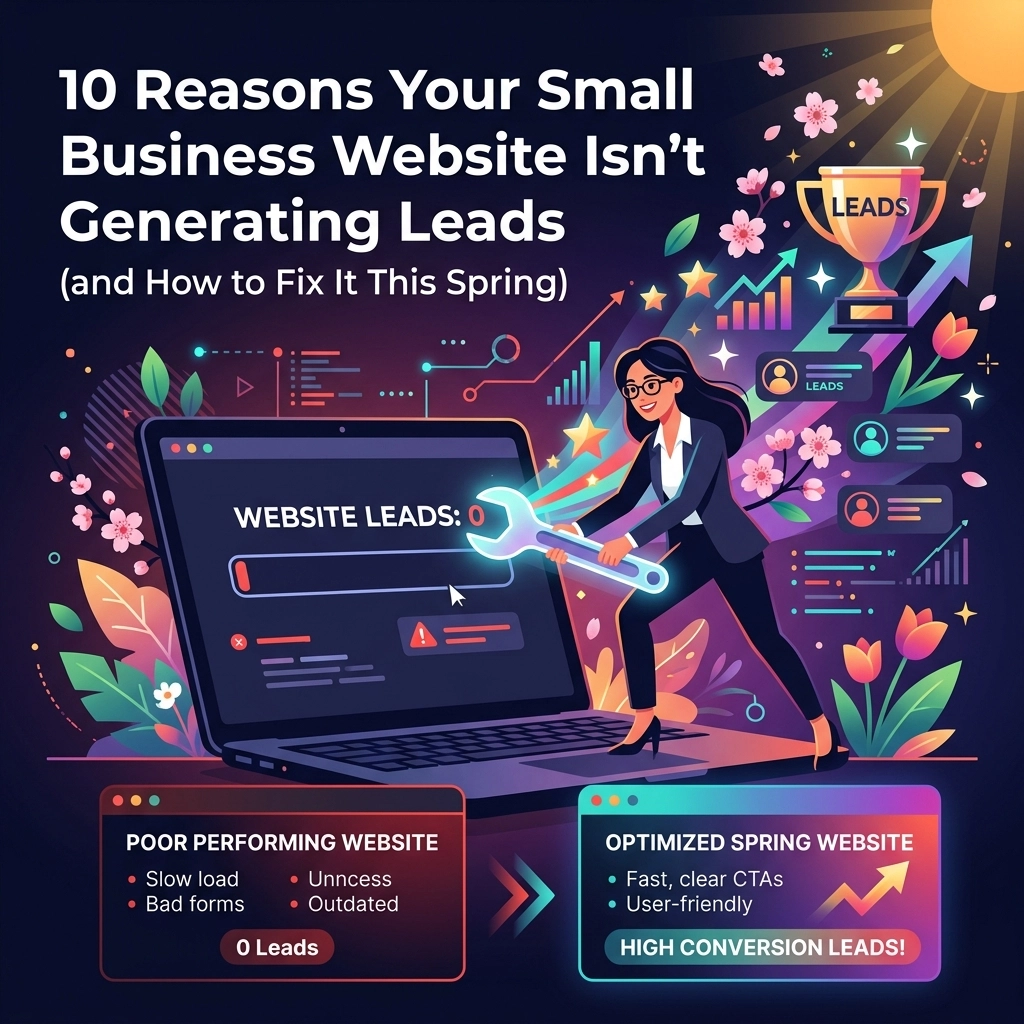
Spring is finally here in Bristol. While you might be thinking about tidying up the garden or clearing out the office filing cabinet, there is one area of your business that probably needs a deep clean more than any other: your website.
If your website feels more like a digital brochure that nobody reads rather than a lead-generating machine, you aren’t alone. Many local business owners find themselves wondering why their site looks “fine” but the phone isn’t ringing. The truth is, a pretty website doesn’t always equal a profitable one.
Let’s look at the ten most common reasons your small business website is stalled and, more importantly, how we can fix it together this season.
1. Your Mobile Experience is a Mess
Have you ever tried to book a table at a restaurant in Clifton or check a plumber’s rates while walking down Gloucester Road, only to find the text is microscopic and the buttons are impossible to click?
If your website isn’t “responsive”: meaning it doesn’t automatically adjust to look great on a phone: you are losing leads every single day. Google also penalises sites that aren’t mobile-friendly, making it harder for local customers to find you in the first place.
Why This Matters: Over half of all web traffic now happens on mobile devices. If your site is frustrating to use on a smartphone, visitors will leave within seconds.
How It Helps You: A mobile-optimised site keeps people sticking around longer, which signals to search engines that your site is valuable, helping your Bristol SEO rankings.
2. You’re Hiding Your “Buy” Button
Here’s the thing: customers shouldn’t have to play detective to figure out how to hire you. If your “Contact Us” page is buried in a sub-menu or your phone number isn’t clickable, you are creating friction.
We often see websites with vague buttons like “Learn More” or “Read More.” While those are okay for blog posts, your primary goal needs a clear Call to Action (CTA). Whether it’s “Get a Free Quote,” “Book a Survey,” or “Call Now,” it needs to be prominent.

3. The “Imagination Gap” is Killing Conversions
Many business owners suffer from what we call the “imagination gap.” You know exactly how great your service is, but your website fails to show it. Visitors struggle to imagine how your business will actually solve their specific problem.
If you feel a bit of “website embarrassment” when sending a link to a prospect, this is likely why. You feel the site doesn’t represent the quality of work you actually do.
How to Fix It: Use the Bamsh Website Preview Tool to get instant visual proof of what a high-performing site looks like compared to your current one. Seeing the difference can help bridge that gap immediately.
4. You Aren’t Answering the “Price” Question
One of the core pillars of the “They Ask, You Answer” methodology is addressing the one thing every customer wants to know: “How much does it cost?”
Most small businesses avoid putting prices on their website because they fear scaring people off or tipping off competitors. The reality is that if you don’t talk about costs, customers assume you are too expensive or that you’re hiding something.
You don’t have to give a final quote, but you should explain what factors influence the price. This builds massive trust.
5. Your Content is About You, Not Them
Does your homepage start with “Founded in 1998, we are a family-run business…”? While that’s a nice sentiment, your customer doesn’t actually care: at least not yet.
Your customers are the hero of the story; your business is just the guide. Your website content should focus on their pain points and how you solve them. Instead of saying “We have the best tools,” try “We fix your leak in under an hour so you can get back to your day.”
6. You’ve Ignored Local Bristol SEO
If you are a locksmith in Bedminster or an accountant in Redland, you need to show up when people search for those specific terms. If your website doesn’t mention the areas you serve or include your Google Business Profile information, you are invisible to local searches.
Why This Matters: Local SEO is the most cost-effective way for small businesses to compete with national brands.
How It Helps You: By targeting Bristol-specific keywords and landing pages, you attract high-intent traffic: people who are ready to buy right now.
7. It Loads Slower Than the M32 at Rush Hour
We live in an era of instant gratification. If your website takes more than three seconds to load, a huge chunk of your audience will hit the “back” button before they even see your logo. Large, unoptimised images are usually the biggest culprit here.

8. DIY vs. Professional: The Reality Check
Many business owners start with a DIY builder like Wix or Squarespace. While these are great for getting started, they often lack the technical “under-the-hood” optimisation needed for serious lead generation as you grow.
Let’s look at how a DIY approach compares to a professional redesign:
| Feature | DIY Website (Template) | Professional Redesign (Bamsh) |
|---|---|---|
| Speed | Often bloated with slow code | Optimised for lightning-fast loading |
| SEO | Basic tools provided | Deep, local Bristol keyword strategy |
| Strategy | “Make it look pretty” | “Make it generate leads” |
| Trust | Can look generic | Bespoke, professional, and credible |
| Cost | Low upfront, high “opportunity cost” | Investment with clear ROI path |
9. You Haven’t Updated Your Content Since the Covid-19 Lockdown
Search engines love fresh content. If your last blog post was from 2022, Google might think your business is no longer active. More importantly, your customers might think the same.
Spring is the perfect time to audit your pages. Remove services you no longer offer and add new testimonials from recent happy clients.
10. You Aren’t Tracking Anything
If you don’t have tracking set up, you are essentially flying blind. You might be getting 1,000 visitors a month, but if you don’t know where they came from or where they left, you can’t improve.
Using tools like Google Analytics or even simpler heat-mapping software allows you to see exactly where people are getting stuck.
Frequently Asked Questions
How much does a new website actually cost in the UK?
The cost of a website can vary wildly depending on what you need. A simple site might start at a few thousand, while a complex lead-generation machine costs more. To get an honest, no-pressure idea of what you should be budgeting, check out our Digital Marketing Costs Estimator.
Do I really need a blog?
You don’t “need” one, but it is the single best way to answer your customers’ questions before they even pick up the phone. It builds authority and helps you rank for hundreds of different search terms.
Will a redesign fix my lack of traffic?
A redesign fixes your “leaky bucket.” If you have traffic but no leads, a redesign fixes the conversion. If you have no traffic at all, you’ll need a combination of a new site and SEO services or Google Ads.
How long does a website redesign take?
Typically, a professional project takes between 4 to 8 weeks, depending on the complexity and how quickly we can get the necessary information from you.
Ready to Stop Being Embarrassed by Your Website?
If you’ve read through these ten points and recognised your own site in a few of them, don’t worry. Most small business owners in Bristol are in the same boat. The good news is that these are all fixable problems.
You don’t have to guess what it will cost or wonder what a better version of your site would look like.
- See the potential: Use our Website Preview Tool to get instant visual proof of how your site could look.
- Plan your budget: Use our Digital Marketing Costs Estimator to see exactly what you should be investing to get the results you want.
Let’s make this the spring your website finally starts working as hard as you do. No jargon, no sales pressure: just a site that actually delivers.
Frequently Asked Questions
Why is my website not generating enough leads?
A website often underperforms when it is hard to use, slow to load, unclear in its messaging, or missing strong calls to action. Even if it looks good, it needs to guide visitors towards making contact or requesting a quote.
How important is mobile optimisation for small business websites?
Mobile optimisation is essential because a large share of visitors now browse on phones. If your site is difficult to use on a mobile device, people are far more likely to leave without taking action.
What makes a good call to action on a website?
A good call to action is clear, visible, and action-focused. Phrases like “Get a Free Quote”, “Book a Survey”, or “Call Now” make it obvious what the visitor should do next.
Why do customers leave a website without enquiring?
Customers often leave when a website loads slowly, hides key information, feels confusing, or fails to explain how the business solves their specific problem. A lack of trust signals or poor user experience can also reduce conversions.
Should a small business website mention pricing?
Yes, in many cases it should. Even if you cannot give exact prices, explaining cost factors or price ranges helps build trust and answers one of the most common questions customers already have.
Why does local SEO matter for Bristol businesses?
Local SEO helps your business appear in search results when nearby customers are actively looking for your services. It is one of the most effective ways for Bristol businesses to attract local, high-intent enquiries.
How does website speed affect conversions?
Website speed affects both user experience and search visibility. If a page takes too long to load, visitors may leave before they even see your content, which reduces your chances of winning the lead.
Can a DIY website still hurt business growth?
Yes, it can. DIY website builders can be useful at the start, but they often lack the strategy, speed, SEO structure, and conversion focus needed to support serious business growth.
Why should I keep my website content updated?
Fresh content shows both customers and search engines that your business is active and relevant. Updating pages, adding testimonials, and publishing helpful content can improve trust and search performance.
Why is website tracking important for small businesses?
Tracking helps you understand where visitors come from, which pages perform well, and where potential customers drop off. Without that data, it is much harder to improve your website effectively.