

You’ve built a great business. You show up, do the work, and deliver real results for your customers. But when someone nearby searches for exactly what you offer, your name doesn’t appear. A competitor gets the call instead. That’s one of the most frustrating situations a UK small business owner can face, and it’s far more common than you’d think. The good news? Most of the fixes are within your reach right now. This guide walks you through the essential steps to improve your online visibility, from free tools and quick wins to advanced tactics that put you in front of customers actively looking for you.
Table of Contents
- Prepare the foundation: essential free tools and quick wins
- Maximise local presence with Google Business Profile
- Level up your website: technical SEO made easy
- Next-level strategies: reviews, schema, and answer engines
- Why most SMEs struggle: the overlooked power of consistency and reputation
- How Bamsh can help you accelerate visibility gains
- Frequently asked questions
Key Takeaways
| Point | Details |
|---|---|
| Claim and optimise GBP | A fully optimised Google Business Profile dramatically increases your chances of being found locally. |
| Invest in reviews | Businesses with more reviews and higher ratings consistently outrank those with low engagement. |
| Prioritise technical health | Mobile responsiveness and site speed are basic yet essential for search visibility. |
| Embrace advanced tactics | Schema markup and answer engine optimisation help future-proof your business in search. |
Prepare the foundation: essential free tools and quick wins
To effectively boost visibility, you first need to get the basics right. Before you spend a penny on advertising or chase complex strategies, three free tools form the bedrock of any solid online presence. Think of them as your visibility dashboard, showing you where you stand and what’s working.
| Tool | What it does | Why it matters | Quick win |
|---|---|---|---|
| Google Search Console | Shows which searches bring visitors to your site | Reveals ranking gaps and indexing issues | Submit your sitemap on day one |
| Google Analytics | Tracks visitor behaviour, traffic sources, and conversions | Helps you measure what’s actually working | Add the tracking tag to every page |
| Google Business Profile (GBP) | Your free listing on Google Maps and local search | Puts you in front of nearby customers instantly | Claim and verify your listing today |
Once you have these in place, a few quick actions can deliver results within days. Our business visibility practical guide covers the full setup process, but here’s where to start:
- Claim your Google Business Profile and verify ownership via postcard or phone
- Submit your website to Google Search Console and confirm it’s being indexed
- Install your Google Analytics tag and check that data is flowing correctly
- Check your site appears in a basic Google search for your business name
- Use a DIY SEO tool to run a quick site audit and spot any obvious errors
As outlined in the foundational monitoring guide for UK SMEs, setting up these three tools gives you the tracking and measurement base you need before anything else.
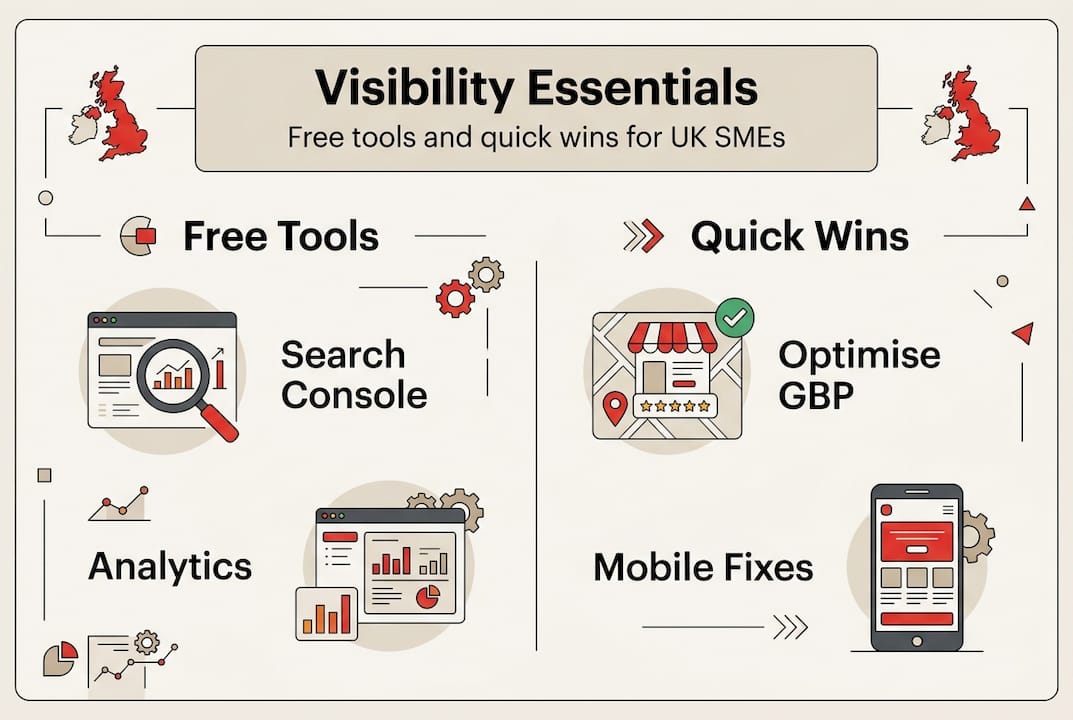
Pro Tip: Prioritise your Google Business Profile above everything else at this stage. A fully optimised GBP listing can lift your local search visibility by up to 70%, making it the single highest-return action available to most small businesses.
Maximise local presence with Google Business Profile
Once basics are set, focus on your most critical asset for local discovery. Your Google Business Profile is not just a listing. It’s often the very first impression a potential customer gets of your business, appearing before they even visit your website.

The difference between a neglected profile and a fully optimised one is significant:
| Feature | Fully optimised GBP | Basic or neglected GBP |
|---|---|---|
| Business categories | Multiple, precise categories selected | One generic category |
| Photos | 10+ quality images, updated regularly | One or no photos |
| Google Posts | Weekly updates, offers, and news | None |
| Reviews | 80+ reviews at 4.7 stars or above | Fewer than 10 reviews |
| Business description | Keyword-rich, detailed, compelling | Blank or minimal |
| Impact | High Maps visibility, more calls and clicks | Buried in results, minimal enquiries |
Follow these steps to get the most from your profile:
- Claim your profile at business.google.com and complete the verification process
- Fill in every single field, including opening hours, website, phone number, and service areas
- Upload at least 10 high-quality photos of your premises, team, and products or services
- Select all relevant business categories, not just your primary one
- Write a compelling business description that naturally includes your key services and location
- Create regular Google Posts to share offers, news, and updates
- Actively ask satisfied customers to leave a review, and respond to every one you receive
Our GBP local leads guide goes deeper on each of these steps, and you can explore the full range of GBP benefits for UK businesses to understand the wider impact.
A fully optimised GBP can boost your local search visibility by up to 70%. That’s not a marginal gain. That’s the difference between being found and being invisible.
Photos boost 42% of direction requests, and consistent posting measurably increases engagement with your listing over time.
Pro Tip: Aim for at least 80 reviews with an average rating of 4.7 stars or higher. Listings with high review volumes and strong ratings consistently outperform lower-volume competitors, even when those competitors have better websites.
Level up your website: technical SEO made easy
With your business profile working hard for local searches, it’s time to make sure your own site isn’t letting you down. Technical SEO sounds intimidating, but the core checks are straightforward. You don’t need to be a developer to identify and fix the most common issues.
Here’s how to audit the four critical areas:
- Mobile-friendliness: Open your site on your phone. Does it display cleanly? Can you tap buttons easily? Google now ranks the mobile version of your site first, so a poor mobile experience directly harms your rankings.
- Page speed: Slow sites lose visitors and rankings. The key metric is Largest Contentful Paint (LCP), which measures how quickly the main content loads. Aim for under 2.5 seconds.
- HTTPS security: Check that your site URL starts with “https” and shows a padlock icon. An unsecured site loses trust signals with both Google and your visitors.
- Core Web Vitals: These are Google’s official user experience metrics. A site that passes them is rewarded with better rankings. A site that fails is quietly penalised.
Use these free tools to test each area:
- Google Mobile-Friendly Test at search.google.com/test/mobile-friendly
- PageSpeed Insights at pagespeed.web.dev for LCP and Core Web Vitals scores
- WebPageTest at webpagetest.org for deeper performance analysis
Our DIY SEO tips page walks you through interpreting these results and prioritising fixes. For a broader checklist, the technical SEO best practices guide covers mobile-responsiveness, speed, Core Web Vitals, and HTTPS in one place.
Benchmark to aim for: An LCP score under 2.5 seconds is considered “Good” by Google. Anything above 4 seconds is classified as “Poor” and will actively suppress your rankings.
Pro Tip: Fixing mobile and responsive design issues often delivers faster ranking improvements than spending weeks chasing backlinks. It’s unglamorous work, but the results are real and measurable.
Next-level strategies: reviews, schema, and answer engines
After shoring up technical elements, you can move beyond basics and adopt the latest methods shaping visibility in 2026. Search is changing fast. Google now shows AI-generated overviews at the top of results pages, and tools like ChatGPT and Gemini are answering questions directly. Getting cited in those answers is the new frontier for visibility.
Here’s what matters most right now:
- Review volume and quality: 80 or more reviews at 4.7 stars consistently outperform lower-volume competitors in both traditional search and AI-generated results
- Schema markup: Structured data tells search engines exactly what your page contains, making it far more likely to appear in rich results and AI summaries
- FAQ schema: Adding FAQPage markup to your site helps you appear in ‘People Also Ask’ boxes and AI overview citations
- LocalBusiness schema: This signals your location, services, and contact details to both Google and AI tools
- Product schema: If you sell products, this markup enables rich results with pricing and availability
Review management is an ongoing discipline, not a one-off task. Monitor your reviews across Google, Trustpilot, and any industry-specific platforms. Respond to negative reviews professionally and promptly. A thoughtful response to a poor review often impresses potential customers more than a string of five-star ratings.
For a full breakdown of how to implement schema markup for AI results, and to understand local SEO best practices for UK businesses, both guides are worth bookmarking.
Prominence in AI and review ecosystems is now outpacing traditional SEO alone. Businesses that appear in AI overviews and hold strong review profiles are capturing the attention that used to go exclusively to page-one rankings.
Pro Tip: Use FAQ schema on your most important service pages. It’s one of the simplest ways to appear in both ‘People Also Ask’ results and AI-generated answer summaries, giving you two visibility gains from a single piece of work.
Why most SMEs struggle: the overlooked power of consistency and reputation
Having outlined both foundational and advanced actions, it’s worth being honest about what really separates visible businesses from invisible ones. In our experience, it’s rarely a lack of knowledge. Most business owners know they should be collecting reviews and posting updates. The gap is execution.
Visibility is not won by a single burst of activity. It’s built through consistent posting and regular profile maintenance, week after week. The competitors ranking above you in local search are almost certainly not doing anything technically brilliant. They’re just showing up reliably.
‘Consistency in engaging your audience and maintaining profiles outperforms large but short-lived campaigns every single time.’
One-off fixes rarely defeat businesses that win through dependable execution. A flurry of reviews followed by six months of silence will not hold your position. A steady flow of two or three reviews per month, combined with weekly Google Posts and monthly technical checks, compounds into a dominant local presence over time. That’s the real strategy. Use our GBP local leads guide to build a simple routine that keeps your profile active without consuming your week.
How Bamsh can help you accelerate visibility gains
If you need guidance turning these steps into real-world results, expert help is available. At Bamsh, we work with UK small and medium businesses every day to implement exactly the strategies covered in this guide. Whether you want hands-on GBP management services to keep your profile optimised and reviewed, or you’re ready to explore AEO solutions that get you cited in AI-generated answers, we have a solution that fits. Prefer to start yourself? Our DIY SEO tool gives you an instant audit and a clear action list. We offer tailored support for both one-off fixes and ongoing reputation management, with no long-term lock-in.
Frequently asked questions
What is the fastest way to boost local online visibility?
Claim and fully optimise your Google Business Profile. This single action can increase local search visibility by up to 70%, making it the highest-return step available to most UK small businesses.
Which tools should every small UK business use to track online visibility?
The essentials are Google Search Console, Google Analytics, and Google Business Profile. All three are free tools for tracking and monitoring your progress, and each takes under an hour to set up.
How do I know if my website is technically holding me back?
Test your site for mobile-friendliness, page speed (aim for LCP under 2.5 seconds), HTTPS security, and Core Web Vitals compliance using free tools like PageSpeed Insights.
What’s the simplest advanced action I can take for more search traffic?
Add FAQ and LocalBusiness schema markup to your key pages. This helps you appear in AI overview citations and ‘People Also Ask’ results, giving you extra visibility with minimal ongoing effort.
Recommended
- How to Improve Online Visibility: UK SME Guide 2026 – Bamsh Digital Marketing
- Boosting Business Visibility: A Practical Step-by-Step Guide
- Why Use SEO: Boosting UK Business Visibility
- Why UK SMEs Need Brand Visibility to Boost Growth in 2026
- Social Media Growth Βήματα για Επιχειρήσεις και Δημιουργούς – maverix.gr