

TL;DR:
- Automated sales funnels improve efficiency and predictable growth for UK small businesses.
- Key tools include CRM systems, lead forms, email/SMS platforms, and GDPR compliance.
- Success relies on balancing automation with personal follow-up and ongoing testing.
Ever wondered why some UK small businesses seem to convert leads on autopilot while others are still chasing every enquiry by hand? The answer usually comes down to one thing: an automated sales funnel. Most SMBs lose a significant chunk of potential revenue simply because manual processes can’t keep up. A prospect fills in a form, nobody follows up in time, and the sale goes elsewhere. Automated funnels fix that. They guide potential customers from first contact to paying client without you needing to manage every step. This guide walks you through exactly what automated funnels are, the tools you need, how to build one, and how to make it work for your UK business.
Table of Contents
- What is an automated sales funnel?
- Key tools and requirements for UK businesses
- How to build your first automated sales funnel: step-by-step
- Testing, optimisation, and common mistakes
- A fresh perspective: automation is only half the answer
- Level up your funnel with expert help
- Frequently asked questions
Key Takeaways
| Point | Details |
|---|---|
| Automated funnel stages | A successful UK SMB sales funnel includes awareness, lead capture, nurturing, and decision stages with automation handling the workflow. |
| Essential tools | Choosing the right CRM and GDPR-compliant automation tools is vital for effective and legal sales streams. |
| Start simple | Build a minimum viable funnel before expanding, ensuring each stage works and integrates smoothly. |
| Never skip testing | Regularly test, measure, and optimise to avoid costly mistakes and improve conversion rates. |
| Balance automation and human touch | The best results come from blending technology with tailored human interactions in every UK sales journey. |
What is an automated sales funnel?
Think of an automated sales funnel as your best salesperson, working around the clock, never forgetting a follow-up, and never having a bad day. It’s a step-by-step process that moves a stranger through stages of awareness, interest, and consideration until they become a paying customer, with minimal manual effort from you.
Understanding the digital marketing funnel is the foundation here. A typical automated funnel for UK SMBs covers these core stages:
- Awareness: A prospect finds you via Google, social media, or a referral.
- Interest: They engage with your content, advert, or landing page.
- Consideration: They receive automated emails or SMS messages that build trust.
- Decision: A targeted offer or case study nudges them towards buying.
- Action: They book, purchase, or enquire, triggering a confirmation sequence.
- Retention: Post-sale emails and check-ins encourage repeat business.
According to 4-7 stage process research, UK SMB funnels typically follow this structure, with optional retention loops added for service-based businesses.
The difference between a manual and automated funnel is stark. Manually, you rely on someone remembering to send an email or make a call. Automated funnels trigger the right message at the right moment, every time. Businesses using automated multi-channel funnels report 20-50% efficiency gains compared to manual processes. That’s not a marginal improvement. That’s transformational.
If you want to generate leads for UK businesses consistently, a well-built funnel is non-negotiable. It removes the feast-and-famine cycle that plagues so many small businesses and replaces it with predictable, repeatable growth.

Key tools and requirements for UK businesses
Once you understand the stages, you’ll need the right tools and essentials to make automation a reality. The good news is that you don’t need an enterprise budget to get started.
The core requirements for any UK SMB funnel:
- A CRM to store and manage your contacts
- Lead capture forms or chatbots on your website
- An email and/or SMS platform for nurture sequences
- Analytics to track what’s working
- GDPR-compliant consent mechanisms at every entry point
GDPR is non-negotiable in the UK. Every form, every automated message, and every data storage point must be compliant. This isn’t just a legal requirement; it builds trust with your audience.
Here’s a quick comparison of the most popular automation tools for SMBs in 2026:
| Tool | Starting price | GDPR-ready | Key features |
|---|---|---|---|
| HubSpot | Free tier available | Yes | CRM, email, landing pages, analytics |
| ActiveCampaign | From £29/month | Yes | Email, SMS, Salesforce integration |
| Pipedrive | From £14/month | Yes | Pipeline management, automation |
| monday CRM | From £10/month | Yes | Visual workflows, team collaboration |
As recommended for UK SMBs, starting with a minimum viable funnel on a free or low-cost tier is the smartest move. Don’t pay for features you won’t use in month one.
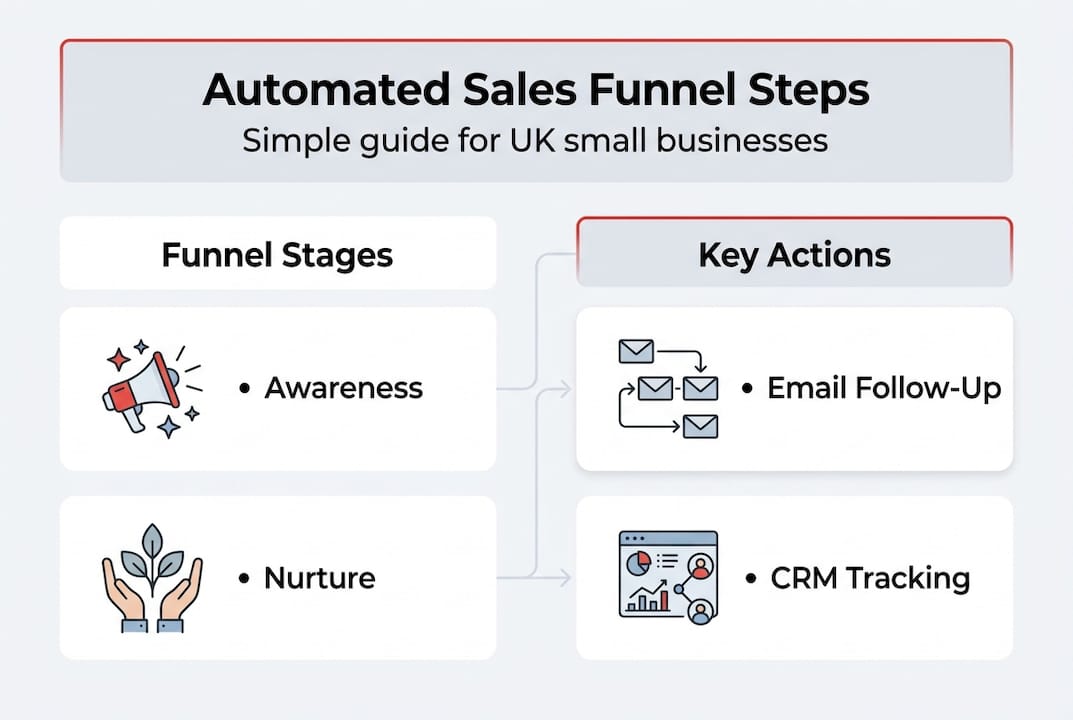
For a broader view of what’s available, explore the top marketing tools that UK businesses are using to drive growth right now.
Pro Tip: Before committing to any paid plan, run your whole team through the free tier for two weeks. If they find it confusing, your leads will too. Ease of use is as important as features.
How to build your first automated sales funnel: step-by-step
Now you’re geared up, let’s break down the creation process from mapping to live funnel. The 7-step build process covers mapping, choosing a platform, defining triggers, building workflows, testing, launching, and optimising. Here’s how that looks in practice for a UK SMB.
Before you start, define your ideal customer profile (ICP). Who are they? What problem are they trying to solve? What channel do they use to find businesses like yours? Without this clarity, even the slickest funnel will underperform.
- Map your process. Write out every touchpoint from first contact to closed sale. Use a whiteboard or a simple spreadsheet. Don’t skip this step.
- Pick a tool. Based on the comparison above, choose the platform that fits your budget and team’s comfort level.
- Set your triggers. Decide what action starts each automated sequence. A form submission, a page visit, or a chatbot interaction are common starting points.
- Design your lead capture. Build a simple form or chatbot that collects name, email, and one qualifying question. Keep it short.
- Build your nurture sequence. Write 3-5 emails that educate, build trust, and present your offer. Space them out over 7-14 days. Understanding the lead nurturing process will help you craft messages that actually convert.
- Test everything. Go through the funnel yourself. Check every trigger, every email, every link. Fix what’s broken before it goes live.
- Go live and optimise. Launch, monitor for the first two weeks, then adjust based on open rates, click rates, and conversions. Knowing how to automate lead nurturing effectively can lift conversion rates by 50% or more.
Linear vs retention funnel structures:
| Structure | Best for | Pros | Cons |
|---|---|---|---|
| Linear funnel | New businesses, single offers | Simple to build and test | No repeat business loop |
| Retention loop funnel | Service businesses, subscriptions | Drives lifetime value | More complex to manage |
Pro Tip: Start with a minimum viable funnel. One traffic source in, one conversion point out. Master that before adding complexity. Explore lead generation tactics to find the best traffic source for your sector.
Testing, optimisation, and common mistakes
With your first funnel running, it’s time to ensure it’s performing and avoid rookie errors. Testing isn’t a one-off task. It’s an ongoing habit.
How to test your funnel properly:
- Use your CRM’s built-in analytics to track how many leads enter each stage
- Monitor email open rates (aim for 25-35% for UK B2B audiences) and click-through rates
- Map the customer path to spot where people drop off
- Run A/B tests on subject lines and landing page headlines
- Review your lead conversion process monthly, not just at launch
Optimise based on cost per qualified lead (CPQL), not just raw lead volume. A hundred unqualified leads are worth far less than ten who are ready to buy.
A note on balance: The most effective UK service businesses combine smart automation with timely human follow-up. Automation handles the volume; people handle the nuance. Never let a hot lead go cold because your system assumed it had done enough.
The most common mistakes UK SMBs make, as highlighted in funnel pitfall research, include:
- Over-automating. Keeping your funnel to a maximum of 5-7 stages prevents confusion and drop-off.
- Broken steps. A single broken trigger can lose dozens of leads. Test every path.
- Ignoring GDPR. Non-compliance isn’t just a fine risk; it damages trust with your audience.
- Skipping human follow-up. Automation should qualify and warm leads, not replace the conversation that closes the deal.
- Automating a broken process. If your manual sales process doesn’t work, automating it just makes the failure faster.
Fix the process first, then automate it.
A fresh perspective: automation is only half the answer
Before you swap your diary for dashboards, here’s what most guides don’t tell you. Automation tools are genuinely powerful. But they are not a substitute for understanding your UK customer.
We’ve worked with dozens of UK SMBs across service industries, and the pattern is clear. The businesses with the best-performing funnels are not the ones with the most sophisticated technology. They’re the ones who combine smart automation with local knowledge, personal follow-up, and genuine relationship-building.
Local SEO, a well-managed Google Business Profile, and even a timely phone call after an automated email can dramatically improve conversion rates for service businesses. As AI sales automation research confirms, combining predictive AI with human qualification avoids the trap of over-automation that many businesses fall into.
Using a CRM for marketing efficiency should free up your time for those personal touches, not eliminate them. The goal is to let the system handle the repetitive tasks so you can focus on the conversations that actually close deals. That balance is where the real growth happens.
Level up your funnel with expert help
Ready to see automated lead generation translate into real growth? Building a funnel that works consistently takes the right strategy, the right tools, and an understanding of the UK market. At Bamsh Digital Marketing, we specialise in exactly that. From optimising your Google Business Profile Management to drive local traffic, to implementing Answer Engine Optimisation so you appear in AI-powered searches, we build systems that generate leads around the clock. We handle GDPR compliance, CRM setup, and nurture sequences so you don’t have to. If you’re serious about scaling, book your 15-minute consultation and let’s map out your funnel together.
Frequently asked questions
What is the most important stage in an automated sales funnel?
The lead nurture stage is the most critical for converting enquiries into paying customers. Nurture emails and SMS during the consideration phase are what separate browsers from buyers in a UK SMB context.
Which automation tool is best for GDPR compliance?
Both ActiveCampaign and HubSpot are strong choices, with GDPR-compliant features built in for UK small businesses. Your final choice should depend on your budget and the integrations your business already uses.
How can I avoid over-automating my sales funnel?
Start simple and limit your funnel to 5-7 stages maximum, always including at least one personal follow-up step to maintain a human connection with your prospects.
What are common mistakes UK SMBs make with sales automation?
The most frequent errors include automating broken processes, ignoring GDPR requirements, and overlooking mobile and omnichannel touchpoints that UK customers increasingly expect.
How quickly can I see results from an automated sales funnel?
Most UK SMBs see measurable improvements in lead quality and conversion within 1-3 months, with efficiency gains of 20-50% possible once the funnel is properly optimised and running consistently.