

Many UK business owners believe a polished logo and a few hundred social media followers signal a strong brand. They don’t. Real brand authority is something far more valuable, and far harder to fake. It’s the trust, credibility, and influence your business earns over time in the minds of your ideal customers. Without it, you’re visible but forgettable. With it, you become the obvious choice. This guide breaks down exactly what brand authority is, why it matters more than raw visibility, and how you can build it in a way that consistently generates better leads and stronger growth for your business.
Table of Contents
- What is brand authority and why does it matter?
- The essential pillars of brand authority for SMEs
- How to build brand authority online: proven strategies for UK SMEs
- How to measure and maintain brand authority
- Why authority beats awareness: what UK SMEs usually miss
- Build your brand authority with expert UK support
- Frequently asked questions
Key Takeaways
| Point | Details |
|---|---|
| Brand authority basics | True brand authority is built on trust, expertise and consistency, not just visibility. |
| Actionable pillars | Focus on expertise, transparency, consistency and real social proof to boost authority. |
| Measure and adapt | Track branded search, reviews and feedback to maintain and grow your authority. |
| Depth over reach | Strong brands prioritise lasting credibility and trust over surface-level audience numbers. |
What is Brand Authority and Why Does it Matter?
Brand authority is not the same as brand awareness. Awareness means people recognise your name. Authority means people rely on your judgement. It means that when a potential customer has a problem, your business is the one they think of first, trust most, and choose over competitors.
As the definition of brand authority from the Content Marketing Institute explains, brand authority links to trust, expertise, and reliability in the eyes of your audience. That’s a very different thing from simply being known.
Why does this matter for UK SMEs? Because authority directly influences purchase decisions. Buyers today research before they buy. They read reviews, scan websites, check social profiles, and look for signals that a business knows what it’s talking about. A business with genuine authority passes those checks easily. One without it loses the sale before the conversation even starts.
“People don’t just buy products or services. They buy confidence. Authority is what gives them that confidence.”
Here’s a quick comparison to make the difference clear:
| Factor | Brand awareness | Brand authority |
|---|---|---|
| What it means | People know your name | People trust your expertise |
| How it’s earned | Advertising and reach | Consistent value and credibility |
| Effect on leads | Increases visibility | Increases conversion rate |
| Longevity | Fades without spend | Compounds over time |
Building authority also supports building trust and boosting results across every part of your marketing. It makes your ads more effective, your content more persuasive, and your sales conversations shorter.
Key reasons authority matters for SMEs:
- Customers choose trusted brands even when competitors are cheaper
- Authority reduces the cost of acquiring new leads over time
- It creates a compounding effect: the more you build, the easier it gets
- Authoritative businesses attract better clients and stronger partnerships
Now that brand authority’s real importance is clear, understanding what builds it is essential.
The Essential Pillars of Brand Authority for SMEs
Authority doesn’t appear overnight. It’s constructed on four core pillars, and every strong brand you admire has all four working together.

Consistent messaging and expertise are universally recognised as foundations of authority, according to Forbes. Here’s how each pillar works in practice for a UK SME:
1. Expertise
You need to demonstrate that you genuinely know your field. This means publishing helpful content, answering real customer questions, and showing your depth of knowledge. A plumber who writes a blog explaining common boiler faults builds more authority than one who just posts before-and-after photos. Explore content marketing steps for lead generation to see how expertise translates into enquiries.
2. Consistency
Your messaging, tone, and visual identity need to feel the same everywhere. Inconsistency creates doubt. If your website sounds professional but your social media is chaotic, customers notice. Consistency signals reliability.
3. Transparency
Being open about your process, pricing, and even your mistakes builds enormous trust. Businesses that hide behind vague language lose authority fast. Those who communicate clearly, as we explore in our guide on transparency and trust, win it consistently.
4. Social proof
Reviews, testimonials, case studies, and client logos all signal that real people have trusted you and been satisfied. This is one of the fastest ways to accelerate perceived authority.
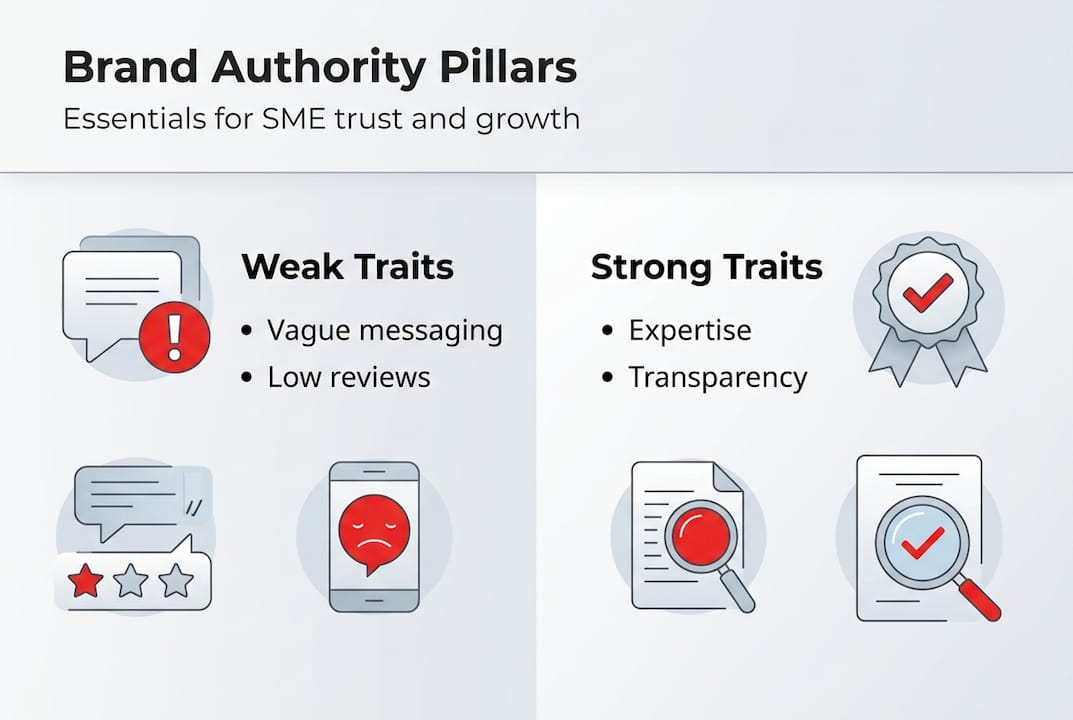
| Weak authority trait | Strong authority trait |
|---|---|
| Vague service descriptions | Clear, specific expertise demonstrated |
| No reviews or testimonials | Dozens of verified, detailed reviews |
| Inconsistent branding | Unified tone and visuals across all channels |
| Avoids difficult questions | Answers objections openly and honestly |
Pro Tip: Transparency is most powerful when it’s specific. Don’t just say you’re honest. Show it. Publish your process. Explain your pricing model. Own up to a past mistake and explain what you changed. That level of openness is rare, and customers remember it.
Once you know the pillars, the next question is how to grow authority in practice, especially online.
How to Build Brand Authority Online: Proven Strategies for UK SMEs
Building authority online is a process, not a one-off task. Here’s a practical framework you can follow:
- Create genuinely useful content. Answer the questions your customers are actually asking. Blog posts, videos, FAQs, and guides all work. Consistent, valuable content and visible expertise are what drive digital brand authority, according to HubSpot. Start with your most frequently asked questions and build from there. Review the content marketing fundamentals to structure your approach.
- Invest in SEO. If your ideal customers can’t find you on Google, your authority is invisible. Optimising your website for relevant search terms puts your expertise in front of people actively looking for help. Strong SEO services for online presence ensure your content actually gets seen.
- Collect and showcase reviews. Ask every satisfied customer for a review. Respond to every review, positive or negative. A business with 80 detailed Google reviews carries far more authority than one with 8. It’s one of the highest-impact, lowest-cost authority builders available.
- Demonstrate thought leadership. Share your opinions. Take a position on industry topics. Appear on podcasts or local business panels. Being seen as a voice in your sector builds authority faster than any advert.
- Leverage customer success stories. Case studies do double duty: they prove your results and serve as compelling content. A detailed story about how you helped a client increasing sales with digital marketing is worth more than a dozen generic testimonials.
Common mistakes to avoid:
- Over-promising results you can’t consistently deliver
- Posting inconsistently across platforms
- Ignoring negative reviews instead of addressing them
- Copying competitors rather than developing a distinct voice
Pro Tip: Don’t wait until you have a polished case study. Start with a simple two-paragraph client story, a problem they had, what you did, and what changed. Real and specific always beats glossy and vague.
With a system in place to grow authority, it’s crucial to know how to measure progress and adapt.
How to Measure and Maintain Brand Authority
You can’t manage what you don’t measure. Fortunately, brand authority growth tracks well through a handful of reliable online metrics, as Search Engine Journal outlines.
| Metric | What it tells you | How to track it |
|---|---|---|
| Branded search volume | How often people search your business name | Google Search Console |
| Online review score | Customer trust and satisfaction | Google, Trustpilot, Facebook |
| Domain authority | Website credibility in search engines | Moz, Ahrefs, Semrush |
| Share of voice | How often you appear vs competitors | SEO tools, social listening |
| Direct website traffic | Loyalty and recognition | Google Analytics |
Here’s a simple authority audit process you can run every quarter:
- Check your branded search volume in Google Search Console. Is it growing?
- Review your average star rating and total review count across all platforms.
- Assess your domain authority using a free tool like Moz.
- Search your main keywords and note where you appear versus competitors.
- Survey recent customers: how did they hear about you, and why did they choose you?
Integrate what you learn. If reviews are slipping, fix the customer experience. If branded search is flat, increase your content output. Authority is a living thing. It needs attention.
Pro Tip: Book a 30-minute authority review into your calendar every quarter. Treat it like a financial review. Bring your metrics, compare them to last quarter, and decide on one action to improve each area. Consistency in reviewing leads to consistency in growing. For a broader view of your digital footprint, explore improving online visibility for UK SMEs.
Early warning signs that authority may be slipping include a drop in direct traffic, a rise in negative reviews, fewer inbound referrals, or competitors appearing above you in search results for your core terms.
As we bring the essentials together, it’s time for a frank take on what really works for UK SMEs and what holds most brands back.
Why Brand Authority Beats Awareness: What UK SMEs Usually Miss
Here’s something most marketing advice won’t tell you plainly: chasing awareness is expensive, temporary, and often misleading. Likes, impressions, and follower counts feel good. They’re easy to report in a meeting. But they don’t pay invoices.
Authority is different. It compounds. A business that spends two years consistently publishing expert content, earning genuine reviews, and being transparent with its audience builds something that no algorithm change can erase overnight. Awareness fades the moment you stop spending. Authority stays.
The businesses we see struggle most are those obsessed with reach. They want to go viral. They want more followers. Meanwhile, a quieter competitor with a well-maintained Google Business Profile, 90 five-star reviews, and a helpful blog is taking their customers every single week.
The uncomfortable truth is that most UK SMEs don’t need more exposure. They need more depth. They need to become genuinely indispensable to a specific audience. That’s what authority does. It makes you the obvious, trusted choice, not just another option in a crowded feed.
Stop measuring your brand by how many people have seen it. Start measuring it by how many people trust it enough to act. That shift in thinking, supported by the right digital marketing strategies for success, is where real growth begins.
Build Your Brand Authority with Expert UK Support
If you’re ready to move beyond surface-level visibility and build authority that actually generates leads, Bamsh Digital Marketing is here to help. We work with UK SMEs to create clear, results-driven strategies that combine SEO, content, review management, and digital presence into a system that works. Whether you want to take control yourself with our DIY SEO tool or hand the reins to an expert team, we have options that fit your goals and budget. Our Google Business Profile management service alone can significantly boost your local authority and visibility. Get in touch today for a free consultation and let’s build something that lasts.
Frequently Asked Questions
How quickly can a small business build brand authority?
Most businesses see measurable gains within 6 to 12 months when they apply consistent content and digital engagement strategies regularly. Patience and consistency matter more than speed.
Is brand authority really more important than social media presence?
Yes. Authority drives purchase decisions in a way that social media presence alone simply cannot. Being noticed is not the same as being trusted.
What is the best way to measure online brand authority for a UK SME?
Track branded search growth, your average review score, and social mentions consistently. Online metrics like branded search and reviews give you the most reliable picture of how your authority is developing.
Can digital marketing alone create lasting brand authority?
Digital marketing is a powerful engine for authority, but it needs genuine expertise and transparency behind it. Authority builds from expertise and credible content, not just ad spend or social activity alone.
Recommended
- 10 Reasons Your Website Isn’t Generating Leads in 2026 (And How to Fix It) – Bamsh Digital Marketing
- How to Improve Your Website and Generate More Leads For Your Business
- 10 Reasons Your Website Not Generating Leads This Spring (And How to Fix It)
- 7 Paid Advertising Benefits for Lead Generation Success
- Blue Bagels – AI-Driven CRO Agency | 30-50% Conversion Uplift