
Let’s cut through the noise. You’re here because your website isn’t performing, and you’re wondering whether you need to patch it up or start from scratch. It’s a question we hear constantly, and the honest answer is: it depends on what’s actually broken.
Here’s the thing most agencies won’t tell you upfront, not every struggling website needs a full rebuild. Sometimes you’re throwing money at a problem that could be solved with targeted updates. But sometimes, trying to save a fundamentally broken site is like putting a plaster on a burst pipe.
Let’s work out which camp you’re in.
The Real Cost of Website Redesigns in the UK
Before we dive into the “should you rebuild” question, you need to know what you’re actually looking at financially.
In 2026, UK website redesigns typically range from £3,000 to £20,000+, but that massive spread tells you nothing useful on its own. Here’s the breakdown that actually matters:
Template-Based Redesigns (£0–£3,000 annually): These involve using existing themes with professional customisation. You’re paying for platform subscriptions (£200–£500/year) plus setup and branding work. Perfect if your existing structure works but looks dated.
Mid-Range Professional Redesigns (£3,000–£6,000): This is where most small to medium businesses land. You get professional template customisation, brand tailoring, mobile optimisation, and proper SEO setup. The site looks bespoke without custom development costs.
Fully Custom Rebuilds (£5,000–£25,000+): Complete ground-up builds with custom functionality. Pricing varies wildly based on who’s doing it, freelancers charge £1,000–£4,500, small studios £3,000–£10,000, and established agencies £10,000+.
For e-commerce sites, add another £2,000–£5,000 to those figures in year one, with ongoing costs of £2,305+ annually for maintenance and updates.
The Technical Debt Problem (And Why It Matters)
Right, let’s talk about technical debt. It’s the invisible killer of websites, and most business owners don’t realise they’re drowning in it until something breaks.
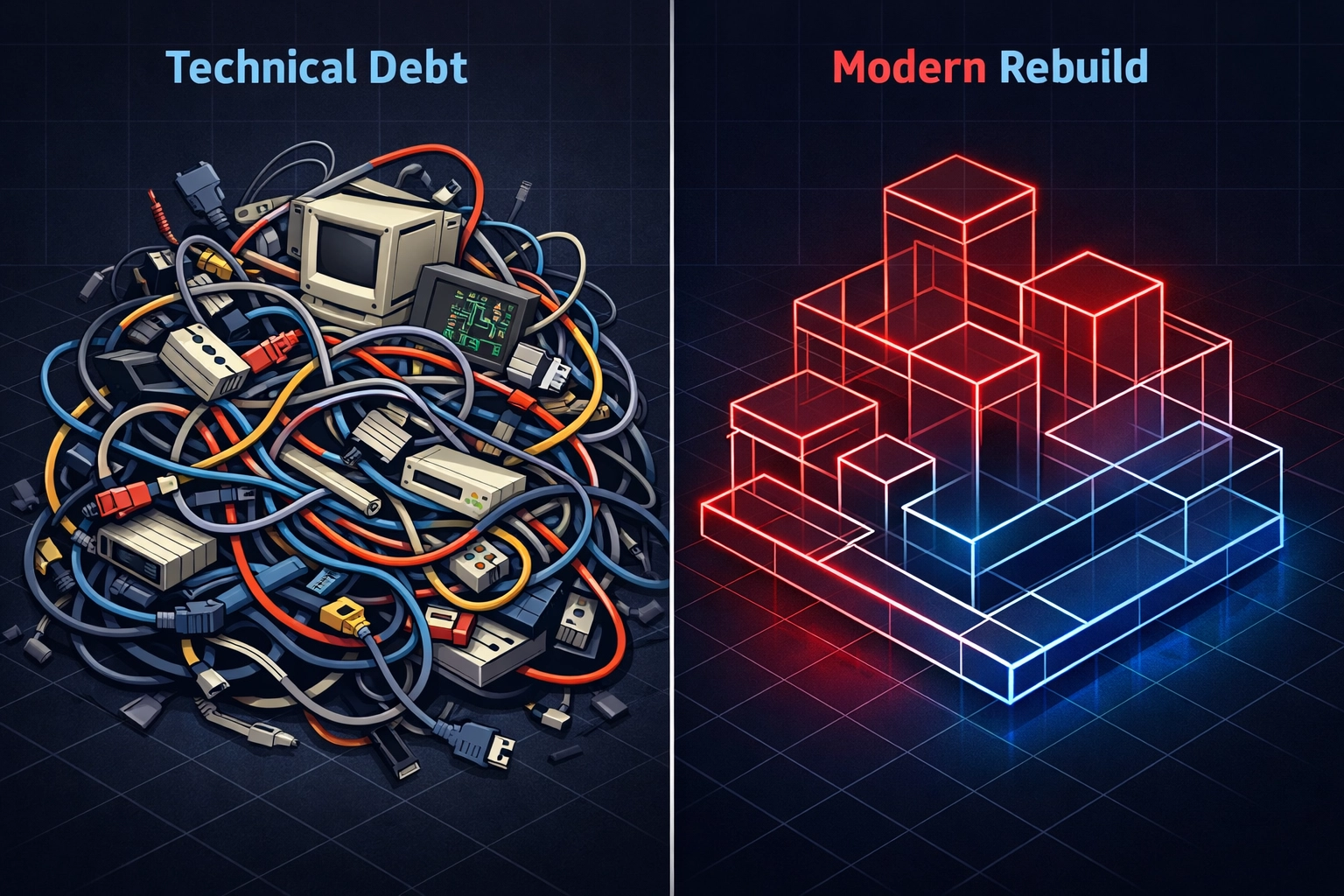
Technical debt is what happens when quick fixes, outdated plugins, and temporary solutions pile up over years. Your site becomes a Jenga tower, everything’s holding together, but one wrong move and it collapses.
Here’s what technical debt looks like in practice:
Your site takes 8+ seconds to load because someone installed 47 plugins five years ago. Half of them conflict with each other, but nobody knows which ones are actually needed. You’re running WordPress 4.9 because “the update might break things.” Your theme hasn’t been updated since 2019, creating security vulnerabilities that hackers absolutely love.
Sound familiar? You’re not alone. We see this constantly.
The brutal truth is that once technical debt reaches a certain threshold, patching becomes more expensive than rebuilding. You’re paying developers to work around problems rather than solve them. Every fix introduces new complications.
When technical debt demands a rebuild:
- Your site crashes regularly without clear cause
- Updates consistently break functionality
- Page load times exceed 5 seconds despite “optimisation”
- Security patches can’t be applied without breaking core features
- Your hosting costs keep increasing to compensate for inefficient code
If more than two of these apply to you, a rebuild likely makes more financial sense than continued patching.
Your Brand Has Evolved (But Your Website Hasn’t)
Here’s a question: Is your website telling the same story your business is living today?
Many businesses outgrow their websites without realising it. You launched with one service offering, but now you’re doing something completely different. Or your target market has shifted, but your messaging still appeals to the wrong audience.
This isn’t about vanity. A misaligned website actively costs you money. Potential clients land on your site, don’t see themselves reflected in your messaging, and leave. You’re paying for traffic that converts poorly because your digital shopfront doesn’t match what you’re actually selling.
Signs your brand evolution requires a rebuild:
Your services have expanded significantly, but you’re trying to squeeze them into a navigation designed for three offerings. Your visual identity was refreshed two years ago, but the website still uses the old colours and logo. Your tone of voice has matured, but the website copy reads like it was written by a completely different company. You’ve pivoted to serve enterprise clients, but your site screams “startup.”
A redesign can address surface-level branding. A rebuild lets you restructure the entire site architecture around who you actually are today, not who you were five years ago.

The Mobile Responsiveness Reality Check
Let’s talk mobile. If your site isn’t genuinely mobile-friendly in 2026, you’re essentially closed for business to more than half your potential customers.
But here’s where it gets tricky. Many older websites claim to be “mobile responsive” because elements shrink to fit smaller screens. That’s not the same as being mobile-optimised. Your text might be readable on a phone, but if users need to pinch-zoom to click buttons or if load times are glacial on 4G, you’ve got a problem.
Google’s mobile-first indexing means your mobile experience directly impacts your search rankings. A poor mobile site doesn’t just frustrate users, it actively pushes you down search results.
The rebuild vs redesign question for mobile:
If your site was built before 2018, it probably uses an older responsive framework. You might be able to update the CSS and improve mobile performance with a redesign. If it was built before 2015, you’re likely better off rebuilding with a modern, mobile-first approach.
Test this yourself. Open your site on your phone right now. If you feel any hesitation using it, any moment where you’re not entirely sure where to tap or what will happen, your customers feel that times ten.
What Actually Justifies a Full Rebuild?
Right, let’s get practical. Here are the scenarios where a full rebuild makes financial and strategic sense:
Your site is built on obsolete technology. Flash-based sites (yes, they still exist), sites running PHP 5.6 or older, or platforms that are no longer supported. Patching these is throwing good money after bad.
You need functionality that’s impossible with your current architecture. If you’re trying to add e-commerce to a brochure site, integrate complex booking systems, or implement membership areas, rebuilding often costs less than forcing square pegs into round holes.
Your current platform limits growth. You’ve maxed out what your site builder can do, and every new feature requires hacky workarounds. You’re paying monthly for a platform that’s actively holding you back.
Security vulnerabilities can’t be patched. If your site has been hacked multiple times, or security audits reveal fundamental architectural flaws, rebuilding with security-first design is your only real option.
Your conversion rate is dismal despite traffic. You’re getting visitors, but nobody’s enquiring or buying. Sometimes the issue is messaging (fixable with a redesign), but if your user journey is fundamentally broken, you need to rebuild the entire experience.

The Redesign Middle Ground
Not everything requires scorched earth. A strategic redesign can solve specific problems without the cost and disruption of a full rebuild.
When a redesign makes sense:
Your technology stack is sound, but the visual design looks dated. Your site architecture works, but individual pages need content and layout improvements. You need better mobile optimisation, but your core functionality is solid. Your SEO is decent, and you don’t want to risk losing rankings with a complete domain or structure change.
A quality redesign typically costs £3,000–£6,000 and takes 4-8 weeks. You’re refreshing the paint, not rebuilding the house. That’s perfect if the foundations are good.
The mistake many businesses make is choosing a redesign when they need a rebuild because of upfront cost. Then they spend the next two years dealing with the same fundamental problems, ultimately paying more than a rebuild would have cost initially.
Making the Decision: Rebuild or Redesign?
Here’s a practical framework for deciding:
Audit your current situation honestly. Get a technical audit from a developer (not the person who built your current site). Identify specific problems. List what’s working. Be brutally honest about what’s broken.
Calculate the true cost of patching. What will it cost to fix your mobile experience? Address technical debt? Add needed functionality? If the answer approaches £5,000+, rebuilding becomes competitive financially.
Consider your timeline. Redesigns are quicker (4-8 weeks). Rebuilds take 8-16 weeks typically. If you need changes urgently, that impacts your decision.
Think about opportunity cost. Every month your website underperforms, you’re losing potential business. Sometimes the “expensive” option of rebuilding pays for itself in increased conversions within six months.
Factor in ongoing costs. Modern rebuilds on platforms like WordPress with proper hosting cost £200–£600 annually to maintain. If your current site requires constant developer intervention costing more than that, rebuilding reduces long-term expenses.
The Bottom Line
Website redesign costs in the UK vary massively because the work required varies massively. You might need a £3,000 refresh or a £15,000 rebuild, and anyone who quotes you without understanding your specific situation is guessing.
The rebuild decision isn’t primarily about age or appearance. It’s about whether your current website architecture can actually deliver what your business needs. If technical debt, brand misalignment, mobile problems, or functionality limitations are actively costing you customers, a rebuild stops being an expense and becomes an investment.
If you’re still unsure which camp you fall into, the web design team at Bamsh can audit your site and give you an honest answer. Sometimes we recommend redesigns. Sometimes rebuilds. Occasionally, we’ll tell you your site just needs better content and some SEO work.
The right answer depends entirely on what your website needs to do for your business: not on what sounds most impressive or costs the least upfront.
Frequently Asked Questions
How much does a website redesign cost in the UK?
Website redesign costs in the UK typically range from £3,000 to £20,000 or more, depending on whether you need a template refresh, a professional redesign, or a fully custom rebuild. E-commerce projects usually cost more because they involve extra functionality, integrations, and ongoing maintenance.
When should a business choose a full website rebuild?
A full website rebuild makes sense when your site has serious technical debt, outdated technology, poor performance, security issues, or structural limitations that prevent future growth. If patching problems keeps costing more over time, rebuilding is often the smarter long-term investment.
What is the difference between a website redesign and a rebuild?
A redesign updates the look, layout, and user experience of an existing site while keeping the core structure in place. A rebuild starts again with new architecture, cleaner code, and a stronger technical foundation.
What is technical debt on a website?
Technical debt refers to the build-up of outdated plugins, temporary fixes, inefficient code, and unsupported software that make a website harder to maintain. Over time, it increases costs, slows the site down, and makes updates more risky.
How can I tell if my website has too much technical debt?
Common signs include frequent crashes, very slow loading times, broken updates, security concerns, and rising hosting or maintenance costs. If fixing one issue keeps creating another, the site may be carrying too much technical debt.
Does poor mobile performance mean I need a rebuild?
Not always, but poor mobile performance can be a strong warning sign. If your site was built on an outdated framework or offers a frustrating mobile experience, a rebuild may be the best way to create a modern mobile-first website.
Can a website redesign improve SEO without a full rebuild?
Yes, a strategic redesign can improve SEO if the existing structure is still strong. Better page speed, improved mobile usability, stronger content, and clearer page layouts can all support better rankings without starting from scratch.
Why does brand misalignment matter during a website redesign?
If your website no longer reflects your current services, audience, or visual identity, it can confuse visitors and reduce conversions. A redesign or rebuild helps align your online presence with the business you are today.
How long does a website redesign or rebuild usually take?
A redesign usually takes around 4 to 8 weeks, while a full rebuild often takes 8 to 16 weeks depending on complexity. Timelines vary based on content, functionality, approvals, and technical requirements.
How do I decide whether to redesign or rebuild my website?
Start with an honest audit of your current website’s performance, structure, mobile experience, and maintenance needs. If the foundations are solid, a redesign may be enough, but if the platform is holding you back, a rebuild is usually the better choice.