

You’re chasing every enquiry that comes through your door. Some turn into customers, most don’t, and you’re left wondering why your sales team is exhausted but your revenue isn’t growing. Here’s the truth: not all leads are equal, and treating them that way is costing you money. Lead scoring helps prioritise leads based on their likelihood to convert, improving sales efficiency. This guide explains what lead scoring is, why it matters for UK businesses, and how to use it to focus your efforts where they’ll actually pay off.
Table of Contents
- What is lead scoring?
- How does lead scoring work?
- Top benefits of lead scoring for UK businesses
- Key models and methods for scoring leads
- How to set up lead scoring: A practical UK guide
- Common pitfalls and how to avoid them
- Stop guessing and start scoring
- Frequently asked questions
Key Takeaways
| Point | Details |
|---|---|
| Prioritise high-quality leads | Lead scoring helps you focus on prospects most likely to buy, making sales efforts more effective. |
| Choose your scoring method | Select a scoring approach that fits your business size and sales process—manual or automated. |
| Review models regularly | Lead scoring systems require ongoing tuning to stay aligned with real buyer behaviour. |
| Avoid common pitfalls | Watch for issues like bad data and failure to track negative signals to keep your scoring accurate. |
What is Lead Scoring?
Lead scoring is a method of ranking your prospects using a numeric value that reflects how likely they are to become paying customers. Think of it as a filter that separates tyre kickers from serious buyers.
Each lead gets a score based on their actions and characteristics. Someone who downloads your pricing guide and visits your contact page scores higher than someone who bounced after five seconds. The higher the score, the more attention they deserve from your sales team.
For UK businesses trying to grow without wasting resources, lead scoring is essential. It tells you who to call first, who to nurture with email, and who to ignore for now.
Here’s what typically influences a lead score:
- Downloading a resource or guide
- Requesting a quote or demo
- Visiting high-intent pages like pricing or services
- Opening and clicking through emails
- Filling in contact forms with detailed information
Pro Tip: Don’t just score for positives. Track negative behaviours too, like unsubscribing from emails or visiting your careers page instead of your services. Ignoring negatives lets weak prospects slip through and wastes your team’s time.
When you understand the lead conversion process, scoring becomes the engine that drives it. You stop guessing and start knowing.
How Does Lead Scoring Work?
Lead scoring combines three types of data: demographic, behavioural, and engagement. Demographic data includes job title, company size, and location. Behavioural data tracks what they do on your website. Engagement data measures how they interact with your emails and content.
Here’s how it works in practice:
- Assign point values to actions. Visiting your pricing page might be worth 10 points. Downloading a case study could be 15. Opening an email might be 5.
- Set thresholds for action. Decide that any lead scoring 50 or above gets a call within 24 hours. Leads between 30 and 49 go into a nurture sequence. Below 30, they stay on your email list but don’t get direct outreach yet.
- Track and adjust. Watch which leads convert and which don’t. If high scorers aren’t buying, your model needs tweaking.
You can score leads manually using a spreadsheet, or automate the process with CRM software. Manual scoring works for small businesses with a handful of leads per week. Automated scoring is better when you’re handling dozens or hundreds.

The advantage of automation is speed and consistency. Your CRM updates scores in real time as leads take action. The downside is setup time and cost. Manual scoring is free but labour intensive.
No matter which method you choose, static models miss buyers’ evolution, so regular review is critical. Buyer behaviour changes. Your scoring model must keep up.
Pro Tip: Use conversion rates to compare the effectiveness of your scoring model. If leads scoring 60+ convert at 40% but leads scoring 40-59 convert at 5%, you know your threshold is working.
Modern AI lead generation tools can automate scoring and follow up simultaneously, saving hours every week.
Top Benefits of Lead Scoring for UK Businesses
Let’s be honest: your sales team doesn’t have time to chase every lead. Lead scoring solves that problem by showing you exactly where to focus.
Here’s what you gain:
- Higher conversion rates. When you focus on high-quality leads, more of them buy. Firms using lead scoring can see up to 20% increased closing rates.
- Faster response times. Your team contacts hot leads immediately instead of wasting time on cold ones.
- Better alignment between sales and marketing. Both teams agree on what makes a lead worth pursuing, ending the blame game.
- Efficient use of resources. Stop spending hours on dead ends. Invest your time where it actually generates revenue.
Think about it this way: if your sales team spends 10 hours a week chasing leads that never convert, that’s 520 hours a year. At an average salary, that’s thousands of pounds down the drain.
Lead scoring fixes that. You work smarter, not harder.
Review your lead scoring model regularly, as static scores miss evolving buyer behaviour. What worked six months ago might not work today.
Combine scoring with automated follow-up and lead nurturing strategies to maximise results.
Key Models and Methods for Scoring Leads
There are three main ways to score leads: point-based, predictive, and hybrid. Each has strengths and weaknesses depending on your business size and resources.
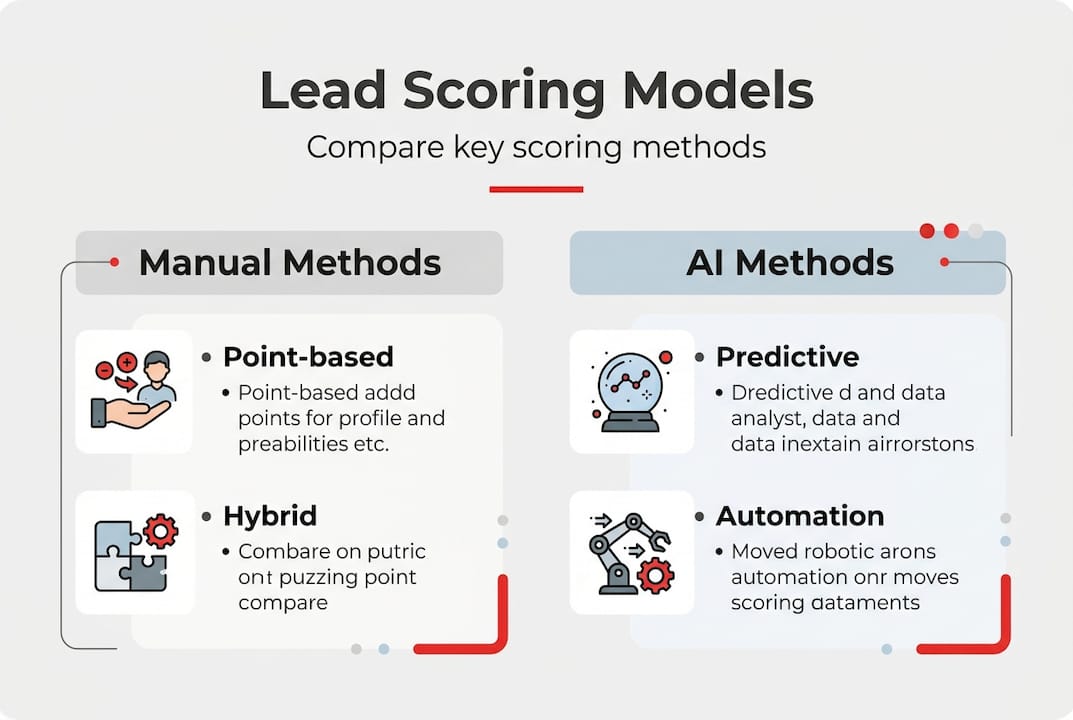
Point-based scoring is the simplest. You manually assign points to actions and attributes. It’s easy to set up and understand, but it requires regular updates and doesn’t adapt automatically.
Predictive scoring uses AI and machine learning to analyse past data and predict which leads will convert. It’s more accurate and adapts over time, but it requires a large dataset and can be expensive.
Hybrid scoring combines both methods. You set the rules, and AI refines them based on performance. It’s the best of both worlds but needs careful setup.
Here’s a quick comparison:
| Model | Best for | Pros | Cons |
|---|---|---|---|
| Point-based | Small businesses, simple sales cycles | Easy to set up, low cost, full control | Requires manual updates, can miss patterns |
| Predictive | Larger businesses, complex sales cycles | Highly accurate, adapts automatically | Needs large dataset, higher cost |
| Hybrid | Growing businesses, moderate complexity | Balances control and automation | Setup complexity, ongoing tuning needed |
For most UK SMEs, starting with point-based scoring makes sense. Once you have enough data and budget, consider upgrading to predictive or hybrid.
Dirty data can bias AI, and ignoring negatives can create false positives. Clean your data before implementing any model.
If you’re exploring automation, compare AI lead gen software to find the right fit. You can also review a detailed lead generation workflow to see how scoring fits into the bigger picture.
How to Set Up Lead Scoring: A Practical UK Guide
Ready to build your own lead scoring system? Here’s how to do it step by step.
- List your ideal customer attributes. What job titles, industries, and company sizes convert best? Assign points to each. For example, a director at a 10-50 employee company might score 20 points, while a junior employee at a large corporation scores 5.
- Identify high-intent actions. Which behaviours signal buying intent? Visiting your pricing page, downloading a guide, or requesting a demo are all strong signals. Assign points accordingly.
- Add engagement metrics. Track email opens, clicks, and replies. Someone who opens every email and clicks through is more engaged than someone who ignores you.
- Set negative scores. Subtract points for actions that indicate disinterest, like unsubscribing or visiting your careers page.
- Define your thresholds. Decide what score triggers a sales call, what score goes into nurture, and what score stays passive.
- Integrate with your CRM. Most CRM tools have built-in scoring features. Set up automation so scores update in real time.
- Review and refine. Review your scoring model versus conversion rates to spot when updates are needed.
Here’s a sample scoring table for a UK service business:
| Attribute/Action | Points |
|---|---|
| Director or owner | +20 |
| Manager | +10 |
| Company size 10-50 employees | +15 |
| Visited pricing page | +15 |
| Downloaded guide | +10 |
| Requested quote | +25 |
| Opened email | +5 |
| Unsubscribed | -20 |
| Visited careers page | -10 |
This is just a starting point. Adjust based on your own data and results.
Combine scoring with tactics for lead generation and content marketing for leads to build a complete system.
Common Pitfalls and How to Avoid Them
Even with good intentions, it’s easy to fall into traps. Here’s how to avoid the common ones.
Poor data quality leads to unreliable scores. If your CRM is full of duplicates, outdated contacts, or incomplete records, your scoring model will fail. Clean your data before you start.
Ignoring negative behaviours lets weak prospects through. If you only score positives, you’ll waste time on people who aren’t interested. Track unsubscribes, bounces, and low-engagement signals.
Failure to update models ignores changing buyer intentions. What worked last year might not work now. Review your model quarterly and adjust based on actual conversion data.
Over-complicating the system. Don’t assign points to 50 different actions. Keep it simple. Focus on the behaviours that actually predict sales.
Here’s the truth:
Dirty data biases AI, ignoring negatives creates false positives, static models miss buyer evolution.
If your scoring model isn’t working, start by checking your data quality. Then review your thresholds and point values. Finally, compare your scores to actual conversions.
If leads scoring 70+ aren’t converting, your model is broken. If leads scoring 30 are buying, you’re missing something.
Need help diagnosing the problem? Learn how to fix your sales funnel and avoid lead scoring mistakes that cost you revenue.
Stop Guessing and Start Scoring
You’ve spent years building your business. You’ve invested in marketing, hired a sales team, and created great products or services. But if you’re still treating every lead the same, you’re leaving money on the table.
Lead scoring changes that. It gives you clarity, focus, and a system that works even when you’re not watching.
At Bamsh, we build CRM systems with automated lead nurturing that score, track, and follow up with leads automatically. You get more conversions without hiring more staff. Our AI Lead Engine combines scoring with SEO, PPC, and automation to create a complete lead generation system that runs 24/7. Most clients are live within a week, and there’s no long-term lock-in. We earn your business every month by delivering results you can see.
If you’re ready to stop wasting time on the wrong leads and start focusing on the ones that actually buy, let’s talk.
Frequently Asked Questions
How is lead scoring different from lead qualification?
Lead scoring assigns a numeric value to prospects, while qualification sorts them into categories based on fit and interest.
What factors should I use to score leads?
Use behaviour, engagement, demographic, and negative signals for a balanced scoring system.
Do small UK businesses need lead scoring, or is it only for large firms?
Small businesses benefit from lead scoring by saving time and focusing on buyers most likely to convert.
How do I know if my scoring model is working?
Compare your lead scores against actual sales conversion rates to ensure accuracy.