

Your business reputation is no longer built on word of mouth alone. Today, 89% of UK shoppers consult ratings before making a purchase, yet many SME owners still underestimate how profoundly online reputation management influences customer trust and revenue. This guide reveals why managing your reputation is essential for growth, explores proven strategies to protect and enhance your standing, and shows how to overcome the common barriers that hold small businesses back from leveraging this critical competitive advantage.
Table of Contents
- Key takeaways
- How reputation management drives business growth
- Core strategies and tools for reputation management
- Challenges and nuances of reputation management for UK SMEs
- Practical tips to enhance your online reputation
- How Bamsh can help your business reputation
- What are common questions about reputation management for SMEs?
Key Takeaways
| Point | Details |
|---|---|
| Reputation drives growth | A strong online reputation underpins trust and is closely linked to higher conversion rates and revenue for SMEs. |
| Reviews shape decisions | Online ratings and reviews heavily influence buyer choices, making reputation a key differentiator for competitive SMEs. |
| Proactive management essential | Active reputation management helps SMEs differentiate themselves and sustain growth when competing with larger firms. |
| AI powered monitoring | AI powered monitoring across multiple platforms provides real time insights and actionable trends to address issues promptly. |
How Reputation Management Drives Business Growth
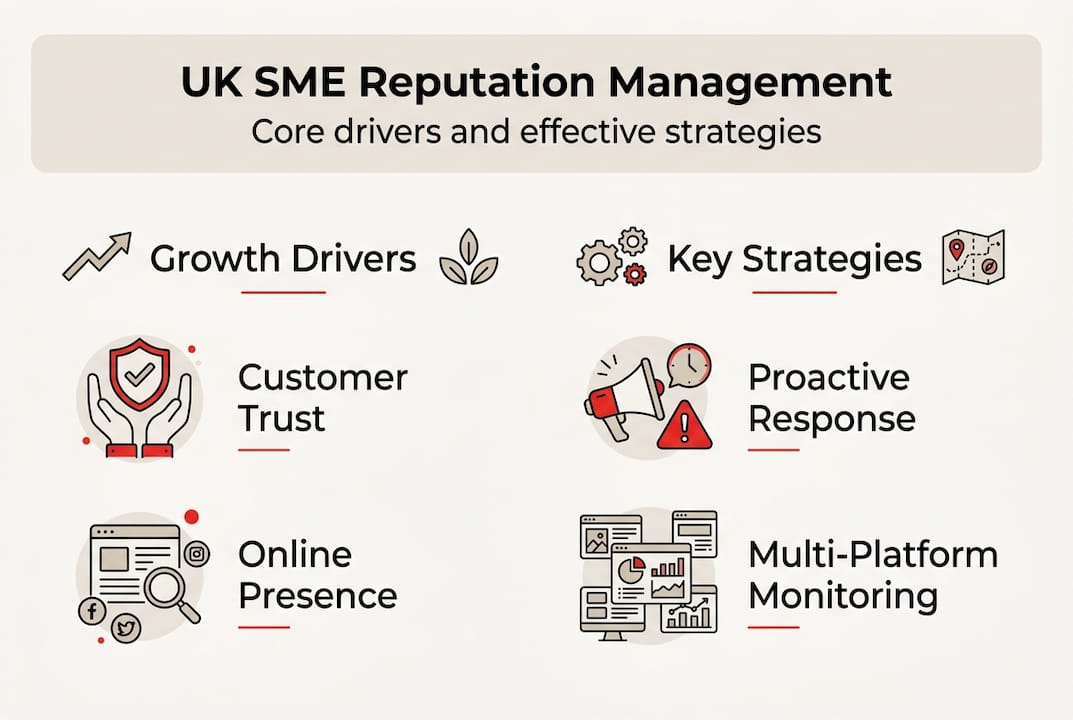
Reputation management builds the foundation of customer trust that determines whether prospects choose your business or a competitor. When potential customers research your company online, they form immediate judgements based on what they discover. The online reputation management market demonstrates that UK consumers overwhelmingly rely on ratings and reviews, with 89% checking them before purchase decisions. This behaviour creates a direct link between your online standing and your bottom line.
For SMEs competing against larger corporations, reputation becomes a powerful differentiator. A strong online presence signals professionalism, reliability, and customer care. Research shows businesses with consistently positive reviews experience measurably higher conversion rates and customer lifetime value. When your reputation reflects genuine quality and responsiveness, it amplifies every other marketing effort you undertake.
The financial impact extends beyond initial sales. Customers who trust your brand return more frequently, spend more per transaction, and refer others organically. This creates a compounding effect where reputation management becomes a strategic investment rather than a defensive cost. SMEs that actively cultivate positive reviews and address concerns promptly see sustained revenue growth through digital marketing channels that complement their reputation efforts.
“Reputation is the cornerstone of customer acquisition in the digital age. Without active management, SMEs surrender control of their most valuable marketing asset to chance and competitors.”
Data-driven reputation strategies enable you to identify patterns in customer feedback, spot emerging issues before they escalate, and recognise opportunities to exceed expectations. Monitoring sentiment across platforms reveals what customers truly value about your service and where improvements deliver the greatest return. This intelligence informs product development, service enhancements, and marketing messaging that resonates authentically with your target audience.
Pro Tip: Set up Google Alerts for your business name and key personnel to catch mentions early. Combine this with monthly review audits across all platforms where customers might leave feedback, creating a simple monitoring routine that requires minimal time investment.
Core Strategies and Tools for Reputation Management
Effective reputation management requires systematic approaches rather than reactive scrambling. AI-powered monitoring tools provide round-the-clock surveillance of your online mentions, alerting you instantly when new reviews appear or sentiment shifts. These systems track multiple platforms simultaneously, aggregating feedback into actionable dashboards that highlight trends and urgent issues requiring immediate attention.
The 5 A’s framework structures your response to every review, whether positive or negative:
- Acknowledge the customer’s experience and thank them for feedback
- Apologise sincerely if the experience fell short of expectations
- Accept responsibility without making excuses or deflecting blame
- Assure the customer you’re taking action to prevent recurrence
- Act by implementing changes and following up to demonstrate commitment
Responding within 15 to 24 hours signals that you value customer input and monitor your reputation actively. Speed matters because prospects evaluating your business see not just the review content but how you handle criticism. A thoughtful, professional response to a negative review often impresses potential customers more than a perfect five-star rating with no engagement.
Platform diversification protects against over-reliance on any single review site. Whilst Google Business Profile remains essential for local visibility, expanding to Trustpilot, Reviews.io, and industry-specific platforms broadens your reach and provides resilience. Each platform attracts different audience segments, and presence across multiple channels demonstrates transparency and confidence in your service quality.
SEO strategies complement reputation management by ensuring positive content ranks prominently when prospects search your business name. Publishing helpful articles, case studies, and thought leadership on your website pushes negative content further down search results. Combining DIY SEO techniques with professional expert SEO services creates a sustainable approach that balances cost control with technical expertise.
| Tool type | Best for | Typical cost | Key benefit |
|---|---|---|---|
| AI monitoring | Real-time alerts | £50-200/month | Catches issues immediately |
| Review management platform | Multi-site responses | £100-300/month | Centralised workflow |
| SEO content strategy | Long-term positioning | £500-2000/month | Suppresses negative content |
| Social listening | Brand mentions | £30-150/month | Broader sentiment tracking |
Integrating reputation tools with your existing AI lead generation software creates a unified system where customer feedback informs lead nurturing and sales processes. When prospects see recent positive reviews automatically featured in your email sequences or chatbot interactions, it reinforces credibility at critical decision points.
Pro Tip: Create response templates for common review scenarios, but always personalise them with specific details from each review. This balances efficiency with authenticity, ensuring every customer feels heard whilst maintaining consistent professionalism across all interactions.
Challenges and Nuances of Reputation Management for UK SMEs
Resource constraints present the most significant barrier to effective reputation management for small businesses. Research shows 53% of SMEs do not actively manage their online reputation, primarily due to limited budgets and lack of confidence in their ability to implement effective strategies. Time-strapped owners juggling operations, sales, and customer service struggle to prioritise monitoring and responding to reviews despite recognising its importance.

Self-efficacy gaps compound these challenges. Many SME owners feel overwhelmed by the technical aspects of reputation management or fear making situations worse through inappropriate responses. This hesitation creates a vicious cycle where inaction allows negative content to dominate search results, further damaging the business whilst the owner remains paralysed by uncertainty about the correct approach.
Yet reputation management functions as a strategic resource that strengthens competitive positioning precisely because it remains challenging. Businesses that overcome these barriers differentiate themselves from competitors who neglect their online standing. The investment in reputation systems and processes creates sustainable advantages that compound over time, building market authority that becomes increasingly difficult for rivals to match.
CEO and founder branding plays an underappreciated role in SME reputation. When business leaders establish personal credibility through thought leadership, speaking engagements, and professional networking, it signals competence and stability to potential customers. This personal dimension helps counter stereotypes about small business reliability and professionalism that larger competitors exploit.
Common pitfalls that undermine reputation efforts:
- Responding defensively to criticism instead of seeking understanding
- Ignoring positive reviews, missing opportunities to deepen customer relationships
- Focusing solely on star ratings whilst neglecting review content and sentiment
- Failing to close the feedback loop by implementing suggested improvements
- Treating reputation management as a marketing task rather than a company-wide priority
Customer-oriented SMEs with strong service cultures derive greater benefit from reputation management because their operational excellence provides the foundation for genuine positive reviews. Marketing transparency and trust become self-reinforcing when excellent service generates organic advocacy that reputation systems amplify and protect.
“The cost of neglecting reputation management far exceeds the investment required to manage it proactively. A single viral negative review can undo years of relationship building and referral generation.”
Proactive reputation management costs less and delivers better outcomes than reactive crisis response. Businesses that monitor continuously, engage consistently, and improve systematically rarely face reputation crises. When issues do arise, their track record of responsiveness and established positive content provide context that mitigates damage. This preventative approach aligns with how successful SMEs approach other business risks, treating reputation as an asset requiring ongoing maintenance rather than occasional emergency intervention.
The strategic importance of reputation management continues growing as consumers become more sophisticated in evaluating businesses online. Younger demographics particularly scrutinise review patterns, response quality, and overall digital presence before making purchase decisions. SMEs that master reputation management position themselves to capture this increasingly dominant customer segment whilst competitors struggle to adapt to evolving buyer behaviour and deliver clear marketing results.
Practical Tips to Enhance Your Online Reputation
Implementing effective reputation management starts with establishing monitoring systems that alert you to new reviews and mentions. Free tools like Google Alerts provide basic coverage, whilst platforms such as Birdeye offer more sophisticated tracking across multiple review sites and social channels. Low-cost monitoring solutions enable even bootstrapped SMEs to maintain awareness of their online standing without significant financial commitment.
Respond to every review, positive or negative, within 24 hours. Thank customers for positive feedback, acknowledging specific details they mentioned to demonstrate genuine appreciation. For negative reviews, follow the 5 A’s framework whilst keeping responses concise and professional. Never argue publicly or make excuses. If resolution requires extended discussion, invite the customer to continue the conversation privately whilst publicly committing to address their concerns.
Maintain consistency across all platforms where your business appears. Ensure your Google Business Profile, social media pages, and review site listings display identical business information, opening hours, and contact details. Inconsistencies confuse customers and undermine trust, whilst uniform presentation signals professionalism and attention to detail. Regular audits prevent information drift as your business evolves.
Integrate reputation efforts with broader SEO and public relations strategies to maximise impact. Publish case studies featuring satisfied customers on your website, optimised for search terms prospects use when researching your industry. Share customer success stories across social channels, tagging participants to encourage organic amplification. This creates positive content that ranks well whilst demonstrating real-world value delivery.
Step-by-step process to improve your online reputation:
- Audit your current online presence by searching your business name and reviewing all listings and mentions
- Claim and optimise profiles on Google, Trustpilot, and relevant industry platforms
- Implement monitoring tools to track new reviews and mentions across all channels
- Create response templates following the 5 A’s framework for efficient, consistent engagement
- Establish a weekly review response routine, dedicating specific time to address all feedback
- Request reviews from satisfied customers through post-purchase email sequences or SMS
- Analyse review content monthly to identify improvement opportunities and service strengths
- Publish positive case studies and testimonials on your website with proper SEO optimisation
- Train all customer-facing staff on the importance of reputation and how their actions influence reviews
- Integrate reputation metrics into business dashboards alongside revenue and customer acquisition data
Leveraging your Google Business Profile effectively amplifies local reputation impact. Regular posts, updated photos, and prompt responses to questions signal active management that Google rewards with improved visibility. Encourage customers to add photos with their reviews, as visual content increases engagement and provides social proof that text alone cannot match.
Pro Tip: Create a simple one-page guide for your team explaining how to ask for reviews naturally during customer interactions. Include specific language that feels comfortable and authentic, making it easy for staff to incorporate review requests into their workflow without awkwardness or pressure.
Building a review generation system ensures a steady stream of fresh positive feedback. Automated email sequences triggered after purchase completion or service delivery make requesting reviews effortless. Keep requests simple, providing direct links to your preferred platforms and explaining how reviews help your business serve customers better. Timing matters, so send requests when customer satisfaction peaks, typically immediately after successful delivery or problem resolution.
Integrating reputation management with your overall strategy to boost local business online creates synergies where each element reinforces the others. Local SEO drives visibility, reputation management converts that visibility into trust, and positive customer experiences generate the reviews that fuel both. This virtuous cycle becomes self-sustaining as your reputation strengthens, reducing acquisition costs whilst increasing customer lifetime value.
How Bamsh Can Help Your Business Reputation
Managing your online reputation effectively requires expertise, consistent effort, and integrated tools that most SMEs struggle to maintain internally. Bamsh specialises in helping UK small and medium-sized businesses build and protect their digital reputation through proven strategies tailored to your specific market and customer base. Our Google Business Profile management services ensure your local presence stays optimised, reviews get professional responses, and your profile ranks prominently when customers search for businesses like yours.
We combine reputation management with cutting-edge Answer Engine Optimisation techniques that position your business favourably in AI-powered search tools like ChatGPT and Google’s AI overviews. This forward-looking approach protects your reputation across traditional and emerging platforms where customers increasingly discover and evaluate businesses. Our comprehensive digital marketing services integrate reputation management with SEO, content strategy, and lead generation to create a unified system that drives measurable growth whilst building lasting customer trust.
Frequently Asked Questions About Reputation Management for SMEs?
How often should I monitor my business reputation?
Daily monitoring is ideal for catching new reviews and mentions immediately, but weekly checks suffice for most SMEs if you have alert systems configured. Set up automated notifications so urgent issues reach you within hours, then dedicate scheduled time for comprehensive platform reviews and response management.
What is the best way to handle a negative review?
Respond quickly and professionally using the 5 A’s framework: acknowledge the experience, apologise sincerely, accept responsibility, assure corrective action, and act on your commitment. Never argue publicly or make excuses. Offer to resolve the issue privately whilst demonstrating to other readers that you take feedback seriously and prioritise customer satisfaction.
Does the CEO’s personal reputation affect the business?
Absolutely. For SMEs especially, founder and leadership credibility directly influences customer trust and business reputation. Active professional networking, thought leadership, and visible community involvement by business leaders enhance overall company standing and help counter size-related credibility concerns that prospects might harbour.
Which reputation management tools work best for small businesses?
Google Alerts provides free basic monitoring, whilst Birdeye and ReviewTrackers offer affordable comprehensive solutions for multi-platform management. Choose tools based on your budget and platform priorities, starting simple and expanding as your reputation management matures. Integration with existing CRM and marketing systems maximises efficiency and impact.
What distinguishes proactive from reactive reputation management?
Proactive management involves continuous monitoring, systematic review requests, regular content publishing, and preventative issue resolution before problems escalate. Reactive approaches only address reputation after crises emerge, costing more whilst delivering inferior outcomes. Proactive strategies build sustainable competitive advantages whilst reactive tactics merely limit damage without creating lasting value.