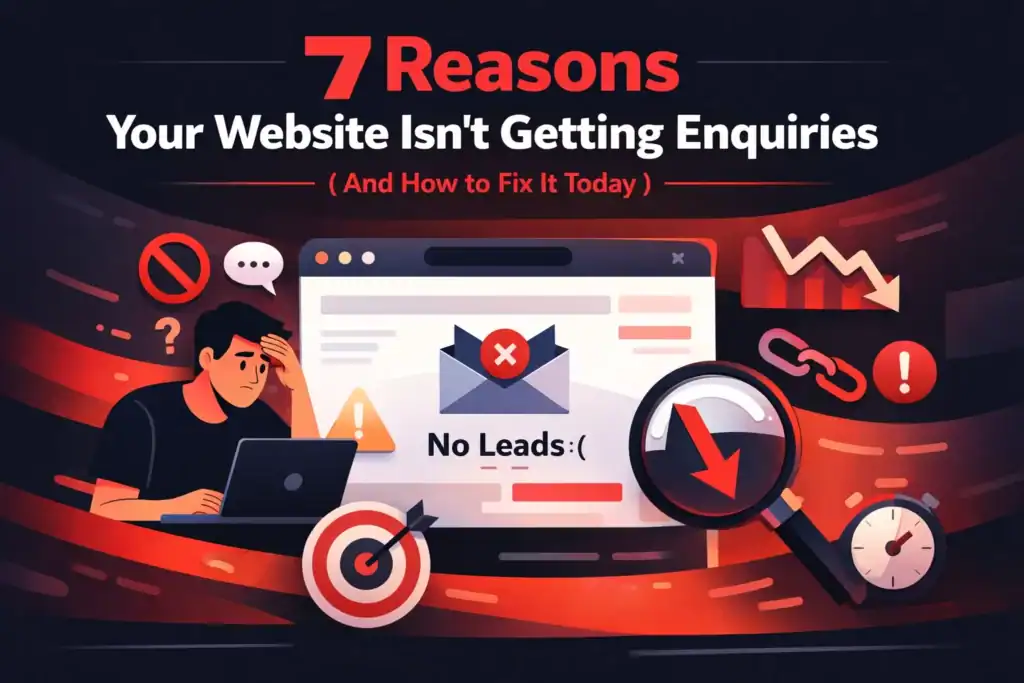
You’ve invested time, effort, and likely a fair bit of money into your business website. You were told it would be your best salesperson, working 24/7 to bring in new leads while you sleep. But lately, the only emails hitting your inbox are spam, and the phone hasn’t rung with a genuine enquiry in days.
It is a frustrating place to be. You know your services are great, and you know people in Bristol are looking for what you offer. So, why isn’t the website doing its job?
The truth is, a website that looks “nice” isn’t necessarily a website that “converts.” Conversion is just the technical term for getting someone to take action, like filling out a form or calling you. If your conversion rate is low, there are usually specific, fixable reasons behind it.
Here is why your website might be stalling and exactly what you can do to jumpstart your lead generation today.
1. Your Website is Testing the Reader’s Patience (Page Speed)
We live in an age of instant gratification. If your website takes more than a couple of seconds to load, most visitors will click the “back” button before they even see your logo. Research shows that a delay of just one second can lead to a significant drop in enquiries.
Why This Matters
When a page is slow, it creates a poor first impression. It tells the visitor that your business might be outdated or that you don’t value their time. In Bristol’s competitive market, your potential customer will simply move on to the next local business in the Google results.
How It Helps You
By optimising your images and cleaning up the technical “weight” of your site, you create a smooth, professional experience. A fast site keeps people engaged longer, which directly increases the chance of them reaching out to you.

2. The “What Do I Do Next?” Confusion (Weak CTAs)
Have you ever landed on a website, read the content, and then realised you weren’t sure how to actually hire the person? This happens more often than you think. Often, business owners use generic buttons like “Submit” or “Click Here,” or worse, they don’t have a clear button at all.
Why This Matters
Your visitors need to be led. If you don’t provide a clear Call-to-Action (CTA), they will finish reading and leave. They won’t hunt for your contact page if it isn’t staring them in the face.
How It Helps You
Switching generic buttons for action-oriented ones: like “Get My Free Quote” or “Book My Bristol Consultation”: tells the user exactly what to expect. It removes the “imagination gap” between browsing your site and becoming a customer.
3. It Looks Messy on a Smartphone (Mobile Experience)
Think about how you browse the web. You’re likely on your phone while waiting for a coffee at Gloucester Road or sitting on the bus. If your website looks great on a desktop but is impossible to use on a phone, you are losing a massive chunk of your audience.
Why This Matters
Google now prioritises the mobile version of your site. If your text is too small to read or your buttons are too close together for a thumb to click, visitors will get frustrated and leave. This is known as a “high bounce rate,” and it hurts your rankings and your enquiries.
How It Helps You
A mobile-responsive design ensures that whether someone is on an iPhone or a laptop, the experience is seamless. This builds trust and makes it physically easier for someone to tap your phone number and call you instantly.

4. You’re Hiding Your Success (Lack of Social Proof)
People in Bristol like to buy from people they trust. If your website is all “we do this” and “we do that” without any evidence from happy customers, visitors will be skeptical. They want to see that you have solved problems for people just like them.
Why This Matters
Social proof, such as testimonials, Google reviews, or case studies, acts as a “seal of approval.” Without it, you’re just another faceless business on the internet. Highlighting your local reputation is one of the quickest ways to boost enquiries.
How It Helps You
When you show a testimonial from a local Bristol business or a photo of a project you completed in Clifton, it grounds your business in reality. It proves you are reliable and capable of delivering results.
5. The Paradox of Choice (Too Much Distraction)
It is tempting to put everything on your homepage. You want people to know about your five different services, your latest blog post, your Instagram feed, and your company history. However, too many options lead to “analysis paralysis.”
Why This Matters
When a visitor is presented with ten different things to click on, they often end up clicking on nothing. Your website should have one primary goal for each page. If the goal is to get an enquiry, everything else on the page should support that goal, not distract from it.
How It Helps You
By simplifying your layout and removing unnecessary clutter, you guide the visitor’s eyes directly to your most important information and your contact form. Less is often more when it comes to conversion.

6. Your Content is About You, Not Them
A common mistake is writing a website that reads like a CV. “We were founded in 1998, we have ten staff, and we pride ourselves on quality.” While that is nice, the customer only cares about one thing: “Can you fix my problem?”
Why This Matters
If your content doesn’t immediately address the pain points of your target audience, they won’t feel a connection. You need to speak their language and show that you understand their specific challenges.
How It Helps You
Reframing your services as solutions changes the dynamic. Instead of saying “We offer SEO,” you say “We help your Bristol business get found by customers who are ready to buy.” This shift makes your business much more attractive to potential leads.
7. You Aren’t Measuring Anything (No Data Analysis)
If you don’t know where people are clicking or where they are leaving your site, you are essentially flying blind. You might think the problem is your pricing, but the data might show that people are getting stuck on a broken contact form.
Why This Matters
Without tools like heatmaps or basic analytics, you are making guesses. Guesses are expensive. Data allows you to see the “roadblocks” in your customer’s journey so you can clear them away.
How It Helps You
Monitoring your site’s performance lets you make small, incremental changes that lead to big results. You can see which pages are driving the most interest and double down on what is already working.

DIY vs. Professional Management
Many business owners start with a DIY approach to save costs, but as the business grows, the gap between a “hobby” site and a “growth” site becomes clear.
| Feature | DIY Website (Template) | Professional Digital Marketing |
|---|---|---|
| Setup Cost | Low upfront cost | Higher initial investment |
| Speed | Often slow due to “bloated” code | Optimised for lightning-fast loading |
| Mobile Use | Basic responsiveness | “Mobile-First” tailored experience |
| SEO | Basic or non-existent | Strategy-led for local Bristol rankings |
| Enquiry Rate | Usually low (1-2%) | High (5-10%+) through optimisation |
| Time Spent | You spend hours “tinkering” | You focus on running your business |
Stop the Website Embarrassment
Many business owners feel a sense of “website embarrassment.” You’re hesitant to send people to your site because you know it doesn’t reflect how good your business actually is. There is an “imagination gap” between what you want your brand to be and what people see online.
You don’t have to stay in that position. You can get instant visual proof of how your site could look and function.
First, use our Website Preview Tool to see your current site through a fresh lens and see what is possible. Then, if you’re wondering what it costs to actually fix these issues and start generating real leads, head over to our Digital Marketing Costs Estimator. It provides a transparent, no-pressure look at the investment required to turn your website into an enquiry machine.
Frequently Asked Questions
How long does it take to see more enquiries after fixing these issues?
Some changes, like fixing a broken contact form or improving your CTA language, can result in enquiries almost immediately. Technical changes like SEO services or improving page speed usually take a few weeks for Google to recognise and reward with better rankings.
Is my website too old to fix?
Not necessarily. While some very old sites might need a full rebuild to be mobile-friendly, many sites can be significantly improved with a “redesign” focus. We often look at the core structure to see if we can save what works and replace what doesn’t.
Do I really need a professional for this?
You can certainly try to fix speed issues or rewrite your copy yourself. However, a digital marketing agency understands the psychology of why people click and buy. We take the guesswork out of the process, ensuring your investment leads to a measurable return.
What is a good enquiry rate for a Bristol business website?
It varies by industry, but generally, if you are getting 2-5% of your visitors to contact you, you are doing okay. If you are under 1%, there is usually a significant “roadblock” on your site that needs to be addressed immediately.
Should I focus on Google Ads or SEO first?
If you need enquiries today, Google Ads is the fastest way to get your site in front of people. However, for long-term growth and lower SEO costs over time, organic search optimisation is essential. A balance of both is often the most effective strategy.
Let’s turn your website back into the asset it was meant to be. Start by checking your potential with our free tools and let’s get those enquiries flowing again.