

Most british brands now face a digital reality where AI search tools decide what customers see online. With platforms like ChatGPT, Google Gemini, and Microsoft Copilot powering search, traditional SEO tactics no longer guarantee visibility. In fact, over 75 percent of AI-generated responses skip generic, keyword-heavy pages entirely. As AI search reshapes online discovery, understanding how to create content that these systems value is key to staying visible and relevant in the British market.
Table of Contents
- AI Search Optimisation: What It Means Now
- How AI Tools Find And Rank Your Website
- Practical Benefits For Local Businesses
- Changing Customer Behaviour And Search Trends
- Key Pitfalls In AI Search Optimisation
Key Takeaways
| Point | Details |
|---|---|
| AI Search Optimisation Focus | Emphasises creating value-driven, structured content that enhances discoverability in AI-powered platforms. |
| Shift in Content Strategy | Local businesses should transition from traditional SEO tactics to producing comprehensive, relevant content that meets user intent. |
| Understanding Customer Expectations | Consumers prefer conversational, personalised interactions; businesses must adapt their content to meet these demands. |
| Avoiding Common Pitfalls | Businesses should steer clear of outdated practices like keyword stuffing and aim for authenticity and depth in their content. |
AI Search Optimisation: What It Means Now
AI search optimisation represents a fundamental shift in how businesses approach online visibility. Unlike traditional search engine optimisation, this emerging strategy focuses on making content discoverable and valuable within artificial intelligence powered search platforms like ChatGPT, Google Gemini, and Microsoft Copilot.
The core principle behind AI search optimisation is understanding how generative AI systems process and retrieve information. Generative Engine Optimisation introduces a new paradigm that goes beyond keyword matching, requiring content to be structured in ways that AI algorithms can comprehend and prioritise. This means creating comprehensive, authoritative content that directly answers user queries with precision and depth.
Local businesses must recognise that AI search fundamentally transforms information discovery. The algorithms now prioritise content that demonstrates expertise, provides clear explanations, and offers genuine value to users. This shifts the focus from traditional SEO tactics like keyword density towards creating genuinely helpful, well-structured informational resources that AI can easily interpret and recommend.
Strategic Considerations for Local Businesses:
- Develop content that comprehensively addresses specific user questions
- Use clear, structured language that AI can parse easily
- Focus on depth and accuracy over keyword manipulation
- Include technical schema markup to improve AI content understanding
Pro Tip: Content Clarity Strategy: Write your website content as if you’re explaining a complex topic to a curious, intelligent friend who knows nothing about your industry.
To clarify how AI search differs from traditional SEO, see the table below:
| Aspect | Traditional SEO Approach | AI Search Optimisation Approach |
|---|---|---|
| Content Structure | Focuses on keywords and tags | Prioritises clarity and semantic depth |
| User Query Handling | Matches explicit keywords | Answers nuanced, conversational queries |
| Assessment Criteria | Page ranking, backlinks, keywords | Expertise, intent, contextual accuracy |
| Technical Enhancements | Meta tags, sitemaps | Schema markup, structured data formats |
How AI Tools Find and Rank Your Website
AI search tools have fundamentally transformed how websites are discovered and evaluated, moving far beyond traditional keyword matching. Modern artificial intelligence platforms employ sophisticated algorithms that analyse content holistically, assessing factors like contextual relevance, depth of information, and overall user value.

Agentic AI Optimisation research demonstrates that autonomous AI agents now interact with online platforms through complex evaluation processes. These intelligent systems don’t just scan for keywords, but comprehensively assess content’s structure, expertise, and ability to provide comprehensive answers to user queries. Local businesses must understand that AI ranking mechanisms prioritise content that demonstrates genuine subject matter expertise and provides clear, authoritative information.
The ranking process involves multiple sophisticated assessment criteria. AI tools examine website content through advanced natural language processing techniques, evaluating factors such as semantic coherence, information density, originality, and the ability to answer complex user questions comprehensively. Local businesses need to shift from traditional SEO strategies towards creating high-quality, contextually rich content that demonstrates a deep understanding of their specific industry or service area.
Key AI Content Ranking Factors:
- Depth and comprehensiveness of information
- Semantic relevance and context
- Clarity of language and structure
- Demonstrated expertise in the subject matter
- Technical optimisation for AI readability
Pro Tip: Content Depth Strategy: Create content that answers not just the surface question, but anticipates and addresses potential follow-up queries a user might have.
Practical Benefits for Local Businesses
AI search optimisation offers transformative opportunities for local businesses, enabling them to reach customers more effectively and efficiently than ever before. By understanding and implementing strategic approaches to AI-powered search, small and medium enterprises can level the playing field with larger competitors, gaining unprecedented visibility and engagement.
Local businesses can leverage local SEO strategies to enhance their digital presence across AI search platforms. These intelligent systems now prioritise businesses that provide comprehensive, location-specific information, making it crucial for local enterprises to develop content that speaks directly to their community’s needs and search behaviours. This means creating detailed, geographically relevant content that answers specific customer questions with precision and authority.
The practical advantages extend beyond mere visibility. AI search tools help businesses understand customer intent more deeply, allowing for more targeted marketing and service delivery. By analysing search patterns and user interactions, local businesses can refine their offerings, create more personalised customer experiences, and develop highly responsive digital strategies that connect directly with their target audience’s evolving needs.
Key Practical Benefits for Local Businesses:
- Increased online visibility in AI search results
- More precise targeting of local customer segments
- Enhanced understanding of customer search behaviours
- Improved ability to answer specific customer queries
- Competitive advantage through intelligent content strategies
Pro Tip: Local Relevance Strategy: Develop content that not only describes your services but also speaks to the unique characteristics, challenges, and interests of your specific local community.
Changing Customer Behaviour and Search Trends
The digital landscape is experiencing a profound transformation in how consumers discover, interact with, and evaluate information. Artificial intelligence has fundamentally reshaped search behaviours, moving beyond traditional keyword-based queries towards more conversational, contextually nuanced interactions that demand sophisticated, intelligent responses from businesses.
Research on AI search trends reveals a significant shift in user expectations, particularly among younger demographics who increasingly rely on AI-powered platforms for comprehensive, immediate information retrieval. Modern consumers no longer simply search for information; they expect personalised, intelligent dialogue that understands their specific context, intent, and underlying needs.
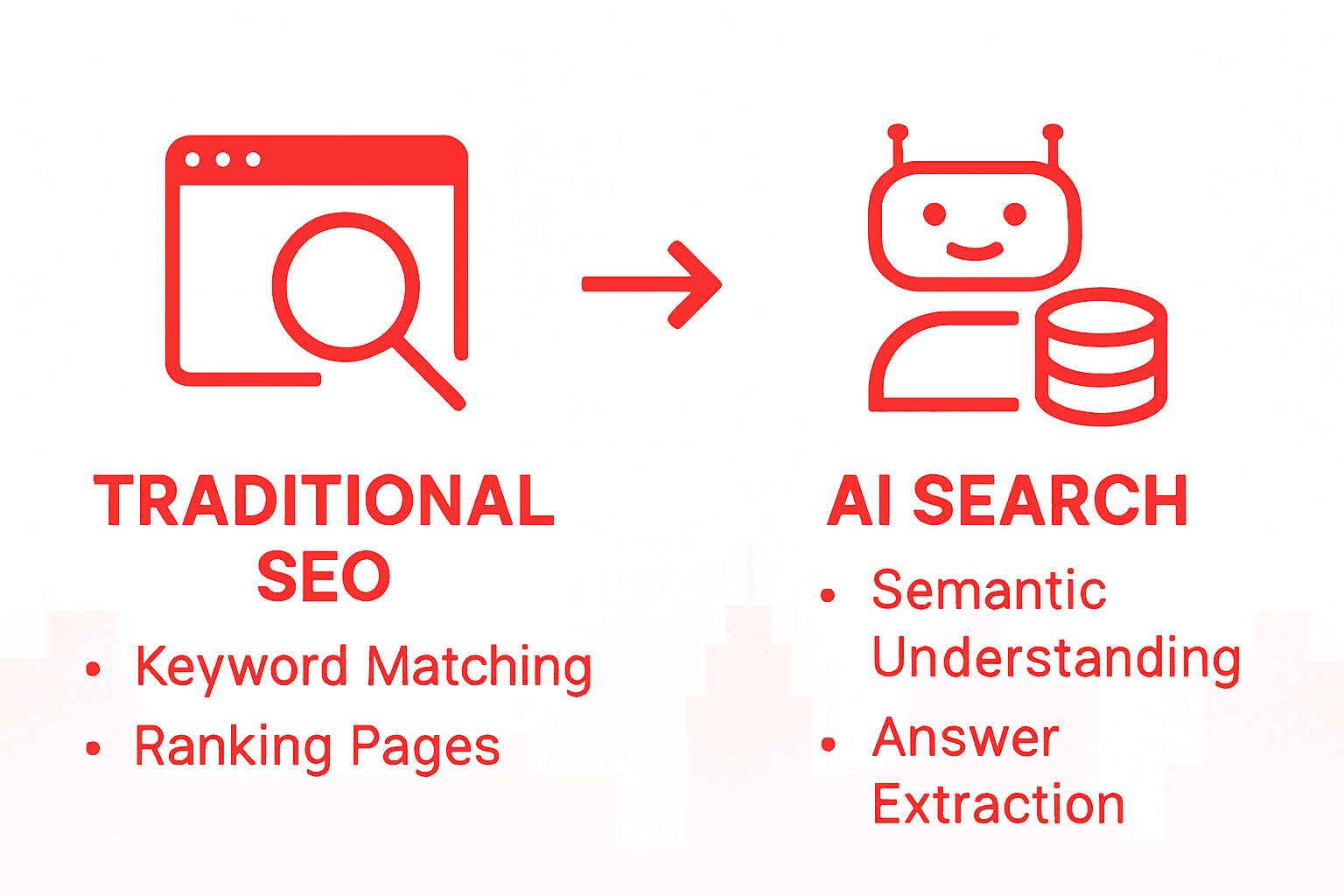
This evolutionary change in search behaviour requires businesses to reimagine their digital communication strategies. Consumers now expect instant, precise answers that go beyond surface-level information, demanding content that demonstrates deep understanding, provides comprehensive insights, and anticipates potential follow-up questions. The linear, transactional search model has been replaced by a more dynamic, conversational approach where AI tools act as intelligent intermediaries between businesses and potential customers.
Key Shifts in Customer Search Behaviour:
- Preference for conversational, context-aware search interactions
- Demand for personalised, immediately relevant information
- Increased reliance on AI-powered recommendation systems
- Expectation of comprehensive, nuanced answers
- Less tolerance for generic, surface-level content
Pro Tip: Adaptive Content Strategy: Design your digital content as an interactive conversation, anticipating and addressing potential user questions before they are explicitly asked.
The following table highlights how AI search trends are reshaping consumer expectations:
| Trend | Business Challenge | Opportunity for Local Businesses |
|---|---|---|
| Preference for conversational search | Adapting to nuanced, open-ended queries | Build dialogue-driven, interactive content |
| Demand for personalisation | Meeting varied user intent | Tailor offerings to specific audiences |
| Reliance on instant recommendations | Keeping content timely and authoritative | Update content and showcase real expertise |
Key Pitfalls in AI Search Optimisation
AI search optimisation presents complex challenges that can significantly undermine a business’s digital strategy if not approached with precision and strategic understanding. Businesses must navigate a sophisticated landscape where seemingly minor oversights can dramatically reduce their visibility and engagement across intelligent search platforms.
Research on bias detection in AI search results reveals critical nuances that businesses must consider when developing their AI search strategies. Potential pitfalls extend beyond simple content creation, encompassing deeper issues of algorithmic representation, contextual relevance, and the intricate ways AI systems interpret and prioritise digital content.
The most significant risks emerge from oversimplified approaches that fail to recognise the sophisticated nature of AI search algorithms. These systems do not merely scan for keywords but evaluate content through complex semantic analysis, assessing depth of information, contextual accuracy, and genuine value to potential users. Local businesses must move beyond traditional SEO tactics, understanding that AI search platforms demand authenticity, comprehensive information, and a nuanced approach to digital communication.
Critical Pitfalls to Avoid:
- Relying on outdated keyword stuffing techniques
- Creating shallow, generic content
- Neglecting semantic context and user intent
- Failing to update content regularly
- Ignoring technical optimisation for AI readability
Pro Tip: Content Authenticity Strategy: Develop content as if you are having a genuine conversation with your ideal customer, focusing on providing real value rather than trying to manipulate search algorithms.
Unlock Growth With AI Search Optimisation Strategies
The article highlights the critical challenge local businesses face in adapting to AI search optimisation and the shift from traditional SEO to content that AI platforms like ChatGPT and Google Gemini prioritise. Key issues include producing deep, expert content that AI can clearly interpret and engaging local audiences with relevant, authoritative information. Without adapting, businesses risk losing visibility and the chance to convert new customers amid evolving search behaviours.
At Bamsh Digital Marketing, we understand these unique demands. Our SEO & Answer Engine Optimisation (AEO) service focuses precisely on making your business discoverable on AI-driven platforms. We help you craft clea,r structured content and implement advanced technical optimisations so AI search tools rank you higher. Combine that with our Google Business Profile Optimisation to boost your local presence and our integrated marketing approach outlined on our landing page.
Ready to meet the new era of search head-on and attract more local customers with AI-optimised strategies? Discover how transparent AI-powered marketing drives real results. Explore insights on our Podcasts or get started today with a free consultation and see what Bamsh can do for your business.
Frequently Asked Questions
What is AI search optimisation and why is it important for local businesses?
AI search optimisation is the process of enhancing content to be more discoverable by AI-powered search platforms. It is crucial for local businesses because it helps them gain visibility and connect with customers who rely on AI tools for information.
How does AI search differ from traditional SEO?
AI search focuses on content clarity, semantic depth, and the ability to answer nuanced user queries, while traditional SEO relies heavily on keyword matching and backlinks. This shift requires businesses to adapt their content strategies accordingly.
What strategies should local businesses implement for effective AI search optimisation?
Local businesses should create comprehensive, authoritative content that addresses specific user questions, use clear language, employ schema markup for better AI understanding, and focus on providing genuine value over keyword manipulation.
How can businesses improve their content to align with AI ranking factors?
To align with AI ranking factors, businesses should prioritise depth and comprehensiveness in their information, ensure clarity in language and structure, and demonstrate expertise in their subject matter, all while optimising their content for AI readability.