

Most British small businesses struggle to convert data into meaningful customer engagement, yet nearly 60 percent of marketers credit data-driven strategies for increased leads. For South West UK business owners, understanding data-driven marketing is more than a trend. It is a practical way to connect with the right customers and build loyal relationships. This guide explains how using real customer data can transform your marketing results and help you compete with larger brands.
Table of Contents
- What Is Data-Driven Marketing?
- Types Of Data Used In Marketing
- How Data Shapes Effective Campaigns
- Applying Data-Driven Tactics In The UK
- Risks, Compliance, And Common Pitfalls
Key Takeaways
| Point | Details |
|---|---|
| Data-Driven Marketing Enhances Engagement | Systematic data collection and analysis allow for precise targeting and personalised marketing strategies that resonate with customers. |
| Diverse Data Types Improve Insight | Utilising demographic, behavioural, psychographic, and transactional data enables marketers to understand customers holistically and tailor their approaches. |
| Continuous Improvement with Data Analytics | Ongoing data analysis facilitates real-time adjustments in campaign strategies, leading to better outcomes and customer experiences. |
| Compliance is Essential | Adhering to data privacy regulations and ethical standards is crucial for building customer trust and avoiding legal issues. |
What Is Data-Driven Marketing?
Data-driven marketing transforms how businesses understand and engage with customers by systematically collecting, analysing, and leveraging customer information to create more targeted, personalised marketing strategies. This approach moves far beyond traditional guesswork, enabling companies to make strategic decisions based on concrete, measurable insights.
At its core, data-driven marketing represents an analytical process that empowers businesses to decode customer behaviour, preferences, and potential purchasing patterns. By carefully examining data from multiple sources such as website interactions, social media engagement, purchasing history, and demographic information, businesses can develop highly sophisticated marketing campaigns that speak directly to individual customer needs.
The primary advantages of data-driven marketing include:
- Precise Targeting: Identify and reach the most relevant audience segments
- Personalisation: Create tailored marketing messages that resonate with specific customer groups
- Performance Measurement: Track campaign effectiveness with real-time metrics and insights
- Cost Efficiency: Reduce marketing spend by focusing on high-potential customer interactions
Customer Data becomes the strategic asset that drives decision-making, allowing marketers to predict trends, understand customer journeys, and craft experiences that genuinely connect with their audience. By prioritising consumer and market data analysis, businesses can develop more intelligent, responsive marketing strategies that adapt quickly to changing market dynamics.
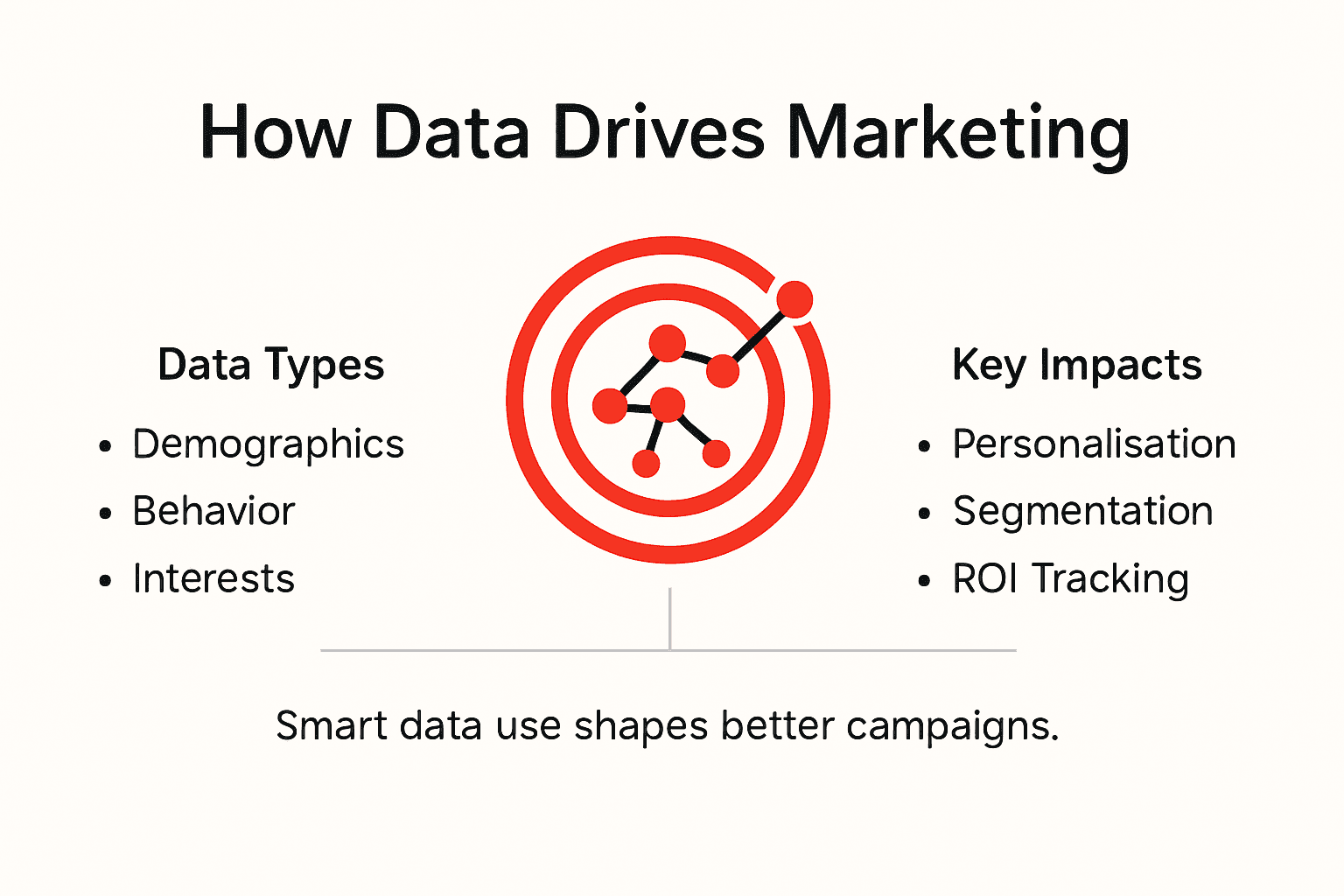
Pro Tip: Start small by collecting basic customer interaction data from your website and social media channels, then gradually build more sophisticated tracking and analysis processes.
Types Of Data Used In Marketing
Marketing professionals now leverage an extensive range of data types to develop precise, targeted strategies that drive business growth. Comprehensive data collection enables businesses to understand consumer behaviour with unprecedented depth, transforming how companies approach customer engagement and marketing campaigns.
The primary categories of marketing data include:
- Demographic Data: Age, gender, income, education level, occupation
- Behavioural Data: Online browsing patterns, purchase history, product interactions
- Psychographic Data: Personal interests, lifestyle choices, values, attitudes
- Transactional Data: Purchase frequency, average spend, product preferences
Modern marketing relies on diverse data sources that provide granular insights into customer preferences. These include website tracking information, social media interactions, customer surveys, loyalty programme records, and advertising engagement metrics. By synthesising these data streams, marketers can create highly personalised experiences that resonate with specific audience segments.
Each data type offers unique insights. Demographic data helps segment audiences, behavioural data reveals purchasing patterns, psychographic information uncovers motivational triggers, and transactional data tracks customer lifetime value. The real power emerges when these data types are integrated to create a holistic understanding of customer journeys.
Here’s a comparison of the main types of marketing data and their unique business applications:
| Data Type | Key Insight Gained | Example Practical Use |
|---|---|---|
| Demographic | Segmenting target audiences | Tailoring offers by age group |
| Behavioural | Understanding buying habits | Optimising website UX |
| Psychographic | Revealing motivation triggers | Customising brand messaging |
| Transactional | Measuring customer value | Shaping loyalty programmes |
Pro Tip: Invest in a robust customer relationship management (CRM) system that can consolidate multiple data sources and provide comprehensive customer insights.
How Data Shapes Effective Campaigns
Data has revolutionised marketing campaign design, transforming how businesses approach customer engagement and strategic communication. Digital marketing data analytics now provide sophisticated models for tracking campaign performance, enabling marketers to make real-time decisions based on precise, actionable insights.
Effective campaign shaping involves multiple strategic components:
- Performance Tracking: Monitoring key metrics across digital channels
- Customer Journey Mapping: Understanding interaction points and conversion paths
- Audience Segmentation: Creating targeted messaging for specific groups
- Predictive Analysis: Forecasting potential campaign outcomes
Modern data strategies help businesses understand consumer search behaviours and preferences with unprecedented precision. By analysing detailed metrics such as website interactions, social media engagement, email response rates, and customer conversion paths, marketers can craft highly personalised communication strategies that resonate directly with target audiences.

The true power of data-driven campaigns lies in continuous refinement. Each interaction provides valuable feedback, allowing businesses to incrementally improve targeting, messaging, and overall marketing effectiveness. This iterative approach transforms marketing from a static, guesswork-driven discipline to a dynamic, responsive strategic function.
Pro Tip: Implement a robust analytics dashboard that consolidates data from multiple sources to provide real-time campaign performance insights.
Applying Data-Driven Tactics In The UK
Comprehensive data-driven marketing strategies are increasingly transforming how British businesses approach customer engagement, with companies across the United Kingdom recognising the critical importance of leveraging data to drive strategic decision-making and competitive advantage.
Key tactical approaches for UK marketers include:
- Real-Time Data Analysis: Monitoring customer interactions instantaneously
- Precise Customer Segmentation: Breaking down audiences into nuanced groups
- Personalised Communication: Tailoring messaging to specific customer profiles
- Performance Benchmarking: Tracking and comparing marketing metrics systematically
Recent surveys reveal UK marketers are prioritising data-driven tactics in email marketing and social media analytics to enhance campaign performance and improve return on investment. This approach allows businesses to move beyond traditional marketing methods, creating more targeted, responsive strategies that directly address customer needs and preferences.
Successful implementation requires a holistic approach that balances technological capabilities with strategic creativity. Businesses must invest in robust data collection systems, develop sophisticated analytical skills, and maintain a flexible mindset that allows for continuous learning and adaptation.
Pro Tip: Develop a cross-functional team that combines data analysis skills with creative marketing expertise to maximise your data-driven marketing potential.
Risks, Compliance, And Common Pitfalls
Data-driven marketing requires meticulous attention to legal and ethical considerations, with UK businesses facing increasingly complex regulatory landscapes that demand sophisticated compliance strategies.
Key compliance risks and potential pitfalls include:
- Data Privacy Violations: Mishandling personal information
- Consent Management: Failing to obtain proper customer permissions
- Regulatory Non-Compliance: Breaching GDPR and Data Protection Act requirements
- Unethical Data Usage: Misusing customer information beyond agreed parameters
The marketing compliance landscape is rapidly evolving from strict regulatory adherence to building genuine consumer trust. This transformation requires businesses to develop robust data governance frameworks that protect customer rights while leveraging data insights effectively.
Successful navigation of these challenges demands a proactive approach. Businesses must invest in comprehensive staff training, implement rigorous data protection protocols, maintain transparent communication with customers, and continuously update their understanding of regulatory requirements. Regular audits, clear consent mechanisms, and ethical data handling practices are no longer optional but essential components of modern marketing strategies.
Below is a summary of major compliance challenges in UK data-driven marketing and proven mitigation strategies:
| Challenge | Typical Impact | Recommended Mitigation |
|---|---|---|
| Data privacy violations | Legal penalties, reputational damage | Staff training on data protection |
| Consent management | Loss of customer trust | Transparent opt-in processes |
| Regulatory non-compliance | Fines, operational disruption | Frequent policy audits |
| Unethical data usage | Erosion of consumer loyalty | Strict internal governance |
Pro Tip: Conduct a quarterly review of your data handling practices and invest in professional legal compliance training for your marketing team.
Unlock the Power of Data-Driven Marketing with Bamsh Digital Marketing
If you are struggling to transform customer data into actionable insights and more profitable marketing campaigns, you are not alone. The article highlights how crucial precise targeting, personalisation, and real-time performance measurement are to overcoming guesswork and costly mistakes in marketing. At Bamsh Digital Marketing, we specialise in turning complex data into clear, results-driven strategies that boost your bottom line while keeping transparency at the forefront.
Discover how our award-winning team can help you harness demographic, behavioural, and transactional data through tailored services like SEO, Google PPC, and CRM automation. With our AI Lead Engine and focused local expertise, you gain the tools to make smarter decisions and connect with your ideal customers confidently. Ready to evolve your marketing approach and achieve predictable growth? Start your journey with Digital Marketing Bristol – Bamsh Digital Marketing, explore insights via Podcasts – Bamsh Digital Marketing, and learn more about our transparent approach at Bamsh – Bamsh Digital Marketing. Take the first step today by booking your free 15-minute online marketing consultation at Bamsh. Your smarter way to grow awaits.
Frequently Asked Questions
What is data-driven marketing?
Data-driven marketing is an approach where businesses systematically collect, analyse, and leverage customer information to create targeted, personalised marketing strategies based on measurable insights rather than guesswork.
What types of data are used in data-driven marketing?
Common types of data include demographic data (age, gender), behavioural data (online browsing patterns), psychographic data (interests and values), and transactional data (purchase frequency and preferences).
How does data shape effective marketing campaigns?
Data shapes effective campaigns by enabling performance tracking, customer journey mapping, audience segmentation, and predictive analysis, which allows marketers to make real-time, informed decisions for better engagement.
What are some common risks associated with data-driven marketing?
Key risks include data privacy violations, issues with consent management, regulatory non-compliance, and unethical data usage, which can lead to legal penalties and erosion of consumer trust.