

More than 90 percent of website visitors leave without making a purchase, yet most British business owners in South West England let these leads slip away. Every missed opportunity lowers your potential return on investment and slows growth. By using smart retargeting strategies, you can re engage shoppers, guide them back, and convert more traffic into loyal customers. This guide reveals practical methods proven to help British entrepreneurs turn digital interest into tangible sales.
Table of Contents
- Step 1: Define Your Retargeting Audience Goals
- Step 2: Set Up Tracking and Data Collection Tools
- Step 3: Create Engaging Retargeting Ad Creatives
- Step 4: Launch and Schedule Your Retargeting Campaigns
- Step 5: Monitor Performance and Optimise for Results
Quick Summary
| Key Insight | Explanation |
|---|---|
| 1. Define audience segments clearly | Create detailed customer personas based on prior interactions to enhance targeting effectiveness. |
| 2. Use effective tracking tools | Implement Google Analytics and Facebook Pixel to gather insights and optimise retargeting strategies. |
| 3. Craft tailored ad creatives | Develop multiple engaging ad variations that resonate with specific customer segments and their behaviours. |
| 4. Schedule campaigns strategically | Plan and time your retargeting campaigns to align with potential purchasing behaviours for maximum impact. |
| 5. Continuously monitor and optimise | Regularly review campaign performance metrics to refine your strategies and improve return on investment. |
Step 1: Define your retargeting audience goals
Defining your retargeting audience goals requires strategic thinking and precise targeting. You will map out exactly who your potential customers are and how they align with your marketing objectives.
Start by identifying precise audience segments based on previous website interactions. This means segmenting visitors who have already demonstrated interest by examining their behaviour patterns. Look at metrics like pages visited, time spent on site, specific product views, and abandoned cart instances. Create detailed customer personas that reflect these behavioural characteristics.
Your audience segmentation should include multiple layers. Consider demographic information like age range, location, income bracket, and professional sector. Then overlay behavioural data tracking previous engagement levels. Some visitors might be casual browsers, while others are close to purchasing. Each segment requires a nuanced retargeting approach tailored to their specific stage in the buying journey.
Practical tip: Create three core audience segments with distinct retargeting strategies to maximise conversion potential.
Here is a summary of key audience segment types and their retargeting approaches:
| Audience Segment | Common Behaviours | Effective Retargeting Approach |
|---|---|---|
| Abandoned Basket Users | Added items but did not purchase | Remind of items, offer limited discounts |
| Product Viewers | Viewed specific product pages | Show product benefits, highlight reviews |
| Browsing Visitors | Visited main pages without deeper engagement | Present brand story, encourage further exploration |
Step 2: Set up tracking and data collection tools
In this step, you will establish the technical infrastructure to capture and analyse visitor interactions across your digital platforms. Effective tracking tools will help you understand user behaviour and refine your retargeting strategies.
Implement marketing data collection using Google Analytics, Facebook Pixel, and your chosen customer relationship management (CRM) platform. Each tool serves a specific purpose in gathering insights about your website visitors. Google Analytics tracks overall site interactions, Facebook Pixel monitors social media engagement, and your CRM captures detailed user information.

When setting up these tools, prioritise data minimisation principles to ensure you collect only relevant information. Configure your tracking to record key metrics like page views, time on site, clicked links, and conversion events. Ensure you have explicit consent mechanisms and clear privacy policies that inform users about data collection practices.
Practical tip: Configure your tracking tools to create custom audience segments based on specific behavioural triggers for more precise retargeting.
This table compares major data tracking tools and their distinct advantages:
| Tool | Main Strength | Typical Use Case |
|---|---|---|
| Google Analytics | Detailed site analytics | Monitoring site activity trends |
| Facebook Pixel | Social engagement insight | Tracking ad interactions on Facebook |
| CRM Platform | Extensive user profiles | Managing customer relationships and communications |
Step 3: Create engaging retargeting ad creatives
In this step, you will craft compelling visual and textual content that reconnects with previous website visitors and motivates them to return and convert. Your ad creatives are the critical bridge between initial interest and final purchase.
Develop creative advertising strategies by understanding your audience segments deeply. Design multiple ad variations that speak directly to different stages of the customer journey. For users who abandoned shopping carts, create ads highlighting product benefits and potential savings. For those who browsed but did not purchase, showcase social proof like customer testimonials or limited-time offers that create urgency.
Ensure your ad creatives maintain visual consistency with your brand while offering personalised messaging. Use high-quality images that demonstrate your product in action, write clear and concise copy that addresses specific pain points, and include strong call-to-action statements. Match the tone and style of your ads to the specific audience segment you are targeting, making each creative feel like a tailored communication rather than a generic advertisement.
Practical tip: A/B test at least three different ad creative variations to discover which resonates most effectively with your target audience.
Step 4: Launch and schedule your retargeting campaigns
In this crucial stage, you will strategically activate your retargeting campaigns across selected digital platforms, ensuring precise timing and audience targeting to maximise conversion potential. Your goal is to reconnect with potential customers at the most opportune moments.
Plan campaign implementation carefully by establishing a structured rollout timeline. Begin by setting specific start and end dates for each audience segment, considering factors like purchase intent, browsing behaviour, and potential seasonal variations. Allocate different budget proportions to high intent and low intent audience groups, prioritising those most likely to convert.
Configure your advertising platforms to manage frequency capping and prevent ad fatigue. This means limiting the number of times an individual sees your retargeting advertisements within a specific timeframe. Most platforms allow you to set daily or weekly impression limits, helping you maintain a balance between visibility and potential customer annoyance. Monitor your campaigns closely during the initial weeks, tracking key performance indicators like click-through rates, conversion rates, and cost per acquisition to make real-time adjustments and optimise your strategy.
Practical tip: Implement a 30-day initial campaign period with weekly performance reviews to quickly identify and scale the most effective audience segments and ad creatives.
Step 5: Monitor performance and optimise for results
In this final stage, you will transform your raw campaign data into actionable insights that drive continuous improvement and maximise your retargeting return on investment. Your goal is to become increasingly precise and efficient with each campaign iteration.
Track marketing performance metrics by establishing a comprehensive monitoring dashboard. Focus on critical key performance indicators such as click-through rates, conversion rates, cost per acquisition, and return on ad spend. Compare these metrics across different audience segments, ad creatives, and platforms to understand which combinations deliver the strongest results.
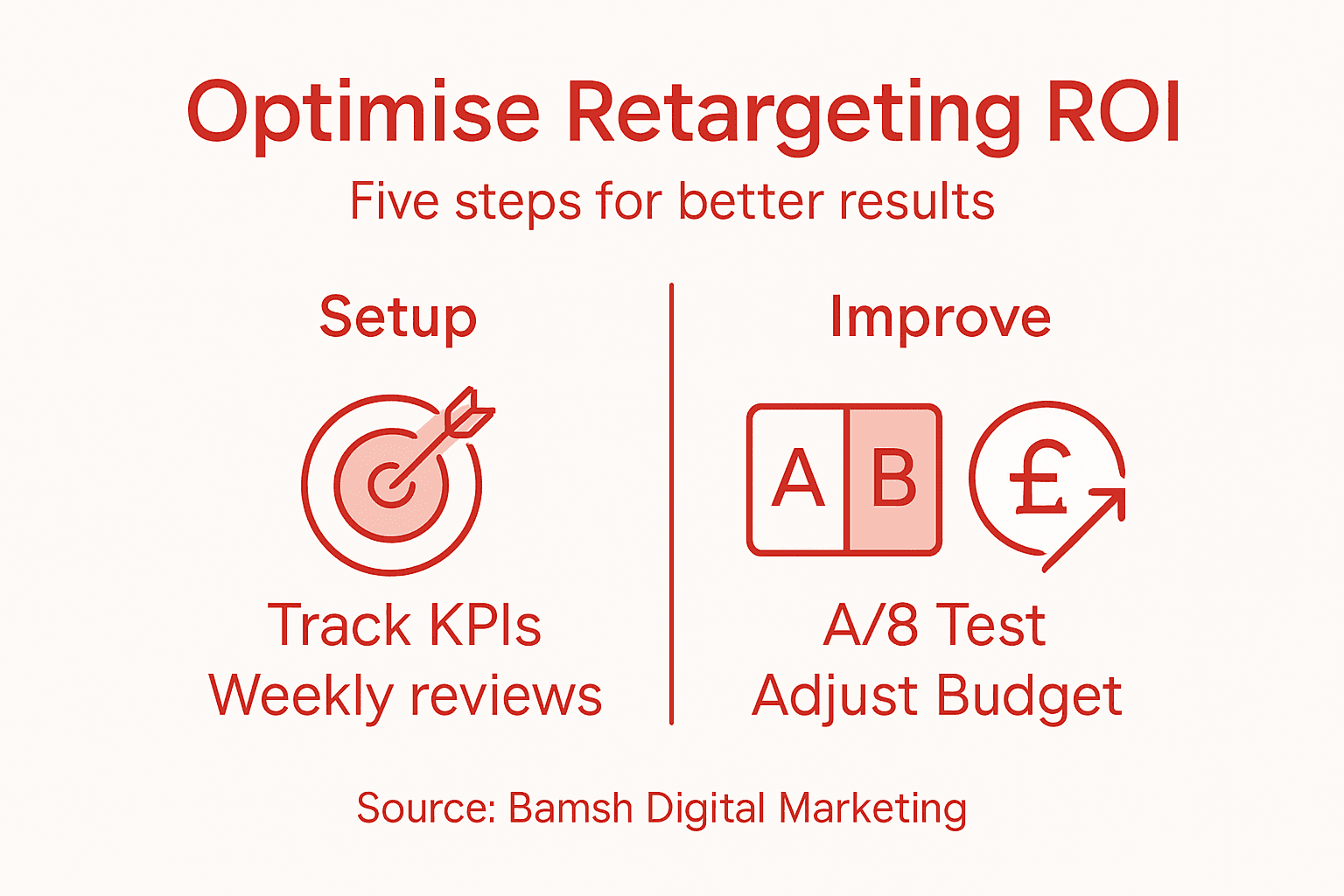
Implement a systematic review process where you analyse campaign performance weekly. Look beyond surface level metrics to understand deeper behavioural patterns. Identify which audience segments demonstrate the highest engagement, which ad creatives generate the most conversions, and where potential optimisation opportunities exist. Be prepared to make swift adjustments to your targeting, budgets, and creative approaches based on these insights. This might involve reducing spend on underperforming segments, scaling successful ad variations, or refining your audience targeting parameters.
Practical tip: Create a monthly performance summary that compares current campaign results against your initial benchmarks to track genuine progress and strategic effectiveness.
Unlock Higher ROI with Expert Retargeting Support from Bamsh Digital Marketing
The challenge of mastering retargeting strategies lies in precisely defining your audience, setting up effective tracking, and crafting engaging ads that convert. Many businesses struggle with segmenting visitors accurately or managing campaign frequency, which leads to wasted budget and low returns. This article highlights key pain points such as audience segmentation based on behaviour, configuring tools like Google Analytics and Facebook Pixel, and optimising ad creatives for different customer stages.
At Bamsh Digital Marketing, we specialise in turning these complex steps into clear, results-driven actions. Whether you need help with creating targeted paid social campaigns for retargeting, setting up automated lead nurturing through CRM integrations, or analysing campaign data to continually improve performance, our award-winning team is ready to partner with you. Discover how our bold, transparent approach helps businesses boost conversions without confusion or jargon.
Explore our Special Offers – Bamsh Digital Marketing to see how cost-effective retargeting solutions can fit your budget now. Then, take the first step to grow your business by booking your free 15-minute consultation at Bamsh Digital Marketing. Looking for fresh insights while you wait? Try our Podcasts – Bamsh Digital Marketing to learn more about smart marketing strategies that work.
Don’t let potential customers slip away. Act now to implement retargeting campaigns that attract, engage, and convert with clarity and confidence.
Frequently Asked Questions
How do I define my retargeting audience goals?
To define your retargeting audience goals, start by identifying precise audience segments based on previous interactions with your website. Map out visitor behaviours such as pages visited and abandoned cart instances to create detailed customer personas that reflect these characteristics.
What tracking tools should I set up for my retargeting campaigns?
Implement essential tracking tools like Google Analytics and Facebook Pixel to capture visitor interactions effectively. Configure these tools to collect key metrics, helping you analyse behaviour and optimise your retargeting strategies.
How can I create engaging ad creatives for my retargeting campaigns?
Develop engaging ad creatives by tailoring visual and textual content to the specific stages of your customers’ journeys. Use high-quality images and clear copy that address pain points, and A/B test at least three variations to identify which resonates best with your audience.
What steps should I follow to launch and schedule my retargeting campaigns?
Launch your retargeting campaigns by carefully planning the rollout, setting specific start and end dates for each audience segment. Monitor performance closely, particularly in the first weeks, adjusting frequency capping to prevent ad fatigue and maximise effectiveness.
How can I optimise my retargeting campaign performance?
To optimise your retargeting campaign performance, track key performance metrics like click-through rates and conversion rates. Conduct weekly reviews to analyse behavioural patterns and adjust targeting or budgets based on the insights you gather, with the aim of increasing ROI by refining your strategies iteratively.