

Struggling to predict where your next steady stream of leads will come from is a familiar challenge for many South West UK business owners. With competition intensifying, finding a cost-effective way to reach high-intent customers quickly becomes crucial to growth. Google Pay-Per-Click advertising stands out by offering immediate visibility on the most popular search engine in the UK, precise targeting, and accountability for every advertising pound spent, helping you build a reliable pipeline for revenue in today’s market.
Table of Contents
- Google PPC Explained For UK Businesses
- Types Of Google PPC Campaigns Available
- How Google PPC Delivers High-Intent Traffic
- Benefits Of Google PPC For Small Businesses
- Common Pitfalls And Cost Control Measures
Key Takeaways
| Point | Details |
|---|---|
| Cost-Effective Advertising | Google PPC only charges businesses when users click on ads, allowing precise budget control and maximising return on investment. |
| Targeted Audience Reach | Businesses can utilise specific keywords, geographic, and demographic targeting to connect with potential customers actively seeking their products or services. |
| Immediate Results and Adaptability | Unlike traditional methods, PPC provides instant visibility and allows businesses to adjust strategies based on real-time performance metrics. |
| Diverse Campaign Options | Google offers various PPC campaign types tailored to different marketing objectives, enabling businesses to choose the most suitable strategy for their needs. |
Google PPC Explained for UK Businesses
Google Pay-Per-Click (PPC) advertising offers British businesses a powerful digital marketing strategy to rapidly drive targeted website traffic and generate quality leads. Unlike traditional advertising models, PPC enables precise audience targeting through strategic keyword bidding and immediate search result visibility.
With PPC, businesses only pay when someone actually clicks their advertisement, making it an incredibly cost-effective approach. This model allows companies to control their advertising budget meticulously while reaching potential customers at the precise moment they’re searching for relevant products or services. UK businesses can set specific spending limits, choose geographic targeting, and track performance metrics in real-time, ensuring every pound invested delivers measurable results.
The core mechanism of Google PPC involves businesses bidding on keywords relevant to their target market. When users search those specific terms, your advertisement appears prominently in search results, dramatically increasing the likelihood of attracting interested potential customers. Unlike organic search strategies that can take months to generate results, PPC provides immediate visibility and allows businesses to quickly test marketing messages and audience responses.
Pro tip: Start with a modest daily budget and gradually increase spending as you identify which keywords and ad variations generate the most cost-effective conversions for your specific business.
Types of Google PPC Campaigns Available
Google offers multiple PPC campaign types designed to help UK businesses reach their unique marketing objectives. Search campaigns remain the most fundamental approach, allowing businesses to display text advertisements directly within search engine results when potential customers search for specific keywords related to their products or services.
Beyond search campaigns, businesses can leverage diverse campaign strategies to maximise their digital marketing potential. Display campaigns enable visual advertisements across the Google Display Network, targeting users browsing relevant websites. Shopping campaigns are particularly powerful for retail businesses, showcasing product listings with images, prices, and merchant details directly in search results. Video campaigns provide opportunities to engage audiences through YouTube, while Performance Max campaigns utilise advanced AI technologies to automatically optimise ad placements across all Google channels.
Each campaign type offers distinct advantages for different business goals. Search campaigns work best for businesses seeking immediate conversions, display campaigns excel at brand awareness, shopping campaigns suit e-commerce retailers, and video campaigns are ideal for storytelling and demonstrating product features. Performance Max campaigns represent the most sophisticated option, using machine learning to distribute advertisements intelligently across search, display, video, and other Google platforms.
To help UK businesses choose the best PPC campaign type, here’s a comparison of their core strengths:
| PPC Campaign Type | Ideal Use Case | Key Advantage |
|---|---|---|
| Search | Immediate lead generation | Highly targeted user intent |
| Display | Building brand visibility | Broad visual reach |
| Shopping | Online retail promotion | Product showcase with pricing |
| Video | Storytelling and engagement | Attention on YouTube platform |
| Performance Max | Multi-channel automation | AI-driven optimisation |
Pro tip: Experiment with multiple campaign types and carefully track performance metrics to understand which strategy delivers the most cost-effective results for your specific business model and target audience.
How Google PPC Delivers High-Intent Traffic
High-intent traffic represents the holy grail of digital marketing – potential customers who are actively seeking precisely what your business offers. Targeting keywords with commercial intent allows businesses to intercept users at the most critical moment of their purchasing journey, when they’re most likely to convert into paying customers.
Google PPC achieves this precision through sophisticated targeting mechanisms that go far beyond traditional advertising approaches. Advertisers can select hyper-specific keywords that match exactly what potential customers are typing into search engines, ensuring their advertisements appear only to audiences with genuine interest. Geographic targeting enables businesses to focus on specific regions, while demographic filters allow further refinement of audience selection. This means a plumbing business in Bristol can target local homeowners searching for emergency repair services, or an online retailer can reach precisely the right age group interested in their products.

The real power of Google PPC lies in its ability to provide immediate, measurable results. Real-time bidding and audience targeting mean businesses can adjust their strategies instantly based on performance data. Unlike traditional marketing channels, every click is tracked, analysed, and can be used to continuously optimise campaign performance. This data-driven approach ensures that marketing budgets are spent efficiently, targeting only those most likely to become customers.
Pro tip: Create separate ad groups with tightly themed keywords and continuously refine your targeting by monitoring which specific search terms generate the highest conversion rates.
Benefits of Google PPC for Small Businesses
Small businesses face unique marketing challenges, and Google PPC provides a strategic solution that levels the playing field against larger competitors. Immediate visibility in search results means even the smallest enterprise can compete for customer attention without requiring massive marketing budgets.
The cost-effectiveness of Google PPC makes it particularly attractive for small businesses with limited marketing resources. Unlike traditional advertising channels, PPC operates on a pay-per-performance model, allowing businesses to set precise budgets and only pay when potential customers actually click their advertisements. Targeted advertising enables small businesses to reach specific demographics, geographic regions, and customer segments with remarkable precision. A local bakery in Manchester, for instance, can target cake-loving customers within a 10-mile radius, ensuring every advertising pound is spent efficiently.
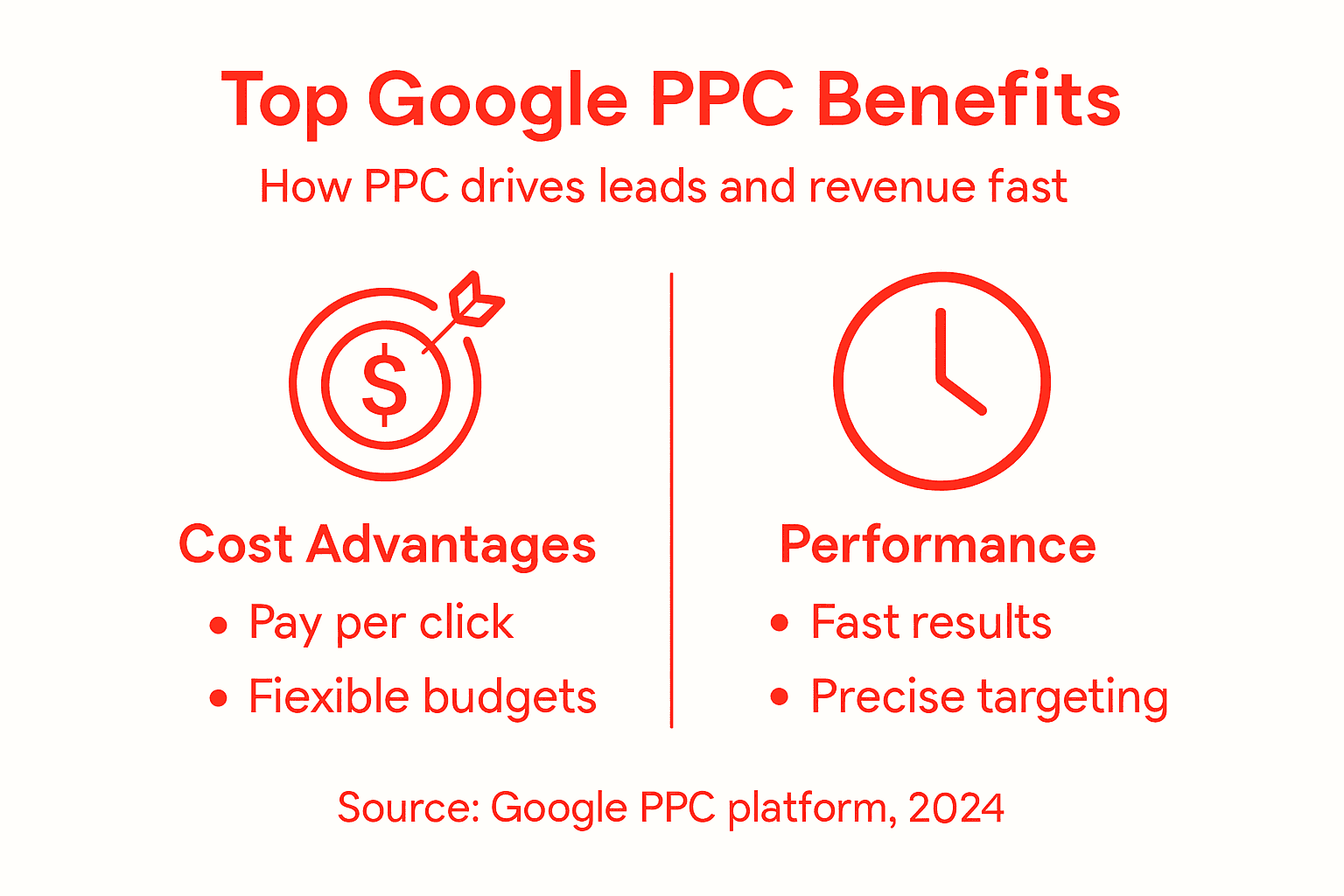
Perhaps the most compelling advantage of Google PPC is its unparalleled measurability. Campaign metrics provide real-time insights into advertising performance, allowing businesses to quickly adjust strategies, optimise spending, and understand exactly which keywords and approaches generate the most valuable customer interactions. This data-driven approach transforms marketing from a guessing game into a precise, controllable business strategy that can drive consistent growth and revenue.
For small businesses, understanding the measurable benefits of Google PPC can guide smarter investments:
| Benefit | Description | Impact on Small Businesses |
|---|---|---|
| Precise Budget Control | Set maximum daily/monthly ad spend | Prevents overspending |
| Geographic and Demographic Targeting | Focus ads on local or niche audiences | Reaches the most relevant customers |
| Real-Time Performance Tracking | Monitor and adjust ads instantly | Optimises results quickly |
| Pay-Per-Click Charging Model | Only pay when an ad is clicked | Improves return on investment |
Pro tip: Start with a modest daily budget and progressively increase spending as you identify the most effective keywords and audience segments that deliver genuine business value.
Common Pitfalls and Cost Control Measures
Budget management represents the most critical aspect of successful Google PPC campaigns. Many businesses inadvertently waste substantial marketing funds by failing to implement strategic cost control mechanisms. Robust tracking and analytics are essential for identifying potential spending inefficiencies and optimising campaign performance.
Common pitfalls that drain advertising budgets include broad keyword selection, neglecting negative keyword strategies, and inadequate audience targeting. Businesses often make the mistake of using generic, high-competition keywords that attract irrelevant clicks, resulting in unnecessary expenditure. Precise targeting becomes crucial – this means carefully selecting keywords, establishing strict geographic and demographic parameters, and continuously refining audience segments to ensure each click has genuine potential for conversion.
Another significant challenge is maintaining compliance with digital advertising regulations while managing campaign costs. UK businesses must navigate complex rules surrounding data protection, particularly GDPR requirements. This involves obtaining proper user consent, implementing transparent tracking mechanisms, and ensuring that advertising practices remain both legally compliant and financially responsible. Sophisticated advertisers use advanced analytics tools to monitor campaign performance, quickly identifying and eliminating underperforming ads and redirecting budget towards high-performing strategies.
Pro tip: Implement a weekly review process to audit your PPC campaign performance, systematically removing low-performing keywords and reallocating budget to tactics demonstrating the highest return on investment.
Supercharge Your Lead Generation with Expert Google PPC Management
If you have been searching for a cost-effective way to boost your business’s visibility and capture high-intent traffic, the challenges outlined in this article will resonate deeply. Managing Google PPC campaigns requires precise keyword targeting, continuous budget control, and real-time optimisation to avoid costly mistakes and wasted spend. At Bamsh Digital Marketing, we understand these pain points and specialise in building highly targeted Google Ads that put your business where eager customers are already searching.
Our approach is transparent and results-driven, delivering better-quality leads at a lower cost with monthly reporting you can trust. Whether you are a small business looking to compete locally or an ambitious company aiming for wider reach, our award-winning team ensures every pound is spent to maximise your return on investment. Discover how we can help you navigate the complexities of PPC, refine your campaigns, and grow your revenue by visiting our Bamsh category page.
Ready to stop wasting budget on guesswork? Take the first step towards reliable lead generation by booking your free 15-minute consultation with us at Bamsh Digital Marketing. For limited-time offers, check out our Special Offers and let us guide you on your growth journey today.
Frequently Asked Questions
What is Google PPC and how does it work?
Google Pay-Per-Click (PPC) is a digital advertising model where businesses bid on keywords relevant to their products or services. When users search those keywords, their advertisements can appear prominently in search results. Businesses only pay when someone clicks their ad, making it a cost-effective method to drive targeted traffic to their websites.
What are the main benefits of using Google PPC for my business?
The primary benefits of Google PPC include immediate visibility in search results, precise targeting of potential customers through demographic and geographic filters, and the ability to set strict budgets and track performance metrics in real-time. This allows businesses to optimise ad spending and improve the return on investment.
How can I ensure my Google PPC ads reach the right audience?
To target the right audience, use specific, relevant keywords that match the intent of your potential customers. Implement demographic targeting, geographic filters, and negative keywords to exclude irrelevant traffic. Regularly monitor and adjust your campaigns based on performance metrics to refine your targeting strategy.
What are common mistakes to avoid when running Google PPC campaigns?
Common mistakes include selecting overly broad keywords, neglecting negative keywords, and failing to monitor campaign performance. These pitfalls can lead to wasted budget. It’s essential to conduct regular audits, refine keyword choices, and focus on precise targeting to enhance the efficacy of your campaigns.