

Many business owners in South Wales and South West find that writing content is only half the battle when it comes to being found online. Modern search engines highlight content that goes beyond keywords, focusing on genuine value and expertise instead. By creating high-quality and relevant material, you can deliver answers your customers want while gaining greater visibility. This article offers practical guidance for building strategic content that meets both search algorithms and user needs, paving the way for real lead generation.
Table of Contents
- What Content Means For Modern SEO
- Types Of Content That Impact Rankings
- How Content Quality Influences Search Visibility
- Optimising Content For Lead Generation
- Common Content Mistakes That Hurt SEO
Key Takeaways
| Point | Details |
|---|---|
| Content Quality Matters | High-quality, valuable content that meets user needs is essential for modern SEO success. Focus on delivering genuine insights that demonstrate expertise to improve search rankings. |
| Diverse Content Types Enhance Engagement | Integrate various content formats such as articles, videos, and FAQs to cater to different audience preferences and boost search engine visibility. |
| Avoid Common SEO Mistakes | Steer clear of keyword stuffing and ensure proper technical SEO practices to maintain strong search performance and user engagement. |
| Regular Content Audits are Crucial | Conduct frequent audits to keep content relevant, current, and aligned with user intent, ensuring continued effectiveness in search rankings. |
What Content Means for Modern SEO
Content is no longer just about keywords – it’s about creating strategic, valuable information that meets user needs and search engine algorithms. Modern SEO demands content that answers real questions, provides genuine value, and demonstrates expertise in ways that genuinely help readers solve problems.
Today’s search algorithms prioritise content that demonstrates relevant search authority. This means producing high-quality, original material that goes beyond surface-level information. Search engines now evaluate content based on depth, accuracy, user engagement, and how comprehensively it addresses user intent.
Effective modern SEO content requires a multi-dimensional approach. It involves understanding your audience’s specific queries, creating comprehensive answers, structuring information for readability, and ensuring technical elements like metadata, headings, and internal linking support your content’s discoverability. Websites must focus on creating content that serves user needs while simultaneously meeting technical search optimisation requirements.
Pro tip: Regularly audit your existing content to ensure it remains current, relevant, and aligned with user search intentions.
Types of Content That Impact Rankings
In the dynamic world of digital marketing, content is far more than just text on a page. Modern SEO content strategies encompass multiple content types designed to engage different audiences and satisfy complex search algorithms. These content types range from traditional blog posts and articles to more sophisticated formats that help websites establish authority and relevance.
The most impactful content types include long-form authoritative articles, which provide in-depth exploration of topics and demonstrate expertise. Structured data and schema markup help search engines understand content context, while frequently asked questions (FAQs) sections directly address user queries. Multimedia content like videos, infographics, and podcasts can also significantly enhance user engagement and provide additional ranking opportunities by offering diverse content consumption methods.

Websites must strategically blend different content formats to create a comprehensive digital presence. This means developing content that not only answers user questions but also provides unique insights, uses relevant keywords naturally, and maintains high-quality standards. Technical elements like proper headings, internal linking, and metadata further support content discoverability and search engine performance.
Pro tip: Create a content matrix that maps different content types against specific user intents and search queries to ensure comprehensive coverage and maximum SEO impact.
Below is a comparison of major SEO content types and their unique benefits:
| Content Type | Distinctive Feature | SEO Benefit |
|---|---|---|
| Long-form Articles | In-depth topic coverage | Establishes authority and expertise |
| FAQs | Direct question responses | Improves featured snippet chances |
| Multimedia (Video, etc) | Engages diverse audiences | Increases on-page dwell time |
| Structured Data/Schema | Machine-readable organisation | Enhances search result visibility |
How Content Quality Influences Search Visibility
Content quality fundamentally determines search visibility by directly impacting how search engines and users perceive digital information. High-quality content goes beyond mere keyword placement, focusing instead on delivering genuine value, answering user questions comprehensively, and providing unique insights that demonstrate expertise and authority.
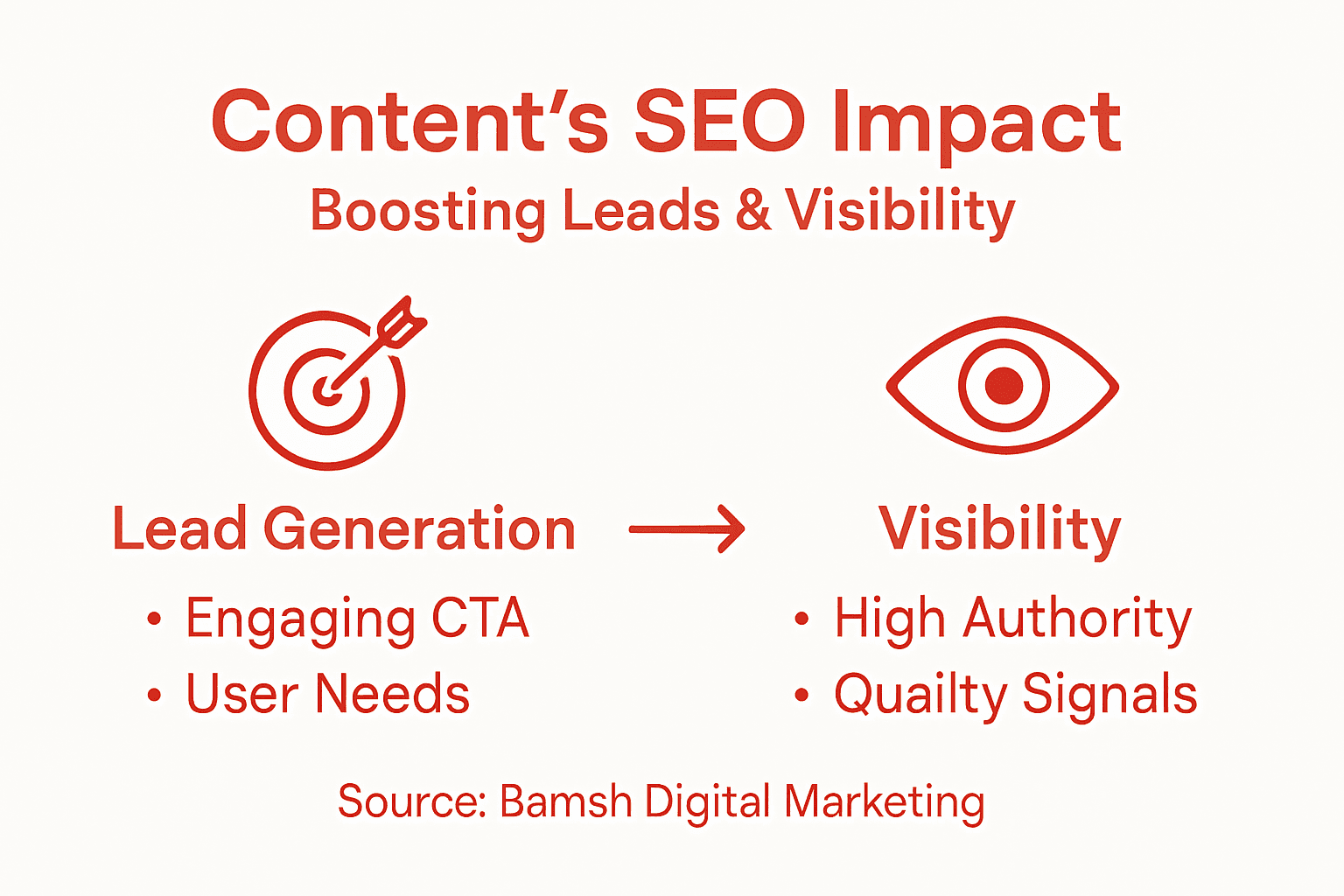
Search algorithms increasingly prioritise content that exhibits experience, expertise, authoritativeness, and trustworthiness (E-E-A-T). This means websites must create content that is not only well-researched and factually accurate but also engaging and user-friendly. Factors like low bounce rates, longer user dwell times, and meaningful user interactions signal to search engines that the content genuinely meets user needs and deserves higher search rankings.
To enhance content quality, businesses must focus on creating comprehensive, original material that addresses user intent from multiple perspectives. This involves conducting thorough research, presenting information clearly, using credible sources, and structuring content in a way that makes complex topics accessible. Multimedia elements, expert insights, and practical examples can further elevate content quality, making it more likely to rank well and attract organic traffic.
Pro tip: Conduct a quarterly content audit to evaluate your existing material against current E-E-A-T standards, identifying opportunities for improvement and updating outdated information.
Optimising Content for Lead Generation
Effective SEO content strategies must be deliberately designed to guide potential customers through their buying journey. This means creating targeted content that addresses specific pain points, answers critical questions, and provides clear value at each stage of the customer decision-making process. Successful lead generation content moves beyond generic information, instead offering precise, actionable insights that demonstrate your understanding of the customer’s challenges.
Content optimisation for lead generation requires a strategic approach that combines technical SEO elements with compelling storytelling. Keyword targeting plays a crucial role, but should be implemented naturally within content that genuinely helps the reader. This involves creating detailed guides, case studies, comparison pieces, and problem-solving resources that position your business as a trusted authority. Each piece of content should include clear conversion opportunities like contact forms, downloadable resources, or consultation offers that make taking the next step intuitive for potential leads.
The most effective lead generation content follows a customer-centric framework. This means deeply understanding your target audience’s motivations, challenges, and decision-making processes. Use data-driven personas to craft content that speaks directly to specific customer segments, addressing their unique needs and presenting your solutions as the most compelling path forward. Incorporate social proof, expert insights, and concrete examples that build trust and demonstrate your capability to solve real-world problems.
Pro tip: Develop a content mapping strategy that aligns specific content pieces with different stages of the customer journey, ensuring you have targeted resources for awareness, consideration, and decision-making phases.
Common Content Mistakes That Hurt SEO
Common content mistakes can significantly damage search engine performance, undermining years of carefully developed digital marketing strategies. The most prevalent errors include keyword stuffing, which artificially inflates content with repetitive phrases that compromise readability and user experience. Search engines have become sophisticated at detecting such manipulative tactics, often penalising websites that prioritise algorithmic tricks over genuine, helpful content.
Technical SEO errors can be equally destructive. Poorly structured content, inadequate metadata, and generic linking practices create significant barriers to search visibility. This means avoiding vague link texts like ‘click here’, neglecting proper header hierarchies, and failing to optimise image alt tags. Mobile responsiveness is crucial – websites with slow loading times or non-adaptive designs will see their rankings plummet, regardless of content quality.
The most critical mistake is producing content without genuine user value. Modern search algorithms prioritise material that comprehensively answers user queries, demonstrates expertise, and provides unique insights. This requires moving beyond superficial, keyword-driven writing towards creating authoritative, in-depth resources that truly serve audience needs. Understanding your target demographic’s specific questions and pain points becomes paramount in developing content that both ranks well and drives meaningful engagement.
Pro tip: Conduct a monthly content audit to identify and systematically eliminate low-performing pages, ensuring your website maintains high-quality, relevant material that search engines and users will reward.
Here is a summary of common content mistakes and their business consequences:
| Mistake | Example | Business Consequence |
|---|---|---|
| Keyword Stuffing | Repetitive keyword use | Lower rankings, user disengagement |
| Poor Technical SEO | Missing meta descriptions | Reduced indexing, lost traffic |
| Weak Mobile Performance | Slow loading on mobiles | Higher bounce rates, lost conversions |
| Lack of User Value | Generic, thin content | Poor engagement, less organic growth |
Unlock the True Power of Content with Bamsh Digital Marketing
The article highlights the crucial challenges businesses face when trying to create content that not only ranks well but also drives real leads and meaningful visibility. If you find yourself struggling with content that lacks depth, fails to engage, or does not convert visitors into customers, Bamsh Digital Marketing can help transform your approach. Understanding key concepts like E-E-A-T and matching content precisely to user intent are essential steps that require expert guidance and clear strategies.
At Bams,h we specialise in delivering transparent, results-driven SEO and Answer Engine Optimisation to ensure your content meets search algorithms while genuinely solving your customers’ problems. From comprehensive content audits to lead-generating strategies tailored to your audience’s journey, our award-winning team is ready to help you build authority and boost your digital presence with no jargon or guesswork. Discover how we can amplify your website’s impact by visiting SEO Agency Bristol – Bamsh Digital Marketing or learn more about our agency ethos at Bamsh – Bamsh Digital Marketing.
Ready to stop missing out on the traffic and leads your business deserves? Take the first step today with a free consultation at https://bamsh.co.uk/15-min/. Let us help you create content that truly connects and converts.
Frequently Asked Questions
What type of content is most effective for SEO?
Modern SEO benefits from a variety of content types, including long-form authoritative articles, FAQs, and multimedia such as videos and infographics. This diverse content strategy helps engage different audiences and satisfy complex search algorithms.
How does content quality affect SEO performance?
Content quality is crucial for SEO as it impacts both user engagement and search engine rankings. High-quality content that provides unique insights, demonstrates expertise, and addresses user intent can lead to lower bounce rates and higher organic traffic.
What common mistakes should I avoid in SEO content?
Common mistakes include keyword stuffing, poor technical SEO practices, and creating content that lacks genuine user value. Avoiding these pitfalls is essential for maintaining search visibility and user engagement.
How can I optimise my content for lead generation?
To optimise content for lead generation, focus on creating targeted pieces that address specific pain points and guide the customer through their buying journey. Incorporating clear conversion opportunities and using data-driven personas can enhance content effectiveness.