

Every Bristol restaurant owner knows the challenge of standing out when hungry customers search for food nearby. The competition is fierce, and your online presence often determines whether you attract new diners or lose them to the next listing. By focusing on local SEO and harnessing customer reviews as powerful signals, you can improve your Google Business Profile, gain trust from potential guests, and drive more meaningful leads right to your door.
Table of Contents
- Defining Local SEO and Reviews
- Types of Reviews and Their Importance
- How Google Evaluates and Ranks Reviews
- Building Trust and Engaging Customers
- Risks, Pitfalls, and Review Management Mistakes
Key Takeaways
| Point | Details |
|---|---|
| Importance of Local SEO | Local SEO enhances a business’s visibility in specific geographical areas, crucial for attracting nearby customers. |
| Role of Reviews | Customer reviews significantly impact search rankings, providing social proof and trust to potential customers. |
| Types of Reviews | Different review formats carry varying weight in SEO; keyword-rich and genuine reviews are particularly valuable. |
| Effective Review Management | Actively managing reviews, including responding promptly, can enhance credibility and customer engagement. |
Defining Local SEO and Reviews
Local Search Engine Optimisation (SEO) is a targeted digital marketing strategy designed to help businesses increase their online visibility within specific geographic areas. When potential customers search for services or products near them, local SEO determines whether your business appears prominently in those search results.
At its core, local SEO focuses on optimising your online presence to rank higher in localised search queries. This means ensuring your business shows up when someone searches for phrases like “restaurants near me” or “Bristol pizza delivery”. The goal is simple: make it easy for nearby customers to find and choose your business.
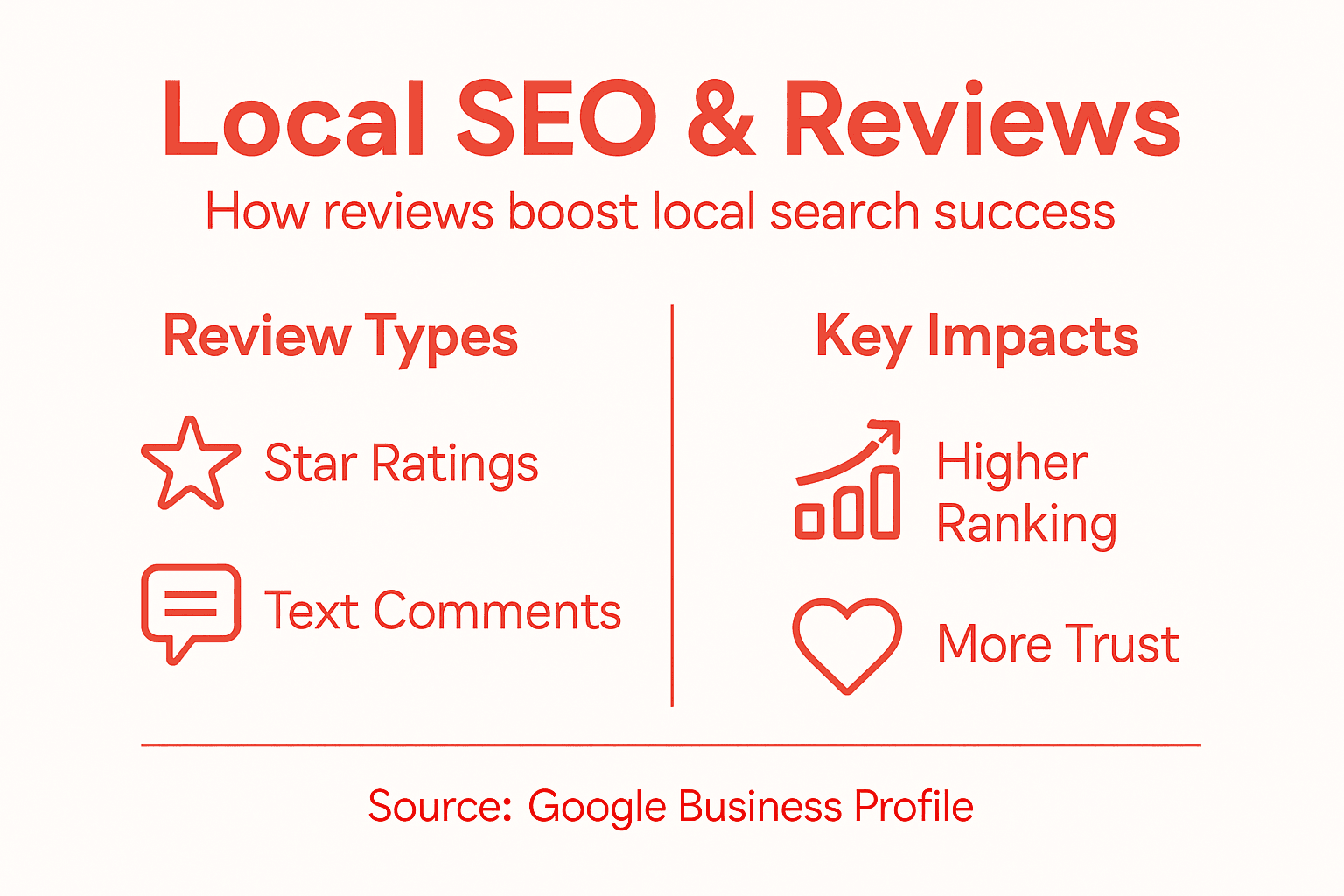
Reviews play a critical role in this process. Search engines like Google use customer reviews as a key ranking factor for local businesses. Positive reviews not only improve your visibility but also build trust and credibility with potential customers. Here’s how reviews impact local SEO:
- Increase search engine rankings
- Provide social proof for potential customers
- Demonstrate business legitimacy and engagement
- Generate fresh, keyword-rich content about your business
- Improve click-through rates from search results
Local SEO strategies require consistent effort and a holistic approach to online reputation management. By understanding how reviews contribute to your digital presence, you can strategically improve your local search performance.
Pro tip: Encourage satisfied customers to leave detailed, genuine reviews that highlight specific aspects of your service or product.
Types of Reviews and Their Importance
Customer reviews come in various formats, each playing a unique role in local SEO and business reputation management. Different types of reviews provide nuanced insights into business performance and customer experiences, helping potential clients make informed decisions.
The primary types of online reviews include:
- Star Ratings: Quick visual indicators of overall customer satisfaction
- Textual Reviews: Detailed written feedback providing context and specific insights
- Verified Purchase Reviews: Reviews from confirmed customers, offering higher credibility
- Video Testimonials: Engaging multimedia content showcasing real customer experiences
- Social Media Recommendations: Direct endorsements shared across digital platforms
Each review type carries different weight in search engine algorithms. Keyword-rich reviews are particularly valuable, as they provide search engines with contextual information about your business services and customer interactions. The more detailed and genuine these reviews are, the more likely they are to positively impact your local search rankings.
Google and other search engines prioritise reviews that demonstrate authentic customer engagement and provide meaningful business insights.
Recency and volume of reviews also play crucial roles. Businesses with a consistent stream of recent, positive reviews are more likely to rank higher in local search results. This means actively managing your online reputation is not just about collecting reviews, but maintaining a steady flow of genuine customer feedback.

The table below highlights how different types of online reviews influence both local SEO and business credibility:
| Review Type | Local SEO Impact | Business Credibility Effect |
|---|---|---|
| Star Ratings | Boosts prominence in listings | Indicates overall satisfaction |
| Textual Reviews | Adds detailed, keyword content | Shows depth of customer input |
| Verified Purchase | Signals authenticity to Google | Builds strong trust |
| Video Testimonials | Enhances engagement and relevance | Demonstrates genuine advocacy |
| Social Media Recommendations | Increases online mention signals | Expands reach and social proof |
Pro tip: Implement a systematic approach to requesting reviews, making it easy and convenient for satisfied customers to share their experiences.
How Google Evaluates and Ranks Reviews
Google’s review evaluation process is complex and multifaceted, designed to ensure that businesses receive fair and authentic representation in local search results. As a Google expert in local strategies, understanding these nuanced ranking criteria is crucial for businesses seeking to improve their online visibility.
The search engine considers several key factors when assessing and ranking reviews:
- Quantity of Reviews: Total number of reviews signals business popularity
- Review Recency: Most recent reviews carry more weight
- Review Diversity: Reviews from multiple platforms indicate broader credibility
- Review Sentiment: Overall positive or negative tone of feedback
- Response Rate: How actively the business engages with customer reviews
Quality signals are particularly important in Google’s algorithmic assessment. Reviews that are detailed, specific, and include relevant keywords tend to have greater impact. Generic or overly brief reviews are typically given less significance in ranking calculations.
Authentic, well-written reviews from verified customers provide the most valuable signals to search algorithms.
Google also prioritises reviews from accounts that appear genuine and have a history of providing meaningful feedback. Fake or manipulated reviews are actively identified and discounted, ensuring the integrity of local search results for businesses and consumers alike.
Pro tip: Encourage customers to write detailed, honest reviews that naturally include specific details about their experience.
Building Trust and Engaging Customers
Building customer trust through online reviews is a strategic process that requires genuine interaction and transparent communication. User-generated content plays a critical role in establishing credibility and attracting potential customers to your business.
Key strategies for building trust and customer engagement include:
- Respond to All Reviews: Acknowledge both positive and negative feedback
- Show Authenticity: Write personalised, sincere responses
- Demonstrate Problem-Solving: Address concerns publicly and constructively
- Encourage Detailed Feedback: Ask customers to share specific experiences
- Share Customer Stories: Highlight genuine testimonials across platforms
Customer engagement goes beyond simply collecting reviews. It involves creating a dialogue that makes customers feel heard and valued. Businesses that actively participate in their review ecosystem demonstrate commitment to customer satisfaction and continuous improvement.
Authentic interactions in reviews transform them from mere ratings into powerful trust-building conversations.
The most successful businesses view reviews as an opportunity for meaningful connection. By treating each review as a chance to showcase your customer service, you can turn potential criticism into a demonstration of your business’s integrity and responsiveness.
Pro tip: Create a systematic approach to reviewing and responding to customer feedback within 24-48 hours of receiving it.
Risks, Pitfalls, and Review Management Mistakes
Navigating the complex landscape of online reviews requires strategic awareness and proactive management. Review management practices can dramatically impact a business’s digital reputation and local search performance.
Common review management mistakes include:
- Ignoring Negative Reviews: Failing to respond to critical feedback
- Generating Fake Reviews: Attempting to manipulate review ratings
- Arguing with Customers: Becoming defensive in public responses
- Inconsistent Response Times: Leaving reviews unaddressed for extended periods
- Violating Platform Guidelines: Breaking review site terms of service
Reputation risks extend beyond immediate customer perception. Unmanaged reviews can trigger algorithmic penalties, reducing your visibility in local search results and potentially damaging long-term business credibility.
Here is a summary of review management errors and their potential consequences for local businesses:
| Mistake | Potential Consequence | Long-Term Risk |
|---|---|---|
| Ignoring negative reviews | Damages customer relationships | Decreases trust and ranking |
| Generating fake reviews | Algorithmic penalties | Lasting reputation loss |
| Arguing with customers | Public image damage | Reduced new customer onboarding |
| Slow response times | Perceived neglect by customers | Lower customer loyalty |
| Violating guidelines | Review removal or suspension | Loss of listing or account closure |
Transparency and genuine engagement are your best defences against review-related reputation challenges.
Businesses must understand that every review represents an opportunity for improvement and public demonstration of customer service excellence. The way you handle both positive and negative feedback can significantly influence potential customers’ perceptions and decision-making processes.
Pro tip: Develop a standardised review response protocol that emphasises empathy, solution-oriented communication, and swift resolution.
Harness the Power of Reviews to Elevate Your Local SEO Success
Understanding the crucial role customer reviews play in your local SEO strategy is only the beginning. If you are struggling to gain trust, increase visibility, or generate consistent positive feedback, Bamsh Digital Marketing can help you transform these challenges into opportunities. We specialise in optimising Google Business Profiles to enhance your local presence and manage reviews with clear, honest engagement strategies that boost your rankings and build lasting customer credibility.
Take control of your online reputation today by partnering with experts who value transparency and proven results. Visit our Bamsh – Bamsh Digital Marketing category to learn how our tailored services elevate your local SEO. Ready to start your journey toward more leads, higher trust, and sustained growth? Book your free 15-minute consultation at https://bamsh.co.uk/15-min/ now and see how we make digital marketing straightforward and effective.
Frequently Asked Questions
What is the role of reviews in local SEO?
Reviews are a crucial factor in local SEO as they impact search engine rankings, build trust and credibility, and provide valuable content rich in keywords related to your business.
How do positive reviews affect my business’s visibility?
Positive reviews can increase your business’s visibility in local search results, enhance your search engine rankings, and improve click-through rates by providing social proof to potential customers.
What types of reviews are most beneficial for local SEO?
Star ratings, textual reviews, verified purchase reviews, video testimonials, and social media recommendations all contribute to local SEO, with the most beneficial being detailed reviews that incorporate relevant keywords about your business.
How can I effectively manage my online reviews?
Effective review management involves responding to all reviews promptly, addressing negative feedback constructively, encouraging genuine customer feedback, and maintaining active engagement with your audience to build trust and reputation.