

Many business owners across South Wales face a growing challenge—manual marketing tasks draining time and leaving little room for customer relationship building. With powerful tools like automated email sequences, real-time behaviour tracking, and personalised communications driven by customer data, modern marketing automation is changing the way United Kingdom small and medium-sized businesses approach customer engagement. Discover how the right automation solutions help maximise lead generation, freeing up your team for the strategies that matter most.
Table of Contents
- Defining Marketing Automation and Its Purpose
- Key Types of Automation in Modern Marketing
- How Automation Transforms Lead Generation
- The Tools, Costs, and Compliance Essentials
- Risks, Mistakes, and How to Avoid Them
Key Takeaways
| Point | Details |
|---|---|
| Importance of Marketing Automation | Marketing automation enhances task efficiency by automating repetitive processes and improving customer engagement. |
| Key Automation Tools | SMEs should leverage tools like CRM systems and email marketing automation to streamline workflows and personalise communication. |
| Lead Generation Transformation | Automation technologies significantly improve lead generation efficiency by enabling real-time tracking and personalised engagement with potential customers. |
| Implementation Risks | Businesses must be aware of potential pitfalls, such as inadequate planning and neglecting data quality, to successfully implement marketing automation strategies. |
Defining Marketing Automation and Its Purpose
Marketing automation represents a sophisticated technological approach that enables businesses to streamline, automate, and measure marketing tasks and workflows. At its core, this strategy transforms how small and medium enterprises (SMEs) engage with potential customers by replacing manual processes with intelligent, data-driven systems.
The fundamental purpose of marketing automation goes beyond simple task efficiency. It provides businesses with powerful capabilities to:
- Capture and track customer interactions across multiple channels
- Personalise communication based on specific customer behaviours
- Nurture leads through targeted, timed messaging
- Reduce human error in repetitive marketing activities
- Generate more accurate performance insights
By automating lead nurturing strategies, businesses can create consistent, scalable engagement processes that adapt to individual customer journeys. This means marketing teams can focus on strategic initiatives rather than getting bogged down in manual administrative tasks.
Automation technologies work by integrating customer data from various touchpoints – websites, social media, email interactions, and customer relationship management (CRM) systems. These integrated platforms allow businesses to create sophisticated, multi-step marketing campaigns that respond dynamically to customer actions.
Key Components of Marketing Automation Include:
- Automated email sequences
- Behavioural trigger campaigns
- Lead scoring mechanisms
- Customer segmentation tools
- Performance analytics dashboards
Pro tip: Start small by identifying one repetitive marketing process you can automate and gradually expand your automation strategy as you gain confidence and see results.
Key Types of Automation in Modern Marketing
Marketing automation encompasses a diverse range of technological tools designed to simplify and enhance marketing processes for UK small and medium enterprises (SMEs). By understanding the key types of automation, businesses can strategically implement solutions that transform their marketing efficiency.
The primary categories of marketing automation include:
- Email Marketing Automation: Sends personalised, targeted messages based on customer behaviours
- Customer Relationship Management (CRM) Automation: Tracks and manages customer interactions and data
- Social Media Automation: Schedules posts and monitors engagement across platforms
- Advertising Automation: Adjusts digital advertising campaigns dynamically
- Lead Scoring Automation: Prioritises and ranks potential customer prospects
Marketing tools for UK business growth demonstrate how these automation technologies can dramatically improve marketing effectiveness. Email automation, for instance, enables businesses to create sophisticated drip campaigns that nurture leads through personalised communication sequences.
CRM automation stands out as a particularly powerful tool for SMEs. This technology integrates customer data from multiple touchpoints, allowing businesses to segment audiences, track interactions, and create more targeted marketing strategies. By automatically collecting and analysing customer information, companies can develop more nuanced understanding of their potential clients’ needs and preferences.

Here’s how the main types of marketing automation compare for UK SMEs:
| Automation Type | Typical Use Case | Potential Business Impact | Example Tool Category |
|---|---|---|---|
| Email Marketing Automation | Nurture leads via timed emails | Increases lead conversion rates | Email campaign platforms |
| CRM Automation | Centralise customer data | Enables personalised marketing | CRM software |
| Social Media Automation | Schedule posts across platforms | Boosts brand consistency and reach | Social media schedulers |
| Advertising Automation | Manage digital ads dynamically | Maximises ad spend efficiency | Ad management tools |
| Lead Scoring Automation | Prioritise prospects | Accelerates sales pipeline movement | Lead scoring solutions |
Emerging Automation Technologies Include:
- AI-powered chatbots
- Predictive analytics tools
- Automated customer segmentation systems
- Machine learning-driven content recommendation engines
- Real-time personalisation platforms
Automation is not about replacing human creativity, but about empowering marketing teams to focus on strategic thinking and innovative campaign development.
Pro tip: Begin by selecting one marketing process that consumes significant time and explore automation solutions that could streamline that specific workflow.
How Automation Transforms Lead Generation
Lead generation has undergone a radical transformation with the advent of sophisticated automation technologies. For UK small and medium enterprises (SMEs), these innovations represent a powerful mechanism to streamline customer acquisition, enhance targeting precision, and dramatically improve conversion rates.
The core mechanisms of automated lead generation include:
- Real-time behaviour tracking
- Predictive lead scoring
- Personalised content delivery
- Automated customer qualification
- Multi-channel engagement strategies
Lead generation strategies enable businesses to capture and nurture potential customers more effectively than traditional manual approaches. Artificial intelligence and machine learning algorithms now analyse vast amounts of customer data, identifying high-potential leads with remarkable accuracy.
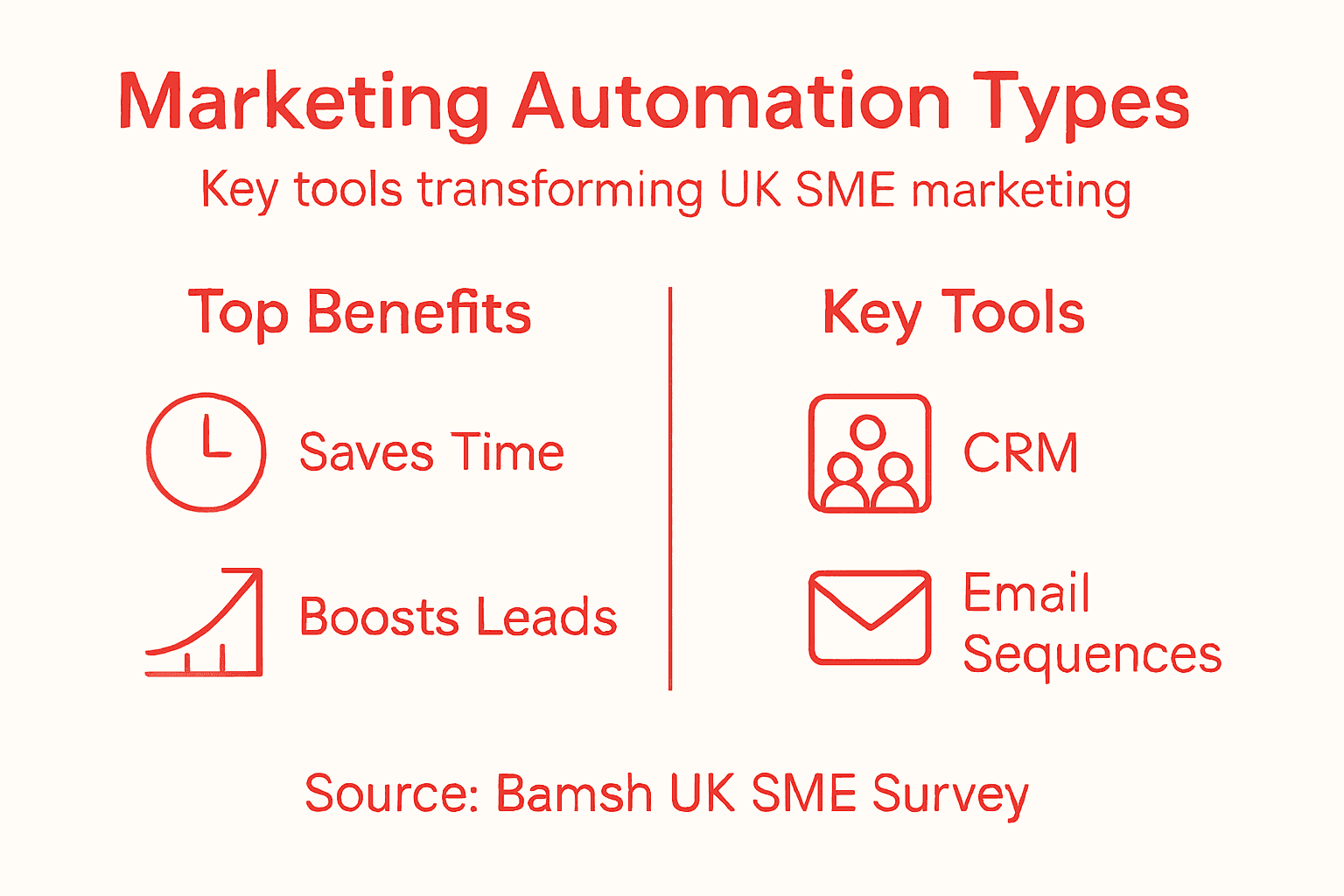
Automation technologies empower SMEs to create intelligent, responsive lead generation systems. AI-powered chatbots, for instance, can instantly engage website visitors, qualify leads through targeted questioning, and seamlessly transfer promising prospects to human sales representatives. These systems operate 24/7, ensuring no potential customer inquiry goes unanswered.
Key Automation Advantages for Lead Generation:
- 67% faster lead qualification process
- 50% reduction in manual administrative tasks
- Enhanced precision in lead targeting
- Improved customer engagement metrics
- Consistent follow-up mechanisms
Automation transforms lead generation from a hit-and-miss activity into a strategic, data-driven process that delivers measurable results.
Pro tip: Implement a pilot automation programme focusing on one specific lead generation channel to understand its potential before expanding across your entire marketing ecosystem.
The Tools, Costs, and Compliance Essentials
Marketing automation tools represent a significant investment for UK small and medium enterprises (SMEs), requiring careful consideration of both financial implications and regulatory compliance. Understanding the landscape of available technologies helps businesses make informed decisions that balance cost-effectiveness with strategic growth objectives.
The primary categories of automation tools for SMEs include:
- Customer Relationship Management (CRM) platforms
- Email marketing automation systems
- Social media scheduling tools
- Lead generation and tracking software
- Analytics and reporting solutions
Cost-effective automation tools range from free applications to monthly subscription services, with pricing typically structured to accommodate businesses of different sizes and capabilities. Most tools offer tiered pricing models, allowing SMEs to start small and scale their automation infrastructure as their needs evolve.
Compliance represents a critical consideration for UK businesses implementing marketing automation technologies. The General Data Protection Regulation (GDPR) and Privacy and Electronic Communications Regulations (PECR) impose strict requirements on data collection, storage, and usage. SMEs must ensure their chosen automation tools provide robust data protection mechanisms, including:
- Explicit consent tracking
- Data encryption
- Secure customer information management
- Transparent opt-out mechanisms
- Regular data audit capabilities
Typical Monthly Investment for SME Automation Tools:
Below is a summary of cost tiers and compliance essentials for automation tools:
| Price Tier | Typical Monthly Cost | Suitable For | Key Compliance Feature |
|---|---|---|---|
| Basic | £20–£50 | Start-ups, micro SMEs | Consent management |
| Mid-range | £50–£200 | Growing SMEs | Data encryption |
| Enterprise-level | £200–£500 | Larger or regulated SMEs | Comprehensive audit trails |
- Basic tier: £20-£50
- Mid-range tier: £50-£200
- Enterprise-level tier: £200-£500
Selecting the right automation tools requires balancing technological capabilities, compliance requirements, and budget constraints.
Pro tip: Conduct a thorough audit of your current marketing processes and select automation tools that directly address your most time-consuming and repetitive tasks.
Risks, Mistakes, and How to Avoid Them
Marketing automation, while powerful, presents significant challenges for UK small and medium enterprises (SMEs) that can derail digital transformation efforts if not carefully managed. Understanding potential pitfalls is crucial for successfully implementing these sophisticated technological strategies.
Marketing frustrations blocking SME growth reveal common mistakes businesses encounter during automation implementation:
- Inadequate strategic planning
- Poor tool integration
- Insufficient staff training
- Neglecting data quality
- Overlooking compliance requirements
- Misalignment between automation and business objectives
The most critical risks emerge when businesses approach automation as a technological solution rather than a strategic business transformation. Many SMEs invest in tools without developing a comprehensive understanding of how these technologies should align with their specific operational needs and customer engagement strategies.
Key Automation Implementation Risks Include:
- Potential data privacy breaches
- Reduced human interaction quality
- Unexpected technical complexity
- High initial learning curve
- Potential customer alienation through impersonal communication
Successful marketing automation requires a holistic approach that balances technological capabilities with human insight and strategic thinking.
Mitigation Strategies for Automation Risks:
- Conduct thorough staff training programmes
- Start with small, manageable automation projects
- Regularly review and update automation strategies
- Maintain personal touchpoints in customer interactions
- Invest in continuous technological education
Pro tip: Create a staged implementation plan that allows gradual automation adoption, enabling your team to learn and adapt without overwhelming existing processes.
Unlock the Power of Marketing Automation for Your UK SME
The article highlights the challenges many UK small and medium enterprises face in implementing marketing automation, such as managing lead nurturing, maintaining compliance, and integrating complex tools without losing the personal touch. If you want to turn these hurdles into growth opportunities, Bamsh Digital Marketing offers tailored solutions designed specifically for businesses like yours. We specialise in CRM setup and automated lead nurturing to ensure no inquiry slips through the cracks. Our AI-powered receptionist and customer service systems work around the clock to engage and qualify leads, freeing your team to focus on strategic growth.
Experience transparency and results-driven marketing with Bamsh. Explore insightful discussions on smart marketing strategies with our Podcasts – Bamsh Digital Marketing and learn from expert insights on our Bamsh – Bamsh Digital Marketing page. Ready to streamline your marketing with clear, honest, and effective automation? Take the first step now and discover how to scale your business confidently at https://bamsh.co.uk/15-min/. Your future customers are waiting.
Frequently Asked Questions
What is marketing automation and how does it benefit UK SMEs?
Marketing automation is a technological strategy that streamlines, automates, and measures marketing tasks and workflows. For UK SMEs, it enhances efficiency by capturing customer interactions, personalising communication, and nurturing leads, ultimately leading to improved conversion rates.
What are the key components of marketing automation?
The key components include automated email sequences, behavioural trigger campaigns, lead scoring mechanisms, customer segmentation tools, and performance analytics dashboards. These elements work together to create targeted, effective marketing campaigns.
How does automation improve lead generation for small businesses?
Automation improves lead generation by enabling real-time behaviour tracking, predictive lead scoring, and multi-channel engagement strategies. This creates a more effective and efficient system for identifying and nurturing high-potential leads.
What risks should UK SMEs consider when implementing marketing automation?
Common risks include inadequate strategic planning, poor tool integration, and data privacy breaches. SMEs should ensure proper staff training, maintain data quality, and align automation strategies with their business goals to mitigate these risks.
Recommended
- Role Of Automation In Lead Generation Success
- Why Automate Lead Nurturing – Unlocking Consistent Growth
- Digital Marketing in 2026: Boosting Growth and Leads
- Digital Marketing in 2026: Boosting Growth and Leads
- Business Growth in 2025: The Essential Guide – Nomad Excel – Your Entrepreneurial Adventure Starts Here