

TL;DR:
- Search evolution now emphasises AI tools, voice assistants, and answer engines beyond traditional Google rankings.
- Combining SEO and AEO ensures visibility across search, voice, AI summaries, and local answer features.
- For optimal results, regularly update content, structure it for answers, and optimise for multiple platforms.
Most business owners treat SEO as the whole answer to online visibility. It has been the go-to strategy for years, and it still matters enormously. But something significant has shifted. Search is no longer just about ranking on Google. AI tools, voice assistants, and answer engines are now where millions of people turn first for information. If your business only optimises for traditional search, you are already leaving leads on the table. This guide breaks down what SEO and AEO each mean, how they differ, and why combining both is the smartest move you can make for your online presence in 2026.
Table of Contents
- What is SEO? The foundation of online visibility
- What is AEO? The rise of answer engines
- AEO vs SEO: key differences for your business
- Integrating AEO and SEO for maximum results
- Why the old approach isn’t enough: a hard truth for UK SMEs
- Ready to boost your visibility and leads?
- Frequently asked questions
Key Takeaways
| Point | Details |
|---|---|
| AEO vs SEO difference | AEO targets instant answers across platforms while SEO focuses on search rankings. |
| Fresh content matters | Both strategies require regular updates, but AEO especially prizes new, structured information. |
| Use both for best results | Combining SEO and AEO ensures maximum online reach and lead generation in 2026. |
| Metrics have changed | AEO measures citations and answer appearances, while SEO measures keyword rankings. |
What is SEO? The Foundation of Online Visibility
Search Engine Optimisation (SEO) is the practice of making your website visible and relevant to people searching for specific terms on platforms like Google and Bing. It has been the cornerstone of digital marketing for over two decades, and for good reason. Done well, it drives consistent, high-quality traffic to your site without paying for every click.
Understanding the benefits of SEO for your business starts with knowing what the strategy actually involves. SEO is not one single tactic. It is a collection of disciplines working together:
- Keyword research: Identifying the exact words and phrases your ideal customers type into search engines.
- Content optimisation: Creating pages that are relevant, useful, and well-structured around those keywords.
- Technical site health: Ensuring your website loads quickly, works on mobile, and is easy for search engines to crawl.
- Link building: Earning links from other reputable websites to signal your authority.
- User experience: Making sure visitors find what they need quickly and easily.
The relationship between SEO vs content is often misunderstood. Content is the vehicle; SEO is the engine that makes it move. You need both working in harmony.
SEO remains vital for ranking on Google and other search platforms, and that is not changing any time soon. What is changing is the environment around it. AI-driven algorithms now assess content quality more rigorously than ever before. Pages that are outdated, thin, or poorly structured are being deprioritised at a faster rate.
If you are curious whether DIY SEO is a viable route for your business, the honest answer is: it depends on your time, skills, and competition level. But regardless of who does the work, the fundamentals remain the same.
Pro Tip: Review your key pages every three to six months. Refresh statistics, update examples, and ensure the content still answers what your audience is actually searching for. Stale pages lose rankings faster now than they did even two years ago.
With the basics of online visibility in mind, let’s examine the new frontier of digital discovery.
What is AEO? The Rise of Answer Engines
Answer Engine Optimisation (AEO) is the practice of positioning your business as the trusted source for direct, instant answers across modern search and AI platforms. Where SEO targets a ranked list of results, AEO targets the answer itself, the featured snippet, the voice response, the AI-generated summary.

To understand what is AEO fully, think about how your own search behaviour has changed. You no longer always scroll through ten blue links. You ask a question and expect an immediate answer. That is precisely what AEO is designed to capture.
Here is what makes AEO distinct:
- Platform diversity: AEO targets Google featured snippets, Bing AI answers, voice assistants like Alexa and Siri, chatbots like ChatGPT and Gemini, and more.
- Question-focused content: AEO content is built around specific questions your audience asks, not just keywords.
- Credibility signals: Answer engines favour sources that are authoritative, up to date, and clearly structured.
- Structured formatting: Using headers, bullet points, and schema markup helps machines read and select your content.
AEO demands fresher content and works across Google, voice assistants, AI tools, and more. This is a critical point. If your content is six months old and a competitor published a clearer, more current answer last week, they get chosen. You do not.
For a deeper look at answer engine optimisation explained, the key insight is this: AEO is not about tricking algorithms. It is about genuinely being the best, clearest, most useful answer available. The way AEO and AI search interact is reshaping how local and national businesses get discovered every day.
Pro Tip: Structure at least some of your content in a question-and-answer format. Write the question as a heading, then answer it directly in two to three sentences beneath it. This simple format dramatically improves your chances of being selected as an answer source.
Now that we have defined both strategies, let’s see how they differ side by side.
AEO vs SEO: Key Differences for Your Business
Understanding the distinction between AEO vs SEO helps you allocate your effort and budget more effectively. They are not rivals. They are complementary disciplines with different goals, metrics, and methods.
| Factor | SEO | AEO |
|---|---|---|
| Primary platforms | Google, Bing, search engines | AI tools, voice search, featured snippets |
| Main goal | Rank highly in search results | Be selected as the direct answer |
| Content format | Long-form, keyword-rich pages | Concise, question-focused, structured |
| Key metric | Rankings, organic traffic | Citations, answer selections, AI mentions |
| Update frequency | Regular but flexible | Frequent, near-continuous |
| Audience intent | Browsing and researching | Seeking immediate, specific answers |
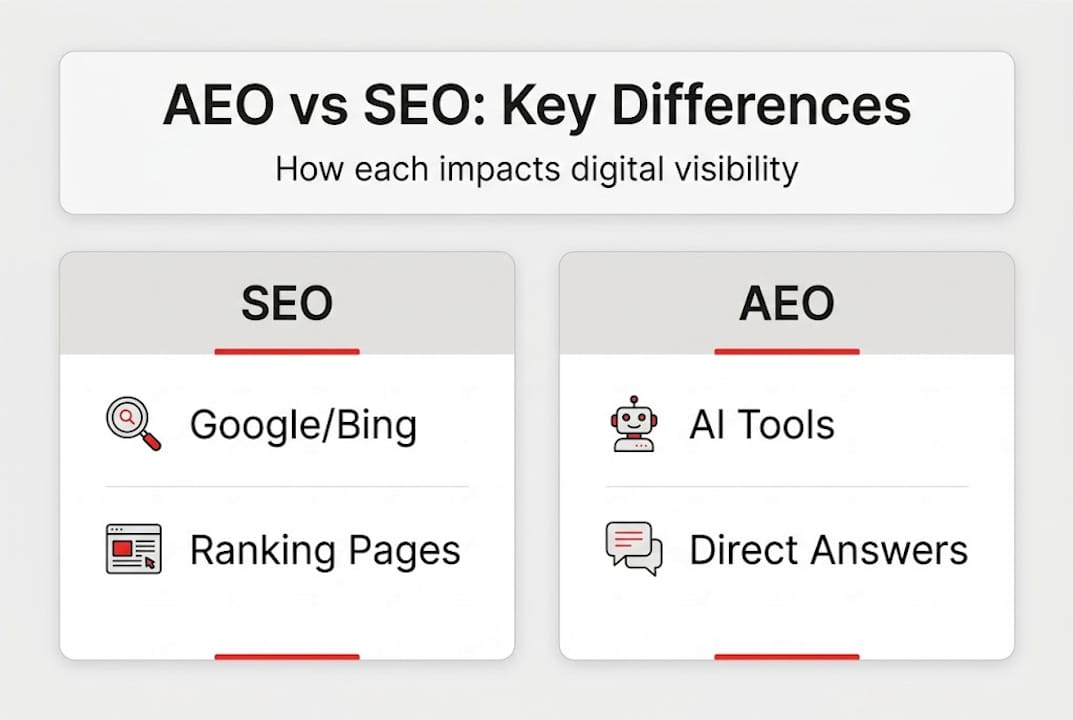
AEO and SEO measure success with different metrics. SEO success shows up in rankings and traffic. AEO success shows up in citations and answer selections across platforms. Both matter, and neither tells the full story alone.
Here is a simple process for auditing where your business currently stands:
- Check your rankings: Use a tool like Google Search Console to see which keywords you rank for and where.
- Test your answers: Search common questions your customers ask. Does your business appear in the answer box or AI summary?
- Review your content format: Is your content structured with clear headings and direct answers, or is it written purely for keyword density?
- Assess your update schedule: When did you last refresh your key pages? If it was over six months ago, that is a risk.
- Explore platform coverage: Are you only thinking about Google, or are you also considering Bing, voice search, and AI tools?
For businesses wondering about AEO for Bristol businesses or any UK location, the local angle matters too. AI tools increasingly surface local answers, making AEO a powerful tool for regional visibility.
Pro Tip: Combining both strategies means you cover all major user intent types. Someone browsing options benefits from your SEO. Someone asking a direct question benefits from your AEO. Together, they close the gaps.
With the importance of both strategies established, here is how to make them work together.
Integrating AEO vs SEO for Maximum Results
Running SEO and AEO in parallel is not complicated, but it does require intention. The good news is that many of the best practices overlap. Strong content, good site structure, and regular updates benefit both strategies simultaneously.
| Action | SEO benefit | AEO benefit | Common pitfall |
|---|---|---|---|
| Refresh existing content | Maintains rankings | Keeps answers current | Updating without improving quality |
| Add FAQ sections | Targets long-tail keywords | Captures question-based queries | Writing vague, unhelpful answers |
| Improve page structure | Better crawlability | Easier machine reading | Over-optimising at expense of readability |
| Build authoritative links | Increases domain authority | Signals credibility to AI tools | Chasing quantity over quality |
| Use schema markup | Enhances rich snippets | Improves AI content parsing | Applying schema incorrectly |
AEO requires content to be continually refreshed and structured for machine reading. This is not optional if you want to stay competitive. AI tools are constantly re-evaluating which sources to trust.
Here is a practical checklist for using AEO to boost leads alongside your existing SEO efforts:
- ✅ Identify the top ten questions your customers ask and create dedicated content for each
- ✅ Ensure every page has a clear, descriptive heading structure (H1, H2, H3)
- ✅ Add schema markup to your key pages, especially FAQs and service pages
- ✅ Refresh your most important pages at least every quarter
- ✅ Monitor AI tools and voice search results to see if your business is being cited
- ✅ Review the balance between balancing SEO and content to ensure neither is being neglected
Pro Tip: Do not limit your strategy to Google alone. Bing powers many AI tools and voice assistants. Optimising for Bing can give you an edge that many of your competitors have not yet considered.
Why The Old Approach isn’t Enough: A hard Truth for UK SMEs
Here is something most marketing articles will not say plainly: treating SEO as your only digital strategy in 2026 is a risk, not a plan. We see it regularly with businesses that come to us frustrated. Their rankings look fine on paper, but their enquiries have plateaued or dropped. Why? Because a growing share of their potential customers never reached the search results page at all. They got their swer from an AI tool or a voice assistant, and that business was not the source.
AI deprioritises stale content and requires multi-platform coverage. UK SMEs that are slow to act on this are not just missing a trend. They are actively ceding ground to competitors who are already optimising for answer engines.
The businesses winning right now are not necessarily the biggest or the best funded. They are the ones who understood early that AI search readiness is a competitive advantage, not a nice-to-have. Local competition in the UK is intensifying. More businesses are waking up to AEO every month. The window to get ahead is still open, but it will not stay that way indefinitely.
Our honest advice: stop treating AEO and SEO as separate conversations. They belong in the same strategy, managed together, with shared goals and shared reporting.
Ready to Boost Your Visibility and Leads?
If this guide has clarified the difference between AEO and SEO, the next step is putting that knowledge into action. Whether you are just starting out or looking to sharpen an existing strategy, combining both disciplines is where the real results live.
At Bamsh, we help UK businesses do exactly that. Explore our in-depth guide on AEO in Bristol or dive into our practical AEO lead generation guide to see how an integrated approach drives more enquiries. If you would prefer a direct conversation about your specific situation, book a free 15-minute consultation with our team. No pressure, no jargon. Just clear, honest advice tailored to your business.
Frequently Asked Questions About AEO vs SEO
Can I focus only on SEO and skip AEO?
Businesses that ignore AEO risk missing leads as search shifts to direct answers across AI, voice, and multi-platform tools. Relying on SEO alone leaves a growing gap in your visibility.
Is AEO only important for Google?
No. AEO has impact across platforms including AI tools like ChatGPT and Gemini, voice assistants like Alexa and Siri, and Bing-powered answer engines, significantly broadening your reach beyond Google.
How do I know if my business is AEO-friendly?
If your content answers questions clearly and is updated regularly with structured formatting, you already have a strong AEO foundation worth building on.
Does AEO replace SEO?
No. AEO and SEO serve complementary roles in a complete digital strategy. You need both to maximise your online reach, generate more leads, and build lasting authority.