

AI is no longer the exclusive territory of large corporations with deep pockets. Right now, small and medium-sized businesses across the UK are using artificial intelligence to engage customers faster, more personally, and more cost-effectively than ever before. The gap between what a big brand can do and what a local SME can achieve is closing rapidly. This guide will show you exactly what AI-driven customer engagement means in practice, which tools are worth your attention, and how to introduce them without disrupting your team or alienating your customers.
Table of Contents
- What is AI in customer engagement?
- How UK businesses use AI for engagement
- AI tools every SME should consider
- Balancing automation and the human touch
- Steps to introduce AI into your customer engagement strategy
- Measuring the impact of AI on customer engagement
- How Bamsh can help your business engage with AI
- Frequently asked questions
Key Takeaways
| Point | Details |
|---|---|
| AI is accessible for SMEs | You do not need a huge budget or IT department to leverage AI in customer engagement. |
| Automation boosts satisfaction | AI-driven tools like chatbots and smart emails speed up response and improve customer experience. |
| Human touch remains essential | Combining automated efficiency with genuine support creates loyalty and deeper engagement. |
| Measure success | Consistently track results and adapt your approach to maximise the value AI brings your business. |
What is AI in Customer Engagement?
AI in customer engagement means using artificial intelligence to interact with, support, and build relationships with your customers, often automatically and at scale. Think chatbots that answer questions at midnight, email systems that send the right message at the right moment, or recommendation engines that suggest products based on what a customer has already browsed.
For UK SMEs, the good news is that AI enables efficient customer engagement for companies of all sizes, not just the big players. You do not need to build your own AI system. Affordable, ready-made tools now exist that plug into your website, social media, and CRM with minimal technical effort.
Here are the core benefits AI brings to customer engagement:
- Responsiveness: Customers get answers instantly, day or night
- Cost reduction: Fewer manual tasks means lower operational costs
- Scalable support: Handle more enquiries without hiring more staff
- Better insight: AI tracks patterns in customer behaviour that humans would miss
- Personalisation: Tailor messages and offers to individual customers automatically
“UK consumers increasingly expect faster, more relevant experiences. AI gives SMEs the tools to meet those expectations without a large team behind them.”
Understanding the impact of AI on digital marketing is the first step. Once you see what is possible, the next question is how other businesses are already doing it.
How UK Businesses use AI for Engagement
With the definition clear, it is helpful to see how local companies are already applying AI to improve customer experiences. The applications are more practical and accessible than most business owners expect.
- Chatbots on websites and social media: AI-powered chatbots are transforming how businesses support customers, providing instant answers even outside office hours. A customer visiting your site at 10pm can get a response in seconds rather than waiting until morning.
- Product and service recommendations: AI analyses browsing and purchase history to suggest relevant items, increasing the chance of a sale without any manual effort from your team.
- Automated follow-up emails and messages: When someone fills in a contact form or abandons a basket, AI triggers a timely, personalised follow-up. This alone can recover a significant portion of lost sales.
- Customer feedback analysis: AI tools can read through reviews and survey responses, identify recurring themes, and flag issues before they become serious problems.
- SMS automation and smart scheduling: Appointment reminders, booking confirmations, and promotional messages can all be sent automatically based on customer actions.
Pro Tip: Start with chatbots on your highest-traffic page. Even a simple bot that answers your top five frequently asked questions can reduce inbound enquiries by a noticeable margin and free up your team for higher-value work.
Answer bots have a measurable impact on engagement and satisfaction, particularly for businesses that receive a high volume of repetitive queries. If your team spends hours each week answering the same questions, automation is not a luxury. It is a practical necessity.

AI Tools Every SME Should Consider
Which AI solutions should you actually consider for your business? Here is a breakdown of the most trusted and practical tools for UK SMEs.
UK SMEs have a growing range of AI tools for marketing and engagement, and the options have improved dramatically in recent years. The key is choosing tools that integrate well with what you already use.
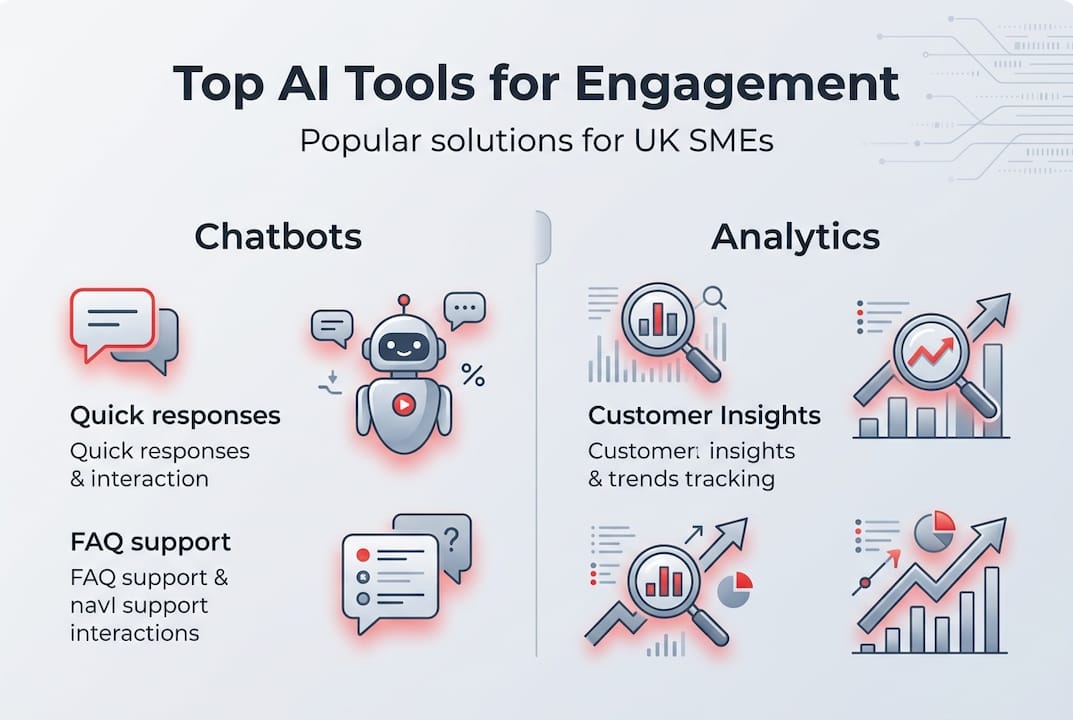
| Tool type | Best for | Typical cost | Integration ease |
|---|---|---|---|
| AI chatbot | Website and social support | Low to mid | High |
| Email automation | Follow-ups and nurturing | Low | High |
| CRM with AI | Lead scoring and tracking | Mid | Medium |
| AI lead generation | Prospecting and outreach | Mid to high | Medium |
| Recommendation engine | E-commerce personalisation | Mid | Medium |
AI lead generation software streamlines engagement and personalisation, making it easier to identify and convert the right prospects without manual research. When evaluating any tool, look for:
- Simple setup with clear onboarding support
- Integration with your website, CRM, and social platforms
- Transparent pricing with no hidden fees
- Measurable outputs so you can track ROI from day one
- UK-based support or at least strong documentation
For a broader view of what is available, exploring top marketing tools for growth can help you compare options side by side before committing.
Balancing Automation and The Human Touch
Some business owners worry that too much technology could make their brand seem cold or robotic. It is a fair concern. But the goal of AI is not to replace human connection. It is to protect your team’s time so they can focus on the interactions that genuinely need a person.
“Automation works best when it handles the routine, freeing your people to handle the meaningful.”
The key is knowing where to draw the line. Maintaining authentic customer relationships is essential when introducing automation, particularly for businesses where trust and personal service are central to the brand.
Here is how to strike the right balance:
- Automate routine queries: FAQs, opening hours, booking confirmations, and order updates are ideal for AI
- Keep humans available for complaints, complex questions, and high-value conversations
- Use personalisation signals: Even automated messages should include the customer’s name and reference their specific situation
- Be transparent: Let customers know when they are speaking with a bot, and make it easy to reach a real person
- Review regularly: Check automated conversations periodically to spot where the AI is falling short
Pro Tip: Add a simple “Speak to a person” option in every chatbot flow. Customers who know they can escalate quickly are far more comfortable engaging with automation in the first place.
Good lead nurturing for loyalty blends automated touchpoints with genuine human moments at the right stages of the customer journey.
Steps to Introduce AI Into Your Customer Engagement Strategy
Once you know the tools and the balance you need, here is how to introduce AI step by step, without overwhelming your team or your customers.
- Identify your pain points: Where does manual work pile up? Where do customers wait longest for a response? These are your starting points.
- Choose one or two tools: Do not try to automate everything at once. Pick tools with strong support and clear integration with your existing systems.
- Start small: Roll out a chatbot on one channel, or set up automated follow-up emails for new enquiries. Measure before expanding.
- Track your metrics: Monitor customer satisfaction scores, response times, and conversion rates before and after the change.
- Iterate and scale: Use what you learn to refine your approach, then roll out to additional channels or customer segments.
| Stage | Action | What to measure |
|---|---|---|
| Before launch | Baseline data collection | Response time, satisfaction score |
| Week 1 to 4 | Limited rollout | Engagement rate, query volume |
| Month 2 to 3 | Review and adjust | Conversion rate, repeat contact |
| Month 4 onwards | Scale successful elements | Revenue impact, cost per lead |
A methodical approach to AI adoption maximises results and reduces the risk of costly mistakes. Rushing in without a plan is where most businesses go wrong. The future of AI in marketing rewards those who build thoughtfully rather than those who move fastest.
Measuring the Impact of AI on Customer Engagement
Success with AI in customer engagement comes down to measuring what matters. Without clear data, you cannot know whether your investment is working or where to improve.
Focus on these core metrics:
- Engagement rate: Are more customers interacting with your content, chatbot, or emails?
- Response time: How quickly are customers getting answers compared to before?
- Customer satisfaction score (CSAT): Are customers rating their experience more positively?
- Repeat business: Are customers coming back more often after AI-driven follow-ups?
- Average spend: Has personalisation led to higher order values or upsells?
Compare your numbers before and after you deploy AI tools. Even a modest improvement in response time can have a significant effect on customer satisfaction and conversion rates. Regular analysis of customer feedback and engagement data is vital for AI success, helping you spot emerging needs and adjust your approach before small issues become big ones.
Share your findings with your team. When everyone can see the impact, it builds confidence in the tools and encourages smarter use across the business.
How Bamsh Can Help Your Business Engage with AI
If you have read this far, you already know that AI-driven customer engagement is not just possible for UK SMEs. It is practical, affordable, and increasingly essential. At Bamsh, we help businesses like yours put these strategies into action without the guesswork. Our AI lead engine for UK SMEs brings together automation, CRM, and AI tools into one joined-up system that generates and nurtures leads around the clock. We also offer answer engine optimisation services to make sure your business gets found in AI-powered search tools as well as Google. Not sure where to start? Book a free 15-minute consultation and we will show you exactly where AI can make the biggest difference for your business.
Frequently Asked Questions
What is the main advantage of AI for small UK businesses?
AI gives small UK businesses access to affordable automation and personalisation that was previously only available to large companies, levelling the playing field considerably. As AI enables efficient engagement for all business sizes, even modest budgets can deliver impressive results.
How do I know if my business is ready for AI-driven engagement?
If you handle repetitive customer queries or want better insight into customer behaviour but lack the resources for manual engagement, AI tools can offer an immediate benefit. A methodical approach to adoption means you can start small and scale as confidence grows.
What types of customer interactions can AI automate?
AI-powered chatbots can automate chat responses, appointment bookings, product recommendations, follow-up emails, and customer feedback collection, covering the majority of routine customer touchpoints.
Will AI make my business feel less personal?
Not if you balance automation with genuine human support for complex or sensitive situations. Maintaining authentic relationships alongside AI tools is what separates businesses that thrive with automation from those that frustrate their customers.
How do I measure if AI is improving my customer engagement?
Review metrics like engagement rates, response times, and customer satisfaction scores before and after you deploy AI tools. Regular analysis of engagement data ensures you can spot what is working and adjust quickly.