

Nearly 80 percent of british small and medium-sized businesses identify automation as a vital tool in staying ahead of digital competition. For marketing managers in South Wales, the challenge is not just keeping up but consistently generating and converting quality leads with limited time and resources. Discover how integrating automation can simplify your lead generation efforts, letting you reach more potential clients and nurture valuable relationships without overloading your team.
Table of Contents
- Defining Automation In Lead Generation
- Key Types Of Lead Generation Automation
- How Automated Lead Processes Work
- Real-World Applications For UK Businesses
- Benefits And Drawbacks Of Automation
- Avoiding Common Lead Automation Pitfalls
Key Takeaways
| Point | Details |
|---|---|
| Importance of Automation | Automation enhances efficiency in lead generation by utilising technology to streamline processes and improve lead targeting. |
| Types of Automation | Key categories include web-based capture systems, email marketing automation, and AI chatbots, each serving to optimise stages of customer engagement. |
| Benefits vs Drawbacks | While automation fosters scalability and quick responses, businesses must balance efficiency with the need for personal customer interactions to avoid impersonal experiences. |
| Pitfalls to Avoid | Companies should refine workflows before automating to prevent reinforcing inefficiencies, ensure GDPR compliance, and maintain data hygiene for effective targeting. |
Defining Automation In Lead Generation
Automation in lead generation represents a transformative approach that leverages technology to streamline and enhance the process of identifying, attracting, and nurturing potential customers. At its core, automation uses intelligent systems to perform repetitive marketing tasks with precision and scalability that surpasses manual methods.
The fundamental mechanism of lead generation automation involves using sophisticated software and artificial intelligence to collect, analyse, and act upon potential customer data automatically. These systems can instantly capture website visitor information, track user interactions, score leads based on predefined criteria, and segment audiences for targeted communication. By removing manual intervention, businesses can respond to potential customers faster, maintain consistent engagement, and prioritise high-potential leads more effectively.
Key components of lead generation automation include customer relationship management (CRM) integration, intelligent email marketing workflows, chatbots for instant communication, and predictive analytics that help businesses understand and anticipate customer behaviour. Advanced AI technologies now enable businesses to identify and qualify leads with unprecedented accuracy and speed, transforming how companies approach their sales and marketing strategies.
Pro tip: Start small by automating one specific part of your lead generation process, such as initial lead capture or email follow-ups, and gradually expand your automation strategy as you become more comfortable with the technology.
Key Types Of Lead Generation Automation
Lead generation automation encompasses several critical types of technological solutions designed to streamline and optimise marketing processes. Businesses can leverage multiple automation strategies to capture, qualify, and nurture potential customers more efficiently, each targeting specific stages of the customer acquisition journey.
One primary category of lead generation automation includes web-based capture systems, which automatically collect visitor information through intelligent forms, pop-ups, and interactive elements. These tools can instantly record contact details, track user behaviour, and segment potential leads based on predefined criteria. Another crucial type involves email marketing automation, which enables businesses to create sophisticated, personalised communication workflows that engage prospects at different stages of their buying journey, sending targeted content and nurturing leads without manual intervention.
Additional key types of lead generation automation include CRM-integrated tracking systems, AI-powered chatbots for immediate customer interaction, and multichannel campaign management platforms. These automated systems work collaboratively to create a seamless lead qualification process, enabling businesses to respond quickly, maintain consistent engagement, and prioritise high-potential prospects with unprecedented precision.
The following table compares key types of lead generation automation and their business impact:
| Automation Type | Core Function | Typical Business Benefit |
|---|---|---|
| Web-Based Capture System | Collect visitor details automatically | Increase in qualified lead volume |
| Email Marketing Automation | Personalised follow-up messaging | Improved engagement and conversion |
| CRM Integration | Track and manage customer data | Enhanced sales pipeline accuracy |
| AI Chatbots | Real-time prospect communication | Faster response to enquiries |
| Predictive Analytics | Score leads by conversion likelihood | Prioritisation of high-value leads |
Pro tip: Select automation tools that integrate smoothly with your existing marketing technology stack and start by implementing one system at a time to understand its impact on your lead generation performance.
How Automated Lead Processes Work
Automated lead processes represent a sophisticated technological approach that transforms traditional manual lead generation into a data-driven, intelligent system. These processes systematically discover, qualify, and prioritise potential customers through a series of interconnected technological steps, enabling businesses to capture and nurture prospects with unprecedented efficiency.
The typical workflow begins with data collection, where automated systems continuously gather information from multiple digital touchpoints such as websites, social media platforms, and online interactions. Advanced algorithms then analyse this raw data, enriching it with contextual insights and comparing potential leads against predefined ideal customer profiles. This intelligent filtering mechanism allows businesses to automatically score and segment leads based on their likelihood of conversion, ensuring that sales teams focus their energy on the most promising prospects.

Automated lead generation workflows integrate multiple data sources to create a comprehensive lead management ecosystem, triggering personalised marketing actions in real-time. These systems can automatically send targeted emails, schedule follow-up communications, and route high-potential leads directly to sales representatives, all without manual intervention. The result is a streamlined process that dramatically reduces response times, increases engagement rates, and provides businesses with actionable intelligence about their potential customers.
Pro tip: Regularly review and update your automated lead process’s scoring criteria and customer profiles to ensure continued accuracy and relevance in your lead generation strategy.
Real-World Applications For UK Businesses
Automation in lead generation has become a critical strategy for UK businesses seeking to streamline their marketing and sales processes. Small and medium-sized enterprises can leverage digital strategies to drive business growth by implementing targeted automation technologies that transform traditional customer acquisition methods.
In practical terms, UK businesses across various sectors are applying lead generation automation in distinctive ways. Professional services like consulting firms use intelligent chatbots to capture initial client inquiries, whilst e-commerce platforms deploy sophisticated recommendation engines that automatically segment and target potential customers based on browsing behaviour. Retail businesses are integrating customer relationship management (CRM) systems with automated email marketing workflows, enabling personalised communication that increases engagement and conversion rates without substantial manual intervention.
Specific applications include automated social media advertising campaigns that dynamically adjust targeting parameters, AI-powered lead scoring mechanisms that prioritise high-potential prospects, and integrated communication platforms that route enquiries directly to the most appropriate sales representative. These technologies not only reduce administrative overhead but also provide granular insights into customer behaviour, allowing businesses to make more informed strategic decisions and allocate resources more effectively.
Pro tip: Start by mapping your current lead generation workflow and identify repetitive tasks that could be automated, then implement solutions incrementally to minimise disruption and maximise adaptation.
Benefits And Drawbacks Of Automation
Lead generation automation presents a complex landscape of strategic advantages and potential challenges for businesses seeking to modernise their marketing approaches. Organisations must carefully evaluate the comprehensive impact of implementing automated systems across their sales and marketing workflows, understanding both the transformative potential and inherent limitations.
The primary benefits of automation include dramatically improved efficiency, consistent lead qualification, and the ability to scale marketing efforts without proportional increases in human resource allocation. Businesses can expect significant reductions in manual administrative tasks, more precise lead targeting, and enhanced data-driven decision-making capabilities. Automated systems enable rapid response times, 24/7 lead capture, and sophisticated segmentation that allows for highly personalised customer interactions without overwhelming marketing teams.
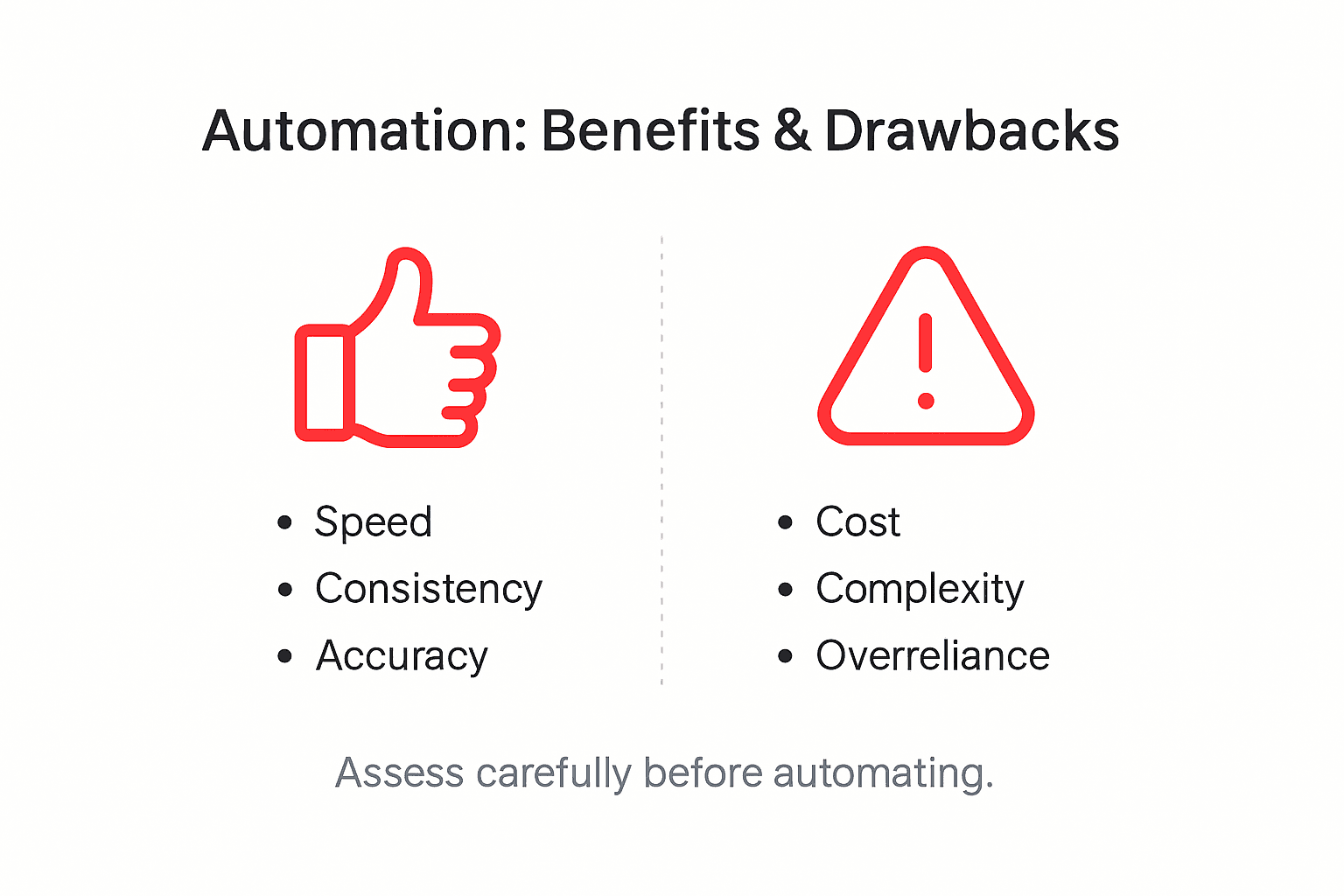
Conversely, businesses must remain cognisant of potential drawbacks in automated lead generation technologies, such as the risk of losing personal touch, potential data privacy complications, and the substantial initial investment required for implementation. Over-reliance on automation can lead to impersonal customer experiences, and without careful configuration, these systems might generate low-quality leads or misinterpret complex customer signals. Technical complexity, ongoing maintenance requirements, and the need for continuous refinement of algorithms represent additional challenges that businesses must navigate thoughtfully.
Pro tip: Implement automation incrementally, continuously monitor performance metrics, and maintain a balanced approach that combines technological efficiency with human insight and personalisation.
Avoiding Common Lead Automation Pitfalls
Lead automation requires strategic implementation to prevent common mistakes that can undermine marketing effectiveness. Businesses must carefully navigate potential pitfalls by understanding the nuanced challenges inherent in automated lead generation processes, recognising that technology alone cannot guarantee successful outcomes.
One fundamental error many organisations commit is automating existing inefficient processes without first critically examining and refining their underlying workflows. Successful lead automation demands a holistic approach that combines technological solutions with strategic thinking. This means meticulously mapping customer journeys, identifying precise touchpoints, and designing automation that enhances rather than replaces human interaction. Businesses must invest time in developing clear, measurable objectives and ensure their automation tools align precisely with specific marketing and sales goals.
UK businesses particularly need to remain vigilant about data management and regulatory compliance when implementing lead generation automation. Critical considerations include maintaining robust data hygiene, ensuring GDPR compliance, and creating flexible systems that can adapt to evolving customer expectations. Overcomplicating automation workflows, neglecting regular performance reviews, and failing to train team members on new technological systems represent additional risks that can significantly diminish the potential benefits of automated lead generation.
Here is a summary of common automation pitfalls and strategies to avoid them:
| Pitfall | Business Risk | Avoidance Strategy |
|---|---|---|
| Automating poor workflows | Reinforces inefficiency | Audit and refine processes first |
| Overcomplicating systems | Reduced team adoption | Implement simple automation first |
| Neglecting data hygiene | Inaccurate targeting | Regularly clean and validate data |
| Ignoring compliance rules | Legal and reputational issues | Ensure ongoing GDPR adherence |
| Lack of performance review | Missed optimisation | Schedule regular automation audits |
Pro tip: Conduct a comprehensive audit of your existing lead generation processes before implementing automation, identifying specific inefficiencies and establishing clear performance metrics to measure success.
Unlock the Power of Lead Generation Automation with Bamsh Digital Marketing
The article highlights the challenge many businesses face in effectively capturing, scoring, and nurturing leads without wasting time or resources on inefficient manual processes. If you feel overwhelmed by managing complicated workflows or worried about losing prospects due to slow follow-up, Bamsh Digital Marketing understands the pain of balancing automation with personal touch. Using terms like CRM integration, AI chatbots and automated lead nurturing, it is clear that businesses need a trusted partner to implement these sophisticated systems and deliver consistent, qualified leads.
At Bamsh, we specialise in building bespoke automated pipelines that capture enquiries, prioritise high-value prospects and engage them seamlessly 24/7. Our award-winning team takes the complexity out of AI-powered lead generation so you can focus on what matters most growing your business with clarity and confidence. Whether you want to enhance your CRM setup, implement AI receptionist services or experience the full potential of our AI Lead Engine, we provide honest advice and transparent results without jargon.
Discover how simple and stress-free automated lead generation can be with Bamsh by visiting Bamsh. Learn more about our approach in the Bamsh category or catch insightful industry talks through our Podcasts. Take the next step today and let us help you generate more high-quality leads with proven automation strategies designed for UK businesses.
Frequently Asked Questions
What is automation in lead generation?
Automation in lead generation refers to the use of technology and intelligent systems to streamline the process of identifying, attracting, and nurturing potential customers without the need for manual intervention.
How does automated lead generation improve efficiency?
Automated lead generation enhances efficiency by allowing businesses to quickly capture and analyse potential customer data, score leads, and segment audiences, all of which can be done in real-time and at scale without excess manual effort.
What are the key components of lead generation automation?
Key components of lead generation automation include customer relationship management (CRM) integration, intelligent email marketing workflows, chatbots for instant communication, and predictive analytics to assess customer behaviour and improve targeting.
What are some common pitfalls in lead generation automation?
Common pitfalls include automating inefficient processes, neglecting data hygiene, overcomplicating systems, ignoring compliance regulations, and failing to conduct regular performance reviews to ensure systems are optimised and aligned with business objectives.