

Running a business in Bristol or South Wales means every pound you spend on marketing should count, but vague metrics and unclear results can leave you guessing where your investment actually goes. For small and medium-sized business owners, defining measurable outcomes tied directly to your business goals is not a luxury, it’s a necessity for survival and growth. This guide shows you how transparent marketing strategies built on clear performance metrics lead to smarter decisions, confident investment, and genuine revenue growth.
Table of Contents
- Defining Clear Marketing Results In Business
- Key Metrics And How To Measure Them
- Transparency And Accountability In Marketing
- Common Pitfalls And How To Avoid Them
- Real-World Impact On Revenue Growth
Key Takeaways
| Point | Details |
|---|---|
| Define Clear Objectives | Establish specific, quantifiable KPIs before launching campaigns, ensuring clarity on what success looks like for your business. |
| Focus on Key Metrics | Identify 3-5 essential KPIs that directly impact your revenue, avoiding the confusion of tracking too many metrics. |
| Ensure Transparency and Accountability | Maintain open reporting on campaign performance to foster trust and accountability within your marketing team or agency. |
| Track and Review Regularly | Implement consistent measurement and monthly reviews of your marketing metrics to optimise strategies based on real performance data. |
Defining Clear Marketing Results in Business
Clear marketing results aren’t about vanity metrics or feel-good numbers. They’re about measurable outcomes directly tied to your business objectives.
When you define clear marketing results, you’re establishing what success looks like for your campaigns. Without this definition, you’re flying blind—spending money without knowing if it’s working.
Marketing effectiveness depends on two critical elements:
- Setting specific, quantifiable objectives before you launch any campaign
- Tracking results consistently using the same measurement approach each time
Think of it like running a shop. You wouldn’t just open your doors and hope customers arrive. You’d track footfall, conversion rates, and revenue to understand what’s working.
What Makes Marketing Results “Clear”?
Clear results have three characteristics. They’re measurable (you can count them), tied to business goals (they matter to your bottom line), and tracked consistently (you use the same method every time).
For many UK SMEs, clarity fails at the first hurdle. You might know your website gets 500 visitors per month, but do you know how many become customers? Or what your cost per acquisition actually is? Setting quantifiable key performance indicators aligned with your business objectives transforms vague activity into actionable intelligence.
Many business owners confuse activity with results. Running ten campaigns isn’t success. Converting three of them into paying customers is.
The Foundation: Define Your KPIs
KPIs (Key Performance Indicators) are the metrics that matter most to your business. They differ from company to company, industry to industry.
Common KPIs include:
- Conversion rates (visitors who take desired action)
- Cost per acquisition (how much you spend to gain one customer)
- Return on ad spend (revenue generated per pound spent)
- Lead quality (percentage of leads that convert to sales)
- Customer lifetime value (total profit from one customer)
The trap most SMEs fall into is tracking everything. You can measure hundreds of metrics, but tracking 20 simultaneously dilutes focus and creates confusion.
Choose three to five KPIs maximum. These should directly reflect your business priorities—whether that’s revenue growth, lead generation, or brand awareness.
Clear marketing results start with choosing 3-5 KPIs that genuinely matter to your bottom line, not metrics that sound impressive.
Why Clarity Drives Better Decisions
When you know your numbers, you make smarter choices. You stop throwing budget at underperforming channels and double down on what works.
This transparency builds accountability throughout your team and agency partnerships. Everyone knows the target, everyone knows the score. Marketing accountability means accepting responsibility for outcomes—and that’s impossible without clear, agreed-upon definitions of success.
For Bristol and South Wales SMEs competing in busy local markets, clarity becomes competitive advantage. Your rivals might be guessing. You’ll be measuring, learning, and optimising.
Pro tip: Write down your three most important marketing KPIs today, define exactly how you’ll measure each one, and commit to reviewing them monthly—consistency transforms data into genuine insight.
Key Metrics and How to Measure Them
Not all metrics matter equally. The trick is identifying which ones directly impact your revenue and growth.
You could track 50 different data points. But tracking the wrong metrics wastes time and clouds your vision. Focus on what moves the needle for your business.
Different marketing channels produce different results. A social media campaign measures success differently than a Google Ads campaign. Understanding key marketing performance indicators that correspond to each stage of your sales funnel helps you optimise effectively.

The Core Metrics Every SME Needs
Start with these foundational metrics. They work across most industries and directly connect to revenue.
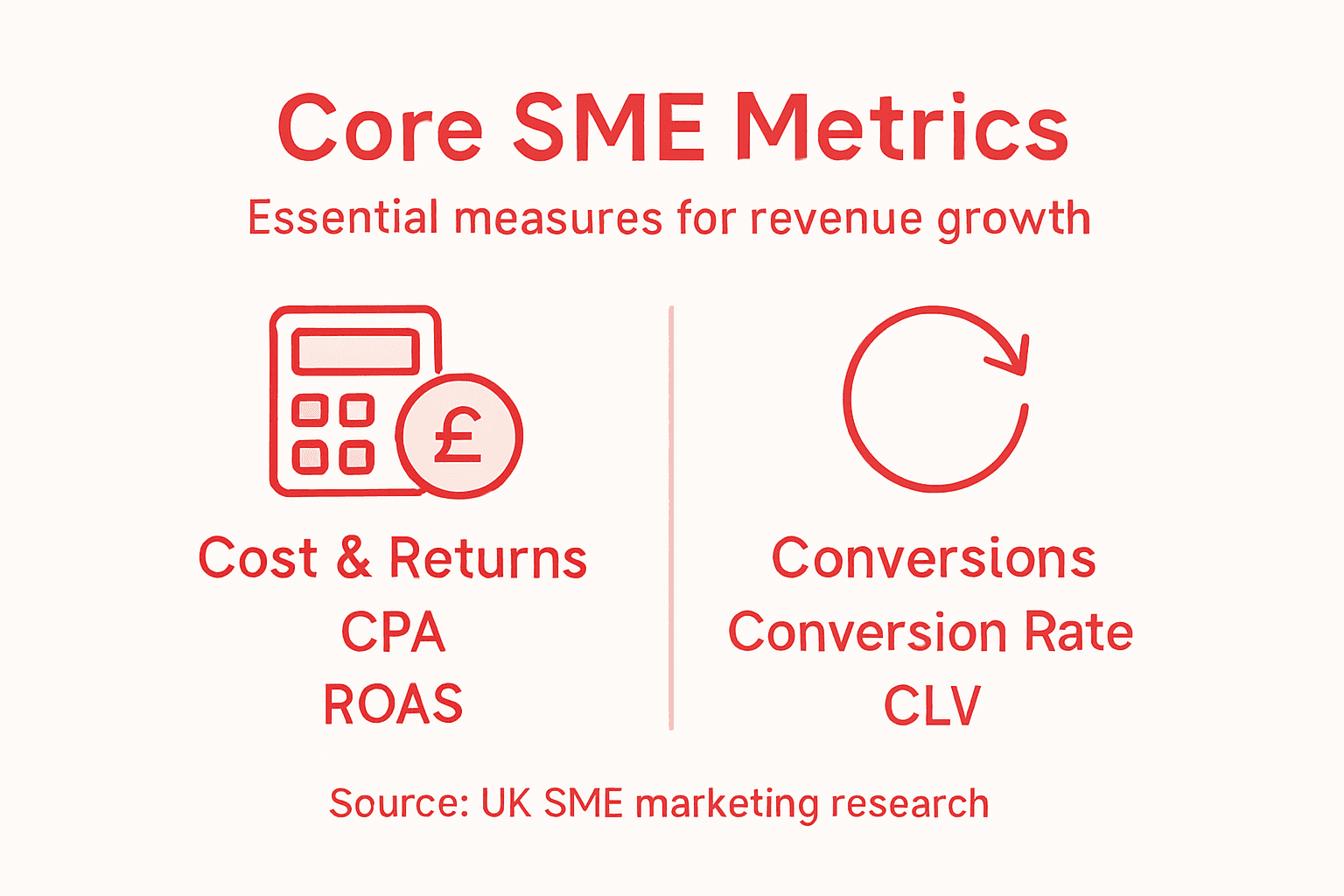
Cost per acquisition (CPA) tells you exactly how much you spend to gain one customer. If your CPA is £50 and your average customer value is £200, you’re making profit. If your CPA is £200, you’ve got a problem.
Return on ad spend (ROAS) shows the revenue generated for every pound spent on advertising. A ROAS of 3:1 means you earn £3 for every £1 invested. This metric transforms vague spending into clear profitability.
Conversion rate measures what percentage of visitors take your desired action—whether that’s filling a form, making a purchase, or booking a call. A 2% conversion rate tells you exactly where you stand.
Customer lifetime value (CLV) reveals the total profit you’ll make from one customer over time. This metric justifies spending more on acquisition because you know the long-term payoff.
To provide clarity on the business value of key marketing metrics, see this summary table:
| Metric | Business Question Answered | Impact if Optimised |
|---|---|---|
| Cost per Acquisition | How much does each new customer cost? | Lowering increases profit |
| Return on Ad Spend | What is the revenue from advertising? | Higher ROAS means efficiency |
| Conversion Rate | How many visitors take action? | Boosting drives growth |
| Customer Lifetime Value | What is a typical customer’s worth? | Rising CLV enables investment |
Metrics at Each Stage of Your Funnel
Your marketing funnel has distinct stages. Each stage needs its own metrics.
Top of funnel (awareness):
- Impressions (how many people see your content)
- Reach (unique individuals exposed to your message)
- Brand searches (people actively looking for you)
Middle of funnel (consideration):
- Click-through rates (percentage clicking your advert)
- Engagement rates (comments, shares, time spent)
- Lead volume (total enquiries generated)
Bottom of funnel (conversion):
- Sales revenue (money actually earned)
- Customer acquisition cost (investment per customer)
- Deal close rate (percentage of leads becoming customers)
Each metric tells a different story. Impressions without clicks suggest poor messaging. Clicks without conversions suggest poor landing pages.
Metrics like ROI and customer acquisition cost are essential for ensuring accountability and making data-driven investment decisions.
How to Actually Track These Metrics
Tracking requires three things: clear definitions, consistent measurement, and regular review.
Define each metric precisely before you start. “Conversion” means what exactly? A form submission? A phone call? A purchase? Write it down. Your agency or team needs to use the same definition every single time.
Use tools that automate measurement. Google Analytics tracks website behaviour. Facebook Ads Manager tracks social performance. Your CRM tracks sales. These tools eliminate guesswork.
Review your metrics monthly. Look for trends, not single data points. One bad week means nothing. Three bad weeks means something’s broken.
Pro tip: Create a simple one-page dashboard showing your five most important metrics updated weekly—this keeps accountability sharp and helps you spot problems before they cost you money.
Transparency and Accountability in Marketing Results
Transparency isn’t a nice-to-have. It’s the foundation of trust between you and your marketing agency or team.
When your marketing results are transparent, everyone knows what’s happening. No hidden fees. No vague promises. No excuses when campaigns underperform.
Accountability means someone—whether that’s your agency, your internal team, or yourself—accepts responsibility for outcomes. Marketing accountability combines creative efforts with rigorous measurement to prove what’s actually working.
Without transparency, marketing becomes a black box. You pay money. You wait. You hope for results. That’s not a strategy. That’s gambling.
Why SMEs Struggle With Marketing Accountability
Small and medium-sized businesses face real challenges proving marketing effectiveness. You’re stretched thin. Resources are limited. You’re juggling operations, sales, and growth simultaneously.
Many SMEs rely on agencies or freelancers without clear accountability structures. No regular reporting. No agreed metrics. No mechanism for course correction.
Here’s the reality: accountability isn’t optional. Your business depends on knowing whether marketing money is generating revenue or disappearing into thin air.
The good news? Accountability isn’t complicated. It requires three things:
- Clear, written agreements about what success looks like
- Regular (weekly or monthly) reporting on agreed metrics
- A process for adjusting strategy when results miss targets
Building Transparent Reporting Into Your Marketing
Transparent reporting means your agency or team shares real numbers, not spin.
Insist on reports that show:
- Money spent (broken down by channel)
- Results delivered (leads, conversions, revenue)
- Cost per result (CPA, ROAS, or equivalent)
- Progress toward agreed targets
- Explanation of what’s working and what isn’t
Good agencies provide this monthly without being asked. They explain underperformance honestly. They recommend changes proactively.
Bad agencies send vague reports full of vanity metrics. They say things like “engagement increased” without showing revenue impact. They deflect when results miss targets.
Marketing accountability requires transparency in reporting outcomes and demonstrating measurable value through clear performance metrics.
How to Hold Yourself (and Others) Accountable
Accountability starts with asking tough questions upfront. Before hiring an agency or launching a campaign, define success explicitly.
What’s the goal? Increase revenue? Generate leads? Build brand awareness? Write it down with numbers. “Increase revenue by 20%” beats “grow the business.”
Who’s responsible for what? You need clarity. Your agency handles campaign creation. You handle providing product information and customer feedback. Someone owns reporting.
What happens if targets are missed? Most relationships fail because nobody agrees on this in advance. Agree now: if results miss targets for two consecutive months, you’ll discuss strategy changes or end the relationship.
Request monthly calls to review performance together. Not quarterly. Not annually. Monthly. This keeps accountability sharp and problems small.
Pro tip: Create a one-page “Marketing Agreement” document listing your three biggest goals, how you’ll measure each one, who’s responsible, and what happens if targets are missed—sign it with your agency and review it monthly.
Common Pitfalls and How to Avoid Them
Most UK SMEs make the same marketing mistakes repeatedly. The good news? These mistakes are entirely preventable.
Understanding common pitfalls before you start saves time, money, and frustration. You’ll avoid expensive dead ends and focus on what actually works.
Let’s walk through the mistakes you’ll see everywhere, and exactly how to sidestep them.
Pitfall 1: Setting Vague Goals Instead of SMART Targets
This is the biggest killer. “Grow revenue” sounds nice but tells you nothing about success.
Small businesses often fail by setting vague goals without measurable targets, making it impossible to track progress or adjust strategy.
Instead, set SMART goals: Specific, Measurable, Achievable, Relevant, Time-bound.
Vague: “Increase sales this year.”
SMART: “Generate 50 qualified sales leads per month within 90 days, with a target cost per lead of £25.”
See the difference? The second one gives you something to measure against.
The following table compares SMART goals to vague goals, highlighting the difference in effectiveness:
| Goal Type | Clarity of Measurement | Example Outcome |
|---|---|---|
| Vague Goal | None, lacks specifics | Unclear progress |
| SMART Goal | Fully defined and trackable | Precise achievement |
Pitfall 2: Marketing Without Understanding Your Audience
Too many businesses run campaigns hoping something sticks. They haven’t defined who they’re actually trying to reach.
Create detailed customer personas before spending money on marketing. Who’s your ideal customer? What problems do they face? Where do they spend time online? What language resonates with them?
Without this clarity, you’ll waste budget reaching the wrong people.
Pitfall 3: Launching Campaigns Without Baseline Data
You can’t measure improvement if you don’t know where you started. Before launching anything, capture baseline metrics:
- Current website traffic
- Current conversion rate
- Current cost per customer
- Current revenue per channel
These become your comparison point. After 30 days, you’ll know if things improved.
Pitfall 4: Ignoring ROI Until It’s Too Late
Spending money on marketing feels productive. Months pass. Then you ask: “Did this actually generate revenue?”
Track ROI from day one. Not quarterly. Not annually. Monthly.
The moment you spot negative ROI on a channel, you have two options: fix it or stop it. Don’t keep throwing money at underperforming tactics hoping they’ll improve.
Avoiding costly marketing mistakes requires setting SMART goals, understanding your target audience deeply, and consistently tracking performance data.
Pitfall 5: Changing Strategy Too Frequently
Some campaigns need three months to show results. You can’t judge a strategy after two weeks.
Give campaigns time to work—typically 30-90 days depending on the channel. Then review, measure, and adjust based on data, not feelings.
Constant pivoting prevents any strategy from reaching full potential.
Pitfall 6: Trusting Vanity Metrics Over Revenue Metrics
“Your post got 500 likes!” Sounds great. Did it generate revenue? Unknown.
Focus on metrics that connect directly to money: leads generated, cost per lead, conversion rate, revenue. Ignore likes, impressions, and engagement if they don’t convert to customers.
Your website may experience common technical issues too—common mistakes Bristol businesses make include poor site speed, unclear value propositions, and broken conversion paths that kill your marketing effectiveness regardless of traffic quality.
Pro tip: Audit your current marketing programme right now—list every channel you’re using, the money spent monthly, and the revenue it generated last month—this reveals what’s working and what’s wasting money.
Real-World Impact on Revenue Growth
Clear marketing results aren’t theoretical. They translate directly into money in your bank account.
Businesses that measure marketing performance grow faster than those that guess. This isn’t opinion—it’s what the data shows across hundreds of UK SMEs.
Let’s look at what actually happens when you shift from vague marketing to results-driven marketing.
The Numbers: What Clear Results Actually Deliver
When SMEs implement clear marketing measurement systems, revenue growth accelerates noticeably.
Here’s what typically happens in the first 12 months:
- Month 1-3: You identify underperforming channels and stop wasting money there (saves 15-25% of marketing spend)
- Month 4-6: You optimise high-performing channels based on data (generates 20-35% more leads at lower cost)
- Month 7-12: You scale what works, kill what doesn’t, and watch revenue climb (average growth of 40-60% by month 12)
These aren’t best-case scenarios. These are typical results when businesses finally know their numbers.
Why This Matters for UK SME Growth
UK SMEs generate significant economic contribution and growth depends on their ability to scale revenue effectively. Clear marketing results enable that scaling by showing exactly where to invest next.
Without clarity, you’re making investment decisions blindly. You might double down on your worst-performing channel. You might abandon a profitable channel because it doesn’t feel impressive.
With clarity, every pound you spend is justified. Every strategy is tested. Every decision is data-backed.
The Three Types of Revenue Impact
Clear marketing results drive growth in three ways:
Immediate impact (Month 1): You stop wasting money on underperforming tactics. Cost per acquisition drops instantly because you’re no longer subsidising failure.
Optimisation impact (Months 2-6): You refine what works based on real performance data. Small tweaks compound. Your best channels become even more efficient. Revenue per pound spent rises steadily.
Scaling impact (Months 7+): You know exactly which channels are profitable at scale. You confidently invest more because you understand the return. Growth accelerates predictably.
When businesses track clear marketing results monthly, they typically increase revenue by 40-60% within their first year compared to businesses running blind.
Real Example: Bristol Service Business
A Bristol-based service company was spending £3,000 monthly on marketing. They had no idea which channel generated which leads.
Withhin 60 days of implementing clear metrics, they discovered:
- Google Ads generated 70% of qualified leads at £18 cost per acquisition
- Social media generated 20% of leads at £45 cost per acquisition
- Traditional advertising generated 10% of leads at £120 cost per acquisition
They reallocated budget toward Google Ads. Within six months, lead volume doubled at a lower overall cost. Revenue grew 55% while marketing spend stayed flat.
This only happened because they could see the numbers. Clarity creates confidence to invest wisely.
Beyond Revenue: Competitive Advantage
Businesses with clear marketing results move faster than competitors. You test, measure, adjust, and scale monthly. Your rivals might adjust quarterly or annually.
This tempo advantage compounds. After 12 months, you’re not just slightly ahead—you’re significantly ahead on market share, customer acquisition, and profitability.
Pro tip: Calculate your current cost per acquisition by dividing total marketing spend by new customers gained last month—if you don’t know this number, you’re costing yourself revenue growth every single day.
Unlock Clear Marketing Results With Bamsh Digital Marketing
If you’re a UK SME struggling with vague marketing goals or unclear ROI, you are not alone. The challenge many businesses face is turning marketing data into measurable, actionable insights that directly boost revenue. Bamsh Digital Marketing specialises in eliminating guesswork and bringing radical transparency to your campaigns. Our bespoke strategies focus on setting clear KPIs like cost per acquisition and conversion rates so you know exactly where every pound is spent and what results it generates.
Bamsh offers proven solutions for SMEs looking to optimise lead generation and scale confidently. Whether you need expert guidance with Digital Marketing Bristol or want to amplify your reach through a specialist Social Media Marketing Agency Bristol, we have you covered. Ready to remove confusion and start making data-driven decisions today? Connect with us for a no-obligation 15-minute chat to explore how clear marketing measurement can transform your business.
Act now to gain clarity, transparency, and growth with a partner who treats your marketing results as seriously as you do.
Frequently Asked Questions
What are clear marketing results?
Clear marketing results are measurable outcomes that are directly tied to your business objectives. They help you understand what success looks like for your marketing campaigns.
Why is it important to set specific KPIs?
Setting specific KPIs (Key Performance Indicators) is crucial because they allow you to track what matters most for your business, such as conversion rates and customer acquisition costs, ensuring your marketing efforts are aligned with your goals.
How can I track my marketing metrics effectively?
To track your marketing metrics effectively, define each metric clearly, use automated tools for measurement, and review your metrics regularly to identify trends and areas for improvement.
What common mistakes do SMEs make in their marketing strategies?
Common mistakes include setting vague goals instead of SMART targets, launching campaigns without understanding the audience, and neglecting to track ROI consistently, which can hinder effective strategy adjustments.