

More than eighty percent of British businesses now use digital marketing funnels to guide customers from first glance to final purchase. With so many choices online, understanding how people move from curiosity to commitment matters more than ever. This guide reveals the strategic steps British companies take to connect, engage, and convert, making the digital marketing funnel essential knowledge for anyone hoping to turn website visitors into loyal buyers.
Table of Contents
- Defining The Digital Marketing Funnel
- Stages Of A Marketing Funnel Explained
- Key Strategies For Each Funnel Stage
- Digital Marketing Funnel Examples For UK SMEs
- Aligning Sales And Marketing For Success
- Common Pitfalls And How To Avoid Them
Key Takeaways
| Point | Details |
|---|---|
| Understanding the Digital Marketing Funnel | Businesses should grasp the multi-stage nature of the digital marketing funnel, from awareness to purchase, to effectively guide prospects. |
| Tailored Content for Each Stage | Crafting specific content for each funnel stage enhances customer engagement and nurtures the decision-making process. |
| Collaboration Between Marketing and Sales | Strong alignment between marketing and sales teams is crucial for optimising lead conversion and creating a unified customer experience. |
| Avoiding Common Pitfalls | SMEs must remain adaptable, utilise data-driven insights, and maintain consistent messaging to prevent engagement losses and improve conversion rates. |
Defining the Digital Marketing Funnel
A digital marketing funnel represents the strategic journey potential customers take from initial awareness to final purchase. Unlike traditional linear sales approaches, this modern framework acknowledges how consumers actually interact with brands in the digital landscape. Digital marketing experts understand that internet-based shopping involves complex, non-linear experiences where engagement and education play critical roles.
The digital marketing funnel typically encompasses multiple stages designed to guide prospects through a comprehensive journey. These stages include awareness, interest, consideration, intent, evaluation, and purchase. At each stage, businesses deploy specific strategies and content to nurture potential customers and progressively build trust. Think of it like a sophisticated roadmap that anticipates customer needs, answers their questions, and smoothly transitions them from casual browsers to committed buyers.
Modern digital marketing funnels differ significantly from older sales models by emphasising relationship-building and personalised interactions. They recognise that today’s consumers are information-hungry, research-driven individuals who want genuine connections with brands. Successful funnels provide value at every touchpoint, whether through educational content, targeted advertising, or responsive customer engagement strategies.
Pro Tip – Funnel Optimisation: Regularly analyse your digital marketing funnel’s performance using analytics tools, tracking conversion rates at each stage and identifying potential bottlenecks that might prevent potential customers from completing their buying journey.
Stages of a Marketing Funnel Explained
Digital marketing funnels represent a strategic framework for guiding potential customers through a comprehensive purchasing journey. Marketing professionals recognise that these funnels typically encompass four primary stages: Awareness, Interest, Consideration, and Action. Each stage requires unique approaches to effectively engage and convert potential customers.

Breaking down these stages reveals a nuanced approach to customer acquisition. In the Awareness stage, businesses focus on generating visibility and introducing their brand to potential customers through targeted content, social media campaigns, and search engine optimisation. The Interest stage involves creating compelling content that captures audience attention, demonstrating the value proposition and addressing potential customer pain points. During the Consideration stage, prospects actively evaluate the product or service, comparing features, reading reviews, and assessing how well the offering meets their specific needs. The final Action stage is where potential customers make the critical decision to purchase, transforming from interested prospects to actual customers.
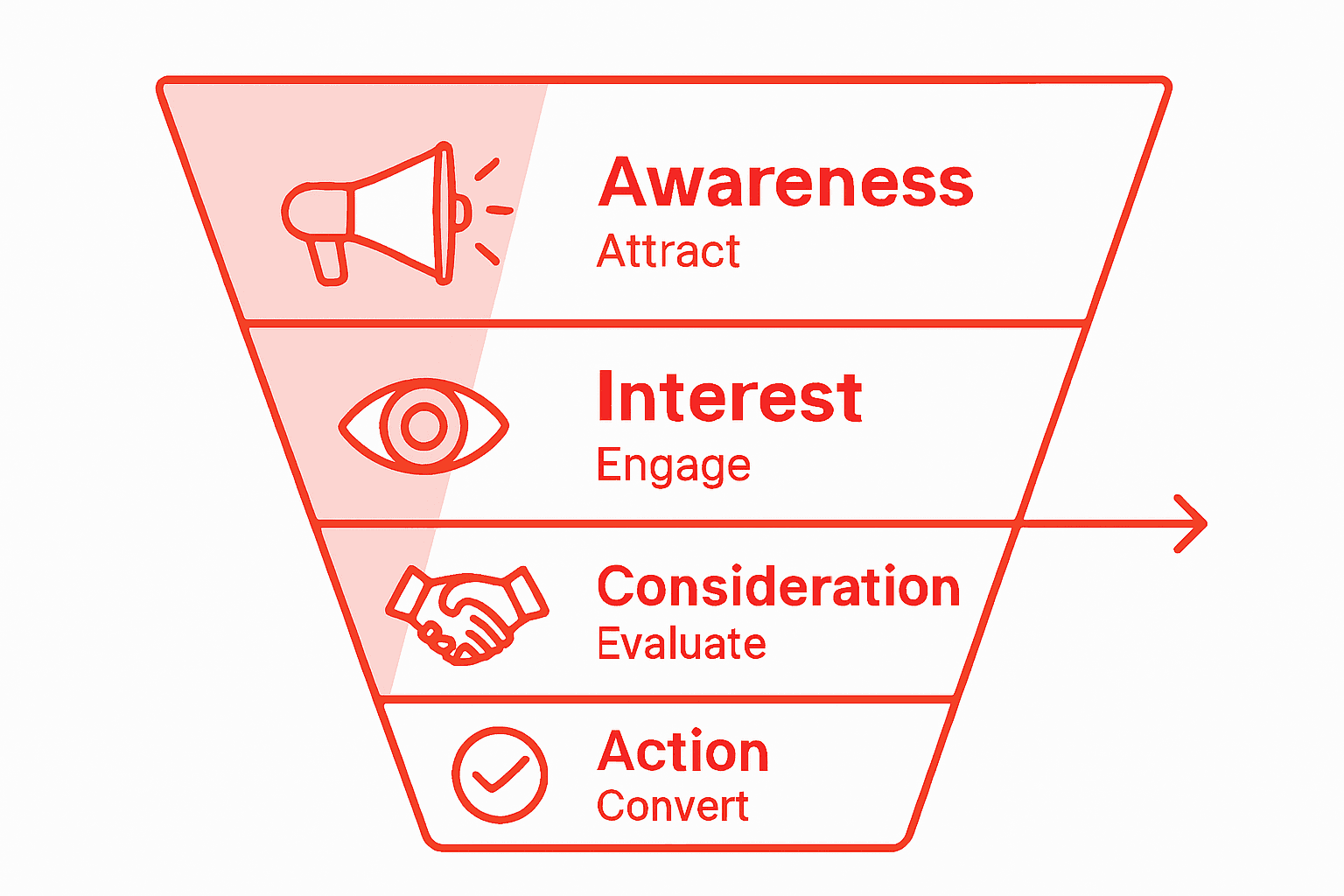
Modern digital marketing funnels increasingly recognise the complexity of customer journeys. While traditional models presented a linear progression, contemporary strategies acknowledge that customers may move between stages, revisit previous steps, or require multiple touchpoints before converting. Advanced marketing communications approaches now include additional stages like customer relationship commencement and retention, understanding that the funnel extends beyond the initial purchase.
Pro Tip – Funnel Stage Mapping: Create detailed customer personas for each funnel stage, tailoring content and messaging to address specific needs, questions, and motivations unique to each phase of the customer journey.
Here is a concise summary of how each stage of the digital marketing funnel aligns with specific business objectives and ideal types of content:
| Funnel Stage | Primary Business Objective | Ideal Content Types |
|---|---|---|
| Awareness | Maximise brand visibility | Blog posts, social media |
| Interest | Generate customer engagement | Videos, webinars, guides |
| Consideration | Nurture informed decision-making | Case studies, email campaigns |
| Action | Drive conversion and sales | Promotions, clear calls-to-action |
| Retention | Foster loyalty and advocacy | Loyalty programmes, follow-ups |
Key Strategies for Each Funnel Stage
Successful digital marketing requires targeted strategies for each stage of the customer journey. In the initial Awareness stage, businesses must focus on generating visibility through multiple channels like organic search, social media, and strategic content marketing. This means creating compelling content that introduces your brand, addresses potential customer challenges, and establishes initial credibility.
As potential customers move through the funnel, different engagement tactics become critical. During the Interest stage, businesses should develop content that demonstrates deeper value and solves specific problems. This might include targeted blog posts, informative videos, comprehensive guides, and interactive webinars that showcase expertise. Brand engagement tactics on social media platforms become particularly important, allowing direct interaction and building initial trust with potential customers. The Consideration stage requires more personalised content, such as detailed case studies, product comparisons, and targeted email campaigns that address specific customer pain points.
The final stages of the funnel demand precision and strategic nurturing. In the Action stage, businesses must remove potential barriers to purchase by offering clear value propositions, transparent pricing, straightforward purchasing processes, and compelling calls-to-action. Post-purchase strategies should focus on customer retention, including follow-up communications, loyalty programmes, and ongoing value delivery that transforms one-time buyers into long-term brand advocates.
Pro Tip – Content Personalisation: Map your content precisely to each funnel stage, ensuring that every piece of communication speaks directly to the customer’s current mindset and specific informational needs.
Digital Marketing Funnel Examples for UK SMEs
Digital marketing techniques reveal unique opportunities for small and medium enterprises across the United Kingdom to transform their online presence. A local bakery in Bristol, for instance, might implement a digital marketing funnel that begins with targeted social media advertising showcasing their artisan bread and pastries, creating initial brand awareness among local food enthusiasts.
Consider a Manchester-based software consultancy as another practical example. Their digital marketing funnel could start with targeted LinkedIn advertisements highlighting industry insights, drawing potential corporate clients into their awareness stage. As prospects show interest, the consultancy might offer downloadable whitepapers or free webinars exploring technical challenges, effectively nurturing leads through the consideration phase. Sophisticated retargeting campaigns could then re-engage interested businesses, presenting case studies and client testimonials that demonstrate proven expertise and reliability.
For a Cardiff-based fitness equipment retailer, the digital marketing funnel might involve creating engaging YouTube content about home workout strategies, attracting fitness enthusiasts through organic search and social media channels. By offering free training guides in exchange for email addresses, they create opportunities to nurture potential customers with personalised email marketing campaigns. The final conversion stage could involve targeted promotions, bundle deals, and limited-time discounts that encourage immediate purchase decisions.
Pro Tip – Funnel Customisation: Develop distinct digital marketing funnels for different customer segments within your business, recognising that one size rarely fits all in the complex landscape of online marketing.
Aligning Sales and Marketing for Success
Digital marketing strategies demand seamless collaboration between sales and marketing teams to create a unified customer experience. Traditional organisational silos can significantly hinder business growth, preventing the smooth progression of potential customers through the marketing funnel. Successful SMEs recognise that marketing generates high-quality leads while sales teams convert those leads into paying customers, requiring intricate coordination and shared objectives.
Effective alignment begins with establishing common metrics and communication protocols. This means developing shared key performance indicators (KPIs) that both teams understand and track, such as lead quality, conversion rates, and customer lifetime value. Marketing teams should provide sales colleagues with detailed customer personas, insights into prospect behaviour, and comprehensive lead scoring mechanisms. Conversely, sales teams must offer continuous feedback about lead quality, customer interactions, and market trends that can inform marketing strategies and content creation.
Technology plays a crucial role in bridging potential gaps between marketing and sales departments. Integrated customer relationship management (CRM) systems enable real-time information sharing, allowing marketing to track lead progression and sales to understand the precise journey each prospect has taken. Automated lead nurturing workflows can help qualify potential customers before they reach the sales team, ensuring that sales representatives focus their energy on the most promising opportunities. Regular cross-departmental meetings, joint training sessions, and collaborative goal-setting further reinforce this critical partnership.
Pro Tip – Collaborative Goal Setting: Implement quarterly joint planning sessions where marketing and sales teams collectively define goals, share insights, and develop integrated strategies that support the entire customer acquisition process.
Common Pitfalls and How to Avoid Them
Digital marketing strategies require nuanced understanding to prevent common mistakes that can derail customer acquisition efforts. One significant pitfall involves treating the marketing funnel as a rigid, linear progression rather than a dynamic, adaptive journey. Small and medium enterprises often make the error of creating generic content that fails to speak directly to specific customer segments, resulting in low engagement and poor conversion rates.
Another critical mistake is neglecting data-driven insights and performance tracking. Businesses frequently invest resources in marketing campaigns without establishing clear measurement frameworks, making it impossible to understand which strategies genuinely drive results. This approach leads to wasted marketing budgets and missed opportunities. Successful digital marketing requires continuous analysis of key performance indicators, understanding customer behaviour patterns, and being willing to pivot strategies based on empirical evidence. Implementing robust analytics tools and developing a culture of measurement can transform marketing approaches from guesswork to precision.
Many SMEs also struggle with inconsistent messaging and disjointed customer experiences across different digital channels. This fragmentation can confuse potential customers and undermine trust. Effective digital marketing demands a cohesive narrative that maintains consistent brand voice, value proposition, and messaging whether a customer encounters your brand through social media, email, website, or paid advertisements. Developing comprehensive brand guidelines, training team members on communication standards, and using integrated marketing technologies can help create a seamless, professional customer journey.
The following table highlights common pitfalls in digital marketing funnels and actionable solutions for SMEs:
| Pitfall | Potential Consequence | Recommended Solution |
|---|---|---|
| Treating funnel as strictly linear | Low engagement, lost leads | Adopt a dynamic, flexible approach |
| Lack of data-driven measurement | Ineffective use of budget | Implement robust analytics platform |
| Inconsistent brand messaging | Customer confusion, mistrust | Develop unified brand guidelines |
| Generic content for all segments | Poor conversion rates | Customise content for each persona |
Pro Tip – Continuous Learning: Regularly conduct customer feedback surveys and analyse drop-off points in your digital marketing funnel to identify and address potential barriers to conversion.
Unlock Growth with Bamsh Digital Marketing’s Expert Funnel Solutions
If you found the detailed breakdown of the digital marketing funnel enlightening, you may be facing challenges like converting casual visitors into loyal customers or struggling with inconsistent messaging across your sales journey. This article highlighted the need for a dynamic, personalised approach to capturing and nurturing leads through each funnel stage — from awareness to action and retention. At Bamsh Digital Marketing, we understand these key pain points and tailor strategies that help UK SMEs build trust, drive engagement, and boost sales with clarity and honesty.
Our award-winning team specialises in creating transparent funnels that deliver measurable results. Whether you need expert SEO to increase your visibility, targeted paid social advertising for lead generation or powerful CRM automation that nurtures enquiries while you focus on running your business, we have your back. Discover how our services can remove the guesswork from your marketing and turn prospects into repeat customers by visiting our Digital Marketing Bristol page.
Ready to start growing your business with a proven marketing funnel designed for your unique needs? Book a no-obligation strategy call today at Bamsh 15-Minute Marketing Breakthrough and get clear, actionable advice on making your funnel work harder. To explore any new opportunities or special packages, take a look at our Special Offers before you get in touch. The path to more leads, predictable revenue, and lasting customer relationships starts now.
Frequently Asked Questions
What is a digital marketing funnel?
A digital marketing funnel is a strategic framework that outlines the journey potential customers take from awareness of a brand to making a purchase, incorporating multiple stages that guide them through this process.
What are the stages of a digital marketing funnel?
The primary stages of a digital marketing funnel typically include Awareness, Interest, Consideration, and Action. Some models also incorporate Retention as a later stage, focusing on customer loyalty and advocacy after the purchase.
How can I optimise my digital marketing funnel?
To optimise your digital marketing funnel, regularly analyse its performance using analytics tools, track conversion rates at each stage, and identify potential bottlenecks that may hinder prospects from completing their journey.
Why is content important at each stage of the funnel?
Content is crucial at each funnel stage as it helps to engage potential customers, answer their questions, and provide value, thereby nurturing their progression from casual interest to making a purchase.