

Over 97 percent of the British population is now online, yet many small and medium-sized businesses in Bristol and Cardiff still struggle to stand out in a digital-first market. Staying ahead of these rapid changes matters more than ever, as new technologies change how customers find and trust local brands. This article reveals practical digital marketing strategies and tools designed to help British business owners attract more leads and grow confidently in 2026.
Table of Contents
- Digital Marketing Explained For 2026
- Core Digital Marketing Channels And Tools
- How AI Transforms Marketing Strategies
- Benefits For Small And Medium Businesses
- Costs, Risks, And Common Mistakes
Key Takeaways
| Point | Details |
|---|---|
| Emerging Technologies | By 2026, Artificial Intelligence will be central in reshaping digital marketing strategies, enhancing personalisation and engagement. |
| Integrated Marketing Channels | Businesses should adopt a multichannel approach, combining AI tools for effective targeting across search, social media, email, and content marketing. |
| AI-Driven Insights | Implementing AI-powered platforms will enable real-time analysis and optimisation of marketing strategies, ensuring better customer engagement. |
| Mitigating Risks | To avoid financial pitfalls, businesses must focus on compliance and effective performance tracking, leveraging analytics to enhance decision-making. |
Digital marketing explained for 2026
Digital marketing in 2025 represents a transformative landscape driven by unprecedented technological innovation. Business owners must understand how emerging technologies like Artificial Intelligence are radically reshaping marketing strategies and audience engagement. Digital marketing trends are evolving dramatically, with AI and data-driven approaches becoming central to successful campaigns.
The core of digital marketing in 2025 revolves around hyper-personalisation and intelligent content generation. Businesses can now leverage AI tools to create targeted content, analyse customer behaviours, and predict marketing outcomes with remarkable precision. Social commerce continues to grow, with platforms integrating seamless purchasing experiences directly within their interfaces. Video content, particularly live and interactive formats, will dominate marketing strategies, allowing brands to create more engaging and authentic connections.
Key technological developments will include advanced machine learning algorithms that can generate personalised marketing content, predict consumer behaviour, and optimise marketing spend in real-time. Voice search and interactive content formats will become standard, requiring marketers to develop more conversational and immersive digital experiences. Small to medium businesses in the UK will need to adopt these technologies strategically to remain competitive and effectively reach their target audiences.
Pro tip: Invest in AI-powered marketing tools that can analyse your customer data and generate personalised content strategies automatically, saving time and improving engagement rates.
Core digital marketing channels and tools
Digital marketing channels in 2025 are dramatically evolving, with technology transforming how businesses connect with their audiences. Top marketing channels focus on personalised, data-driven strategies that leverage advanced artificial intelligence and precise targeting capabilities. The most effective approaches combine multiple channels to create a comprehensive and integrated marketing ecosystem.
The primary digital marketing channels for 2025 include search engine marketing, social media advertising, email marketing, and content marketing. Search engine platforms now incorporate AI-powered intent recognition, allowing businesses to create hyper-targeted advertising experiences. Social media channels have become sophisticated commerce platforms, enabling direct purchasing and immersive brand interactions. Email marketing has transformed from generic broadcasts to highly personalised communication flows that adapt in real-time based on individual user behaviours and preferences.
Technological tools are becoming increasingly intelligent and integrated. AI-powered content generation tools, advanced customer relationship management systems, and predictive analytics platforms are now essential components of a modern digital marketing strategy. Businesses can leverage machine learning algorithms to optimise advertising spend, create personalised content, and predict customer engagement patterns with unprecedented accuracy. Voice search optimisation, interactive content creation tools, and AI-driven chatbots are rapidly becoming standard marketing technologies that enable more dynamic and responsive customer interactions.

Below is a comparison of major digital marketing channels and the unique advantages each provides in 2025:
| Channel | Unique Advantage | Typical UK Business Benefit |
|---|---|---|
| Search Engine Marketing | AI-driven intent recognition | High-quality lead acquisition |
| Social Media Advertising | Integrated shopping experiences | Increased sales directly on platforms |
| Email Marketing | Real-time personalisation | Loyal repeat customers |
| Content Marketing | Intelligent content automation | Consistent brand presence and recall |
Pro tip: Invest in an integrated marketing platform that combines AI-powered analytics, content generation, and multichannel management to streamline your digital marketing efforts and improve overall campaign performance.
How AI transforms marketing strategies
Artificial Intelligence is fundamentally reshaping marketing strategies across the United Kingdom, offering businesses unprecedented capabilities for targeted engagement and efficiency. AI revolutionises marketing automation by providing intelligent tools that transform traditional approaches to customer interaction, content creation, and campaign management.
The most significant transformations include hyper-personalisation and predictive analytics. AI-powered technologies now enable businesses to analyse vast amounts of customer data, creating highly targeted marketing experiences that adapt in real-time. Machine learning algorithms can predict customer behaviours, preferences, and potential purchasing patterns with remarkable accuracy. This means marketing strategies can now be proactively designed to meet individual customer needs, moving beyond generic mass-market approaches to truly personalised communication.
Technological integrations are creating more sophisticated marketing ecosystems. AI-driven tools now seamlessly connect with customer relationship management systems, enabling automated content generation, sentiment analysis, and intelligent customer interactions. Chatbots powered by advanced natural language processing can handle complex customer queries, while generative AI tools help marketers create compelling content faster and more efficiently. These technologies not only streamline marketing processes but also provide deeper insights into customer engagement, allowing businesses to make data-driven decisions with unprecedented precision.
Pro tip: Implement an AI-powered marketing platform that integrates predictive analytics, automated content generation, and real-time customer insights to transform your marketing strategy and improve overall business performance.
Benefits for small and medium businesses
Digital marketing offers transformative opportunities for small and medium enterprises in the United Kingdom, enabling businesses to compete effectively in an increasingly digital marketplace. Benefits of digital marketing extend far beyond traditional advertising, providing unprecedented access to targeted audiences and sophisticated marketing tools that were previously available only to larger corporations.
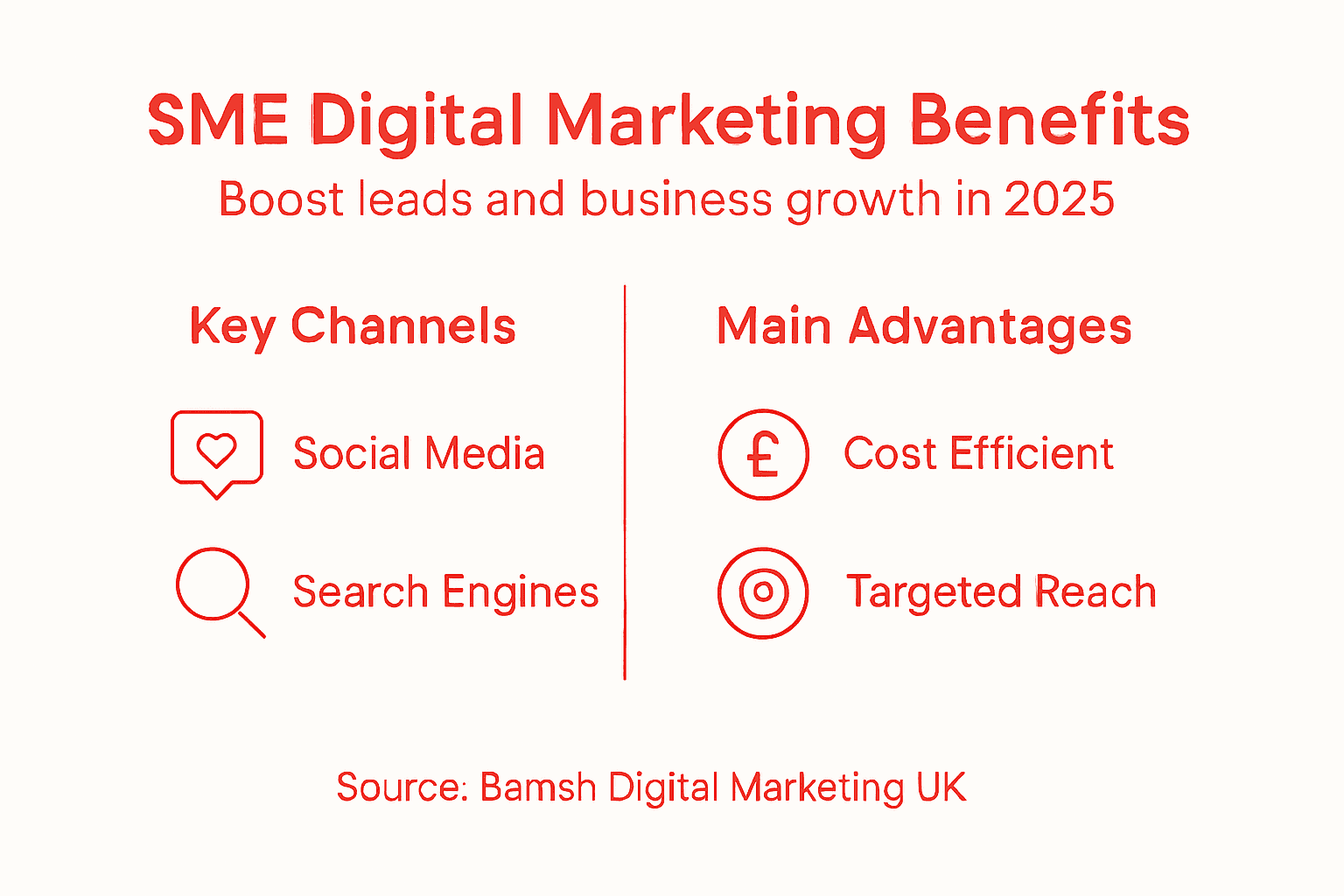
The primary advantages for small businesses include enhanced online visibility, precise audience targeting, and cost-effective marketing strategies. With 97.8% of the United Kingdom’s population online, digital platforms provide an unparalleled opportunity to reach potential customers directly. Social media channels, email marketing, and targeted advertising enable businesses to create personalised marketing campaigns that resonate with specific customer segments. These strategies allow small enterprises to build strong brand recognition, engage customers more authentically, and generate leads with significantly lower marketing expenditure compared to traditional advertising methods.
Technological advancements have democratised marketing capabilities, allowing small and medium businesses to leverage sophisticated tools previously reserved for large corporations. Advanced analytics provide real-time insights into campaign performance, customer behaviour, and market trends. This data-driven approach enables businesses to make rapid, informed decisions, adjust marketing strategies dynamically, and optimise their return on investment. Machine learning algorithms and AI-powered tools can now help small businesses create intelligent, adaptive marketing campaigns that continuously improve their effectiveness, providing a level of marketing sophistication that was unimaginable just a few years ago.
Pro tip: Allocate at least 20% of your marketing budget to digital channels and invest in learning analytics tools to track and continuously improve your marketing performance.
Costs, risks, and common mistakes
Digital marketing requires a strategic approach to mitigate potential financial risks and avoid costly errors that can undermine business performance. Understanding common digital marketing mistakes is crucial for businesses seeking to optimise their marketing investments and maintain competitive effectiveness.
The primary financial risks in digital marketing stem from inefficient spending, poorly targeted campaigns, and inadequate performance tracking. Businesses often waste resources on broad, unfocused advertising that fails to reach their intended audience. Common pitfalls include neglecting search engine optimisation, failing to optimise websites for mobile platforms, and creating inconsistent messaging across different digital channels. These mistakes can result in significant budget drainage, with companies potentially spending thousands of pounds on ineffective marketing strategies that generate minimal returns.
Compliance and data privacy represent another critical risk area for digital marketing in 2025. With increasingly stringent regulations surrounding customer data, businesses must invest in robust systems that protect user information and adhere to evolving legal frameworks. Overlooking these requirements can lead to substantial financial penalties, reputational damage, and loss of customer trust. Additionally, over-reliance on artificial intelligence tools without human oversight can create strategic blind spots, potentially generating content or targeting strategies that lack nuance or fail to connect authentically with target audiences.
Here is a summary of common digital marketing risks and recommended mitigation strategies for 2025:
| Risk Area | Potential Issue | Recommended Solution |
|---|---|---|
| Inefficient Spend | Broad, unfocused campaigns | Use AI for precision targeting |
| Data Compliance | Failing to meet privacy regulations | Regular compliance audits and updates |
| Tech Overreliance | Overlooking human review | Combine AI tools with human oversight |
| Performance Tracking | Poor measurement of outcomes | Implement advanced analytics platforms |
Pro tip: Conduct a quarterly digital marketing audit to review campaign performance, compliance requirements, and return on investment, ensuring your strategies remain both effective and legally sound.
Take Control of Your Digital Marketing Growth in 2025
The fast-paced evolution of digital marketing in 2025 brings exciting opportunities but also complex challenges for businesses aiming to boost growth and generate more leads. If you find yourself overwhelmed by AI tools, hyper-personalisation demands, or finely targeting audiences with limited time and budget, you are not alone. Many UK businesses struggle with transforming innovative digital marketing concepts into clear, actionable strategies that genuinely work.
At Bamsh Digital Marketing, we specialise in turning these challenges into competitive advantages. Our transparent and bold approach helps small and medium-sized businesses like yours cut through confusion and use cutting-edge SEO, PPC, social advertising, and AI-powered automation to attract, engage and convert customers with clarity and confidence. Discover how our award-winning growth services can help you harness powerful tools like AI-driven content, CRM automation, and local optimisation to create lasting growth.
Ready to get started with a clear, results-driven digital marketing plan? Visit Digital Marketing Bristol – Bamsh Digital Marketing to explore tailored strategies developed for the 2025 landscape. Learn more about our agency culture and client success stories at Bamsh – Bamsh Digital Marketing. Take the first step today by booking your 15-minute free consultation at https://bamsh.co.uk/15-min/. Your business growth in 2025 deserves clarity, honesty, and proven expertise.
Frequently Asked Questions
How is AI transforming digital marketing in 2025?
AI is significantly reshaping digital marketing by enabling hyper-personalisation, predictive analytics, and automated content generation. Businesses can analyse vast amounts of customer data to create highly targeted marketing experiences that adapt in real time, improving engagement and campaign effectiveness.
What are the key digital marketing channels to focus on in 2025?
The primary digital marketing channels in 2025 include search engine marketing, social media advertising, email marketing, and content marketing. These channels leverage advanced AI technologies to improve targeting and integrate shopping experiences, helping businesses connect more effectively with their audiences.
What benefits does digital marketing offer small businesses in 2025?
Digital marketing provides small businesses with enhanced online visibility, precise audience targeting, and cost-effective strategies. With online platforms, small enterprises can engage customers authentically and build strong brand recognition without the high costs of traditional advertising.
What common mistakes should businesses avoid in digital marketing?
Businesses should avoid inefficient spending on broad campaigns, failing to comply with data privacy regulations, and relying solely on AI without human oversight. Regular audits and using advanced analytics can help mitigate these risks and improve overall marketing performance.