

Choosing where to focus your marketing can often feel like mapping out routes without knowing which leads to new customers. For digital marketing managers across the South West UK, truly understanding your audience forms the backbone of any campaign that actually converts. By applying a methodical approach to audience research and blending strategic planning with tailored, high-value content, you set the stage for content marketing that fuels lead generation and improves return on investment.
Table of Contents
- Step 1: Define Audience Needs And Goals
- Step 2: Develop A Strategic Content Plan
- Step 3: Produce Tailored, High-Value Content
- Step 4: Distribute Content Across Key Channels
- Step 5: Measure Performance And Optimise Strategy
Quick Summary
| Key Point | Explanation |
|---|---|
| 1. Understand audience motivations | Conduct in-depth research to identify your target audience’s needs, desires, and challenges for effective content marketing. |
| 2. Create a strategic content plan | Develop a flexible and focused content strategy that aligns with both your business objectives and audience preferences. |
| 3. Produce high-value content | Craft content that addresses specific customer pain points while ensuring clarity and relevance to engage effectively. |
| 4. Distribute content strategically | Maximise reach by tailoring your content for various channels based on where your audience engages most. |
| 5. Measure and optimise performance | Use analytics to track key metrics and refine your strategy, ensuring your approach remains effective and responsive to change. |
Step 1: Content Marketing: Define audience needs and goals
Discovering your target audience is like creating a detailed map before embarking on a marketing journey. This step involves understanding precisely who your potential customers are and what they truly want.
To effectively define audience needs, you’ll want to start by conducting comprehensive audience research. This means diving deep into data that reveals not just basic demographics, but genuine motivations and challenges.
Here are key strategies to map out your audience profile:
- Segment your audience by geographical location, age range, professional background, and specific interests
- Analyse existing customer data from previous interactions and sales records
- Create detailed buyer personas that represent your ideal customer types
- Conduct surveys and interviews to gain direct insights from your target market
Effective audience research helps you understand not just who your customers are, but why they might choose your services.
To get granular, break down audience needs into specific categories:
- Identify primary pain points
- Understand their goals and aspirations
- Recognise potential barriers to engagement
- Map their typical decision-making process
By taking a methodical approach to understanding your audience, you’ll create a solid foundation for targeted content marketing that speaks directly to their needs.
Professional insight: Continuously update your audience research, as customer needs and market dynamics evolve rapidly.
Step 2: Develop a strategic content plan
Crafting a strategic content plan transforms your marketing efforts from scattered attempts to a precision-targeted approach. This crucial step involves creating a roadmap that aligns your content creation with your business objectives and audience needs.
Begin by developing a comprehensive content strategy that considers your organisation’s goals and the specific requirements of your target audience. Your plan should be flexible yet focused, providing a clear direction for your content marketing efforts.
Key components of an effective content strategy include:
- Identify primary content objectives that support your business goals
- Analyse your target audience’s content consumption habits
- Map out content types and formats that resonate with your audience
- Create a content calendar with consistent publishing schedules
- Establish key performance indicators to measure content success
A strategic content plan is your compass, guiding your marketing efforts towards meaningful audience engagement.
To build a robust content strategy, follow these essential steps:
- Conduct a thorough content audit of existing materials
- Identify gaps in your current content offering
- Align content themes with audience pain points
- Develop a consistent brand voice and messaging
- Prioritise content formats that drive maximum engagement
Remember that your content plan is a living document. It should evolve with your business, audience needs, and market dynamics. Regularly review and adjust your strategy to ensure continued relevance and effectiveness.
Professional insight: Develop a content plan that is both strategic and adaptable, allowing room for creative exploration while maintaining a clear focus on your core business objectives.
Step 3: Produce tailored, high-value content
Creating content that truly resonates with your audience is an art and science combined. This step is about transforming your strategic plan into compelling, targeted content that speaks directly to your readers’ needs and challenges.

Tailoring content for maximum impact requires a deep understanding of your audience’s preferences, pain points, and information consumption habits. Your goal is to craft content that not only attracts attention but provides genuine value and drives meaningful engagement.
Key principles for producing high-value content include:
- Research your audience thoroughly before creating any content
- Address specific customer pain points with precision
- Use clear, conversational language that feels authentic
- Incorporate data and expert insights to build credibility
- Ensure content is easily scannable and digestible
High-value content is not about volume, but about delivering exactly what your audience needs at the right moment.
To create truly tailored content, implement these strategic steps:
- Develop detailed buyer personas
- Conduct keyword research aligned with audience interests
- Match content formats to audience preferences
- Write with a consistent, authoritative brand voice
- Include practical, actionable insights in every piece
Remember that high-value content is an ongoing process of listening, learning, and adapting. Continuously gather feedback and metrics to refine your approach and ensure your content remains relevant and impactful.
Professional insight: Prioritise depth and quality over quantity, focusing on creating content that solves real problems and provides genuine value to your target audience.
Step 4: Distribute content across key channels
Successful content marketing isn’t just about creating great content – it’s about getting that content in front of the right people at the right time. This step focuses on strategically spreading your carefully crafted content across multiple channels to maximise reach and engagement.
Selecting strategic distribution channels requires a nuanced understanding of where your target audience spends their time and how they consume information. Your distribution strategy should be as targeted and thoughtful as the content itself.
Key principles for effective content distribution include:
- Understand your audience’s preferred platforms
- Adapt content for each specific channel
- Create a consistent cross-channel narrative
- Leverage both organic and paid distribution methods
- Track performance across different channels
Content distribution is about precision – reaching the right audience through the most appropriate channels.
To implement a robust distribution strategy, follow these steps:
- Map your audience’s digital consumption habits
- Prioritise channels with the highest audience engagement
- Repurpose content for different platform requirements
- Develop a consistent posting schedule
- Monitor and analyse channel performance
Remember that distribution is an ongoing process of learning and refinement. Continuously analyse your metrics, adapt your approach, and be prepared to shift your strategy as audience behaviours evolve.
Professional insight: Don’t just broadcast your content – create a strategic ecosystem where each channel complements and amplifies the others.
Here is a comparison of common content distribution channels and their typical business impact:
| Channel | Reach Potential | Ideal Content Type |
|---|---|---|
| Social media | Broad, engaging audiences | Short-form posts, videos |
| Company website | Targeted, existing visitors | In-depth articles, guides |
| Email campaigns | Direct, loyal base | Newsletters, exclusive offers |
| Paid advertising | Highly targeted segments | Promotional content |
| Partner platforms | Niche or new audiences | Guest articles, case studies |
Step 5: Content Marketing: Measure performance and optimise strategy
Transforming your content marketing from guesswork to precision requires a systematic approach to measuring and improving your results. This final step is about turning data into actionable insights that continuously enhance your marketing effectiveness.
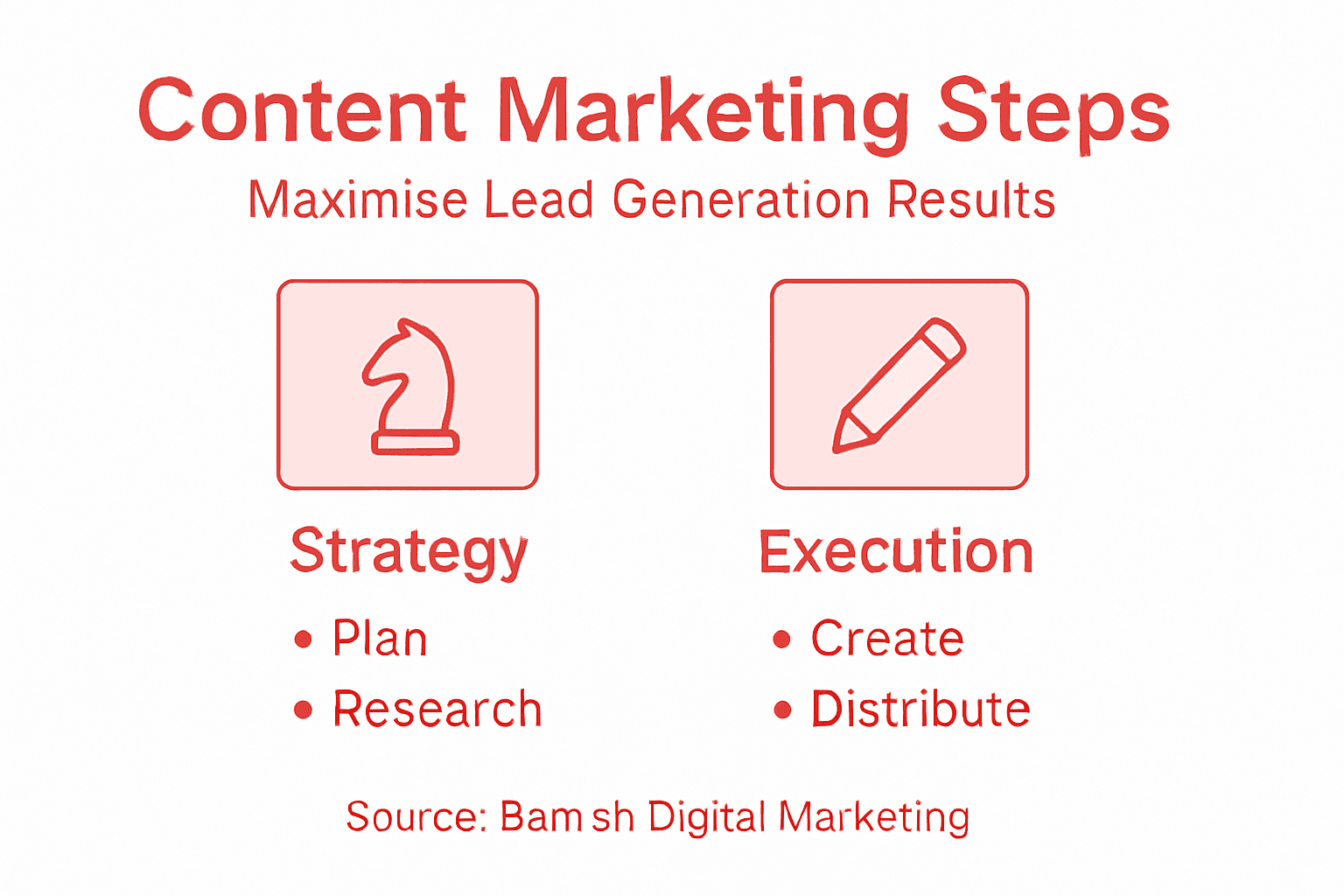
Establishing key performance indicators enables you to track the real impact of your content marketing efforts with clarity and purpose. The goal is to create a dynamic, responsive strategy that evolves based on concrete evidence.
Critical metrics to track and analyse include:
- Engagement rates across different content types
- Conversion rates from content to leads
- Traffic sources and audience behaviour
- Return on investment for content creation
- Customer acquisition costs
Performance measurement is not about perfection, but about continuous learning and improvement.
To effectively measure and optimise your strategy, follow these steps:
- Set up comprehensive analytics tracking
- Define clear, measurable objectives
- Conduct regular performance reviews
- Identify top-performing and underperforming content
- Implement data-driven refinements
Remember that measurement is an ongoing process. Your content strategy should be a living document that adapts and improves based on real-world performance data. Be prepared to pivot, experiment, and continuously learn from your metrics.
Professional insight: Don’t just collect data – create a systematic approach to understanding and acting on your content marketing performance metrics.
The following table summarises each main step with its core aim and a practical tip for success:
| Step | Core Aim | Practical Tip |
|---|---|---|
| Define audience needs | Understand customer motivations | Update research regularly |
| Develop a strategic plan | Align content with goals | Build a flexible calendar |
| Produce high-value content | Solve real audience problems | Focus on actionable insights |
| Distribute across channels | Maximise audience reach | Tailor content by platform |
| Measure and optimise | Enhance strategy with analytics | Review and refine continually |
Unlock Maximum Lead Generation with Bamsh Digital Content Marketing
Struggling to translate your content marketing efforts into consistent, high-quality leads can be frustrating. This article highlights vital steps like defining audience needs, producing targeted content, and measuring performance to create a powerful marketing engine. If your goals include clearer customer insights, a strategic content plan, and optimised distribution channels, Bamsh Digital Marketing offers proven solutions designed exactly for these challenges.
Our award-winning team specialises in helping businesses boost visibility and drive more leads through transparent, results-driven strategies. Whether you need expert SEO and Answer Engine Optimisation or a comprehensive digital marketing system like our AI Lead Engine, we focus on helping your ideal customers find and choose you. Discover how our approach removes confusion and builds predictable growth by visiting Bamsh – Bamsh Digital Marketing and exploring tailored options under Special Offers – Bamsh Digital Marketing. Ready to supercharge your lead generation? Take the next step and book your free strategy session today at https://bamsh.co.uk/15-min/.
Frequently Asked Questions About Effect Content Marketing
How do I identify my audience’s needs for effective content marketing?
To identify your audience’s needs, conduct thorough audience research to understand their motivations and pain points. Start by segmenting your audience based on demographics and interests, and create detailed buyer personas within 30 days.
What should be included in a strategic content plan for lead generation?
A strategic content plan should include your primary content objectives, an analysis of audience consumption habits, a content calendar, and key performance indicators to measure success. Develop this plan to align all content with your business goals and update it every quarter to remain effective.
How can I ensure my content is high-value and tailored to my audience?
To produce high-value content, research your audience’s pain points and use clear, conversational language that addresses their specific needs. Make it actionable by providing practical insights or tips in each piece, and aim to create one high-value piece every week.
What are the best channels for distributing content effectively?
To distribute content effectively, identify the platforms where your audience spends most of their time and tailor your content for each one. Start by mapping out their preferred channels and aim to post consistently, at least three times a week, to maximise engagement.
How do I measure the performance of my content marketing efforts?
Measure the performance of your content by tracking engagement rates, conversion rates, and traffic sources. Establish a regular review process, such as monthly analytics assessments, to identify what is working and where improvements are needed.
What actions should I take to optimise my content strategy over time?
To optimise your content strategy, implement data-driven adjustments based on performance metrics and audience feedback. Conduct quarterly strategy reviews and adjust your content types or distribution methods to drive better engagement by up to 20%.