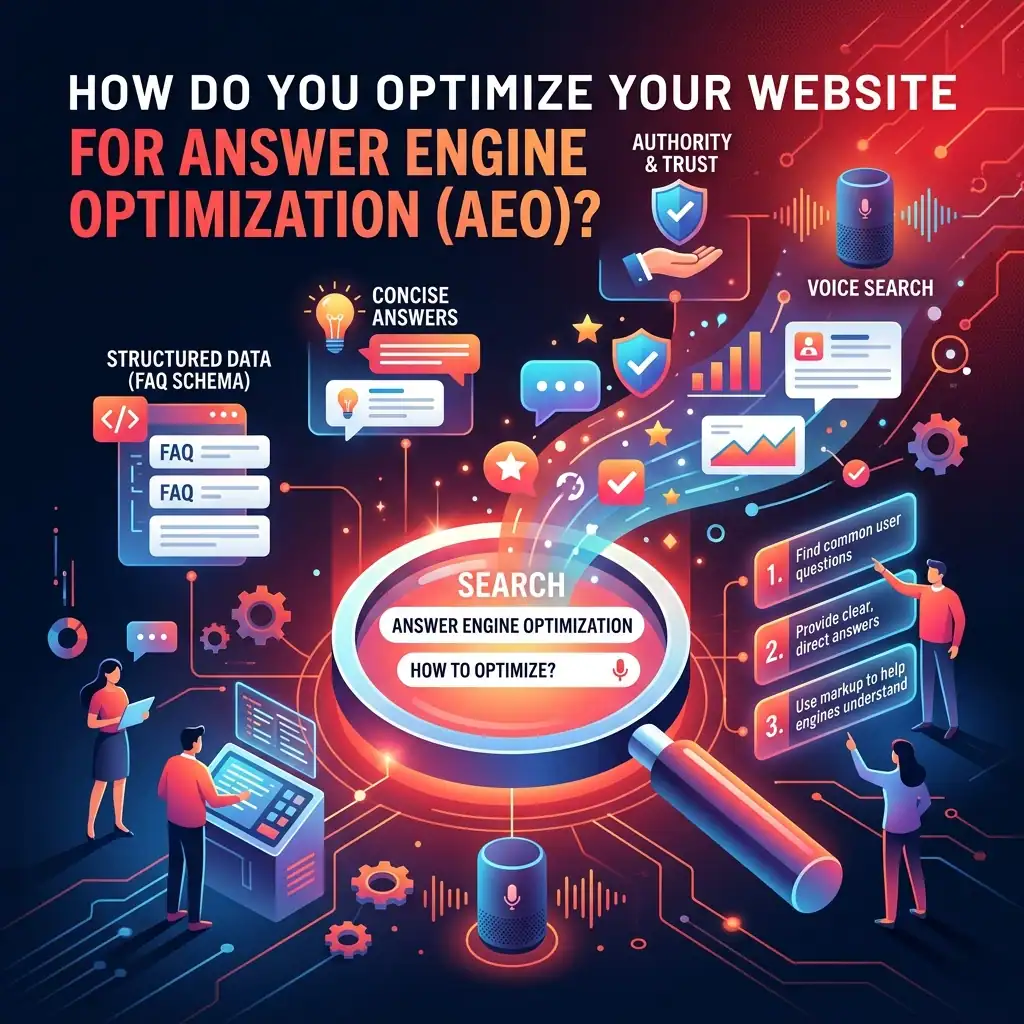
To understand how to optimise your website for Answer Engine Optimisation (AEO), you must focus on providing direct, concise answers to specific customer questions, using structured data (schema markup) to help AI understand your content, and formatting your pages so that information is easily extracted by machines. You need to transition from targeting broad keywords to targeting the actual intent behind a user’s query, ensuring your most valuable information is placed prominently at the top of your pages.
Why is AEO Different From Traditional SEO?
Traditional Search Engine Optimisation (SEO) focuses on ranking your website in a list of blue links on a results page. Answer Engine Optimisation is different because it focuses on being the single answer provided by AI assistants like ChatGPT, Claude, or Google’s Gemini. When you search for something today, you often don’t want a list of websites; you want the answer right there on the screen.
If you run a business in Bristol, you are no longer just competing for a spot on page one. You are competing to be the “source” that the AI quotes. This requires a shift in how you write and organise your website. While SEO is still vital for driving traffic, AEO is about brand visibility and authority in a world where AI does the searching for the user. Bamsh integrates AEO into all standard SEO services because the two now go hand-in-hand.
To optimise your website for Answer Engine Optimisation (AEO), you need to make your content easy to find, understand, verify and reference.
That means answering real customer questions clearly, organising your pages logically, using appropriate schema markup and providing evidence that supports what you say.
Traditional SEO remains essential. But people now discover businesses through a mixture of Google search results, Google AI Overviews and AI assistants such as ChatGPT and Perplexity.
A customer might search Google for “SEO agency Bristol”. Another might ask an AI assistant, “Which Bristol marketing agencies offer SEO and AEO together, and what do they charge?”
Those are related searches, but they do not necessarily produce the same results.
AEO helps make your business information suitable for answer-led search, while SEO helps search engines discover, understand and rank your website.
This guide explains how to optimise for AEO in the UK, with practical examples you can apply to your own website.
BAMSH includes AEO services within its ongoing SEO packages, starting from £799 per month excluding VAT.
What Is Answer Engine Optimisation?
Answer Engine Optimisation is the process of improving website content and technical information so that search engines and AI-powered systems can more easily find, interpret and use it when answering relevant questions.
Instead of concentrating exclusively on keywords, AEO also considers how people phrase questions and what information they need to make decisions.
For example, a traditional search might be:
“Emergency plumber Bristol”
An answer-led query might be:
“What should I check before calling an emergency plumber in Bristol, and how much could it cost?”
A useful website should be capable of answering both types of search.
For small businesses, AEO can involve:
-
Clear answers to customer questions
-
Detailed service information
-
Transparent pricing where possible
-
Relevant structured data
-
Genuine experience and expertise
-
Consistent business information
-
Strong internal linking
-
Technically accessible pages
-
Reliable supporting sources
The objective is to make your website a useful, credible source rather than simply adding AI-related terminology to existing pages.
Why Is AEO Different From Traditional SEO?
SEO and AEO have different emphases, but they overlap considerably.
Traditional SEO helps your website compete in search results for relevant queries.
AEO considers how your information can be understood and referenced when an AI-powered system generates an answer.
| Feature | Traditional SEO | Answer Engine Optimisation |
|---|---|---|
| Main objective | Improve organic search visibility | Improve visibility and usefulness in answer-led search |
| Typical search | “Roof repairs Bristol” | “How do I know whether my roof needs repairing or replacing?” |
| Content | Service pages, guides, local pages | Direct answers, explanations, comparisons, evidence |
| Technical work | Crawlability, indexing, internal links, performance | The same foundations, plus suitable structured information |
| Authority | Relevant links, reputation, useful content | Credible, attributable, well-supported information |
| Measurement | Rankings, clicks, impressions, conversions | AI referrals, observed citations, brand mentions and conversions |
| Relationship | Essential foundation | Complements SEO |
AEO does not mean abandoning keywords, backlinks or technical SEO.
A website that cannot be crawled or indexed properly is already at a disadvantage.
That is why BAMSH treats SEO and AEO as connected activities rather than selling them as completely unrelated services.
“More people are now asking AI tools like ChatGPT, Claude and Google Gemini their questions instead of doing a traditional Google search. Getting your business into those answers is called answer engine optimisation – and it starts with the same foundation as SEO: a website search engines can read and understand.”
– Martyn Lenthall, Bamsh
Standard Search Result vs AI Overview Citation: What’s the Difference?
A traditional Google search result normally provides a page title, URL and description.
An AI Overview can instead generate an answer from information drawn from multiple sources and display links to supporting pages.
Here is an illustrative comparison.
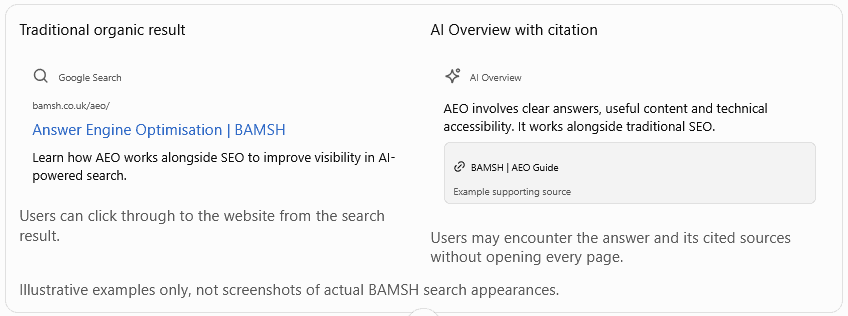 A citation can expose your business to someone who might not otherwise have encountered it.
However, it would be misleading to say that being cited always matters more than ranking.
Organic rankings can still drive valuable traffic and enquiries. AI citations may improve awareness, but they do not always produce a click or customer.
The strongest strategy considers both.
How Do You Find the Right Questions to Answer?
The starting point is simple.
Listen to your customers.
Every email, telephone call, sales meeting and quotation request can reveal questions worth answering.
This is where the They Ask, You Answer approach becomes useful.
For example, a roofing company might repeatedly hear:
-
How much does a roof replacement cost?
-
Can I repair a leaking roof myself?
-
How long does a new roof last?
-
Is a flat roof cheaper than a pitched roof?
-
How do I choose a roofing contractor?
A marketing agency might hear:
-
How much does SEO cost?
-
Is Google Ads better than SEO?
-
What does AEO actually involve?
-
How long does SEO take?
-
How do I know whether my agency is generating leads?
These are not just content ideas.
They are questions that prospective customers may also ask search engines and AI assistants.
Start by collecting questions from:
-
Sales calls and customer enquiries
-
Customer service conversations
-
Google Search Console
-
Google’s People Also Ask results
-
Existing website searches
-
Keyword research
-
Competitor content
-
Relevant industry discussions
You can also use BAMSH’s free tools to support your research.
Prioritise questions that are relevant to your actual services and customers.
Do not create dozens of near-identical articles simply to target different versions of the same question.
“We used to have a knotweed company that ranked for “will diesel kill knotweed” – it brought thousands of visits, but those people were miles from his target area and were never going to become customers. These days AI answers a question like that on the spot, which can reduce clicks like those even further. That’s why the questions you answer have to be the ones your actual customers ask.”
– Martyn Lenthall, Bamsh
How Should You Structure Content for AI Search?
The clearest approach is to answer the main question early.
If somebody asks how much a service costs, do not make them read six paragraphs of marketing copy before mentioning a price.
For example:
Before: Vague Service Content
We provide excellent roofing solutions tailored to your needs. Our experienced team takes pride in delivering high-quality workmanship across Bristol and the surrounding areas.
That might be suitable as a short introduction, but it does not answer a specific question.
After: Direct, Useful Answer
The cost of repairing a roof in Bristol depends on the type of roof, the cause of the problem, access requirements and the extent of the damage. Replacing a few damaged tiles is usually a smaller job than repairing rotten roof timbers or extensive water damage. A roofer should inspect the problem before providing a reliable quotation.
The second example gives the reader practical information.
It also provides a clearer passage that a search or answer system can interpret.
Practical Content Formatting
Use:
-
Question-led H2 and H3 headings where natural
-
Direct answers near the beginning of relevant sections
-
Short, meaningful paragraphs
-
Lists for genuine steps or comparisons
-
Tables when comparing options
-
Specific examples
-
Clear explanations of technical terms
-
Relevant sources and supporting evidence
Avoid forcing every heading into a question.
A good article should still read naturally for people.
What Is Schema Markup and Why Does It Matter for AEO?
Schema markup is structured data that describes information on a webpage using a recognised vocabulary such as Schema.org.
It can identify content types and relationships, including articles, organisations, services, questions and step-by-step instructions.
JSON-LD is a commonly recommended format because it can be implemented without changing the visible layout of the page.
Schema can help search engines interpret content more consistently.
It does not guarantee that ChatGPT, Perplexity or Google AI Overviews will cite your website.
Google also requires structured data to accurately represent the visible content.
Example 1: FAQ Content Before Schema
Imagine a website has this visible question:
How much does a roof inspection cost?
The cost depends on the property, inspection requirements and whether specialist access equipment is needed. Ask the roofing company what is included before booking.
That is useful content even without schema.
Example 2: The Same FAQ With Schema
The page can additionally include the following JSON-LD:
<script type=”application/ld+json”>
{
“@context”: “https://schema.org”,
“@type”: “FAQPage”,
“mainEntity”: [
{
“@type”: “Question”,
“name”: “How much does a roof inspection cost?”,
“acceptedAnswer”: {
“@type”: “Answer”,
“text”: “The cost depends on the property, inspection requirements and whether specialist access equipment is needed. Ask the roofing company what is included before booking.”
}
}
]
}
</script>
The schema describes the question and its accepted answer in a machine-readable format.
The question and answer must also appear on the webpage.
Important: Google has restricted FAQ rich results primarily to eligible authoritative government and health websites. A normal UK trade or marketing website should not expect FAQ rich results simply because it adds FAQPage markup.
Example 3: HowTo Content Before Schema
Suppose an article explains how to check whether a webpage is indexed.
The visible instructions might be:
-
Open Google Search.
-
Search for the exact webpage URL using the
site:operator. -
Check whether the intended page appears.
-
Use Google Search Console’s URL Inspection tool for a more reliable inspection of indexing status.
These are useful steps for the reader.
Example 4: HowTo Schema Applied
The same instructions can be described using HowTo structured data.
<script type=”application/ld+json”>
{
“@context”: “https://schema.org”,
“@type”: “HowTo”,
“name”: “How to check whether a webpage is indexed”,
“step”: [
{
“@type”: “HowToStep”,
“position”: 1,
“name”: “Open Google Search”,
“text”: “Open Google Search in your browser.”
},
{
“@type”: “HowToStep”,
“position”: 2,
“name”: “Search for the URL”,
“text”: “Use the site: operator with the webpage URL to look for the page.”
},
{
“@type”: “HowToStep”,
“position”: 3,
“name”: “Review the results”,
“text”: “Check whether the intended page appears in the results.”
},
{
“@type”: “HowToStep”,
“position”: 4,
“name”: “Inspect the URL”,
“text”: “Use Google Search Console’s URL Inspection tool to check the page’s indexing status.”
}
]
}
</script>
This is a Schema.org example, not a method of obtaining a Google HowTo rich result.
Google discontinued HowTo rich results in Search in 2023.
Which Schema Types Should Small Businesses Consider?
| Schema type | Appropriate use |
|---|---|
Organization |
Identifying the business and its official information |
LocalBusiness |
Describing an eligible local business |
Service |
Describing services offered |
Article or BlogPosting |
Marking up editorial articles |
BreadcrumbList |
Describing page hierarchy |
FAQPage |
Representing genuine visible FAQs |
HowTo |
Describing genuine step-by-step instructions |
Choose schema based on the actual content.
Do not add every available schema type to every page.
For further guidance on technical implementation, see BAMSH’s AEO service.
How Do You Build Trust and Authority for AEO?
Search engines and AI systems need to assess the information they encounter.
You can improve the credibility of your website by making your experience and supporting evidence visible.
Show Who Is Responsible for the Content
Where relevant, include an author name, professional background and experience.
For specialist subjects, explain why the author is qualified to discuss them.
Use Genuine Examples
A contractor explaining how a roof problem was diagnosed on a real property can provide insights that generic content often misses.
An agency explaining how it investigated a client’s falling enquiries can do the same.
Experience-based details can make content more useful.
Support Factual Claims
If you quote research, name the source.
If you use statistics, make sure the figures actually support the statement being made.
Avoid repeating unsupported percentages simply because they appear on other websites.
Keep Important Information Accurate
Update outdated prices, discontinued services, old qualifications and incorrect contact details.
Do not change article dates merely to make content appear fresh.
Build a Consistent Business Identity
Your website, Google Business Profile and other genuine business listings should accurately represent the same organisation.
This is especially important for local businesses.
“Start with search engine optimisation – getting the website so it ranks well. That’s the foundation. Then there’s extra activity that helps: genuinely useful FAQs on your pages, keeping your Google Business Profile up to date, and getting as many genuine customer reviews as you can. There’s no guaranteed way to appear in any AI’s answers, but this is the work that gives you the best chance.”
– Martyn Lenthall, Bamsh
How Does AEO Affect Bristol Businesses?
AEO for small businesses can be particularly useful when customers ask detailed questions about local services.
For example:
-
Which Bristol roofing companies work on commercial properties?
-
How much does SEO cost for a small business in Bristol?
-
What should I check before choosing a Bristol web designer?
-
Which electricians cover South Gloucestershire?
-
What is included in a commercial cleaning contract?
A local business should explain its services and geographic coverage clearly.
It should also provide relevant evidence of local experience.
That might include genuine Bristol projects, named service areas, case studies and customer feedback.
Avoid adding neighbourhood names simply to create artificial local relevance.
For businesses targeting Bristol and the South West, BAMSH combines local search work with AEO and wider SEO services.
Can AI-Referred Visitors Convert Better Than Google Organic Visitors?
There is evidence that visitors arriving from AI-powered platforms can behave differently from traditional organic search visitors.
One figure BAMSH already cites on its Bristol digital marketing agency page is:
ChatGPT-referred visitors
15.9%
Reported conversion rate
Google organic visitors
1.8%
Reported conversion rate
BAMSH attributes this comparison to Seer Interactive, 2025. These are reported figures from a particular analysis, not a general benchmark for every website or industry.
This comparison is interesting because people using AI assistants may have already researched their options before visiting a website.
However, conversion rates depend on the audience, attribution method, type of conversion, sector and sample.
A small number of AI referrals can also produce a volatile conversion rate.
The practical lesson is to measure the quality of AI-referred visits, not assume they will always outperform Google organic traffic.
How Do You Measure AEO Performance?
Unlike conventional rankings, AI answers are not always consistent.
The same question can produce different responses depending on context, location, platform and when the question is asked.
That makes AEO measurement more complicated.
Useful indicators include:
AI Referral Traffic
Check analytics for visits referred by identifiable AI platforms.
Remember that not every AI-influenced visit will be correctly attributed.
Observed AI Citations
Record instances where your pages appear as cited sources in relevant AI answers.
Keep the query, platform, date and citation URL.
One citation is useful evidence, but it does not establish permanent visibility.
Brand Mentions
Monitor whether relevant AI answers mention your business.
Distinguish between a genuine citation, an uncited brand mention and a recommendation.
Organic Search Performance
Continue monitoring Google Search Console.
Impressions, clicks, queries and landing pages remain useful because AEO and SEO share many foundations.
Leads and Conversions
The most important commercial question remains whether relevant visitors become customers.
Monitor calls, enquiries, bookings and other meaningful outcomes.
Real AEO Citation Examples: What Should You Look For?
A particularly useful addition to this cornerstone guide would be a verified example of BAMSH client content appearing in ChatGPT, Perplexity or a Google AI Overview.
However, no verified client citation screenshots, query records or URLs were supplied in the brief.
Rather than inventing a case study, I would add a real example once BAMSH has recorded:
-
The exact customer question
-
The AI platform
-
The date of the result
-
The cited client URL
-
A screenshot or saved result
-
The information the AI used
-
Any measurable referral or enquiry data
[INSERT VERIFIED BAMSH CLIENT AI CITATION EXAMPLE HERE]
A real example would be much stronger than an unsupported claim that a client is being recommended by AI.
How BAMSH Includes AEO in Every SEO Package
BAMSH includes Answer Engine Optimisation within its ongoing SEO packages rather than charging for it as a separate add-on.
BAMSH SEO + AEO starting price
£799/month
excluding VAT
AEO included at no additional charge.
The work should bring together conventional SEO with the content and technical improvements that support AI search visibility.
A practical monthly AEO workflow can include:
-
Question research: Identifying questions customers ask about the business’s services, prices and common problems.
-
Content optimisation: Improving existing pages with direct answers, useful explanations and better structure.
-
Schema review: Checking whether structured data accurately describes relevant content.
-
Internal linking: Connecting service pages with supporting guides and FAQs.
-
Technical checks: Identifying crawlability, indexing and content accessibility problems.
-
Credibility improvements: Strengthening evidence, author information, case studies and factual accuracy.
-
Performance monitoring: Reviewing organic performance, identifiable AI referrals and observed citations.
The exact work completed in any month should depend on the website’s needs and the agreed package scope. Not every task will necessarily be performed on every client account every month.
You can read more about BAMSH’s AEO service, review the SEO packages or use the digital marketing costs estimator to understand the likely investment.
For more specific requirements, BAMSH also provides a bespoke digital marketing calculation.
Common AEO Mistakes to Avoid
Adding FAQ Schema to Every Page
FAQ markup should represent genuine questions and answers visible on the page.
Adding large amounts of unrelated schema does not make a page more authoritative.
Writing for AI Instead of Customers
Content should be useful to the person reading it.
Artificially repetitive question-and-answer sections can make a website less helpful.
Assuming Schema Guarantees Citations
Structured data is not a shortcut to AI recommendations.
It is one part of technical optimisation.
Ignoring Traditional SEO
If important pages are blocked, poorly linked or technically inaccessible, improving their wording alone may not solve the problem.
Publishing Unsupported Statistics
AI-generated answers can repeat inaccurate claims.
Your content should make factual statements easy to verify.
Creating Multiple Articles About the Same Question
If several pages answer essentially the same question, consider consolidating them into one stronger resource.
This is particularly relevant when building a cornerstone guide.
A Practical AEO Checklist for UK Small Businesses
AEO implementation checklist:
[ ] Identify the questions customers regularly ask
[ ] Review whether important pages answer those questions clearly
[ ] Improve headings and content structure
[ ] Check that service and location information is accurate
[ ] Add genuine examples and supporting evidence
[ ] Review existing schema markup
[ ] Check crawlability and indexing
[ ] Improve internal links between related pages
[ ] Track AI referrals and observed citations
[ ] Review enquiries and conversions
If you already have a website, you do not necessarily need to rebuild it.
Start by improving the pages that matter most commercially.
For straightforward improvements, see our guide on how to improve your website today.
Is AEO Worth Investing in for a Small Business?
AEO can be worthwhile when your customers research services, compare providers or ask detailed questions before buying.
However, it should not come at the expense of more immediate problems.
If your website is technically broken, your Google Business Profile is incomplete or your service pages are poor, those issues may deserve attention first.
The strongest approach is to build good SEO foundations and then improve how your content answers questions across traditional and AI-powered search.
That is why BAMSH includes AEO within its SEO services, rather than presenting it as a guaranteed shortcut to AI visibility.
If you want to discuss how this could apply to your business, book a free 15-minute call.
Frequently Asked Questions About Answer Engine Optimisation
What is Answer Engine Optimisation?
Answer Engine Optimisation, or AEO, is the process of making website content easier for search engines and AI-powered answer systems to find, understand and reference. It involves clear answers, useful information, technical accessibility, relevant structured data and credible supporting evidence. AEO works alongside traditional SEO rather than replacing it.
How do I optimise my website for AEO in the UK?
Start by identifying genuine customer questions and answering them clearly on relevant pages. Improve your website structure, technical SEO, internal linking and business information. Add appropriate schema markup where it accurately represents visible content, and support important claims with reliable evidence.
Is AEO different from SEO?
Yes, although the two approaches overlap. SEO focuses on improving visibility in organic search results, while AEO places additional emphasis on how content can be interpreted and referenced in answer-led search experiences. Both depend on useful content and technically accessible websites.
Does FAQ schema help with AEO?
FAQ schema can describe visible questions and answers in a structured format, but it does not guarantee AI citations or enhanced search results. Google has restricted FAQ rich results primarily to eligible government and health websites. Businesses should use FAQ markup accurately rather than expecting it to produce a special search appearance.
Does HowTo schema still work?
HowTo remains a Schema.org vocabulary type for describing step-by-step instructions. However, Google discontinued HowTo rich results in Search in 2023. Adding the markup does not guarantee additional visibility or citations in AI-generated answers.
Do I need to delete my old blog posts for AEO?
No. Start by auditing the existing content. Improve useful articles with clearer answers, updated information, better internal linking and relevant supporting evidence. Where multiple articles cover the same topic, consolidation may be more useful than publishing additional similar pages.
Will AEO reduce my website traffic?
AI-powered answers can satisfy some searches without a website visit, which may reduce clicks for certain informational queries. However, some users still follow citations to investigate a business or learn more. Measure organic traffic, identifiable AI referrals and conversions rather than assuming every citation will produce a click.
Is AEO only for voice search?
No. AEO is relevant to answer-led search experiences across AI assistants, Google AI Overviews and other search interfaces. Voice search is one use case, but AEO also applies to typed questions and research-oriented queries.
How long does AEO take to show results?
There is no guaranteed timeframe. Results depend on the website’s existing visibility, content quality, competition, technical accessibility and the questions being targeted. AI-generated answers can also change between searches, so isolated citations should not be treated as permanent rankings.
How can I tell whether ChatGPT or Perplexity is citing my website?
Test relevant questions and record observed citations, including the platform, date and cited URL. You can also review identifiable AI referral traffic in analytics. Neither method provides a complete picture of all AI visibility, so use several measurements together.
Does AEO work for local businesses in Bristol?
It can help local businesses whose customers ask detailed questions about services, prices, locations and providers. Accurate business information, genuine local experience, useful service pages and clear answers can support wider visibility. Local SEO and Google Business Profile optimisation remain important alongside AEO.
How much does AEO cost at BAMSH?
BAMSH includes AEO within its ongoing SEO packages, which start from £799 per month excluding VAT. There is no separate AEO surcharge for those packages. The work should be tailored to the website’s needs and the agreed SEO scope.
Can AEO guarantee that ChatGPT recommends my business?
No. AI systems select and generate responses using their own processes, and results can vary. No agency can guarantee that a particular business will be cited or recommended for every relevant question. AEO improves the quality, clarity and accessibility of the information available about your business.
What is Your Next Step?
Optimising for AEO is about being the most helpful resource on the internet for your customers. If you are ready to make your website the go-to answer for Bristol buyers, Bamsh is here to help.
Choose your preferred next step:
- Book a 15-minute introductory call to discuss your strategy.
- Request a free SEO and AEO audit of your current website.
- Use our cost estimator to see how AEO fits your budget.