
When was the last time you really looked at your website? Not just glanced at it, but actually used it the way a customer would?
If you’re a Bristol business owner and your website hasn’t been touched since 2021 (or earlier), chances are it’s showing its age. The problem is, an outdated website doesn’t just look old, it actively costs you customers, rankings, and revenue.
Here’s the thing: you don’t always need a complete rebuild. Sometimes a strategic refresh is all it takes. But how do you know which one you need?
Let’s walk through the five telltale signs your website is outdated, what each one means for your business, and exactly what to do about it.
1. Your Website Loads Slower Than Your Customers’ Patience
Speed isn’t just about convenience anymore, it’s about credibility.
When your site takes more than three seconds to load, you’re not just testing patience. You’re sending a signal that your business might be as sluggish as your website. Modern users, especially on mobile, expect instant access. Even a few seconds of lag creates friction and doubt.
The culprits are usually straightforward: unoptimised images weighing down your pages, outdated plugins or themes that haven’t been updated in years, and hosting that can’t handle today’s traffic demands.
Why this matters: Google uses site speed as a ranking factor. Slower sites get pushed down in search results. More importantly, visitors spend an average of 15 seconds deciding whether to stay on your website. If half that time is spent watching a loading spinner, they’re already looking for the back button.
How to check: Use Google’s PageSpeed Insights tool. Type in your URL and you’ll get a score out of 100. Anything below 50 on mobile means you’ve got serious work to do.

2. Your Mobile Experience Feels Like an Afterthought
Here’s the reality: most of your customers are viewing your website on their phones. If your mobile experience isn’t excellent, you’re losing business.
Outdated websites often treat mobile as a shrunken version of desktop. But mobile users behave completely differently. They’re scanning quickly, looking for specific information, and they’re often multitasking.
Watch for these red flags: long paragraphs that force endless scrolling, buttons too small to tap accurately, navigation menus that are confusing or hidden, and important information (like your phone number or contact form) buried halfway down the page.
What this means for you: Google switched to mobile-first indexing years ago. That means they primarily use your mobile site to determine your rankings. A poor mobile experience doesn’t just frustrate users, it tanks your SEO.
Pull up your website on your phone right now. Can you easily find your services? Is it obvious how to contact you? Can you read the text without zooming in? If any answer is no, you’ve got a problem.
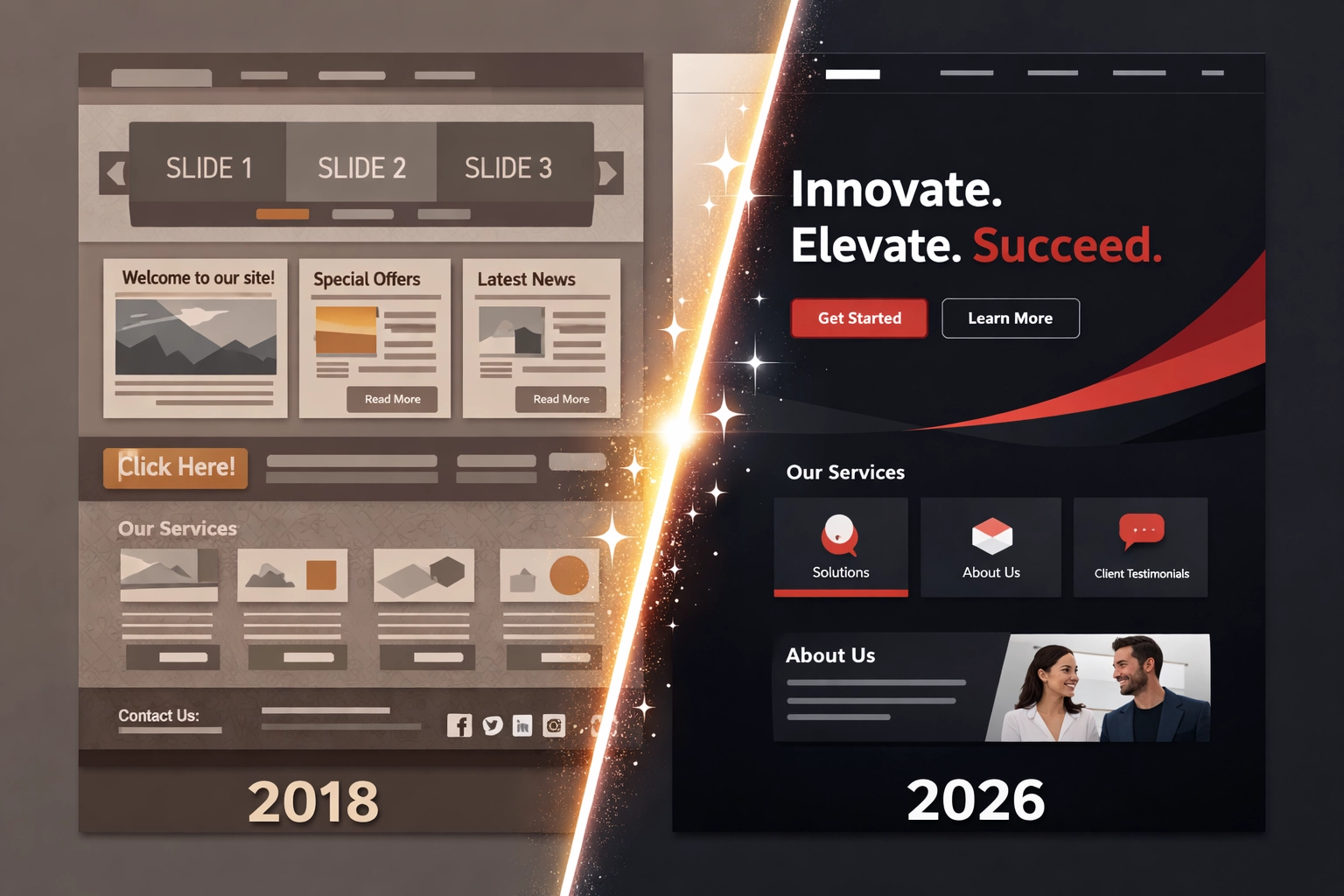
3. Your Design Screams “2018 Called”
Visual design matters more than you might think. Users make snap judgments about your credibility within milliseconds of landing on your site.
If your website looks dated, potential customers assume your business is dated too. It’s not fair, but it’s how perception works.
Common signs your design is showing its age include carousel sliders at the top of your homepage, cluttered layouts trying to cram everything above the fold, outdated fonts and color schemes that feel “off,” and generic stock photos that look like they came from a 2015 catalogue.
Here’s what you need to know: You don’t need to chase every design trend. What you need is a clean, modern, professional look that will stay current for 3-5 years. Simple, uncluttered layouts with plenty of white space, clear typography, and authentic imagery (even simple ones) will always beat flashy gimmicks.
Think about the websites you trust and use regularly. They’re probably not the fanciest, but they’re clean, fast, and easy to use. That’s what your customers expect from you.

4. Your Content Hasn’t Changed Since Launch
Nothing signals neglect quite like stale content.
If your blog’s last post is from 2023, your service pages contain outdated information, or your copyright date at the bottom still says “2020,” you’re telling visitors that your business isn’t active or growing.
Why this matters for you: Search engines love fresh, updated content. They interpret regular updates as a signal that your site is active and relevant. Stale content suggests the opposite, which can hurt your rankings.
More importantly, outdated information erodes trust. If you can’t keep basic details current on your website, customers wonder whether they can trust you to deliver quality work.
Take a look at your About page. Does it reflect where your business is today? Check your service descriptions: are they accurate? When someone lands on your site, can they tell you’re an active, thriving business, or does it feel like they’ve stumbled onto an abandoned storefront?
5. Security and Trust Signals Are Missing
In 2026, security isn’t optional: it’s expected.
Outdated websites often lack the trust signals modern users look for: clear calls to action, recent customer testimonials or reviews, updated case studies or portfolio work, and obvious contact information.
But the biggest red flag is security. If your site shows “Not Secure” in the browser bar because you don’t have an SSL certificate, you’ve got a serious problem. Broken links, missing images, and outdated plugins all signal to both Google and your visitors that this site isn’t being maintained.
What this means: With data privacy regulations getting stricter and security breaches making headlines, customers are cautious about sharing information with businesses that appear to have lax security. Every security warning, broken element, or missing trust signal is a reason for them to go to a competitor instead.
Check your site for these basics: Does it have HTTPS (the padlock icon)? Are all your forms working? Do all your images load properly? Are your testimonials current? If you’re missing any of these, you’re leaving money on the table.
Refresh or Rebuild? Here’s How to Decide
You’ve identified the problems. Now you’re wondering: do I need a quick refresh or a complete rebuild?
Here’s a simple checklist to help you decide:
You probably need a refresh if:
- Your site is less than 4 years old
- The overall structure and navigation still work
- You mainly need speed improvements, content updates, and mobile optimisation
- Your brand identity is still current
- The core functionality meets your needs
You likely need a rebuild if:
- Your site is 5+ years old
- The technology platform is outdated or unsupported
- You need significant new functionality (e-commerce, booking systems, etc.)
- Your brand has evolved and the site no longer reflects it
- Multiple fundamental issues exist across design, speed, mobile, and security
The truth is, if you’re checking three or more boxes in that second list, a rebuild is probably more cost-effective in the long run than trying to patch an outdated foundation.
The Benefits of Getting It Right
Whether you refresh or rebuild, updating your website delivers tangible benefits:
Better search rankings: Modern, fast, mobile-optimised sites rank higher. It’s that simple.
Higher conversion rates: When your site loads quickly, looks professional, and makes it easy for customers to take action, more of them do.
Improved credibility: A current, well-maintained website signals that you’re a serious business worth trusting.
Lower bounce rates: When visitors find what they need quickly on a site that works well, they stick around longer and explore more pages.
Future-proofing: Building or updating with modern standards means your site will stay relevant longer.
What Happens Next?
If you’ve recognised your website in any of these five signs, don’t panic: but don’t wait either.
Start by running those quick checks we mentioned: test your speed, check your mobile experience, review your content freshness, and verify your security. That will give you a clear picture of where you stand.
But what if you want a quick, visual way to see what your site looks like through a “modern website” lens, without committing to a full project yet?
The perfect next step: use the Bamsh Website Preview Tool
Our Website Preview Tool is built for this exact moment. If your site feels outdated but you’re not sure what to tackle first, it helps you get clarity fast.
Here’s the key: it’s not just “a report”, it’s a practical next step that helps you decide whether you need a refresh, a rebuild, or just a few focused fixes.
While you’re planning your next move, it’s also worth checking your budget range using the Bamsh Website Cost Estimator so you’re not guessing at numbers.
Website Preview Tool vs “doing nothing” vs jumping straight into a rebuild
If you’re thinking “Should I just leave it for now, or rip the whole thing up?”, this table makes it simpler.
| Option | What you get | Best for | The downside |
|---|---|---|---|
| Do nothing for now | No time spent, no short-term cost | Sites that are already performing well | You keep losing leads if your site is slow, dated, or confusing |
| Use the Website Preview Tool | A clear next step that helps you see what’s outdated and what to prioritise | You want clarity before spending money or time | You still need to act on the findings (either DIY or with help) |
| Jump straight into a rebuild | A brand new site and a clean slate | Your site is 5+ years old or the tech is holding you back | You can over-spend if a refresh would have solved most issues |
FAQs: Website Preview Tool (and what to do if your site is outdated)
Is the Website Preview Tool only for Bristol businesses?
No. It works for any business with a live website URL, whether you’re in Bristol or anywhere else in the UK.
Will it tell me if I need a refresh or a full rebuild?
It will help you spot the most obvious “outdated” problems and prioritise fixes. If the issues are structural (platform limitations, messy navigation, broken templates), that’s usually a rebuild conversation.
What if my site is slow, but everything else seems fine?
That’s a classic refresh scenario. Speed fixes (images, hosting, plugins, code tidy-up) often deliver a big win without changing your whole website.
Do I need to be technical to use it?
No. If you can copy and paste your website address, you’re good. We keep it no-jargon for a reason.
What should I do after I use the tool?
Pick one of three paths:
- Fix a few quick wins yourself (content updates, image compression, broken links)
- Use the Bamsh Website Cost Estimator to sanity-check budget and scope
- Talk to us if you want an honest steer on refresh vs rebuild: https://bamsh.co.uk/web-design
From there, you’ve got options. If you’re handy with technology, you might tackle some quick wins yourself: updating content, optimising images, or refreshing copy. But for the technical stuff: speed optimisation, mobile responsiveness, security updates: you’ll want professional help.
That’s where we come in. At Bamsh, we work with Bristol businesses to create websites that actually work for them. We keep things jargon-free, we’re transparent about what you need (and what you don’t), and we focus on results that matter to your business.
If you’re ready to update your website or you’re still trying to figure out whether you need a refresh or a rebuild, let’s have a chat. We’ll give you an honest assessment and help you figure out the best path forward.
Your website should be working for you, not against you. If it’s not doing that right now, 2026 is the year to fix it.