

Many businesses in South Wales watch promising enquiries slip away simply because they are not sure how to keep the conversation going. With buying journeys growing longer and more complex, reaching the right person with the right message at the right time has never mattered more. By understanding the power of lead nurturing and blending automation with personalisation, you can build stronger relationships that turn more prospects into loyal customers while reducing lost opportunities to competitors. Strengthen your strategy and see higher conversion rates with a targeted, thoughtful approach.
Table of Contents
- Defining Lead Nurturing In Modern Marketing
- Types Of Lead Nurturing Strategies Explained
- Automation, Crm, And Lead Nurturing Tools
- Key Stages Of An Effective Lead Nurture Funnel
- Avoiding Common Lead Nurturing Mistakes
Key Takeaways
| Point | Details |
|---|---|
| Lead Nurturing Importance | Building relationships with potential customers through tailored content leads to increased trust and conversion rates. |
| Tailored Strategies | Different nurturing strategies should be applied based on lead categories: cold, warm, and hot, ensuring targeted communication. |
| Automation and Personalisation | Combining automation with personalisation saves time and enhances engagement, allowing for efficient follow-up while maintaining meaningful connections. |
| Continuous Improvement | Regularly measure and refine nurturing efforts based on performance metrics to optimise conversion at each stage of the funnel. |
Defining Lead Nurturing in Modern Marketing
Lead nurturing is simply the process of building and strengthening relationships with potential customers throughout their buying journey. Rather than pushing a sale immediately, you provide relevant information that addresses their specific concerns and challenges at exactly the right moment. The goal is straightforward: develop trust, guide prospects toward action, and turn enquiries into loyal customers without resorting to aggressive tactics.
At its core, lead nurturing means delivering tailored content at each stage when prospects are most receptive to it. Someone in the early awareness stage needs different information than someone ready to make a purchase decision. You wouldn’t hand a first-time enquirer a price list, just as you wouldn’t overwhelm them with educational content when they’re already convinced and ready to buy. The real skill lies in understanding where each prospect sits and providing exactly what they need to move forward.
Modern lead nurturing relies heavily on two critical components: marketing automation and personalisation. Automation handles the repetitive work of sending follow-up emails, tracking engagement, and scoring leads based on their behaviour. Personalisation ensures that every message feels relevant to that specific person, not a generic broadcast. When done correctly, prospects feel understood rather than bombarded.
For marketing managers in South Wales, this approach transforms how you think about enquiries. Instead of losing interest after an initial contact, you maintain consistent communication that builds credibility and keeps your business top of mind. Prospects who receive nurturing are significantly more likely to convert because you’ve earned their trust through valuable, timely information.
The reality is that most enquiries aren’t ready to buy immediately. Some need weeks or months to make a decision. Without proper nurturing, those potential customers drift toward competitors who stay engaged with them. Your job is to remain present, helpful, and relevant throughout that entire journey.
Pro tip: Start mapping your prospect’s journey right now. List what information a potential customer needs to know at each stage: awareness, consideration, and decision. This becomes the foundation for your nurturing strategy and helps you create content that actually resonates.
Types of Lead Nurturing Strategies Explained
Not all leads are the same, and neither should your nurturing approach be. Different strategies work better depending on where prospects sit in their journey and how ready they are to engage. Understanding these variations helps you allocate your effort wisely and see better results from your marketing investment.
One fundamental approach divides leads into three categories: cold, warm, and hot. Cold leads are just beginning to explore solutions and need educational content that builds awareness. Warm leads show genuine interest and respond well to targeted messaging that highlights how you solve their specific problems. Hot leads are nearly ready to purchase and benefit most from case studies, testimonials, and direct conversations with your sales team. Tailoring your approach to each category ensures you’re not wasting effort on tactics that don’t match their readiness level.
Automated lead nurturing works effectively for straightforward situations like new leads, short sales cycles, and lower-value deals. For complex B2B sales or longer decision processes, however, personalised and consultative approaches often deliver stronger results. The key is matching your strategy to your specific situation rather than assuming one size fits all.

Blending sales and marketing efforts across multiple channels creates the strongest nurturing programmes. Email remains highly effective, but successful strategies also incorporate social media, webinars, thought leadership content, and direct phone conversations. Interactive opportunities like webinars or one-on-one consultations build genuine relationships that pure automation cannot achieve.
For small and medium-sized businesses in South Wales, the sweet spot often lies in combining automation with personal touches. Use automation to handle consistent follow-ups and segment your audience, but reserve genuine conversations for prospects showing serious intent. This approach scales your efforts without losing the human connection that builds real loyalty.
Pro tip: Create a simple matrix showing which nurturing tactics work best for each lead stage and customer type you serve. This prevents your team from applying random tactics and ensures consistency across all customer interactions.
Automation, CRM, and Lead Nurturing Tools
Manually following up with every enquiry is exhausting. You send an email, wait for a reply, send another email, check for engagement, adjust your messaging. By the time you’ve done this for ten prospects, you’ve spent hours on repetitive work that could be handled automatically. This is where the right tools make all the difference.
A solid Customer Relationship Management (CRM) system becomes the backbone of your nurturing efforts. It captures every interaction with a prospect, tracks their behaviour, and gives your team visibility into where each lead sits in the buying process. When your entire team can see the same information, nobody falls through the cracks. Sales and marketing work from the same playbook instead of duplicating effort or contradicting each other.
AI-powered CRM software enhances customer engagement5/1305132139.pdf) by analysing data in real-time and personalising interactions automatically. These systems score leads based on behaviour, identify which prospects are sales-ready, and recommend next actions. Rather than guessing which leads matter most, you have data-driven insights showing exactly who to prioritise.
Marketing automation handles the repetitive tasks that drain your team’s time. Triggered email sequences send follow-ups based on specific actions a prospect takes. Someone downloads a guide? An email series introduces your services. Do they visit your pricing page? A different sequence addresses common objections. This happens 24/7 without your team lifting a finger.
The magic happens when you combine automation with human judgment. Automation keeps every prospect engaged and on track through the nurturing pipeline. Your team then focuses on having meaningful conversations with prospects who show genuine intent. Automation in lead generation works best when it handles volume, whilst humans build relationships.
For marketing managers in South Wales running lean teams, this combination is a game-changer. You get the consistency of automation without losing the personal touch that builds trust and converts leads into customers.
Compare how automation and personalisation impact lead nurturing effectiveness:
| Component | Role in Nurturing | Business Impact | Example Tool/Technique |
|---|---|---|---|
| Automation | Manages repetitive tasks | Saves time, increases consistency | Automated email sequences |
| Personalisation | Targets individual needs | Boosts engagement, builds trust | Segmented emails, tailored content |
| CRM Integration | Tracks prospect activities | Improves collaboration, prevents lost leads | AI-powered CRM |
Pro tip: Start by mapping your ideal prospect’s journey in your CRM, then build automated sequences that trigger at each key step. Test and refine these sequences monthly using engagement data, gradually improving your conversion rates without adding headcount.
Key Stages of an Effective Lead Nurture Funnel
Think of your lead nurture funnel as a journey with distinct checkpoints. Each stage requires different information, different messaging, and different tactics. Move someone too quickly towards a sale and you’ll lose them. Move them too slowly, and they’ll drift towards a competitor. Getting the stages right is what separates businesses that convert enquiries from those that lose them.
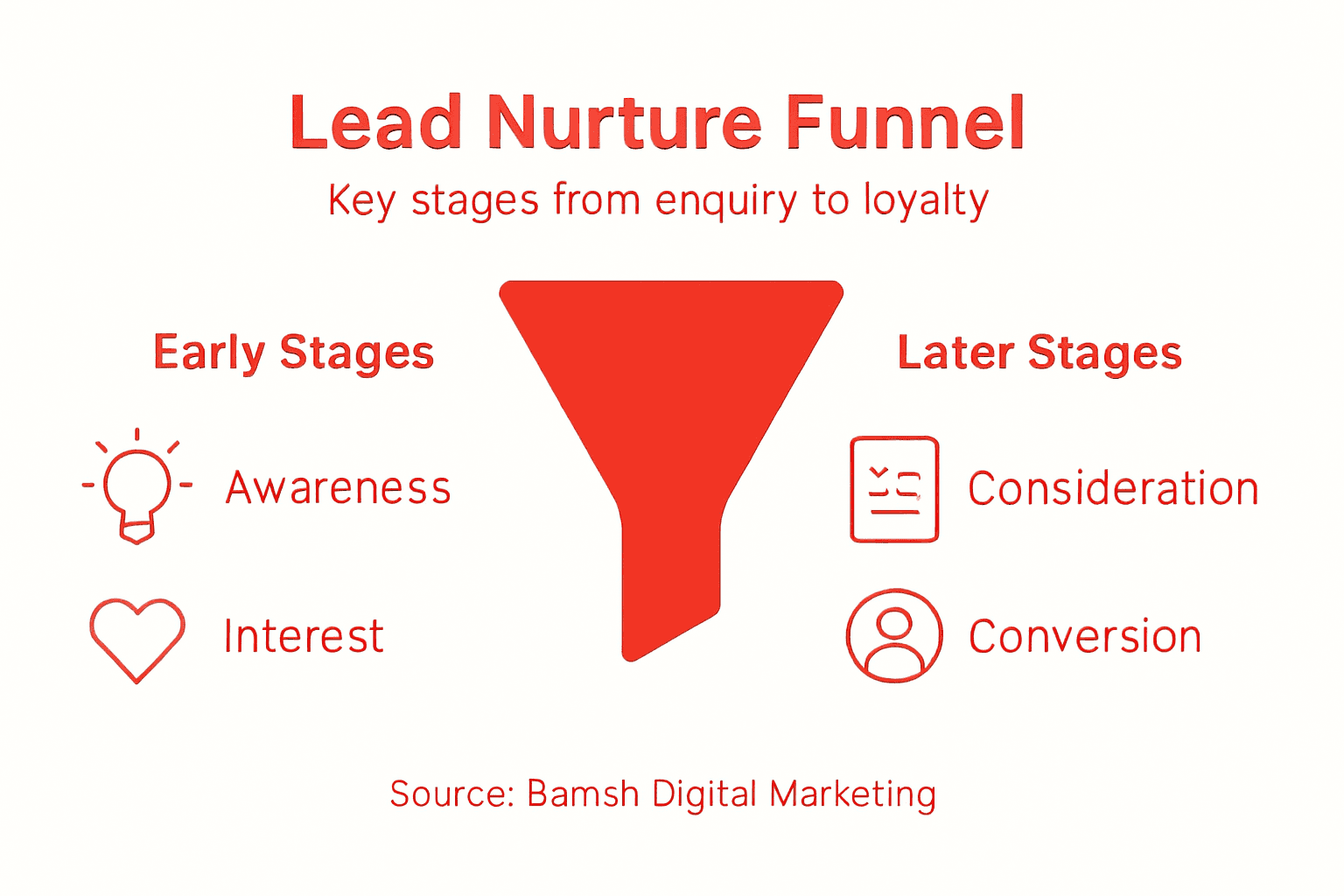
The journey begins with Awareness. Prospects don’t yet know you exist or that your solution addresses their problem. Your job at this stage is visibility and education. Blog content, social media, search ads, and local listings get you in front of people searching for answers. You’re building the initial awareness that starts the entire funnel.
Next comes Interest. Someone has found you and wants to know more about how you help. This is where you offer something of value, like a guide, webinar, or consultation. They exchange their contact information for genuine insight. You’ve moved from a stranger to someone actively curious about your services.
Consideration is where prospects compare their options. They’re not just thinking about you, they’re thinking about competitors, too. Case studies, testimonials, and detailed explanations of your approach work well here. The lead conversion process moves through this stage by demonstrating clear advantages and building confidence.
Intent signals that a prospect is ready to buy. They’ve moved past exploration and now want pricing, timelines, or next steps. Direct conversations with your sales team become valuable. Objection handling and personalised proposals become your focus. Some businesses miss this stage entirely and lose deals by not recognising when someone is ready.
Conversion is the actual purchase. But your work isn’t finished. Retention nurturing begins immediately. Onboarding, regular check-ins, and proactive support turn customers into advocates. Nurture funnel stages extend beyond purchase to maximise lifetime value.
For South Wales businesses, understanding these stages means you can stop treating all prospects the same. Different content, different channels, different conversations for each stage.
Here is a quick summary of lead nurturing stages with objectives and suggested content for each:
| Funnel Stage | Main Objective | Recommended Content | Key Marketing Channel |
|---|---|---|---|
| Awareness | Build brand visibility | Educational blog posts | Social media and search |
| Interest | Encourage engagement | Free guides or webinars | Email capture landing page |
| Consideration | Demonstrate unique value | Case studies and testimonials | Email and website |
| Intent | Address objections and close | Personalised proposals | Direct sales calls |
| Conversion | Confirm sale and onboard | Welcome packs, onboarding | CRM follow-ups |
| Retention | Maximise customer loyalty | Exclusive offers, support | Account management |
Pro tip: Map your current customer journeys stage by stage and identify which stages are weakest for your business. Often, it’s not awareness that’s the problem; it’s the consideration of intent transition where deals stall.
Avoiding Common Lead Nurturing Mistakes
Most businesses fail at lead nurturing not because they lack good intentions, but because they stumble on preventable mistakes. These errors waste time, damage relationships, and leave money on the table. The good news is that knowing what to avoid puts you ahead of your competition.
One of the biggest mistakes is treating sales and marketing as separate operations. Marketing generates leads and hands them over to sales, then checks out. Sales complains that the leads are of poor quality. Meanwhile, prospects fall through the cracks because nobody owns their journey. Your teams need aligned objectives, shared visibility into prospect progress, and regular communication about what’s working.
Another critical error is one-size-fits-all messaging. Sending the same generic email to every prospect feels lazy and converts poorly. Personalisation and segmentation are non-negotiable for effective nurturing. Someone in the awareness stage needs completely different content than someone ready to buy. Segment by industry, company size, stage in the buying journey, or behaviour. Then craft messages that actually speak to their specific situation.
Neglecting to measure and refine is another common pitfall. You set up email sequences, send them out, and assume everything is working. Without tracking open rates, click-through rates, and conversion data, you’re flying blind. You can’t improve what you don’t measure. Review your metrics monthly and adjust based on what the data tells you.
Many businesses also rush the nurturing process or execute it superficially. They send one or two follow-ups and expect immediate results. Real nurturing takes time and consistency. Some prospects need weeks or months of valuable touchpoints before they’re ready to engage. Stick with it and do it genuinely.
For marketing managers in South Wales, avoid the trap of launching nurturing campaigns without clear planning. Define your objectives upfront. What does success look like for each stage? Who owns what? What content will you send and when? A little planning prevents wasted effort and false starts.
Pro tip: Audit your current nurturing efforts by looking at what happens to a lead after first contact. Map every email, call, and touchpoint they receive over the next 90 days. You’ll quickly spot gaps, duplications, and timing issues that kill conversions.
Turn Your Enquiries Into Loyal Customers With Bamsh Digital Marketing
If you find that your potential customers drift away after the first contact or struggle to move through those key nurture funnel stages discussed in the article, you are not alone. The challenge often lies in managing lead nurturing with consistent, personalised care — from early awareness to conversion and beyond. With so many moving parts like automation, CRM integration, and targeted content, trying to do this manually can feel overwhelming and time-consuming.
Bamsh Digital Marketing specialises in solving these exact pain points with expert solutions like CRM Setup & Automated Lead Nurturing, designed to capture, score, and nurture enquiries automatically. Our transparent, data-driven approach ensures your prospects receive the right content at the right moment to build trust and guide them confidently toward purchase. Whether you need help optimising your marketing automation or combining it with tailored personal touches, we make scaling your lead conversion process stress-free and consistent.
Ready to stop losing leads and start building loyal customers? Discover how our proven growth strategies can transform your enquiry management and deliver predictable revenue. Book your free 15-minute consultation today at Bamsh Digital Marketing and take the first step towards stronger lead nurturing and measurable growth.
Frequently Asked Questions
What is lead nurturing?
Lead nurturing is the process of building and strengthening relationships with potential customers throughout their buying journey by providing relevant information that addresses their specific concerns at the right moment.
Why is personalisation important in lead nurturing?
Personalisation ensures that every message sent to prospects feels relevant and tailored to their specific needs, which increases engagement and helps build trust between the business and potential customers.
How can automation improve lead nurturing efforts?
Automation can manage repetitive tasks such as sending follow-up emails and tracking engagement, allowing teams to focus on more meaningful interactions with leads and ensuring consistent communication throughout the nurturing process.
What are the key stages of a lead nurture funnel?
The key stages of a lead nurture funnel include Awareness, Interest, Consideration, Intent, Conversion, and Retention, with different objectives and content recommended for each stage to effectively guide prospects through their decision-making journey.