

Many small business owners in the South West UK find themselves facing a wall of jargon, vague promises, and reports that leave them more frustrated than informed. Clarity and honesty matter now more than ever, as customers expect to see exactly how their data is used and what real value comes from their marketing spend. By focusing on marketing transparency, you earn trust, reduce confusion, and set a clear foundation for stronger, more profitable relationships.
Table of Contents
- Marketing Transparency – Definition And Misconceptions
- Types Of Transparency In Digital Marketing
- How Transparent Marketing Builds Trust And Results
- Legal And Ethical Obligations For UK Marketers
- Common Pitfalls And Best Practices To Avoid
Key Takeaways
| Point | Details |
|---|---|
| Importance of Transparency | Marketing transparency fosters trust, leading to longer client relationships and higher retention rates. |
| Types of Transparency | Focus on data, strategic, financial, and performance transparency to build customer trust effectively. |
| Consistent Communication | Regularly communicate key metrics to customers in plain language to avoid confusion and enhance trust. |
| Legal Compliance | Adhere to UK regulations on marketing transparency to protect your business and maintain credibility. |
Marketing transparency – definition and misconceptions
Marketing transparency is the practice of being honest, open, and clear about how you acquire and use customer data, what your marketing actually delivers, and where your budget goes. It’s the opposite of smoke and mirrors.
Many business owners think transparency simply means posting privacy policies or listing your fees online. That’s a start, but it’s not the full picture. Transparency involves two key approaches: ensuring information is accurate and verifiable, and understanding how that openness actually affects customer relationships and business results.
Here are the most common misconceptions:
- Transparency means giving away all your business secrets or strategies
- It requires constant, overwhelming communication with customers
- It only matters for large corporations with dedicated compliance teams
- Transparent marketing costs more money than traditional marketing
- Customers don’t actually care whether you’re transparent
The reality is different. Transparency is about being honest within sensible boundaries. You don’t reveal proprietary processes, but you do explain what you’re doing and why.
For small businesses in the South West, this means telling your customers straightforwardly: “Here’s what we found in your account. Here’s what we did. Here’s the result.” It means showing them the leads you generated, the cost per lead, and the revenue impact.
Transparency isn’t about perfection—it’s about honesty. Your customers respect businesses that admit what they don’t know and show what they do.
Why does this matter to your bottom line? Transparent businesses build trust faster. Trust leads to longer customer relationships, better retention, and more referrals. When you stop hiding behind jargon and start explaining what’s really happening, customers feel confident committing to longer partnerships.
Think about it from your customer’s perspective. Would you rather work with a marketer who hands you a complex report you don’t understand, or one who breaks down what happened in plain language and shows you exactly what you got for your money?
Pro tip: Start tracking and communicating one transparent metric this month—whether it’s leads generated, cost per acquisition, or revenue attributed to your marketing. Pick something simple, measure it honestly, and show your customer the number every single month.
Types of transparency in digital marketing
Transparency in digital marketing comes in multiple forms, each serving a different purpose in building trust with your customers. Understanding these types helps you identify what your business should prioritise.
Access to information is the foundation. This means your customers can actually find the data they need about your marketing activities. They should be able to see what channels you’re using, what you’re spending, and what results you’re achieving. No hidden reports or buried metrics.
Presentation for comprehension is equally important. Raw data means nothing if your customer can’t understand it. A spreadsheet full of numbers isn’t transparent if nobody knows what those numbers mean. You need to translate the technical details into language your customer actually grasps.

Clarity in communication prevents misunderstandings before they happen. When you explain your strategy, your tactics, and your results, you remove the ambiguity that breeds doubt. Clear communication means straightforward sentences, plain English, and no marketing jargon.
Absence of deception is non-negotiable. Information transparency also depends on credibility and verifiability—your claims need to be provable. If you say you generated 50 leads, you should be able to show proof. If you claim your strategy works, you should have evidence.
For your business, this breaks down into four practical types:
To highlight how transparency impacts business outcomes, here’s a summary of transparency types and their primary advantages:
| Transparency Type | Key Advantage | Example Benefit |
|---|---|---|
| Data transparency | Greater accountability in campaigns | Clients see actual results |
| Strategic transparency | Improved expectation management | Clear understanding of actions |
| Financial transparency | Reduced billing surprises | No hidden charges |
| Performance transparency | Enhanced trust through honest reporting | Stronger client loyalty |
- Data transparency: You show customers exactly what your campaigns are doing and how much they cost
- Strategic transparency: You explain why you’re doing what you’re doing and what results to expect
- Financial transparency: You break down costs clearly so there are no surprises
- Performance transparency: You report results honestly, including what didn’t work as well as what did
The types of transparency that matter most are the ones your customers actually need to see. Don’t overwhelm them with everything—focus on what drives their decisions.
Many businesses think they can pick and choose which types to use. That rarely works. Customers quickly spot when you’re being transparent about some things but evasive about others. Your best approach is consistent transparency across all four areas.
For small businesses in the South West competing against larger agencies, this is your advantage. You can be transparent in ways bigger competitors won’t because you’re agile and honest about your limitations as well as your strengths.
Pro tip: Map out which of these four transparency types you’re currently strongest in, then pick the weakest one and commit to improving it this quarter. Usually it’s financial or strategic transparency that needs work.
How transparent marketing builds trust and results
Transparent marketing works because it removes the gap between what you promise and what you deliver. When customers know exactly what to expect, they’re rarely disappointed. When they’re not disappointed, they trust you more.
Trust is the currency of business. It’s what turns a one-time customer into a loyal repeat client. It’s what makes someone recommend you to a friend. And transparent marketing builds that trust by providing honest information upfront, so customers understand precisely what they’re paying for and what results they should anticipate.
Here’s the practical chain of events. You tell a customer exactly what your marketing will do. You show them the metrics that matter. You report results honestly, including what didn’t work as expected. The customer sees you’re truthful. They believe what you tell them next. They stay longer. They spend more. They refer others.
Consider what happens without transparency. A customer hires you, receives a confusing report full of numbers they don’t understand, and feels anxious about whether they got value. That anxiety breeds doubt. Doubt leads to cancellation.
Transparency and ethical marketing practices enhance consumer trust by demonstrating genuine honesty and integrity. This directly improves your marketing outcomes because customers become advocates rather than skeptics.
For your business, this translates into tangible benefits:
- Longer client relationships: Customers who trust you stay with you longer
- Higher lifetime value: Loyal clients spend more over time
- Better referrals: Trusted customers recommend you actively
- Lower acquisition costs: Word-of-mouth reduces your marketing spend
- Easier upsells: Customers willing to try new services from partners they trust
Trust isn’t built in a single conversation. It’s built through consistent, honest communication month after month, showing that you deliver on what you promise.
Small businesses have an advantage here. You’re nimble enough to respond quickly to problems. You’re close enough to your customers to have real conversations. You can be genuinely transparent in ways larger agencies struggle with.
The key is consistency. If you’re transparent about some things but evasive about others, customers notice. They lose trust faster than if you’d never tried to be transparent at all.
Showing performance data actually strengthens relationships because it puts the customer in control of decision-making. When they can see exactly what’s working and what isn’t, they feel empowered rather than manipulated.
Pro tip: Start sharing one specific metric monthly with every client—leads generated, cost per lead, or revenue attributed to your campaigns. Pick the number that matters most to them and report it honestly, even when results are below target.
Legal and ethical obligations for UK marketers
If you’re marketing in the United Kingdom, you operate within a strict framework of legal requirements. Ignoring these isn’t just risky—it can damage your reputation and cost you money.
UK marketers must comply with regulations governing transparency in advertising and marketing practices. These rules address unfair competition, misleading advertising, and transparency in online marketing. The key principle is simple: your marketing communications must be truthful, non-deceptive, and provide all required disclosures to protect consumers.
This affects everything you do. Your Google Ads copy. Your email campaigns. Your social media posts. Your website claims about results. All of it must be honest and verifiable.
Beyond legal compliance, you also face ethical obligations. Ethical marketing practices stress honesty, fairness, and respect in all communication, whilst avoiding deceptive advertising and respecting consumer privacy. With digital marketing rising, data protection and non-exploitative tactics are paramount.
For your business, this breaks down into specific areas you need to address:
Here’s a quick reference summarising UK legal obligations for marketing transparency:
| Regulation | Focus Area | Implication for Businesses |
|---|---|---|
| ASA standards | Truthful, legal advertising | All claims must be genuine |
| GDPR compliance | Data security and processing | Safeguard consumer information |
| Consumer Rights Act | Fair commercial practice | Avoid misleading or unfair tactics |
| Competition law | Honest comparison and claims | No false competitor statements |
| Disclosure requirement | Clear sponsorship indication | Mark paid partnerships transparently |
- Advertising Standards Authority (ASA) compliance: All ads must be honest, legal, and decent
- Data protection: You must follow GDPR rules when collecting and using customer data
- Consumer Rights Act: You cannot engage in unfair commercial practices
- Competition law: You cannot make false claims about competitors or your own services
- Disclosure requirements: Hidden sponsorships, affiliate links, and paid partnerships must be clearly marked
Many small business owners think these rules are for big corporations with legal teams. Wrong. The ASA targets businesses of all sizes. A misleading claim about results can trigger a complaint, investigation, and a requirement to remove your advertising.
Breaking these rules damages trust far more than transparent marketing ever could. One complaint can undo months of relationship-building.
The practical reality is this: transparent marketing naturally keeps you compliant. When you’re honest about what you do and what results you deliver, you’re already following the rules. When you start exaggerating claims or hiding information, you cross the line.
Small businesses actually have an advantage. You can build compliance into your processes from the start rather than trying to retrofit it later like larger agencies do.
Pro tip: Document your marketing claims with evidence before you publish them. If you say you generated 50 leads, keep records proving it. If you claim results, have proof. This protects you legally and makes transparency effortless.
Common pitfalls and best practices to avoid
Transparency sounds straightforward until you try to implement it. That’s when most businesses hit problems. Understanding the pitfalls helps you avoid expensive mistakes.
The biggest pitfall is information overload. You dump raw data on your customer thinking you’re being transparent. They receive a 40-page report full of metrics they don’t understand. Confusion isn’t transparency—it’s the opposite.
Common pitfalls in marketing transparency include overloading customers with excessive information and failing to balance transparency with strategic communication. You need clarity, not volume.
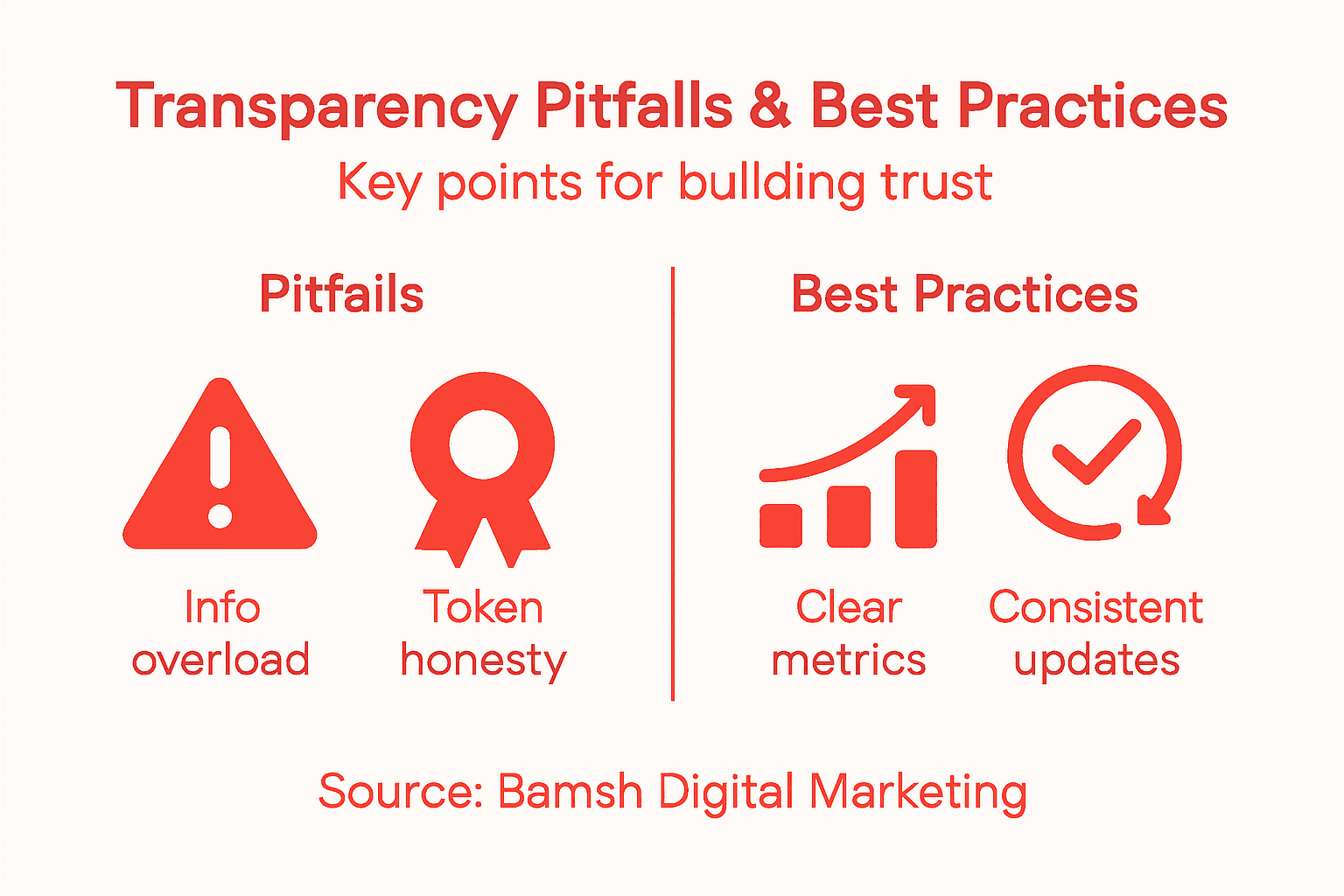
Another dangerous trap is token transparency. You share some information but hide the parts that make you look bad. Customers sense this immediately. Selective transparency destroys trust faster than no transparency at all.
Complexity in message presentation creates consumer confusion. If your explanation requires a PhD to understand, it’s not transparent. Best practices focus on ensuring transparency is non-arbitrary, specific, and accessible, supported by clear communication that customers actually comprehend.
Here are the pitfalls to avoid:
- Dumping data without context: Numbers mean nothing without explanation
- Hiding negative results: Mentioning only what worked damages credibility
- Using jargon and technical language: Your customer isn’t an expert in your field
- Inconsistent reporting: Changing metrics monthly confuses stakeholders
- Over-promising to balance bad news: This creates the trust problems you’re trying to prevent
The best practices are simpler than you’d expect. Pick the three metrics that actually matter to your customer. Report them every month in plain language. Explain what happened and why. Include both wins and shortfalls. That’s it.
Transparency isn’t about being perfect. It’s about being honest and consistent, which is far more valuable to customers than flawless results.
Consistency matters enormously. When you report the same metrics in the same format every month, customers develop trust because they know exactly what to expect. When you suddenly change what you’re measuring, they wonder what you’re hiding.
Another best practice is anticipating concerns. If results are below target, explain why before your customer has to ask. This positions you as honest rather than evasive. It also shows you’re paying attention and thinking about their business.
Small businesses can outperform larger agencies here because you can personalise your communication. A major agency sends templated reports. You can write directly to your customer about their specific situation.
Pro tip: Create a one-page summary of your customer’s three key metrics at the top of every report, with plain-English explanations of what changed and why. Everything else supports that summary.
Boost Your Business with Radical Marketing Transparency
The challenge businesses face today is clear: customers demand honesty and openness in marketing. As explored in the article, marketing transparency is not just about sharing data but about explaining your strategy, showing clear results, and building genuine trust. Many businesses struggle with confusing reports, hidden costs, and unclear communication which undermines customer confidence and damages long-term relationships.
At Bamsh Digital Marketing, we understand these pain points deeply. Our approach aligns perfectly with the principles of transparency outlined in the article. We provide clear, jargon-free reporting and keep you informed every step of the way so you truly understand where your marketing budget goes and how it grows your business. Whether it is through targeted Google Ads, social media campaigns, or automated lead nurturing, we deliver honest results you can trust.
Ready to see how transparent marketing can transform your customer relationships and boost your results? Discover our straight-talking, results-driven services tailored for businesses who value clarity and trust. Explore our Social Media Marketing Agency Bristol to find out how targeted advertising meets transparent reporting. Tune into insights and reports in our podcasts for practical transparency tips. Don’t wait to build longer client relationships based on honesty. Book a no-obligation 15-minute call with us today at Bamsh Digital Marketing and start growing your business with integrity and confidence.
Frequently Asked Questions
What is marketing transparency?
Marketing transparency is the practice of being honest and clear about how you acquire and use customer data, your marketing efforts, and how your budget is allocated. It focuses on providing accurate and verifiable information to build trust with customers.
Why is marketing transparency important for businesses?
Marketing transparency builds trust with customers, leading to longer relationships, better retention, and increased referrals. When customers understand what to expect from your marketing efforts, they are more likely to feel confident and commit to your services.
What types of transparency should businesses focus on?
Businesses should focus on four types of transparency: data transparency (showing campaign results), strategic transparency (explaining marketing strategies), financial transparency (breaking down costs clearly), and performance transparency (reporting results honestly, including both successes and failures).
How can I implement transparent marketing practices?
To implement transparent marketing practices, start by tracking and communicating key metrics that matter to your customers. Use clear language to explain these metrics in monthly reports, and ensure consistency in what you measure and how you present the information.
Recommended
- Mastering SEM Techniques to Drive Digital Growth – Bamsh Digital Marketing
- Why Free Marketing Audits Build Trust and Drive Results
- Mastering Digital Marketing: Strategies for Success
- Ethics Policy – Bamsh Digital Marketing Integrity & Trust