

TL;DR:
- AI answer engines prioritize clear, concise, and trustworthy content for direct citations.
- Traditional SEO and AEO overlap but differ in goal focus and content structuring strategies.
- Effective AEO requires a mindset shift towards transparency, completeness, and multi-platform presence.
If you’ve been investing in SEO and still watching your leads stagnate, you’re not alone. Across the UK, small and medium businesses are doing everything right by traditional standards, yet finding themselves invisible where it matters most. The reason? AI-powered answer engines like ChatGPT, Google’s Search Generative Experience, and Bing Copilot are reshaping how people find information. They don’t just list links. They deliver direct answers. Answer Engine Optimisation (AEO) is the strategy built for this new reality. This guide explains what AEO is, how it differs from traditional SEO, and exactly how to use it to generate more leads for your business.
Table of Contents
- What is answer engine optimisation (AEO)?
- How AEO compares to traditional SEO
- Essential strategies for effective AEO
- Winning visibility across answer engines and platforms
- The hidden truth: why AEO is a mindset shift, not just a tactic
- Boost your visibility with expert AEO support
- Frequently asked questions
Key Takeaways
| Point | Details |
|---|---|
| AEO definition | AEO is optimising your content so AI-powered answer engines can extract, cite, and trust your answers. |
| Key AEO vs SEO difference | AEO builds on SEO foundations but focuses on clear citations and answer capsules across platforms. |
| Multi-platform impact | 80% of answer engine traffic now occurs away from Google, so visibility means appearing everywhere. |
| Actionable strategies | Use schema markup, self-contained Q&A content, and transparent brand mentions for maximum AI visibility. |
| Trust and compliance | Transparent, compliant answers build trust with AI engines and users, supporting sustainable lead growth. |
What is Answer Engine Optimisation?
AEO is the practice of structuring your content so that AI-powered answer engines can extract, trust, and cite it as a direct response to a user’s question. Think of it this way: traditional search engines show people a list of links and let them choose. Answer engines skip that step entirely. They read your content, decide if it’s trustworthy and clear, and then present your answer directly to the user, often without them ever clicking through to your site.
For a UK business owner, this changes everything. Your potential customers are increasingly asking questions like “What’s the best accountant in Manchester?” or “How do I fix a leaking boiler?” directly into AI tools. If your content isn’t structured to answer those questions clearly, you simply won’t appear.
Here’s what Answer Engine Optimisation enables for your business:
- Greater visibility in AI-generated answer boxes and citations
- Stronger authority as a trusted source in your industry
- More qualified leads from users who already trust the answer you provided
- Broader reach across multiple platforms beyond Google
As AEO explained on our site, the goal is to become the source that AI engines rely on, not just a page that ranks well.
It’s also worth noting that AEO and SEO share an 80% overlap in their foundations. The distinction lies in where each strategy focuses its energy. SEO wants you to rank. AEO wants you to be cited.
Pro Tip: Start by identifying the ten most common questions your customers ask you in person or by phone. Those are your first Answer Engine Optimisation content targets.
How AEO Compares to Traditional SEO
Understanding AEO’s definition, it’s vital to see where the lines shift between AEO and traditional SEO.
The good news is that if you’ve already invested in solid SEO, you’re not starting from scratch. Major SEO foundations like quality content, E-E-A-T (Experience, Expertise, Authoritativeness, and Trustworthiness), and technical site health are also core Answer Engine Optimisation requirements. You don’t throw away what you’ve built.

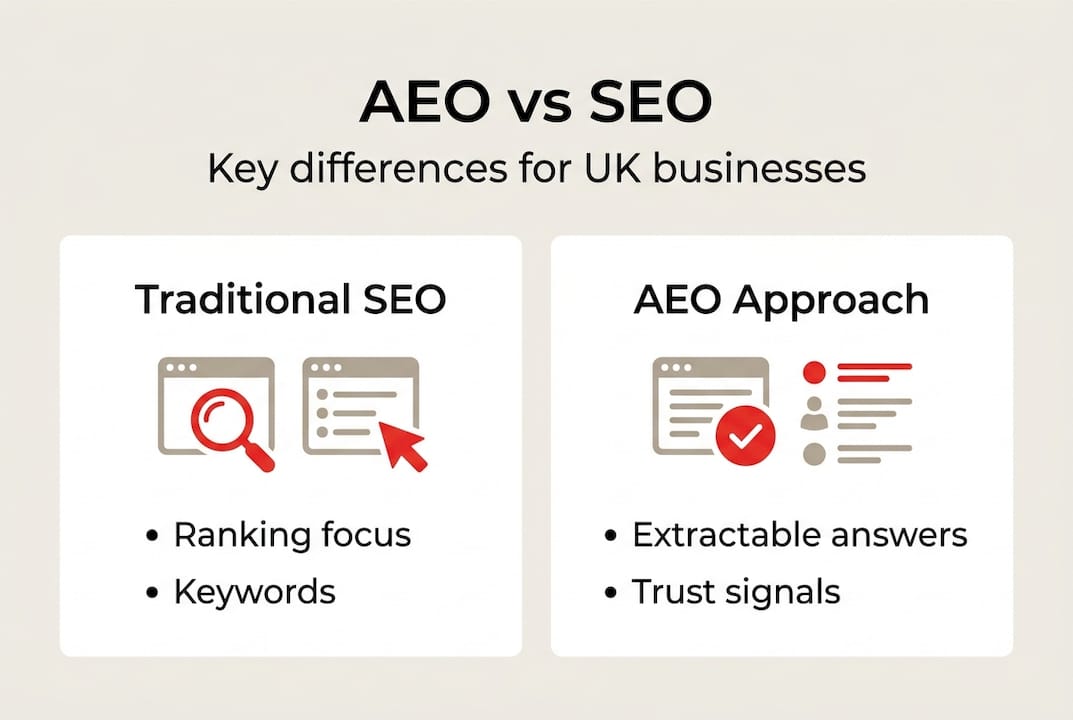
But the divergences are real and they matter. Here’s a practical comparison:
| Factor | Traditional SEO | AEO |
|---|---|---|
| Primary goal | Rank highly in search results | Be cited as a direct answer |
| Content format | Long-form, keyword-rich pages | Self-contained Q&A blocks |
| Key signals | Backlinks, keywords, page authority | Schema markup, freshness, answer clarity |
| Platform focus | Primarily Google | Google, Bing Copilot, ChatGPT, Perplexity |
| Success metric | Click-through rate, rankings | Citation frequency, answer box appearances |
The critical divergence is answer extractability. Answer Engine Optimisation rewards content that an AI can lift cleanly and present as a complete, trustworthy response. Vague, hedged, or overly complex content gets ignored.
The role of schema markup in AEO is particularly significant. Schema is a type of code you add to your website that tells search engines and AI tools exactly what your content means. It’s like adding labels to your filing cabinet so a robot can find the right folder instantly.
Key AEO tactics that go beyond standard SEO:
- Structured Q&A content with definitive answers
- Regular content updates to maintain freshness signals
- Multi-platform optimisation beyond Google
- Schema markup for FAQs, products, and local business data
Learn more about the AEO and SEO differences and where your current strategy may have gaps.
Essential Strategies for Effective AEO
Knowing what sets Answer Engine Optimisation apart, it’s time to explore how you can put it into action for your business.
- Create answer capsules. Write self-contained blocks of content that answer one specific question completely. Open with the question as a heading, deliver the answer in 40 to 60 words, then expand with supporting detail. AI engines love content they can extract cleanly.
- Use schema markup. Adding structured data to your pages tells AI tools what your content is about. FAQ schema, LocalBusiness schema, and HowTo schema are especially powerful for UK SMEs. Explore using schema for Answer Engine Optimisation to see how to implement this correctly.
- Prioritise brand mentions and video. Brand mentions and YouTube outpace backlinks for AEO impact. Getting your business mentioned on reputable sites and creating short, informative YouTube videos builds the kind of authority AI engines trust.
- Keep content fresh. AI engines favour up-to-date information. Review your key pages every quarter and update statistics, examples, and dates.
- Be definitive, not vague. Hedged answers like “it depends” without further explanation are AEO killers. Give clear, confident responses.
- Follow UK transparency guidelines. The Competition and Markets Authority (CMA) expects honesty in digital communications. Clear, accurate content protects you legally and builds trust with both users and AI engines.
“The businesses winning in AI-driven search aren’t the ones with the most backlinks. They’re the ones whose content is so clear and direct that an AI engine can trust it immediately.”
For a deeper look at content optimisation that works across both SEO and AEO, we’ve covered the practical steps in detail.
Pro Tip: Audit your existing content for hedged language. Replace phrases like “it can sometimes be” with direct, confident statements. This single change can improve your Answer Engine Optimisation performance noticeably.
Winning Visibility Across Answer Engines and Platforms
Once you master core strategies, it’s essential to broaden your reach across the full spectrum of modern answer engines.
Here’s a surprising fact that most UK businesses overlook: 80% of answer engine visibility occurs outside Google. If you’re only optimising for Google, you’re missing the vast majority of the opportunity.
The major platforms you need to consider are Google SGE, Bing Copilot, ChatGPT, and Perplexity. Each has its own preferences:
| Platform | Best content format | Optimisation focus |
|---|---|---|
| Google SGE | Structured Q&A, schema | E-E-A-T, featured snippet readiness |
| Bing Copilot | Conversational content | Microsoft indexing, Bing Webmaster Tools |
| ChatGPT | Clear definitions, factual content | Brand mentions, reputable citations |
| Perplexity | Concise, well-sourced answers | Freshness, source credibility |
Where UK SMEs are missing out right now:
- No presence on Bing. Many businesses have never set up Bing Webmaster Tools, leaving Copilot users unable to find them.
- Ignoring YouTube. Video content is increasingly cited by AI engines as a trusted source.
- Single-format content. Publishing only long blog posts misses users on platforms that prefer concise, structured answers.
- No local schema. UK businesses with physical locations are losing local AI citations by skipping LocalBusiness schema.
The future of search and AEO is moving fast. Understanding the impact of AI search on UK businesses and staying ahead of SEO trends in 2026 will separate the businesses that grow from those that get left behind.
The Hidden Truth: Why Answer Engine Optimisation is a Mindset Shift, Not Just a Tactic
Let’s be honest about something. Most businesses that adopt AEO treat it like a checklist. Add some schema. Write a few Q&A blocks. Job done. And then they wonder why the results don’t materialise.
The businesses we see genuinely winning in AI-driven search have made a deeper shift. They’ve started thinking like an answer engine. That means asking: “Is this content so clear, so trustworthy, and so complete that an AI would stake its reputation on it?”
Real gains come when businesses proactively adapt to how AI answer engines extract and trust answers, not just when they bolt on a few new tactics.
This is a transparency game. AI engines are, in essence, trying to serve their users well. They cite sources that are clear, honest, and authoritative. If your content is evasive, outdated, or written primarily to game an algorithm, it won’t get cited.
The Answer Engine Optimisation mindset starts with one simple question: what does my customer actually need to know? Answer that completely, honestly, and in plain language. That’s the foundation that no algorithm update can take away from you.
Boost Your Visibility With Expert AEO Support
If you want to build lasting visibility in a world of answer engines, here’s how expert support makes the difference.
Getting AEO right takes time, technical knowledge, and a clear strategy. At Bamsh Digital Marketing, we specialise in helping UK SMEs appear where their customers are searching, whether that’s Google, ChatGPT, or Bing Copilot. Our Answer Engine Optimisation services are built around your business goals, not generic templates. If you’re new to the concept, our AEO explained resource is a great starting point. We also offer local visibility solutions that combine AEO with Google Business Profile management to drive more local leads. Let’s build you a presence that AI engines trust and customers choose.
Frequently Asked Questions
Is answer engine optimisation just a new name for SEO?
No, AEO builds on SEO but focuses on structuring content so AI engines can extract and cite clear, direct answers more reliably. While AEO and SEO share an 80% overlap in foundations, the goals and tactics diverge meaningfully.
Do Google rankings matter for AEO?
Yes, but AEO is about appearing as the cited source in answer boxes, which doesn’t always align with traditional rankings or click-through rates. AEO emphasises citation and answer extractability over simply ranking on page one.
What kinds of content perform best for AEO?
Self-contained question and answer blocks, clear definitions, up-to-date fact-based content, and pages with schema markup perform best. AEO rewards answer capsules and well-structured Q&A content that AI engines can extract cleanly.
How long does it take to see results from AEO?
If you begin with solid SEO foundations already in place, you may see increased answer box citations and leads within two to three months, though results vary depending on your industry and competition level.
Does AEO only apply to Google?
No, 80% of AEO visibility comes from non-Google engines such as Bing Copilot, ChatGPT, and Perplexity, making multi-platform optimisation essential for UK businesses.