
Most customers no longer stick to a single channel when engaging with your business. Today, someone might browse your website at breakfast, respond to an email on their laptop, click a Facebook advert from their phone, and visit your physical location in Devon or Cornwall. For small and medium business owners in the South West, mastering customer-focused marketing activities that drive demand across various platforms is essential to generating more leads and revenue. This guide shows how coordinated multi-channel marketing can help you meet customers where they already are, increasing your visibility and improving your results.
Table of Contents
- Defining Multi-Channel Marketing Practices
- Types Of Marketing Channels Used
- How Multi-Channel Strategies Work
- Key Benefits And Challenges For SMEs
- Risks, Costs And Common Pitfalls
- Comparing Multi-Channel With Alternatives
Key Takeaways
| Point | Details |
|---|---|
| Multi-channel marketing enhances visibility. | Engaging customers across various platforms increases brand awareness and reach, improving the chances of customer interaction. |
| Coordination is crucial for effectiveness. | Successfully integrating marketing efforts across channels ensures consistent messaging and enhances customer experience. |
| Resource management is essential. | Small and medium-sized enterprises should prioritise their top channels based on audience engagement and focus on automation to maximise efficiency. |
| Data integration drives success. | Connecting systems for tracking customer interactions enables informed decisions and personalised follow-ups, amplifying the effectiveness of multi-channel strategies. |
Defining Multi-Channel Marketing Practices
Multi-channel marketing isn’t some buzzword that appeared overnight. It’s a response to how your customers actually behave. They don’t stick to one place anymore. They browse on their phone, check email on their laptop, see an advert on Facebook, and pop into your physical location if you have one. Customer-focused marketing activities that drive demand across various platforms is what multi-channel marketing fundamentally is. It means you’re meeting people where they already are, not hoping they’ll find you in just one spot.
Here’s what makes this approach different from simply being “everywhere.” Multi-channel marketing isn’t about throwing your message at every platform and hoping something sticks. It’s about coordinating your activities strategically across multiple channels so your customers get a consistent experience, whether they’re interacting with you via email, social media, search engines, your website, or in person. Think of it like having multiple doors into your shop, but once people walk through any of them, they experience the same level of service and quality.
The practice involves several core elements that work together:
- Awareness building across multiple touchpoints so potential customers know you exist
- Consistent messaging that reinforces who you are and what you offer, regardless of channel
- Coordinated campaigns where your email marketing supports your paid ads, which align with your social media content
- Data collection from each channel to understand which audiences respond best where
- Stakeholder management both internally (your team) and externally (your suppliers and partners)
Multi-channel marketing requires you to think like your customer, not like your business. Where are they spending their time? What channels make sense for your specific audience?
From a business perspective, marketing efforts across multiple channels reflect an evolution from old-school single-channel approaches to integrated systems. That old model was simple: you advertised in the local paper or on telly, and that was basically it. Now, you’re orchestrating a symphony across search, social, email, your website, maps listings, and more. But here’s the reality check. Many small and medium businesses in the South West still treat their channels as separate silos. Your Google Ads campaign doesn’t know what your email marketing is doing. Your social media team isn’t aware of what’s in the latest email broadcast. That’s where opportunities get lost.
When you’re defining multi-channel marketing for your business, you’re essentially answering three questions. First, where are your ideal customers spending their attention? Second, what channels give you the best return on investment? Third, how can you make sure someone who sees your Facebook advert today gets a follow-up email tomorrow that acknowledges that interaction? The answers to these questions will look different for a plumbing business in Plymouth than they will for a digital agency in Bristol, and that’s exactly as it should be.
The beauty of multi-channel marketing is that it compounds. One customer might discover you through Google search, click through to your website, add their email to your list, receive a nurture email sequence, book a call through your AI receptionist, and become a paying customer. That’s one person taking multiple journeys through multiple channels, and each touchpoint matters.
Pro tip: Map out every place your customers could potentially interact with your business (Google Search, Facebook, your website, phone calls, email, Maps listings), then pick the three channels where your specific audience is most active and focus on getting those right before you expand.
Types Of Marketing Channels Used
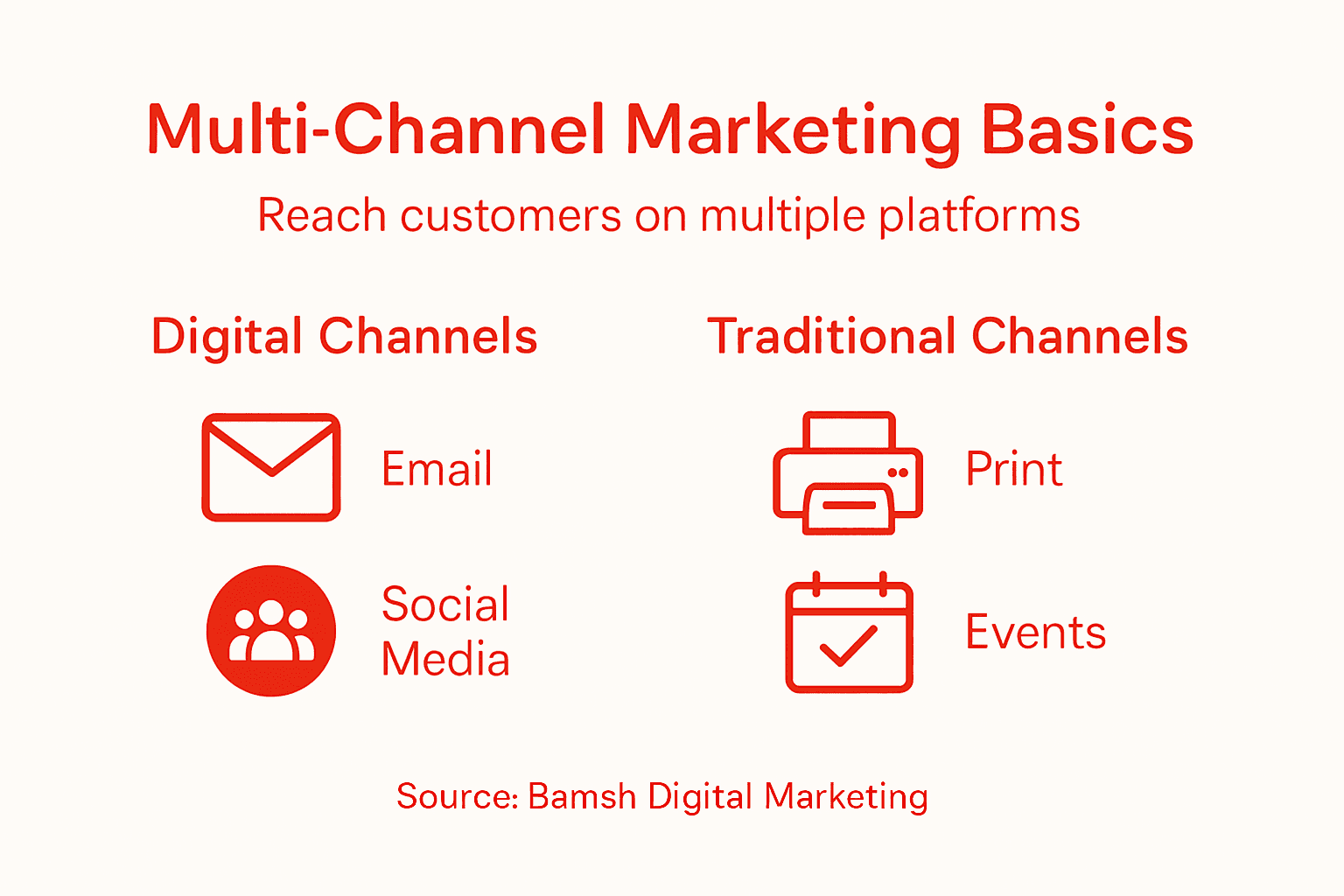
When we talk about marketing channels, we’re talking about the routes your message takes to reach customers. Some are digital, some are traditional, and the best multi-channel strategies use a mix of both. The channels you choose depend entirely on where your audience spends their time and what makes sense for your business. A local plumbing company in Cornwall might prioritise Google Maps and local search differently than a Bristol-based software company would. But regardless of your industry, you’ve got options, and understanding what each channel does is where you start.
Digital channels dominate most multi-channel strategies today, and for good reason. Email marketing remains one of the highest-returning channels because you’re reaching people who’ve already shown interest in your business. Social media platforms like Facebook and Instagram let you target specific demographics and retarget people who’ve visited your website. Your website itself is a channel, not just a destination. Google Ads and search marketing put you in front of people actively looking for what you offer. Digital platforms including social media, email, and websites form the backbone of modern marketing strategies. Google Business Profile optimisation helps you show up in local search results and Maps, which is crucial if you have a physical location.

But don’t sleep on traditional channels. Offline channels still matter, especially in the South West where community connections run deep. Direct mail can work incredibly well when it’s targeted properly. Print media in local publications reaches people in your area. Events, whether you’re sponsoring them or hosting your own, build real relationships. Radio advertising and even door-to-door approaches still have their place depending on your audience. The key is that strategic importance of selecting impactful channels means you can’t just use everything.
Here’s a practical breakdown of the main channels you should consider:
To clarify the strategic impact of each marketing channel, see this summary table of channel functions and their business effects:
| Channel Type | Main Function | Typical Business Impact |
|---|---|---|
| Email Marketing | Nurtures customer relationships | Drives repeat sales and loyalty |
| Social Media | Builds awareness and engagement | Expands reach, boosts brand visibility |
| Search Marketing | Captures active demand | Generates high-intent leads |
| Website | Centralises information | Converts visitors to enquiries/sales |
| Direct Mail | Targets geographic audiences | Encourages local response |
| Offline Events | Fosters community connections | Builds trust, personal relationships |
- Email marketing – Direct communication with people on your list; excellent for nurturing leads and repeat customers
- Social media – Facebook, Instagram, LinkedIn, TikTok depending on your audience; great for awareness and engagement
- Search marketing – Google Ads and organic search; crucial when someone is actively looking for your solution
- Your website – The hub where all other channels point; your owned asset
- Google Business Profile – Local search and Maps visibility; essential if you serve a geographic area
- Content marketing – Blog posts, videos, guides that answer customer questions and build authority
- Direct mail – Physical mail to targeted addresses; surprisingly effective for certain audiences
- Events and sponsorships – In-person connections in your community
- Paid social advertising – Targeted ads on Facebook, Instagram, LinkedIn with precise audience control
- Offline partnerships – Local radio, print media, community boards
The channels that work best aren’t the flashiest ones. They’re the ones where your actual customers are already spending their attention.
Now here’s the thing that trips up most businesses. Having channels isn’t the same as using them effectively. You could be on Facebook, email, Google Ads, and local radio simultaneously, but if your messages contradict each other or you’re not following up properly, you’re wasting money. Someone who clicks your Facebook ad should see a consistent message on your website. Someone who books a call through your AI receptionist should receive an email confirmation that matches your brand voice. That’s the coordination part that separates multi-channel marketing from just being scattered.
Your choice of channels should also reflect your budget and capacity. A one-person business can’t manage ten channels well. It’s better to do three channels brilliantly than ten channels poorly. Start with where your audience is, then add more channels only when you’ve got systems in place to manage them.
Pro tip: Choose your top three channels based on where your ideal customers actually are, not where you think they should be, and give yourself three months to build proper systems (automation, content calendars, tracking) before adding more channels.
How Multi-Channel Strategies Work
A multi-channel strategy isn’t just about being everywhere. It’s about orchestrating your presence across multiple channels so that every customer journey feels coordinated, not chaotic. Think of it like conducting an orchestra. Each instrument (channel) plays its own part, but they’re all following the same sheet music and working towards the same goal. When done properly, customers don’t notice the complexity behind the scenes. They just experience a business that meets them where they are, with consistent messaging, and genuine follow-up.
The mechanics of how this actually works start with understanding your customers and your budget. Multi-channel strategies require thoughtful allocation of marketing budgets across different customer segments and channels. This means you’re not necessarily spending equally on every channel. A customer who’s brand new to you might be reached through paid social ads or search marketing. A customer who’s already on your email list might be nurtured through email sequences and remarketing ads. An existing client might see you in their Google Business Profile reviews and get reminders through email. Each segment gets a different mix of channels because each segment is at a different stage of their journey.
Here’s how the mechanics break down in practice:
- Identify your target audiences – Not just “businesses in the South West” but specific segments: new prospects, existing customers, people who visited but didn’t convert
- Map the customer journey – Where does each segment hang out? What message do they need to hear at each stage?
- Allocate your budget strategically – Spend more on channels that work for each segment, not on channels that look impressive
- Create consistent messaging – Your core message stays the same whether someone’s reading your email or scrolling Facebook, but the format adapts to the channel
- Build automation and workflows – When someone does something in one channel (clicks an ad, visits your website, opens an email), the other channels respond automatically
- Track and measure everything – You need to know which channels work for which segments so you can adjust in real time
The data integration part is absolutely critical here. If your email system doesn’t know that someone just clicked your Facebook ad, you might send them an email that contradicts what they just saw. If your CRM isn’t connected to your website, you don’t know which pages someone visited before they filled out a form. Delivering consistent customer experience across various channels requires you to actually connect your systems so data flows between them. This is where many small businesses stumble. They’ve got tools, but the tools aren’t talking to each other.
Consider a real-world example. Someone in Plymouth searching for “plumbing services near me” finds you on Google Maps, calls your number, but gets no answer. With a multi-channel strategy, that missed call goes into your CRM. Your AI receptionist or automated system takes their details. Within hours, they receive an email acknowledging their enquiry. That email has a link back to your website where they can read reviews and book online. If they book, they get a confirmation. If they don’t, a second email goes out three days later with a special offer. Meanwhile, that person’s details are being used to target them with Facebook ads about your services. They’re now seeing you across multiple channels, and each touchpoint feels intentional.
The power of multi-channel marketing comes from the fact that every interaction reinforces every other interaction. Each channel amplifies the others.
The strategy also accounts for channel effectiveness by segment. Direct mail might work brilliantly for reaching homeowners aged 55 plus in your area but waste money on 30-year-olds. Email works best for people already engaged with you. Search marketing converts people actively looking for your solution. Social media builds awareness but doesn’t always drive immediate conversions. A smart multi-channel strategy doesn’t try to use every channel equally. It uses data to understand which channels work best for which segments, then adjusts spending accordingly.
What makes this all work is automation and systems. You can’t manually manage all these touchpoints. You need CRM setup with automated lead nurturing so that when a lead comes in from any channel, your system automatically follows up. You need your email platform talking to your ads platform so retargeting happens seamlessly. You need your website tracking who visits and what they do so you can personalise their experience.
Pro tip: Before adding more channels, make sure the ones you have are connected and automated. One well-integrated channel that nurtures leads automatically will outperform five disconnected channels that require manual follow-up.
Key Benefits And Challenges For SMEs
Multi-channel marketing offers genuine advantages for small and medium-sized businesses, but let’s be honest about the reality. The benefits are significant if you get it right. The challenges are real if you don’t. As a small business owner in the South West, you’re competing against larger companies with bigger budgets, so understanding both sides of this equation matters.
The benefits start with reach and visibility. Multi-channel marketing provides increased reach, engagement, and brand awareness opportunities that a single-channel approach simply can’t match. When you’re on Google Search, Facebook, email, and Google Business Profile simultaneously, more people see you. Someone might discover you through a local search result, another person through a Facebook ad, and a third through a review. Each channel brings different people. That compounds your visibility without necessarily requiring a proportionally larger budget.
Brand recall improves too. When someone sees your business across multiple touchpoints, they remember you better. They see your name in search results, then an email lands in their inbox, then a Facebook ad appears. By the third interaction, your business feels established and trustworthy. This is especially valuable for SMEs because bigger companies already have brand recognition. You’re building it.
The real advantages for your bottom line are more subtle. Multi-channel strategies let you personalise the experience based on where someone is in their journey. A new prospect gets different messaging than someone who’s already engaged with you. You can use data-driven approaches to improve customer experience by understanding which channels work best for which customer segments. Email might drive repeat business from existing customers. Search marketing might catch people actively looking to buy. Social retargeting might remind someone who visited but didn’t convert.
Here are the main benefits SMEs actually see:
- Increased customer reach across multiple audiences and demographics
- Better brand recall through repeated touchpoints and consistent messaging
- Higher conversion rates by meeting people at different stages of their buying journey
- Improved customer loyalty through consistent engagement and personalisation
- Better use of marketing budget by targeting the right channels for each segment
- Competitive advantage against other small businesses still using single-channel approaches
But now for the challenges. And they’re substantial.
The first challenge is resource constraints. You probably don’t have a team of ten marketers. You might be the marketer, the sales person, and the business owner all rolled into one. Managing multiple channels effectively takes time and skills. Your budget is limited. SMEs face constraints due to limited budgets and resources, which means you can’t afford to waste money testing random channels or hiring expensive agencies without clear results.
The second challenge is coordination and consistency. Getting your message right across email, social media, your website, and paid ads is harder than it sounds. If your Facebook ad says one thing but your email says something slightly different, customers get confused. If your website hasn’t been updated in six months but your ads are promoting your latest service, that’s a disaster.
The third challenge is data management. To run a proper multi-channel strategy, you need your systems talking to each other. Your email platform needs to know who clicked your ad. Your CRM needs to track which channels customers came from. Most small businesses don’t have this connected. They’ve got separate tools that don’t share information.
The fourth challenge is knowing what’s working. With multiple channels running simultaneously, attribution becomes tricky. Did someone convert because of the email they received, the Google ad they clicked, or the Facebook ad they saw three weeks ago? Without proper tracking, you make budget decisions based on guesses rather than data.
The SMEs that win with multi-channel marketing aren’t the ones trying to do everything. They’re the ones who do three things brilliantly and measure obsessively.
Here’s the challenge breakdown you’ll actually face:
Here’s a quick reference table highlighting SME challenges and suggested solutions when adopting multi-channel marketing:
| Challenge | Typical Issue | Practical Solution |
|---|---|---|
| Resource Constraints | Limited staff and budget | Automate and prioritise channels |
| Message Consistency | Contradictory branding | Use unified content guidelines |
| Data Management | Systems not integrated | Connect tools, centralise data |
| Attribution Problems | Unclear revenue tracking | Setup analytics and tracking |
- Skill gaps – You need knowledge of email marketing, social ads, Google Ads, and more
- Tool complexity – Setting up automation requires technical knowledge or expensive help
- Message consistency – Keeping your story straight across channels takes discipline
- Time investment – Creating content for multiple channels is significantly more work
- Attribution problems – Understanding which channels actually drive revenue
- Budget allocation – Deciding how much to spend on each channel
- Testing and learning – Small budgets make it harder to test and optimise
The good news is that these challenges aren’t insurmountable. They require a systematic approach rather than unlimited budget. Start with your top three channels. Build solid systems for automation and tracking. Measure relentlessly. Grow from there. Many SMEs we work with started in exactly this position and now run profitable, predictable multi-channel operations that generated 167% more leads than their single-channel efforts.
The key difference between SMEs that succeed and those that struggle is having a clear plan before you launch. Don’t spin up five channels hoping something works. Choose your channels based on where your actual customers are, set up your systems and automation first, then launch.
Pro tip: Invest in connecting your systems before you invest in more channels. A CRM that knows your customer’s entire journey across all channels is worth more than advertising on ten disconnected platforms.
Risks, Costs And Common Pitfalls
Multi-channel marketing can generate remarkable results, but it can also drain your budget and damage your reputation if done poorly. The risks are real. The costs are substantial. And the pitfalls are more common than you’d think. Understanding what goes wrong helps you avoid becoming another cautionary tale.
Let’s start with cost escalation. When you’re managing multiple channels, expenses multiply quickly. Each platform has its own learning curve, its own tools, its own content demands. You might subscribe to email marketing software, social media management tools, Google Ads, Facebook Ads, analytics platforms, and a CRM. That’s easily £200 to £500 per month before you even create any content. Then there’s the time cost. Creating unique content for Facebook, Instagram, email, your blog, and paid ads is significantly more work than creating for one channel. If you’re doing this yourself, that’s hours every week. If you’re hiring help, that’s salary costs on top of software costs.
Costs escalate due to managing multiple platforms and content creation demands. The money can disappear fast if you don’t have clear systems to track what’s working. You might be spending £300 per month on Facebook ads that generate no leads whilst your email marketing generates ten qualified prospects for £50 per month. Without proper measurement, you won’t know which is which, and you’ll keep funding the waste.
The risks go deeper than just wasted money. One of the biggest risks is message fragmentation. Imagine a customer sees your Facebook ad promising “quick service,” receives an email talking about your premium, bespoke approach, and lands on your website describing affordable solutions. They’re confused. They don’t know what you actually stand for. Trust erodes. They click away and try your competitor instead. Common pitfalls involve inconsistent branding and message fragmentation that undermines your credibility.
Another critical risk is poor data management. If your channels aren’t connected, you make decisions based on incomplete information. You don’t know which customers came from which channels. You can’t retarget effectively. You might email someone who just received a promotional offer on Facebook, annoying them. You might target the same person across five channels in a week, leading to brand fatigue. They get exhausted by you and unsubscribe or mute your ads.
Here are the pitfalls that trip up most small businesses:
- Spreading too thin – Trying to manage ten channels when you should focus on three
- No integration – Channels operating independently without shared data or coordination
- Inconsistent messaging – Different story on each platform confuses customers
- Ignoring channel suitability – Using platforms where your audience isn’t active
- Poor measurement – No clear way to know which channels generate revenue
- Content quality drops – Rushed content across multiple channels performs worse than polished content on fewer channels
- Brand fatigue – Targeting the same person too aggressively across channels
- Neglected follow-up – Getting leads but not following up systematically
- Technology overload – Using tools that don’t integrate, creating manual work
- Inconsistent posting – Starting strong then abandoning channels after two months
The most expensive mistake isn’t the channels you choose. It’s the inconsistent execution across the channels you do choose.
Let’s talk about specific cost scenarios. A small plumbing business in Exeter might spend:
- Google Ads management: £400 per month (ads plus software)
- Facebook ads and Instagram: £300 per month
- Email marketing software: £50 per month
- CRM system: £100 per month
- Content creation (either your time or freelancer): £300 to £800 per month
- Total: £1,150 to £1,650 per month before you even know if it’s working
If that business doesn’t have proper systems, measurement, and coordination, they might spend £15,000 to £20,000 per year and generate no additional revenue. That’s how quickly this goes wrong.
The coordination challenge creates another pitfall. Common pitfalls include misalignment of campaign objectives and poor coordination between team members. If one person is running Google Ads, another is posting on social media, and a third is managing email, they might not know what the others are doing. The email campaign promotes a discount, but the Google Ads campaign is promoting premium positioning. Customers see contradictory messages.
The risk of customer disengagement is serious too. When customers see your ads everywhere and receive emails constantly, they get tired of you. They unsubscribe or mute your ads. Worse, they start to view your brand as pushy or spammy. That reputation is hard to recover from.
Avoid these pitfalls by starting small, building systems first, measuring everything, and expanding only when you’ve proven each channel works. Don’t launch five channels simultaneously hoping to find quick wins. That’s the fastest way to burn through budget without results.
Pro tip: Before you spend a pound on any new channel, define exactly what success looks like: how many leads or sales you need from it, what you’ll spend, and how you’ll measure it. If you can’t articulate this clearly, don’t launch the channel.
Comparing Multi-Channel With Alternatives
When you’re deciding on a marketing strategy, you’ve got options. You could stick with one channel. You could embrace multi-channel. Or you could aim for omnichannel. Each approach has different costs, complexity levels, and results. Understanding the differences helps you choose what actually makes sense for your business right now.
Single-channel marketing is the simplest approach. You pick one channel – say, Google Ads or Facebook – and focus all your effort there. The advantage is obvious. You become really good at that one channel. You don’t spread yourself thin. You understand the platform deeply. Your messaging is consistent because there’s only one message. For a very small business with a tiny budget, single-channel can work.
But single-channel has serious limitations. You only reach people on that one platform. Someone who doesn’t use Facebook won’t see you. Someone who avoids Google might never find you. Your reach is capped. If that channel’s algorithm changes or costs rise, you’re stuck. You’ve got no backup. Single-channel works temporarily, but it doesn’t scale.
Multi-channel marketing is what we’ve been discussing throughout this guide. You use multiple channels – Google Ads, Facebook, email, your website, Google Business Profile – but each channel operates with some independence. You’re reaching more people across more places. Your messaging is roughly consistent, but adapted to each channel. The advantage is significantly broader reach and the ability to meet customers where they already are.
The challenge is coordination and complexity. Multi-channel marketing focuses on using various channels somewhat independently whilst trying to maintain consistency. You need systems to manage multiple platforms. You need content for each channel. You need budget spread across channels. It’s more work than single-channel, but more effective.
Omnichannel marketing is different. It’s not just multiple channels. Omnichannel aims for seamless customer integration across all channels with unified messaging and support. Every touchpoint knows about every other touchpoint. If a customer starts browsing on your website, then continues on mobile, then visits in person, the experience is seamless. They don’t have to re-enter information. The system knows their history. Their experience feels effortless.
Omnichannel is the gold standard, but it requires significant technology investment. You need sophisticated CRM systems, integrated point-of-sale systems, unified inventory management, and data analytics platforms. You need your team trained on these systems. You need ongoing technical support. Most SMEs don’t have the budget or technical capacity for true omnichannel immediately.
Here’s how the three approaches compare:
| Approach | Reach | Complexity | Cost | Consistency | Results |
|---|---|---|---|---|---|
| Single-channel | Limited | Low | Low | Very high | Moderate |
| Multi-channel | Good | Medium | Medium | Good | High |
| Omnichannel | Excellent | High | High | Excellent | Highest |
For most SMEs in the South West right now, multi-channel is the sweet spot. It’s more sophisticated than single-channel so you reach more customers and generate more leads. It’s less complex and costly than omnichannel so it doesn’t require massive technology investment. You can actually implement it without hiring a whole new team.
The key difference between multi-channel and omnichannel comes down to integration. Single-channel marketing is simpler but limits reach, while omnichannel integrates all channels for a cohesive approach. Multi-channel gets you most of the benefits without the full omnichannel complexity. You’re using multiple channels effectively. You’re tracking customer journeys. You’re automating follow-up. You’re measuring results. You’re just not achieving the perfect seamlessness of true omnichannel.
Think of it this way. Single-channel is like having one door into your shop. Multi-channel is having five doors, each one working well. Omnichannel is those five doors plus an internal tunnel system so customers can move between them invisibly. Multi-channel is what wins for most SMEs because it gives you the benefit of multiple doors without the cost of the tunnel system.
Consider your current situation. If you’re doing zero marketing, single-channel gets you started quickly. If you’re doing marketing but only on one or two channels, multi-channel is your next logical step. If you’re already running multi-channel well and want to evolve further, omnichannel becomes worth exploring.
The best marketing approach is the one you’ll actually execute consistently. A brilliant multi-channel strategy you implement beats a perfect omnichannel strategy you can’t afford or manage.
Many SMEs make the mistake of trying to jump straight to omnichannel without mastering multi-channel first. They buy expensive technology, don’t implement it properly, and waste money. The better path is to get multi-channel working brilliantly first. Build your systems. Prove your channels work. Generate consistent revenue. Then, if you want to invest in omnichannel integration, you’ll have the budget and the expertise to do it right.
Pro tip: Don’t choose an approach based on what sounds impressive. Choose based on what you can realistically manage with your current team and budget. Master that approach, measure results, then upgrade when you’ve proven success.
Unlock the Power of Multi-Channel Marketing with Bamsh Digital Marketing
The article highlights a key challenge for small and medium-sized businesses in the South West: managing multiple marketing channels effectively while maintaining consistent messaging and coordinated customer journeys. If you find yourself struggling with fragmented campaigns, unclear tracking, or overwhelmed by limited resources, you are not alone. Multi-channel marketing demands strategic integration of channels like email, social media, search advertising, and local listings — all working together to nurture leads and build lasting customer relationships.
At Bamsh Digital Marketing, we specialise in simplifying complex multi-channel strategies into clear, automated, and results-driven systems. Whether it is optimising your Google Business Profile to boost local visibility, creating targeted paid social campaigns, or setting up CRM-powered automated lead nurturing, we make sure your channels talk to each other seamlessly. With our AI Lead Engine, you get an all-in-one solution that combines SEO, PPC, social ads, and AI automation designed to deliver more quality leads and predictable revenue.
Ready to stop juggling and start growing effectively across multiple channels? Discover how we help businesses like yours build coordinated marketing strategies that drive results at Bamsh Digital Marketing. Take the first step with our AI Lead Engine or explore our Google PPC Management and Google Business Profile Optimisation services designed specifically to meet your needs. Don’t wait to make every marketing pound count. Act now and turn your multi-channel marketing into a growth engine for your business.
Frequently Asked Questions
What is multi-channel marketing?
Multi-channel marketing is a strategy that involves using multiple marketing platforms to engage customers. It focuses on providing a consistent customer experience across channels such as email, social media, search engines, and physical stores.
Why is multi-channel marketing important for businesses?
Multi-channel marketing is crucial because it increases visibility, enhances customer reach, and improves brand recall. By meeting customers where they are, businesses can foster personalised experiences and drive higher conversion rates.
What are the common challenges of implementing a multi-channel marketing strategy?
Common challenges include resource constraints, maintaining message consistency across platforms, managing data effectively, and determining which channels are most effective for specific customer segments.
How can a business measure the success of its multi-channel marketing efforts?
Success can be measured through tracking metrics such as customer engagement rates, conversion rates from various channels, and customer journey insights. Integrating systems and using analytics tools helps in evaluating the effectiveness of individual channels.