
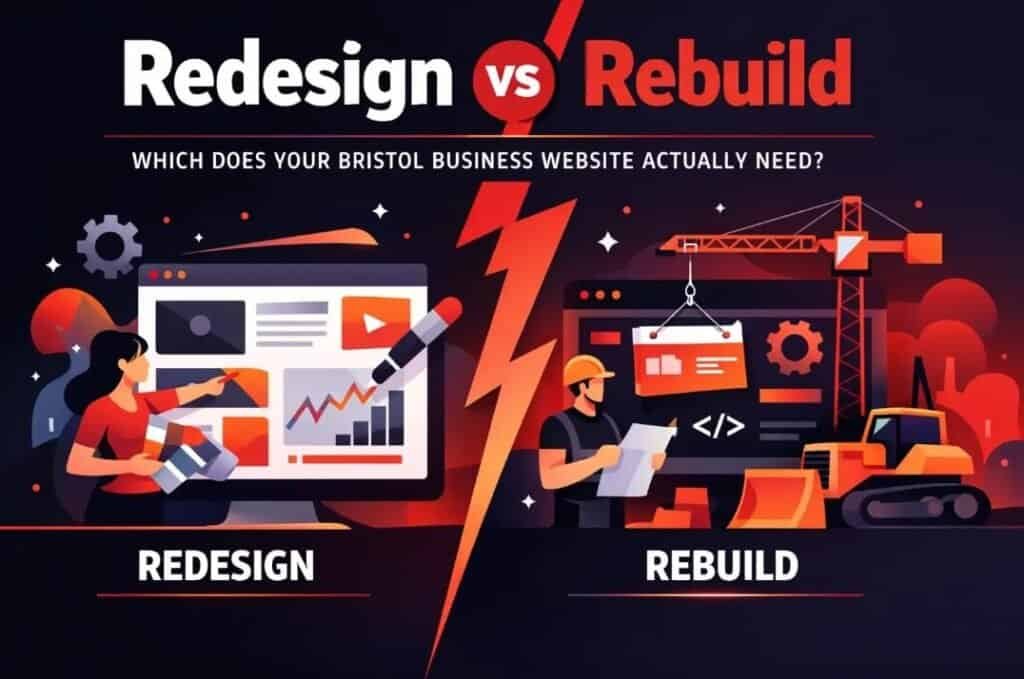
You know your website needs work. It’s either looking tired, performing poorly, or both. But here’s the question that’s probably keeping you up at night: do you need a redesign or a complete rebuild?
Let’s be honest, most Bristol business owners aren’t sure what the difference actually is. And that confusion can cost you thousands of pounds and months of time if you pick the wrong option.
Here’s the thing: these aren’t interchangeable terms. They’re completely different approaches that solve completely different problems. Let’s break down exactly what each one means, when you need which option, and how to make the smartest decision for your Bristol business.
What’s the Actual Difference Between a Redesign and a Rebuild?
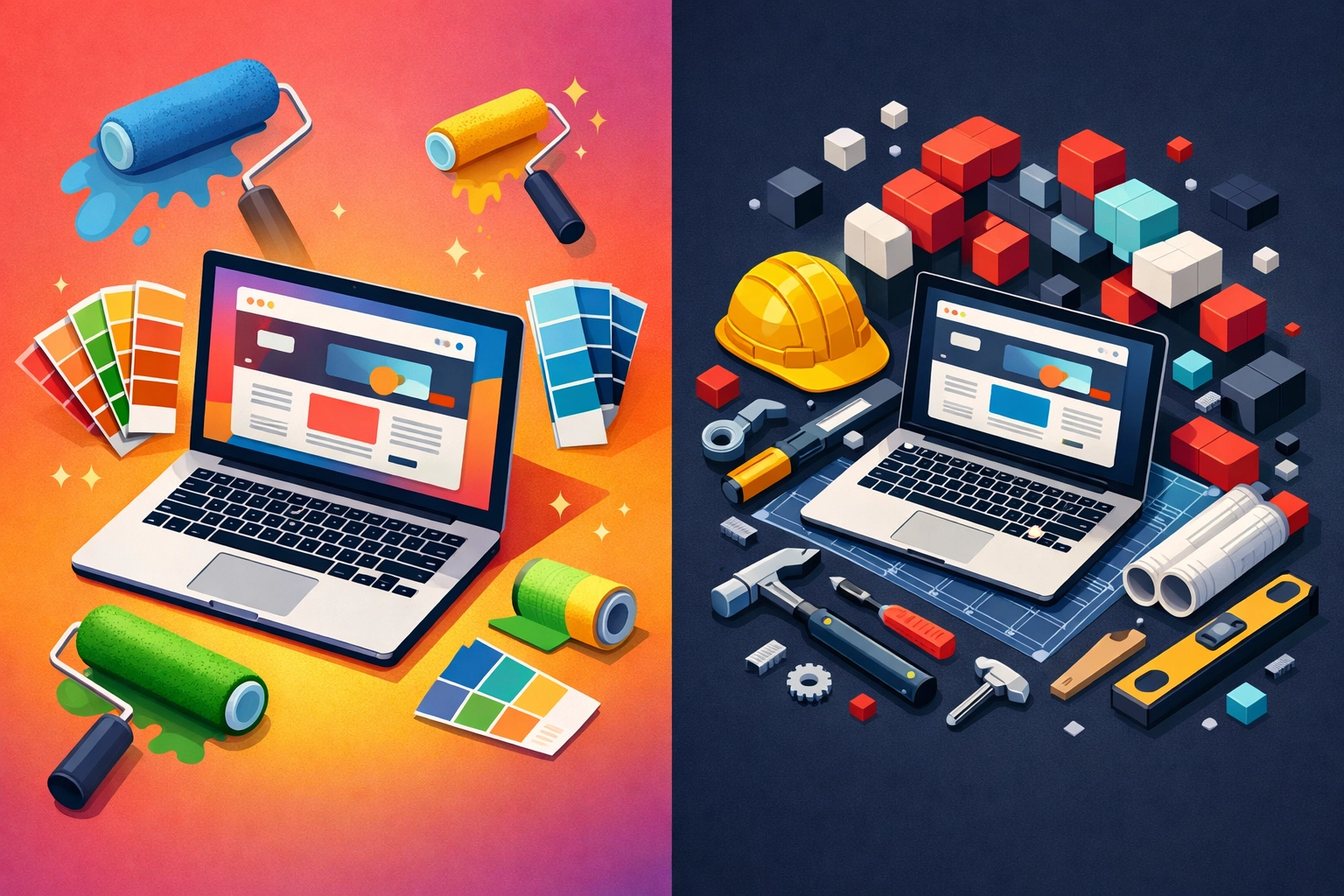
Think of your website like a building. A redesign is like renovating the interior, new paint, modern furniture, better lighting. The foundation and structure stay the same, but everything looks and feels fresh.
A rebuild, on the other hand, is knocking the whole thing down and starting from scratch. New foundation, new structure, new everything.
A website redesign updates your site’s visual appearance and user experience while keeping the underlying technology intact. You’re working with your existing content management system, keeping your backend code, and maintaining your site’s core structure. You’re just making it look better and work more smoothly.
A website rebuild replaces everything from the ground up. New platform, new code, new database structure, new content management system. It’s a complete do-over.
When Does Your Bristol Business Need a Redesign?
You might wonder how you know if a redesign is enough. Here are the telltale signs.
Your Website Looks Outdated But Works Fine
If you’re embarrassed to send prospects to your website because it looks like it was built in 2015, but everything actually functions properly, you need a redesign. Your technology is sound, you just need a fresh coat of paint.
Bristol businesses competing in professional services, retail, or hospitality often fall into this category. Your competitors have sleek, modern websites, and yours looks dated by comparison. That’s a redesign situation.
Navigation Feels Clunky But Your Backend Performs Well
Maybe users struggle to find what they need, or your mobile experience feels awkward. These are front-end user experience issues that a redesign addresses perfectly. The engine runs fine: you just need better controls.
You Need Branding Updates
Your business has evolved. Your logo changed. Your messaging shifted. Your website needs to catch up. A redesign brings your visual identity in line with your current brand without touching the technical foundation.
Why Redesigns Make Financial Sense
Redesigns cost significantly less than rebuilds because you’re not rebuilding infrastructure. You’re also working faster: most redesigns take weeks, not months. And here’s the key benefit: less SEO risk.
When you keep your website structure intact, your existing search rankings remain stable. You’re not moving pages, changing URLs, or restructuring your entire site architecture. Google already knows and trusts your current setup.
When Does Your Bristol Business Need a Rebuild?
Some problems run deeper than what a fresh design can fix. Here’s when you need to start from scratch.
Your Website Is Painfully Slow
If your pages take more than three seconds to load, you’ve got a problem. Slow websites kill conversions: 57% of visitors abandon sites that take longer than three seconds to load.
Sometimes slow performance stems from outdated code, inefficient databases, or platforms that weren’t built for modern web standards. No amount of visual redesign fixes that. You need new infrastructure.

Your Current Platform Is Outdated or Unsupported
Are you running on an old version of WordPress that’s no longer receiving security updates? Maybe you built your website on a platform that’s been discontinued or is no longer properly maintained.
This isn’t just inconvenient: it’s dangerous. Outdated platforms expose your Bristol business to security vulnerabilities, data breaches, and potential downtime. You need a rebuild to move to modern, secure technology.
You’re Adding E-commerce or Advanced Functionality
Let’s say you’ve been running a brochure website for your Bristol service business, and now you want to sell products online. Or you need complex booking systems, membership areas, or custom integrations with your CRM.
If your current platform wasn’t built to handle these features, forcing them in creates technical debt. You’ll end up with a fragile, difficult-to-maintain mess. A rebuild on the right platform saves you headaches down the road.
You’re Planning Major Business Growth
Your website handles your current traffic and customer base fine. But you’re about to scale up significantly: maybe you’re expanding locations, launching new service lines, or targeting enterprise clients.
Will your current infrastructure support that growth? If not, rebuild now before you’re dealing with performance issues while trying to grow.
Mobile Experience Is Fundamentally Broken
Not “needs improvement”: actually broken. If your website wasn’t built with responsive design from the ground up, you’re likely dealing with clunky workarounds that create a poor mobile experience.
With mobile traffic accounting for more than half of all web visits, this isn’t something you can ignore. A proper rebuild creates a truly mobile-first experience that works beautifully across all devices.

How to Decide: The Honest Assessment
Here’s how to make this decision practically. Ask yourself these questions:
Want Instant Visual Proof Before You Spend a Penny?
If you’re currently embarrassed by how your website looks, you probably don’t want a long meeting or a 20-page proposal first. You want to see what “better” could look like.
That’s exactly why we built the Website Preview Tool. It gives you a quick, visual preview of what your site could look like with a more modern design, so you can stop guessing and start making decisions with something concrete in front of you.
Why this matters: If your website looks dated, you’re losing trust before people even read a word.
How it helps you: You get instant “okay, that’s the direction” clarity, without committing to a full redesign or rebuild.
Try it here: https://bamsh.co.uk/website-preview-tool/
In the next section, we’ll get practical about the questions that help you choose redesign vs rebuild.
Is this primarily a visual problem? If your website works well but looks dated, lean toward redesign.
Are you experiencing performance, security, or scalability issues? These signal the need for a rebuild.
What’s your timeline? Need results quickly for an upcoming campaign? Redesign is faster. Planning for long-term growth? Rebuild might be the smarter investment.
What’s your budget? Redesigns typically cost 30-50% less than rebuilds. But remember: choosing a cheap redesign when you actually need a rebuild will cost you more in the long run.
The Hybrid Approach Some Bristol Businesses Take
Sometimes the smartest move is a strategic redesign now, followed by a planned rebuild later. Here’s when this makes sense:
You’re launching a marketing campaign next month and your website looks terrible. A redesign gets you presentable quickly. Then you plan a proper rebuild for next year when you have more budget and time.
This works if your current website isn’t actively hurting your business: it just needs to look better in the short term. But be honest with yourself. If you’re dealing with security vulnerabilities or major performance issues, you can’t afford to wait.
Redesign vs Rebuild: Side-by-Side Comparison
If you just want the quick “which one is this?” view, use this table.
| Question | Redesign (best fit when…) | Rebuild (best fit when…) |
|---|---|---|
| What are you changing? | Mainly the look, layout, and usability | The platform, code, structure, and how the site works |
| Is your current site “fine under the hood”? | Yes | No (it’s slow, fragile, outdated, or limiting you) |
| Typical timeline | Weeks | Months |
| Typical cost | Lower (often 30–50% less) | Higher (more moving parts) |
| SEO risk | Lower (structure often stays similar) | Higher (bigger structural changes need careful planning) |
| Good for | Updating an outdated look, improving UX, refreshing branding | Fixing deep technical issues, adding serious functionality, scaling properly |
| The “gut check” | “I’m embarrassed by how it looks” | “It’s breaking, holding us back, or risky to keep” |
In the next section, we’ll walk through what actually happens during each process.
What Actually Happens During Each Process
Let’s talk about what you’re signing up for with each option.
During a redesign, your designer works with your existing website structure. They update layouts, refresh branding elements, improve navigation, and enhance user experience. Your content typically migrates smoothly because the underlying structure stays the same. You might see some downtime during the switch, but it’s usually minimal.
During a rebuild, everything starts fresh. Your team audits your current content, decides what to keep and what to rewrite, then builds a completely new website on a new platform. This involves new design, new development, careful content migration, and extensive testing. Expect more downtime and a longer implementation period.
The Real Cost of Getting This Wrong
Choose a redesign when you need a rebuild, and you’ll face the same problems within months. You’ve spent money on a temporary fix that doesn’t address core issues.
Choose a rebuild when you only needed a redesign, and you’ve overspent by thousands of pounds and wasted months of time. You’ve also taken unnecessary SEO risks by restructuring a website that didn’t need it.
The key is defining what’s actually broken before deciding how to fix it.
If you want to sanity-check costs before you choose a path, run your numbers through the Bamsh Cost Estimator: https://bamsh.co.uk/cost-estimator/
And if you’re a Bristol business owner unsure which option makes sense, our web design team can audit your current website and give you an honest assessment of what you actually need.
Making the Call for Your Bristol Business
Here’s the truth: most Bristol businesses need a redesign, not a rebuild. If your website was built in the last five years on a modern platform, functions properly, and just needs to look better: redesign it.
But if you’re facing security issues, major performance problems, or your platform is genuinely holding your business back, don’t put a bandage on a broken leg. Rebuild it properly.
The decision comes down to honest assessment of where your problems actually lie. Visual and user experience issues? Redesign. Fundamental technical problems? Rebuild. Sometimes you need both, just not at the same time.
Your website is one of your most important business assets. Making the right call between redesign and rebuild ensures you’re investing wisely in digital infrastructure that actually serves your Bristol business goals.
FAQ: Redesign vs Rebuild (Bristol Businesses)
Can I redesign now and rebuild later?
Yes, and it’s often a smart move if your website is mostly “okay” but looks dated. Just be honest: if your platform is unsupported or security is a concern, delaying the rebuild can be risky.
Will a redesign improve my Google rankings?
A redesign can help if it improves usability, mobile experience, and content clarity. The key is not accidentally breaking the stuff Google already understands (page structure, internal links, metadata). Keep changes controlled and you reduce risk.
Will a rebuild tank my SEO?
Not if it’s done properly, but the risk is higher because more things change. A careful rebuild includes a URL plan, redirects (so old links still work), and a proper content/technical SEO checklist before launch.
How do I know if my website is “outdated” versus “broken”?
Outdated usually means it looks old, feels clunky, or doesn’t match your brand anymore. Broken means performance, security, or core functionality is failing (slow load times, crashes, plugin chaos, hard-to-edit pages).
I’m embarrassed by my current website. What’s the quickest first step?
Use our Website Preview Tool to get instant visual proof of what a modern version could look like: https://bamsh.co.uk/website-preview-tool/. Then you’ll know whether you’re aiming for a redesign vibe or a full rebuild.