

Many South West business owners feel overwhelmed by complex marketing data, but the reality is much simpler than it appears. Learning the true role of marketing analytics means understanding what your customers do, not just collecting numbers for the sake of it. When you use analytics to guide decisions, you focus your efforts and spend wisely. This article sheds light on common misconceptions and reveals how practical tools and clear-thinking can drive real growth without unnecessary fuss.
Table of Contents
- Core Definition And Misconceptions Explained
- Main Types Of Marketing Analytics Tools
- How Analytics Enables Data-Driven Decisions
- Key Legal And Privacy Responsibilities In The UK
- Avoiding Common Pitfalls And Misuse Risks
Key Takeaways
| Point | Details |
|---|---|
| Understanding Marketing Analytics | Marketing analytics involves tracking and measuring data to optimise marketing strategies based on customer behaviour and campaign performance. |
| Data Types and Sources | Effective analytics rely on various data types, including first-party, second-party, and third-party data, to gain comprehensive insights into customer actions. |
| Compliance with UK Laws | Businesses must adhere to UK GDPR and PECR regulations, ensuring proper consent and transparency in the collection of customer data. |
| Avoiding Common Pitfalls | It’s essential to minimise unnecessary data collection, properly configure tracking systems, and monitor for bias in analytics processes to maintain compliance and accuracy. |
Core Definition and Misconceptions Explained
Marketing analytics sounds technical, but it’s really quite simple. At its core, marketing analytics is the process of tracking and measuring data from your marketing efforts to reach your business goals. It’s about understanding what’s working, what’s not, and where to invest next.
Here’s what actually happens when you use analytics properly:
- You track customer behaviour across your website, emails, and ads
- You measure results against specific targets like leads or sales
- You use that data to improve future campaigns and strategies
- You make decisions based on facts, not guesses
The real value? You stop wasting money on campaigns that don’t work and double down on those that do.
What Analytics Actually Measures
Your data comes from different sources, and understanding the difference matters. Marketing analytics tracks multiple data types including first-party data (what you collect directly), second-party data (from partners), and third-party data (from external providers). Each tells you something different about your customers.
For a South West business, this might mean tracking:
- Website visitors and where they came from
- Which pages they visit and how long they stay
- Whether they complete a form or make a purchase
- How many times they return
This isn’t complicated data collection. It’s just paying attention to what your customers actually do.

The Biggest Misconception
Here’s what most business owners get wrong: they think analytics is about collecting data for data’s sake. Wrong. Analytics only matters when it drives decisions.
Too many companies gather metrics, create fancy dashboards, and never actually use the information to change anything. That’s a waste of time and money.
Real analytics requires alignment between your technology and your business goals. You need to know what questions you’re trying to answer before you start measuring. Are you trying to generate more leads? Reduce customer acquisition costs? Improve customer retention? Your analytics should answer exactly that question, nothing more.
Another common mistake: thinking analytics must be perfect before you use it. It doesn’t. Start simple, measure what matters to your business, and improve from there.
Analytics only has value when it directly influences the decisions you make about your marketing spend and strategy.
Why This Matters to Your Business
For a small or medium-sized business in the South West, analytics helps you:
- Stop guessing about what customers want
- Allocate limited budgets more intelligently
- Show exactly which marketing activities generate revenue
- Identify opportunities competitors might be missing
You don’t need to be a data scientist. You just need to understand your numbers well enough to say: “This campaign returned £3 for every £1 we spent, so we should do more of it.” That’s it. That’s powerful.
Pro tip: Start by identifying just three metrics that matter most to your business—lead volume, conversion rate, or cost per lead—then focus your analytics efforts there rather than trying to track everything at once.
Main Types of Marketing Analytics Tools
Marketing analytics tools fall into several distinct categories, each serving a different purpose in your data journey. Understanding which type does what helps you choose the right combination for your business rather than buying everything and using nothing.
The main categories are:
- Website and behavioural analytics – tracking what happens on your site
- Customer relationship management (CRM) – organising and nurturing leads
- Data collection and processing – gathering information from multiple sources
- Reporting and visualisation – turning data into understandable dashboards
- Attribution and conversion tracking – understanding which marketing activity drove results
Each type answers a different question about your marketing performance.
To clarify how different types of marketing analytics tools contribute to business strategy, here is a functional comparison:
| Tool Category | Main Purpose | Typical Output | Strategic Benefit |
|---|---|---|---|
| Web Analytics | Tracks website behaviour | Visitor journey reports | Identifies effective campaigns |
| CRM Systems | Centralises customer records | Contact profiles, automation | Enhances lead nurturing and retention |
| Reporting Platforms | Visualises performance metrics | Dashboards, trend analysis | Supports fast decision-making |
| Attribution Tools | Links results to marketing actions | Conversion tracking insights | Guides budget allocation and ROI |
Web Analytics Tools
Web analytics track visitor behaviour on your website. How many people visit? Where do they come from? Which pages do they view? Do they convert?
These tools measure the customer journey from first click to final purchase. For a South West manufacturing business or service provider, this means seeing exactly which campaigns bring qualified traffic and which waste your budget.
Most small businesses start here because website traffic is something you can control and measure immediately.
CRM and Customer Data Platforms
Customer relationship management systems store everything you know about each prospect and customer. They track interactions, conversations, and purchase history in one place.
When combined with automation, CRM tools do the follow-up work for you. A prospect downloads your guide? The CRM automatically sends them targeted emails based on their behaviour. This is where analytics becomes action.
Data platforms go a step further, consolidating information from your website, emails, ads, and customer service into unified customer profiles.
Data Collection and Processing Solutions
Raw data is useless without the tools to collect it properly. Ethical data use and measurement resources are essential for UK businesses navigating compliance while gathering customer insights.
These tools capture data from various sources – your website, forms, payment systems, social media – and prepare it for analysis. Without proper collection infrastructure, your analytics will be incomplete or inaccurate.
Reporting and Visualisation Platforms
Dashboards turn numbers into pictures. Instead of staring at spreadsheets, you see trends, patterns, and performance metrics at a glance.
Good reporting tools:
- Display metrics that matter to your business
- Update automatically so data stays current
- Allow you to drill down for detail when needed
- Create reports you actually use for decision-making
Poor reporting tools create pretty dashboards that nobody looks at.
Attribution and Conversion Tracking
This is where analytics becomes genuinely valuable. Attribution tools answer the critical question: “Which marketing activity actually drove this sale?”
Did the customer find you through Google search? A Facebook ad? A referral? Attribution tracking shows you exactly which touchpoint converted them, helping you allocate budget intelligently.
The best marketing analytics tool for your business is the one you’ll actually use to make decisions, not the one with the most impressive features.
Choosing the Right Tools
For most small to medium-sized businesses, you don’t need all seven categories. Start with three core areas: website tracking, CRM, and basic reporting.
Many tools now bundle multiple functions together. A modern CRM might include basic reporting. Your website platform might include analytics. This reduces complexity and cost.
The trap most businesses fall into is tool overload – buying software, integrating it poorly, and creating dashboards nobody reads. Start simple, measure what matters, and expand only when you’ve mastered the basics.
Pro tip: Choose one tool in each core category (web analytics, CRM, and reporting), ensure they integrate with each other, and use them consistently for at least three months before considering additional tools.
How Analytics Enables Data-Driven Decisions
Data-driven decisions sound simple in theory. You gather information, analyse it, and make a choice. In practice, most businesses still rely on guesswork, experience, or what the loudest person in the room thinks.
Analytics changes this. It gives you evidence instead of opinions.
When you use data-driven decision-making in marketing, you’re combining quantitative information, analytical models, and evidence to support every choice. Instead of wondering if your new campaign will work, you know what worked before and can predict what will work next.
From Uncertainty to Clarity
Without analytics, decision-making is expensive. You try something, spend money, hope it works. If it fails, you lose budget and time. If it works, you might not understand why, so you can’t repeat it.
Analytics reduces this uncertainty. Data analytics supports decision-making by enabling organisations to use empirical evidence to optimise outcomes and improve marketing performance.
This means:
- You know which campaigns generate actual revenue
- You understand why certain strategies work for your customers
- You can confidently allocate budget to proven tactics
- You spot problems before they drain your resources
For a South West business with limited marketing budget, this is everything.
The Four Types of Analytics That Drive Decisions
Not all analytics are the same. Different types answer different questions at different stages of your business.
Descriptive analytics answers: what happened? You look at historical data and see which campaigns performed well last month.
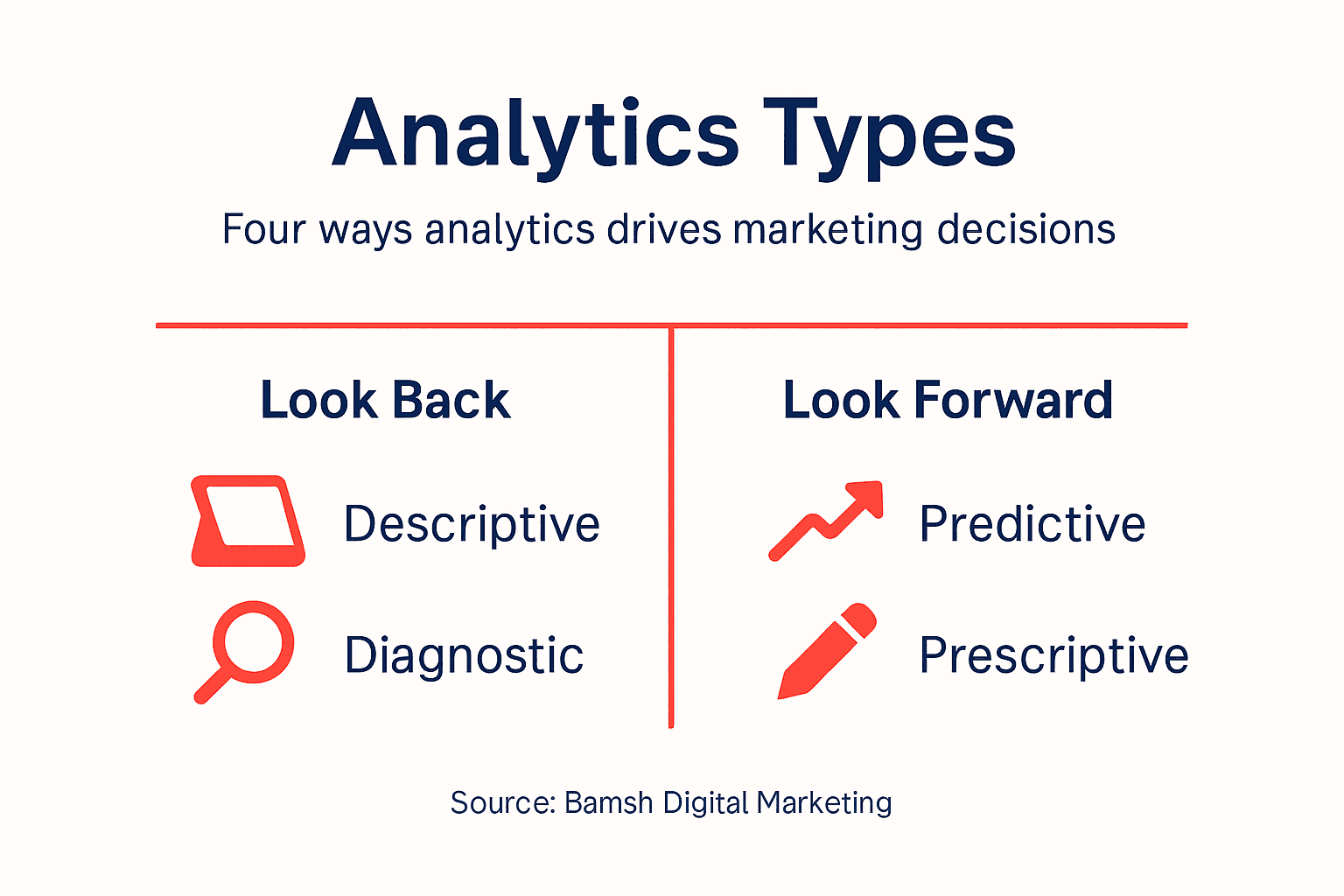
Diagnostic analytics answers: why did it happen? You dig deeper to understand which factors influenced those results.
Predictive analytics answers: what will happen? You use past patterns to forecast future performance with reasonable accuracy.
Prescriptive analytics answers: what should we do? The system actually recommends the best action based on all available data.
Most small businesses start with descriptive and diagnostic, then add predictive as they mature.
How This Translates to Real Decisions
Here’s what this looks like in practice. Your CRM shows that prospects who download a specific guide have a 40% conversion rate, while other leads convert at 12%. Instead of guessing which content matters, you now know. You produce more of that guide, promote it harder, and invest less in other content.
Another example: your Google Ads data reveals that customers aged 45-60 from Exeter cost less to acquire and have higher lifetime value than customers from Plymouth. Your next campaign targets Exeter specifically and adjusts your bids accordingly.
These aren’t guesses. They’re facts.
Analytics doesn’t make decisions for you—it gives you the evidence to make better ones with confidence and speed.
The Real Business Impact
When decisions are driven by data rather than intuition:
- Lead generation costs drop because you stop funding ineffective channels
- Conversion rates improve as you optimise based on what actually works
- Customer satisfaction increases because you understand their behaviour
- Team confidence grows because everyone sees the same clear metrics
- Budget allocation becomes predictable and justifiable
You’re not just spending money on marketing. You’re investing it strategically.
Pro tip: Start by identifying your three most important business decisions (lead volume, conversion rate, customer lifetime value), then gather data specifically to answer those questions rather than collecting random metrics.
Key Legal and Privacy Responsibilities in the UK
If you’re collecting customer data for marketing analytics, you’re not operating in a lawless space. UK law is strict about what you can do with personal information, and breaking these rules costs money, reputation, and trust.
The good news? Compliance isn’t complicated if you understand the basics.
What the Law Actually Requires
Your marketing analytics must comply with UK GDPR and the Privacy and Electronic Communications Regulations (PECR). These aren’t optional guidelines. They’re legal requirements that apply to every business collecting customer data.
UK marketing analytics must respect data protection consent requirements and transparency standards. This means:
- You need consent or legitimate interest before processing personal data
- You must be transparent about how you use customer information
- You must provide easy ways for people to opt out
- You must respect individuals’ rights regarding their data
For a South West business collecting email addresses, phone numbers, or browsing behaviour, these rules matter immediately.
Consent vs. Legitimate Interest
You can process customer data in two ways. The first is consent – you ask permission explicitly before collecting or using data. Someone ticks a box. Clear and simple.
The second is legitimate interest – you have a valid business reason to use data without explicit consent, provided you’re transparent about it and respect privacy. This applies to existing customers or data you’ve collected through normal business operations.
Most businesses use a combination of both. You might have consent for email marketing from website visitors but legitimate interest for analytics about current customers.
The Data (Use and Access) Act 2025
UK data protection law updated recently. The new legislation maintains high privacy standards whilst enabling innovation and data sharing. Key responsibilities now include:
- Safeguards for automated decision-making
- Extra protection for children’s data
- Lawful processing requirements that haven’t changed
- Continued compliance with consent and transparency rules
If you’re using AI or algorithms to make decisions about customers, you have additional obligations to explain how those systems work.
Practical Responsibilities for Your Business
Here’s what you actually need to do:
- Keep records of what data you collect and why
- Get consent where required (email marketing, tracking cookies)
- Provide privacy notices explaining data use
- Establish a process for people to request their data
- Report data breaches to the Information Commissioner’s Office within 72 hours
- Only keep data for as long as you need it
Compliance isn’t punishment—it’s the foundation of customer trust and sustainable marketing.
Why This Matters Beyond Legal Risk
Yes, non-compliance brings fines from the Information Commissioner’s Office. But the real cost is customer trust. When people learn you’re handling their data carelessly, they stop engaging with your business.
Proper analytics practices build confidence. Transparent data use differentiates you from competitors who cut corners. When you tell customers exactly what you’re measuring and why, they’re more likely to provide better data.
For small to medium-sized businesses, compliance also prevents expensive mistakes. One mishandled data breach can consume months of management time and significant budget.
Pro tip: Document your data collection practices now—what you collect, why, and how long you keep it—then review it quarterly to ensure you stay compliant as regulations evolve.
For businesses navigating UK data regulations, here is a quick reference on compliance responsibilities:
| Legal Requirement | What It Means | Practical Step | Business Advantage |
|---|---|---|---|
| GDPR & PECR Compliance | Protects personal data | Obtain consent, show privacy notices | Builds customer trust |
| Data Breach Reporting | Notify regulators quickly | Document and act within 72 hours | Reduces legal risk |
| Data Minimisation | Only collect what is needed | Regular audits and restrict access | Limits exposure, increases efficiency |
| Transparency | Explain data use clearly | Update privacy policies, offer opt-outs | Differentiates your business |
Avoiding Common Pitfalls and Misuse Risks
Marketing analytics is powerful. It’s also easy to mess up. Many businesses implement analytics and unknowingly breach privacy laws, leak sensitive data, or build biased systems that harm their reputation.
These mistakes are preventable. You just need to know what to watch for.
Data Collection Gone Wrong
The most common mistake is collecting data you don’t need. Businesses add tracking codes without understanding what information they’re capturing. Sometimes personal data ends up in URLs, parameter strings, or system logs where it shouldn’t be.
Common pitfalls in analytics include inadvertently collecting personal data in URLs and tag management misconfigurations, which create GDPR non-compliance and data leakage risks. A single poorly configured form might capture email addresses or phone numbers in your analytics platform when you only meant to track page views.
Another trap: storing excessive identifiers. You don’t need customer email addresses, postcodes, and credit card details in your analytics. Restrict data collection to what you actually use for decisions.
Misconfigurations and Technical Risks
Tag management systems are powerful but dangerous if misconfigured. A marketing team member adds tracking code incorrectly, and suddenly personal information flows into systems you can’t control.
These risks require:
- Regular audits of what data you’re actually collecting
- Clear documentation of why each data point is collected
- Restrictions on who can modify tracking code
- Testing new tracking changes before deployment
- Quarterly reviews of your analytics setup
One misconfiguration isn’t just a technical problem. It’s a compliance violation.
Bias and Unfair Treatment
Here’s the subtle risk many businesses miss: your analytics can encode bias and discrimination. If your data is skewed towards certain customer groups, your predictive models make unfair decisions about others.
Responsible analytics assessment requires evaluating fairness, avoiding biased algorithm encoding, and undertaking ethical evaluations to prevent adverse effects. For example, if your training data mostly includes customers from London, your system might make poor predictions for South West prospects.
This affects your marketing directly. You target the “right” customers based on biased data, and your campaigns underperform because the data didn’t reflect reality.
Over-Reliance on Automation
Some businesses set analytics rules and forget them. Automated campaigns run based on outdated data. Algorithms make decisions without human oversight. A single data error cascades across your entire marketing operation.
Analytics should inform decisions, not replace them. You need humans in the loop validating findings and questioning assumptions.
The best analytics implementation combines automated data collection with human judgment about what the data actually means.
Practical Prevention Steps
Protect yourself by doing this:
- Document exactly what data you collect and why
- Audit your tracking implementation quarterly
- Restrict access to analytics tools and data
- Train team members on data responsibility
- Test algorithm outputs for bias before using them
- Keep data only as long as you need it
For South West businesses with limited IT resources, this means starting with basics rather than complex AI systems. Master simple analytics first, then add sophistication.
Pro tip: Before implementing any new tracking or automation, ask: What data am I collecting? Why? Who sees it? How could it be misused? If you can’t answer clearly, don’t implement it yet.
Unlock the Power of Marketing Analytics with Bamsh Digital Marketing
If you are struggling to make clear, data-driven decisions that actually improve your marketing results then you are not alone. The article highlights how many businesses waste budget by guessing which campaigns work and miss out on true insights due to poor analytics practices. At Bamsh, we understand your challenge of turning complex data into straightforward actions that grow your business without confusion or jargon.
Our expert team offers tailored solutions such as CRM setup and automated lead nurturing that capture and score leads for you, plus Google PPC management and Paid Social Media Advertising to reach the right customers efficiently. We focus on giving you transparent reporting to show which activities deliver real returns and how to optimise them. By combining trusted analytics with award-winning marketing services, we empower South West businesses to spend confidently and stop wasting money on ineffective campaigns.
Ready to take the guesswork out of your marketing and harness the full potential of your data? Visit our 15-minute marketing consultation page to get started today. Explore how our Special Offers can provide incredible value or tune into insights from our Podcasts to see how smart analytics fuels business success. Don’t wait to turn your marketing data into predictable growth—let Bamsh be your trusted partner on this journey.
Frequently Asked Questions
What is marketing analytics?
Marketing analytics is the process of tracking and measuring data from marketing efforts to reach business goals, understanding what works, what doesn’t, and informing future investments.
Why is analytics important for decision-making in marketing?
Analytics provides evidence-based insights that reduce uncertainty in decision-making. It allows businesses to understand which campaigns generate revenue and how to allocate budgets effectively.
What types of data does marketing analytics track?
Marketing analytics tracks various data types, including first-party data collected directly from customers, second-party data from partners, and third-party data from external providers, providing a comprehensive view of customer behaviour.
How can small businesses effectively use analytics tools?
Small businesses should start with basic tools that cover website tracking, CRM, and reporting. It’s essential to focus on a few key metrics relevant to business goals to avoid overwhelming complexity.