
Conversion rate optimisation for trade business websites
Your website gets visitors. People find you on Google, click through to your homepage and look at your services.
But your phone isn’t ringing.
You might be paying for SEO, running Google Ads or regularly posting on social media. The traffic is coming in, yet hardly anyone requests a quote.
For plumbers, electricians, roofers, builders and other UK tradespeople, the problem isn’t always a lack of visitors. Sometimes, it’s the website itself.
A slow homepage, hidden telephone number, confusing call to action or complicated contact form can make potential customers leave before getting in touch.
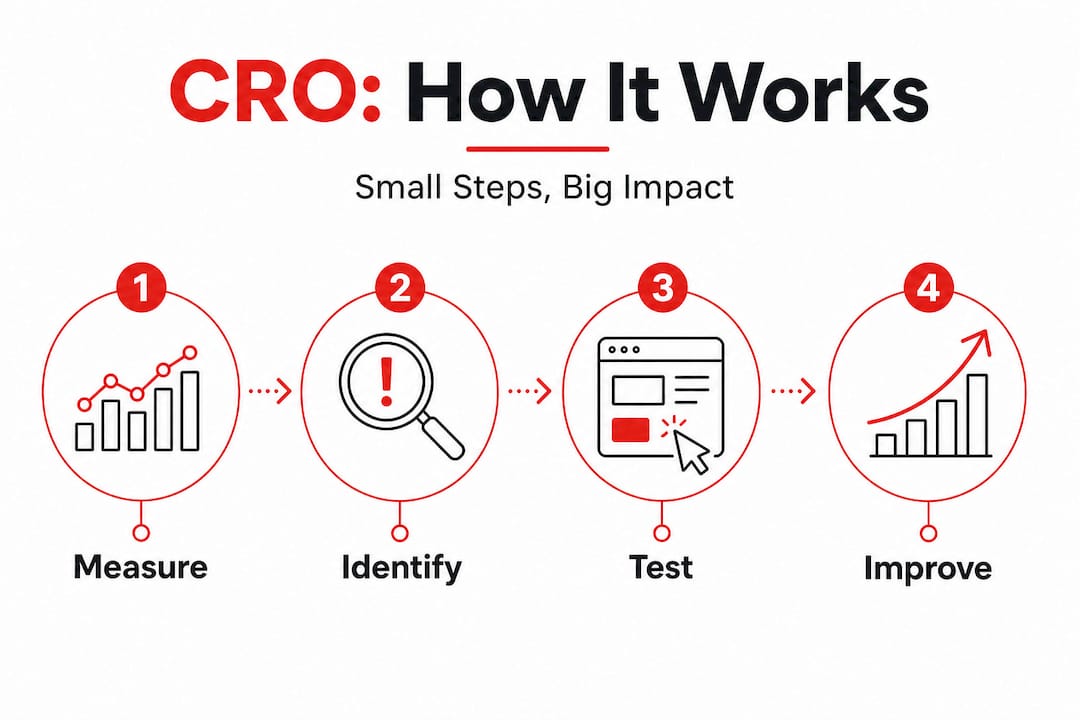
This is where conversion rate optimisation (CRO) comes in.
At BAMSH, we’ve applied these principles to our trades brochure landing page, using one clear call to action, a short form and social proof positioned close to the point of conversion.
We’ve also seen how relatively small website changes can make a difference for trade businesses. In one South Gloucestershire roofing example, monthly enquiries increased from two to seven without additional advertising spend.
This guide explains how to identify the problems stopping visitors from contacting you and which changes to prioritise.
Key Takeaways
-
Conversion rate optimisation helps trade websites generate more enquiries from their existing visitors.
-
Five common conversion problems are slow loading, hidden phone numbers, unclear CTAs, missing trust signals and poor mobile usability.
-
A clear quotation button and visible contact details make it easier for potential customers to take action.
-
BAMSH’s trades brochure landing page uses one primary CTA, a name-and-email form and social proof directly above the form.
-
A South Gloucestershire roofing case study reported an increase from two to seven monthly enquiries after website improvements, with traffic remaining broadly unchanged.
-
CRO should be measured through genuine enquiries, not just button clicks or page views.
1. What Is Conversion Rate Optimisation for a Trade Website?
Conversion rate optimisation means improving your website so that more visitors take a useful action.
For a trade business, that action is usually:
-
Calling to discuss a job.
-
Completing a quotation request form.
-
Booking an appointment.
-
Sending an enquiry about a service.
An online shop measures purchases. A trade website usually needs to measure enquiries that could turn into paid work.
That difference matters.
A roofing website doesn’t need hundreds of visitors adding products to a basket. It needs homeowners and property managers who can quickly understand the services offered, trust the business and request a quotation.
How Website Conversion Rate Is Calculated
The basic formula is:
Conversion rate = (Number of conversions ÷ Number of visitors) × 100
For example, if your website receives 200 visitors and generates four enquiries:
4 ÷ 200 × 100 = 2% conversion rate
If the same website generates eight enquiries from 200 visitors, its conversion rate increases to 4%.
You haven’t needed more traffic. You’ve improved how effectively the website converts the visitors it already receives.
For more information, read our guide to conversion rate optimisation in Bristol.
2. The Five Biggest Reasons Trade Websites Don’t Convert
Many trade websites have similar problems.
They may look reasonably professional on a desktop computer but become difficult to use when a customer visits from their phone.
Or they explain the company’s history in detail without making it obvious how to request a quotation.
Here are five issues worth checking first.
1. Your Website Takes Too Long to Load
Imagine a homeowner searching for a roofer because water is coming through their ceiling.
They click your website.
The page takes several seconds to display properly.
They return to Google and try another business.
Slow loading can create unnecessary friction, particularly when somebody needs help quickly.
Common causes include oversized images, unnecessary scripts, excessive plugins and poorly configured hosting.
How to fix it:
Run your main service pages through Google PageSpeed Insights.
Check mobile performance rather than relying on desktop results.
Compress large images, remove unnecessary scripts and prioritise loading the information visitors need first.
The aim isn’t to chase a perfect performance score. It’s to make the page usable as quickly as possible.
2. Your Phone Number Isn’t Visible Above the Fold
Above the fold means the part of the page visible before somebody starts scrolling.
For a trade website, this area should make it easy to contact the business.
If your phone number only appears in the footer, visitors may have to search for it.
Some won’t bother.
How to fix it:
Display your telephone number prominently in the header.
On mobile, make it clickable so customers can call without copying the number.
If you provide emergency services, make the contact option particularly easy to find, but only advertise response times or availability you can genuinely provide.
3. There’s No Clear Primary Call to Action
A call to action, or CTA, tells the visitor what to do next.
Examples include:
-
Get a Free Quote
-
Request a Roofing Survey
-
Book an Appointment
-
Call Our Team
Problems arise when a homepage presents too many competing actions.
One section asks visitors to subscribe to a newsletter. Another promotes a blog. A third encourages them to follow the business on Facebook.
Meanwhile, the quotation button is difficult to find.
How to fix it:
Choose one primary action for each important landing page.
For most trade service pages, that will be requesting a quote or making contact.
You can repeat the same CTA further down the page without introducing a different objective.

4. Customers Can’t See Any Trust Signals Without Scrolling
Visitors need a reason to trust your business.
They may be considering allowing somebody into their home or committing money to an expensive project.
If the homepage provides no visible evidence of your experience or previous work, customers may hesitate.
Useful trust signals include genuine Google reviews, customer testimonials, relevant accreditations, photographs of completed work and clear business contact information.
How to fix it:
Place your strongest relevant trust signals near the top of the homepage.
A short review excerpt, accurate review rating or genuine accreditation can help establish credibility before the visitor reaches the contact form.
Don’t use invented testimonials, misleading star ratings or accreditations your business doesn’t hold.
5. Your Website Is Difficult to Use on Mobile
A website may look excellent on a large monitor but fail on a phone.
Buttons might be too small to tap.
Text may overlap photographs.
The menu might cover important content.
A contact form could require too much typing.
For a tradesperson, these issues can directly affect enquiries because potential customers often want to make contact quickly.
How to fix it:
Open your website on a real mobile phone.
Try calling the business, finding a service and submitting the contact form.
If any of those actions are difficult, prioritise fixing them.
The Five Conversion Killers at a Glance
| Conversion Problem | What the Visitor Experiences | Recommended Fix |
|---|---|---|
| Slow loading | Waits too long for useful content | Improve mobile page speed |
| Hidden phone number | Struggles to find contact details | Add a clickable number to the header |
| Unclear CTA | Doesn’t know what to do next | Use one prominent primary action |
| Missing trust signals | Has little reason to trust the business | Show genuine reviews and credentials near the top |
| Poor mobile experience | Cannot navigate or enquire easily | Test and repair mobile usability |
These problems often occur together.
A slow page with no obvious quotation button and little evidence of previous work creates several reasons for somebody to leave.
3. Case Study: Same Traffic, More Than 3x the Enquiries
BAMSH CASE STUDY | SOUTH GLOUCESTERSHIRE ROOFER
A roofing business in South Gloucestershire was receiving more than 200 website visitors per month.
But despite that traffic, the website was generating an average of only two enquiries.
The issue wasn’t necessarily that people couldn’t find the website.
It was what happened after they arrived.
The Problems BAMSH Identified
The homepage had no clear call to action above the fold.
The telephone number was only displayed in the footer.
Visitors couldn’t see trust signals without scrolling.
The website also took 6.2 seconds to load on mobile, and its contact form contained eight fields.
These issues made it unnecessarily difficult for a potential customer to get in touch.
What BAMSH Changed
The improvements focused on the existing website rather than creating more content or attracting additional traffic.
-
Added the telephone number to the header so it appeared on every page.
-
Placed a Get a Free Quote button above the fold.
-
Added three Google review star elements to the homepage.
-
Reduced mobile page loading time from 6.2 seconds to 1.8 seconds.
-
Shortened the contact form from eight fields to three.
The work took approximately half a day of development time.
Before and After Results
| Performance Metric | Before CRO | After CRO |
|---|---|---|
| Monthly website visitors | 200+ | Similar traffic |
| Monthly enquiries | 2 | 7 |
| Mobile page load time | 6.2 seconds | 1.8 seconds |
| Contact form fields | 8 | 3 |
| Phone number in header | No | Yes |
| Primary CTA above the fold | No | Yes |
| Trust signals visible near top | No | Yes |
| Additional advertising spend | £0 | £0 |
| New content required | No | No |
REPORTED ENQUIRY INCREASE
2 → 7 per month
3.5 times as many enquiries within 30 days, with similar traffic levels.
The case study figures come from BAMSH’s August 2026 content improvement brief. They should be checked against client reporting before publication.
What This Case Study Demonstrates
The improvements removed several barriers to making an enquiry.
Customers could find the telephone number more easily, identify the next step, see trust information and complete a shorter form.
The results are consistent with the changes helping the website convert more effectively, although the available information does not isolate the impact of each individual change.
The key lesson is that a trade website doesn’t always need more traffic. Sometimes, it needs to make better use of the visitors it already has.
4. The Squint Test: Can Visitors See Your Call to Action?
Here’s a simple way to check whether your homepage makes the next step obvious.
Open your website on a desktop or mobile screen.
Look at the top of the homepage and squint your eyes slightly, so the smaller text becomes difficult to read.
Now ask yourself:
Can you still identify the main call-to-action button?
If the quotation button blends into the background or competes with several other elements, visitors may struggle to notice it.
The squint test isn’t a scientific usability measurement. It’s a quick visual check of hierarchy and contrast.
What You Should Be Able to Identify
Without reading every word, you should be able to recognise:
-
What the business offers.
-
The main headline.
-
The primary contact or quotation button.
-
A relevant trust signal.
-
The general direction of the page.
For example, a roofing homepage might display:
Roof Repairs and New Roof Installations in Bristol
Professional roofing services for domestic and commercial properties.
CTA: Get a Free Roofing Quote
Underneath, it could show genuine customer reviews or relevant credentials.
This gives visitors a clear reason to stay and an obvious next step.
If you’re unsure where to start, our guide to seven quick website improvements covers other practical changes.
5. How BAMSH Applied CRO to Its Trades Brochure Landing Page
BAMSH recently developed a landing page for a free marketing brochure aimed at UK tradespeople.
The page was designed to encourage plumbers, electricians, roofers, builders and other trade business owners to request the guide.
Unlike a general website homepage, the landing page has one specific conversion goal.
The visitor should understand the offer and complete the brochure request.
Three decisions were particularly important.
Decision 1: One Primary CTA Only
The page focuses on requesting the brochure.
It doesn’t ask visitors to choose between several unrelated actions.
The main CTA directs attention towards downloading the guide.
This keeps the conversion path straightforward.
A dedicated landing page usually benefits from a more focused structure than a homepage, which may need to serve several different visitor needs.
Decision 2: Name and Email Only
The brochure request form asks for two details:
Name and email address.
It doesn’t ask for a phone number, business turnover, postcode, marketing budget or several additional questions.
Those details may become relevant later, but they aren’t necessary to deliver a free brochure.
Reducing the number of fields makes the initial request simpler.
However, a shorter form should still include appropriate privacy information and distinguish brochure delivery from optional marketing consent.
Decision 3: Social Proof Directly Above the Form
The landing page places social proof close to the sign-up form.
This is a deliberate decision.
Visitors may be interested in the brochure but still want reassurance that BAMSH is a credible business.
Positioning genuine reviews or other verifiable evidence near the form helps answer that concern at the point where they’re deciding whether to submit their details.
The trust information should be authentic, relevant and accurately presented.
BAMSH’s Landing Page CRO Decisions
| Landing Page Element | BAMSH’s Approach | Reason for the Decision |
|---|---|---|
| Main objective | Brochure requests | Keeps the page focused |
| Primary CTA | One clear download action | Reduces competing choices |
| Form fields | Name and email | Makes the request straightforward |
| Social proof | Directly above the form | Provides reassurance near the conversion point |
| Offer | Free marketing brochure for tradespeople | Gives the intended audience a relevant reason to act |
| Next step | Brochure delivery and appropriate follow-up | Connects the enquiry to the wider lead generation process |
[INSERT SCREENSHOT OF THE ACTUAL BAMSH TRADES BROCHURE LANDING PAGE HERE]
A screenshot showing the headline, primary CTA, social proof and form would make this example more useful.
The brief documents the landing page decisions but does not provide verified conversion results. These should not be described as proven performance improvements until campaign data is available.
6. Why Your Contact Form Might Be Losing Enquiries
A contact form should make it easy for customers to explain what they need.
But some trade websites ask for too much information before a business has even spoken to the customer.
For example, a roofing quotation form might request:
-
Full name.
-
Email address.
-
Telephone number.
-
Full postal address.
-
Property type.
-
Roofing material.
-
Estimated budget.
-
Detailed project description.
Some of this information may be useful eventually.
But it isn’t always necessary for the first conversation.
A Simpler Contact Form
For an initial enquiry, a trade business might begin with:
| Field | Purpose |
|---|---|
| Name | Identify the customer |
| Contact details | Allow the business to respond |
| Brief enquiry | Understand the type of work |
Further details can be gathered when arranging a survey or quotation.
There are exceptions. An emergency service may need the customer’s location immediately, while a specialist contractor may require additional information to assess whether the job is suitable.
The aim isn’t to remove every field.
It’s to remove questions that create effort without providing useful information at that stage.
Read our guide to content optimisation for conversions for more ways to improve the relationship between page content and visitor actions.
7. How to Make a Trade Website More Trustworthy
Trust matters when customers are choosing somebody to work on their property.
They may be comparing several businesses that offer similar services.
A website needs to give them enough information to make a confident decision.
Useful Trust Signals for Trade Websites
| Trust Signal | Why It Helps | Best Placement |
|---|---|---|
| Genuine Google reviews | Shows feedback from previous customers | Homepage and relevant service pages |
| Completed project photographs | Demonstrates the type of work carried out | Service pages and project galleries |
| Relevant accreditations | Helps customers assess qualifications or standards | Near service information |
| Business contact details | Makes the company easier to identify and contact | Header, footer and contact page |
| Named team members | Shows the people behind the business | About page and relevant service pages |
| Customer testimonials | Provides context about previous work | Near relevant service descriptions |
| Clear service areas | Confirms whether the business covers the customer’s location | Homepage and service pages |
The most useful trust signals are specific.
For example, a roofer showing photographs of completed slate roofing projects provides more relevant evidence than a generic statement about delivering excellent customer service.
Accreditations should be current and accurately described.
Review stars should reflect genuine customer feedback, not decorative ratings created for marketing purposes.
8. Why Mobile CRO Matters for UK Tradespeople
A potential customer may find your business while standing outside their property, travelling home or looking for help during a break.
They may be using a mobile phone rather than a desktop computer.
That means the mobile experience deserves particular attention.
Check These Mobile Elements
| Mobile Element | What to Check |
|---|---|
| Telephone number | Is it visible and clickable? |
| Primary CTA | Can visitors see and tap it easily? |
| Navigation | Can users find services without difficulty? |
| Text | Is it readable without zooming? |
| Images | Do they load properly without covering text? |
| Contact form | Is it straightforward to complete? |
| Page speed | Does useful content appear promptly? |
| Trust signals | Can visitors see credible evidence near the top? |
Testing your website on your own phone is useful, but it isn’t enough on its own.
Try different screen sizes and browsers where possible.
Ask somebody unfamiliar with the website to find a service and submit an enquiry.
If they struggle, potential customers may experience the same problem.
For further ideas, see our guide to small website changes that improve conversions.
9. How to Measure Whether Your Website CRO Is Working
Before changing your website, establish how it currently performs.
Otherwise, you won’t know whether the changes helped.
For a trade website, the most important metrics usually relate to enquiries.
Metrics Worth Tracking
| Metric | What It Measures | Why It Matters |
|---|---|---|
| Website visitors | Number of people visiting the site | Provides traffic context |
| Enquiry form submissions | Completed contact forms | Measures a key conversion action |
| Telephone clicks | Visitors tapping a phone link | Indicates contact intent |
| Confirmed telephone enquiries | Actual calls received | Helps distinguish clicks from conversations |
| Conversion rate | Percentage of visitors completing a defined action | Measures website effectiveness |
| Mobile performance | Loading and usability indicators | Helps identify technical barriers |
| Landing page performance | Results from specific service pages | Identifies stronger and weaker pages |
| Qualified enquiries | Contacts relevant to the business | Measures lead quality |
| Jobs booked | Enquiries turning into work | Connects CRO with business outcomes |
Google Analytics 4 can help track website events and key actions.
However, a click on a telephone number isn’t necessarily a completed call.
For more reliable reporting, combine website analytics with enquiry records or suitable call tracking.
Before and After CRO Tracking
For each significant change, record:
-
The problem you identified.
-
The page or element changed.
-
The date the change went live.
-
The number of visitors before and after.
-
The number of genuine enquiries received.
-
Any relevant changes in traffic source or seasonality.
This helps you assess whether the improvement is meaningful.
10. Should You Use A/B Testing on a Trade Website?
A/B testing compares two versions of a page or element to see which performs better.
For example, you could test:
Version A: Contact Us
Version B: Get a Free Roofing Quote
Visitors are divided between the versions, and the business measures which generates more enquiries.
However, A/B testing isn’t always practical for a small trade website.
If your website receives only a few hundred visitors each month, it may take a long time to gather enough data for a reliable result.
In those circumstances, fixing obvious usability problems first is often more sensible.
A hidden telephone number, broken mobile form or unreadable CTA doesn’t need a complicated experiment to justify investigation.
CRO Changes Worth Prioritising
| Change | When to Prioritise It |
|---|---|
| Fix broken forms | Immediately |
| Make telephone number visible | When contact details are difficult to find |
| Improve mobile usability | When visitors struggle on phones |
| Add a clear primary CTA | When the next step is unclear |
| Improve page speed | When loading delays affect usability |
| Add genuine trust signals | When the website lacks evidence of credibility |
| Run A/B tests | When there is enough traffic to compare versions reliably |
CRO should be based on the scale and needs of the business, not simply copying the methods used by large online retailers.
11. A Practical CRO Checklist for UK Trade Websites
Use this checklist to review your homepage and most important service pages.
Website CRO self-audit
0 of 10 complete
If several of these checks fail, prioritise those issues before investing heavily in attracting more visitors.
12. Do You Need More Traffic or Better Conversion Rates?
Traffic growth and CRO are both important.
But they solve different problems.
If nobody can find your website, improving the quotation form alone won’t create a steady flow of enquiries.
If hundreds of relevant visitors are arriving but very few contact you, increasing advertising spend may simply send more people to a website that isn’t working effectively.
Which Problem Should You Fix First?
| Situation | Likely Priority |
|---|---|
| Very few visitors and very few enquiries | Improve relevant visibility and traffic |
| Good traffic but few enquiries | Investigate conversion barriers |
| Many form submissions but poor-quality leads | Review targeting, messaging and qualification |
| Plenty of enquiries but few bookings | Review sales follow-up and quotation process |
| Good conversion rate but limited traffic | Consider increasing relevant traffic |
| Strong traffic and strong conversion | Continue monitoring and improving both |
For some trade businesses, the biggest opportunity is SEO.
For others, it’s better web design.
And for businesses already receiving relevant visitors, improving the existing website may produce a faster operational benefit than creating more pages.
Our guide to digital marketing and revenue growth explains how these activities fit together.
13. How BAMSH Can Help Improve Your Trade Website’s Conversion Rate
A trade website should do more than look professional.
It should help potential customers understand what you offer, decide whether you’re suitable and get in touch without unnecessary effort.
At BAMSH, our web design services focus on creating websites that support real business objectives.
That includes clear page layouts, straightforward contact options, relevant content and mobile usability.
If you already have a website, the right starting point may be improving what is there rather than replacing everything.
Our SEO audit report can help identify technical and content issues that may be affecting website performance.
You can also use our DIY SEO tool to review aspects of your website independently.
If you’d prefer to discuss the issues with somebody, book a free 15-minute call.
We’ll help you identify whether your priority should be better visibility, improved conversion or a combination of both.
Frequently Asked Questions
What is the average conversion rate for UK small businesses?
There isn’t one reliable conversion rate that applies to every UK small business. Performance depends on the industry, traffic source, offer and type of conversion being measured. A trade website generating quotation enquiries should not be compared directly with an online shop measuring purchases. The most useful benchmark is your own historical performance alongside the quality of the enquiries received.
Can I do CRO myself or do I need an expert?
Many basic CRO improvements can be completed without specialist support. Making your telephone number visible, checking mobile usability and simplifying a contact form are practical starting points. More complicated issues involving tracking, website development or structured experiments may require professional help. Start by identifying the most obvious barriers.
Which CRO change gives the fastest results?
Fixing a broken contact form or making a hidden telephone number accessible can remove an immediate barrier to enquiries. Adding a clear CTA near the top of the page is another useful starting point. However, the effect depends on the website’s existing problems and visitor behaviour. No single change guarantees an increase in enquiries.
How do I know CRO is working?
Measure your website’s performance before and after making changes. Track genuine enquiries, relevant traffic and conversion rate using consistent definitions. Where possible, also record whether those enquiries turn into quotations and booked jobs. Avoid judging success from button clicks alone.
What tools can help me with CRO?
Google Analytics 4 can track website interactions and conversions. Google PageSpeed Insights can help identify loading and performance issues. Mobile device testing, form checks and customer feedback are also useful. Businesses with sufficient traffic may benefit from A/B testing tools to compare different page versions.
Why isn’t my trade website converting visitors into enquiries?
Common causes include slow loading, hidden contact details, weak calls to action, missing trust signals and poor mobile usability. Your website may also be attracting visitors who aren’t looking for the services you offer. Reviewing the landing pages, traffic sources and enquiry process can help identify the problem.
Should a trade website have a phone number at the top?
For many trade businesses, yes. Customers often want to call directly, especially when requesting urgent repairs or arranging a quotation. Displaying a clickable telephone number in the header makes it easier to contact the business. A quotation button can provide an alternative for visitors who prefer submitting an enquiry online.
How many fields should a trade website contact form have?
Use the minimum number of fields needed to handle the initial enquiry properly. Name, contact details and a brief description may be enough for many businesses. Other services may require a postcode, preferred appointment date or project details. The goal is to avoid unnecessary questions while collecting enough information to respond effectively.
Can conversion rate optimisation increase enquiries without more advertising?
Yes, it can. If a website already receives relevant visitors, removing barriers to contact may help more of them submit enquiries. BAMSH’s South Gloucestershire roofing example reported an increase from two to seven monthly enquiries after website improvements, without additional advertising spend. Results will vary by website and business.
Is CRO worth doing on a small trade website?
Yes, particularly when the website receives relevant visitors but generates few enquiries. Small websites can benefit from clearer contact details, faster loading and more straightforward forms. However, businesses with very little traffic may also need to improve their visibility. CRO and traffic generation should support one another.