

Many small business owners believe CRM systems are expensive tools reserved for large corporations with dedicated IT teams. This misconception costs UK SMBs countless opportunities to nurture leads, retain customers, and scale efficiently. CRM systems help SMBs centralise customer data and streamline interactions to improve relationships and sales. This guide reveals how the right CRM strategy transforms lead nurturing, boosts conversion rates, and drives measurable business growth for companies of all sizes.
Table of Contents
- Key takeaways
- What is CRM and why it matters for business growth
- Key ways CRM drives business growth for small and medium businesses
- Choosing and integrating the right CRM for your business needs
- Measuring success: how CRM insights boost marketing and sales performance
- Boost your business growth with expert marketing support
- Frequently asked questions
Key Takeaways
| Point | Details |
|---|---|
| Centralised customer data | CRM centralises customer data and interactions in one system, enabling faster, more personalised responses. |
| Improved lead nurturing | Automation and segmentation deliver timely follow ups without constant manual effort. |
| Sales pipeline visibility | A clear view of each prospect stage helps identify bottlenecks and prioritise the best opportunities to close. |
| Behaviour insights guide growth | Insights into campaigns, products and segments inform smarter marketing decisions and better budget prioritisation. |
What is CRM and Why it Matters for Business Growth
Customer Relationship Management (CRM) software organises all your customer information and interactions in one accessible place. Instead of scattered spreadsheets, sticky notes, and email folders, you get a single system that tracks every lead from first contact to final sale. For small and medium businesses, this centralisation creates agility that larger competitors struggle to match.
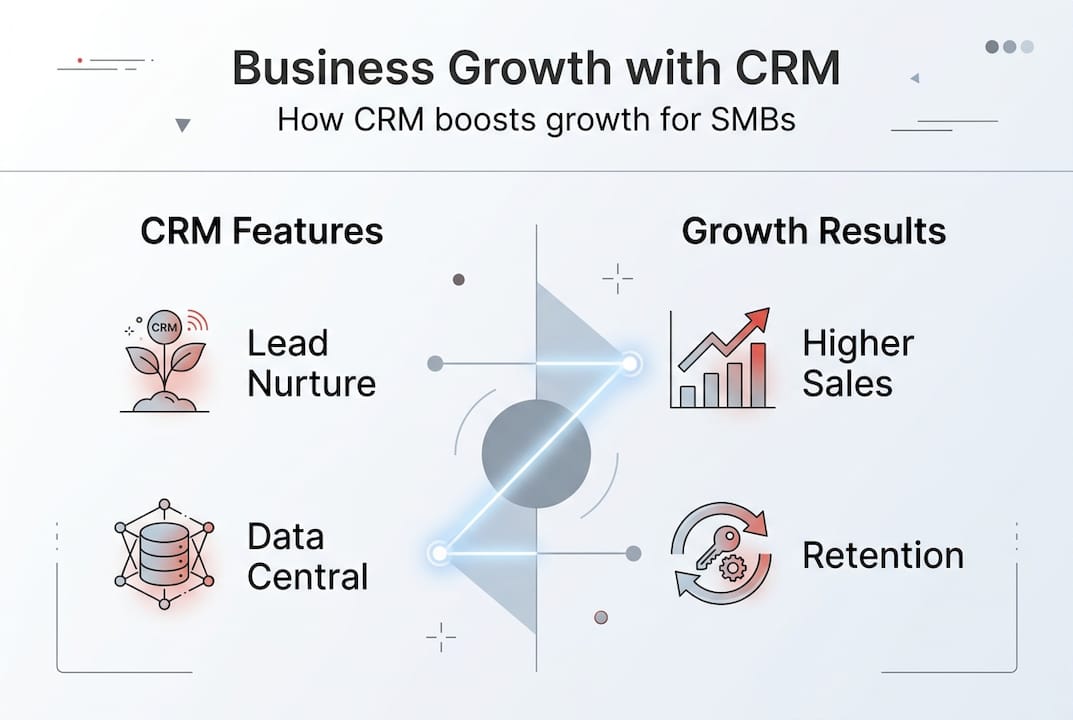
CRM systems help SMBs centralise customer data and streamline interactions to improve relationships and sales. When your team can instantly see a customer’s purchase history, previous conversations, and current needs, they respond faster and more personally. This responsiveness directly impacts your bottom line through higher conversion rates and stronger customer loyalty.
The right CRM transforms how you manage growth opportunities. Rather than relying on memory or manual processes, you build systematic approaches to lead nurturing that work consistently. Every enquiry gets captured, every follow-up happens on schedule, and no potential customer falls through the cracks.
Key CRM features that drive SMB growth include:
- Contact management that stores complete customer profiles and interaction history
- Sales pipeline tracking that shows exactly where each prospect stands
- Task automation that schedules follow-ups and sends personalised messages
- Reporting dashboards that reveal which marketing efforts actually generate revenue
- Mobile access that keeps your team connected wherever they work
Pro Tip: Start with basic contact management and automated reminders before expanding to advanced features. This gradual approach prevents overwhelm and helps your team adopt the system naturally.
The beauty of modern CRM lies in its scalability. You can begin with simple lead tracking and gradually add email campaigns, customer service tools, and advanced analytics as your business grows. This flexibility makes CRM accessible regardless of your current size or technical expertise.
Key Ways CRM Drives Business Growth for Small and Medium Businesses
The most significant growth impact comes from improved lead nurturing. CRM enhances lead nurturing by automating follow-ups and segmenting prospects effectively. When someone enquires about your services, your CRM immediately adds them to a nurture sequence tailored to their interests and behaviour. This automation ensures timely, relevant communication without requiring constant manual effort.
Sales pipeline management gives you unprecedented visibility into your revenue forecast. You can see exactly how many prospects sit at each stage, identify bottlenecks that slow conversions, and focus energy on the opportunities most likely to close. This clarity helps you allocate resources strategically rather than chasing every lead equally.

Customer behaviour insights inform smarter marketing decisions. Your CRM reveals which campaigns generate the highest quality leads, which products attract repeat purchases, and which customer segments deliver the best lifetime value. These insights let you double down on what works and eliminate what wastes budget.
| Sales approach | Average follow-up time | Conversion rate | Customer retention |
|---|---|---|---|
| Traditional manual methods | 48-72 hours | 12-18% | 60-65% |
| CRM-enabled processes | Under 1 hour | 25-35% | 78-85% |
Pro Tip: Review your CRM data weekly to spot trends early. A sudden drop in lead quality or engagement rates signals problems you can address before they impact revenue.
CRM systems excel at keeping customers engaged after the initial sale. Automated birthday messages, renewal reminders, and personalised product recommendations maintain relationships that drive repeat business. This ongoing engagement costs far less than acquiring new customers whilst generating more predictable revenue.
Specific CRM benefits that accelerate growth:
- Higher conversion rates through timely, personalised follow-up sequences
- Increased customer retention via automated check-ins and satisfaction monitoring
- Better resource allocation by identifying your most profitable customer segments
- Improved team collaboration with shared visibility into customer interactions
- Faster sales cycles by eliminating manual administrative tasks
The connection between CRM and revenue growth through digital marketing becomes clear when you track results properly. You can attribute specific sales to individual campaigns, calculate accurate customer acquisition costs, and optimise your entire marketing funnel based on real data rather than guesswork.
Integrating your CRM with marketing ROI tracking creates a complete picture of what drives growth. You see not just which channels bring traffic, but which ones bring customers who actually buy and stay loyal. This insight transforms how you invest your marketing budget.
Choosing and Integrating the Right CRM for Your Business Needs
Selecting the right CRM starts with understanding your specific requirements rather than chasing features you’ll never use. Consider these essential criteria:
- Ease of use: Your team must adopt it willingly, so prioritise intuitive interfaces over complex functionality
- Scalability: Choose systems that grow with you without forcing expensive migrations later
- Integration capabilities: Ensure compatibility with your existing email, accounting, and marketing tools
- Cost structure: Look for transparent pricing that fits your budget without hidden fees
- Support quality: Reliable customer service becomes crucial when technical issues arise
The most powerful CRM delivers little value if your team won’t use it consistently. Involve staff in the selection process and prioritise systems they find straightforward. A simple CRM used daily beats a sophisticated one that sits ignored.
Integrating CRM with your existing workflows requires methodical planning:
- Audit your current tools and identify which data sources need CRM connections
- Map out your ideal customer journey from first contact to repeat purchase
- Configure your CRM fields and pipelines to match your actual sales process
- Import existing customer data carefully, cleaning duplicates and outdated information
- Connect your email marketing, calendar, and communication tools to the CRM
- Train your team thoroughly on daily tasks before introducing advanced features
- Establish data entry standards so everyone maintains consistent, accurate records
Common integration pitfalls include rushing implementation without proper training, failing to clean existing data before migration, and trying to customise too much too soon. Start with standard configurations and adjust based on real usage patterns rather than theoretical needs.
Integrating CRM with marketing and sales workflows enhances marketing ROI and operational efficiency. When your CRM connects to your email platform, every campaign automatically updates contact records with engagement data. This connection reveals which messages resonate and which prospects need different approaches.
Essential CRM integrations for SMB growth:
- Email marketing platforms for automated campaigns and engagement tracking
- Calendar tools for seamless meeting scheduling and follow-up reminders
- Analytics software to connect website behaviour with CRM contact records
- Accounting systems to track customer value and payment history
- Communication tools like phone systems and live chat for complete interaction logs
The relationship between CRM and email marketing creates particularly powerful growth opportunities. Segment your audience based on CRM data, send targeted messages that address specific needs, and automatically update contact records based on responses. This integration turns generic email blasts into personalised conversations that drive action.
Working with experienced digital marketing professionals can accelerate your CRM integration and ensure you’re maximising its growth potential from day one. They bring expertise in connecting systems, avoiding common mistakes, and building workflows that actually get used.
Measuring Success: How CRM Insights Boost Marketing and Sales Performance
CRM analytics transform vague marketing efforts into precise, measurable campaigns. Three metrics matter most for tracking business growth:
Customer acquisition cost (CAC) shows exactly how much you spend to win each new customer. Your CRM calculates this by dividing total marketing and sales expenses by the number of customers acquired in a period. Lower CAC means more efficient growth.
Lead conversion rate reveals what percentage of enquiries become paying customers. Track this overall and by source to identify which marketing channels deliver the best prospects. A 2% improvement in conversion rate can double your revenue without increasing marketing spend.
Customer lifetime value (CLV) predicts the total revenue you’ll earn from a typical customer relationship. Higher CLV justifies spending more to acquire customers and signals strong retention strategies.
| Metric | Before CRM implementation | After CRM implementation | Improvement |
|---|---|---|---|
| Customer acquisition cost | £450 | £280 | 38% reduction |
| Lead conversion rate | 14% | 28% | 100% increase |
| Customer lifetime value | £2,100 | £3,800 | 81% increase |
| Average sales cycle | 45 days | 28 days | 38% faster |
Using CRM analytics enables businesses to optimise marketing ROI and drive business growth effectively. Instead of spreading your budget across multiple channels hoping something works, you invest heavily in proven winners and test new approaches systematically.
CRM reports inform critical business decisions:
- Marketing budget allocation based on which channels generate the highest CLV customers
- Sales team prioritisation by highlighting prospects most likely to convert soon
- Product development direction by revealing which features customers request most
- Customer service improvements by identifying common pain points and complaints
- Pricing strategy adjustments based on what your most profitable segments will pay
Pro Tip: Schedule monthly CRM review meetings where your team analyses trends together and commits to specific improvements. Regular reviews prevent data from sitting unused and ensure insights drive actual changes.
The connection between CRM data and increasing sales through digital marketing becomes obvious when you track the complete customer journey. You see which blog posts attract prospects who eventually buy, which email sequences move leads through your pipeline fastest, and which follow-up timing maximises conversions.
Advanced CRM users create custom dashboards showing real-time progress towards growth goals. Sales teams see daily pipeline value and conversion rates. Marketing teams track campaign performance and lead quality scores. Leadership monitors overall business health through revenue forecasts and customer retention trends.
The key is acting on insights rather than just collecting data. When your CRM reveals that leads contacted within one hour convert at three times the rate of those reached after 24 hours, you restructure your team to enable faster response. When reports show certain customer segments generate 80% of your profit, you focus acquisition efforts on similar prospects.
Boost Your Business Growth with Expert Marketing Support
Whilst CRM provides the foundation for systematic growth, combining it with expert marketing support accelerates results dramatically. Bamsh specialises in helping UK small and medium businesses maximise their CRM investment through targeted SEO and PPC campaigns that fill your pipeline with qualified leads.
Our DIY SEO tool empowers you to improve your search visibility whilst our Google Expert services deliver professional campaign management for businesses ready to scale faster. We integrate seamlessly with your CRM, ensuring every lead gets captured and nurtured effectively.
The combination of robust CRM processes and strategic lead nurturing creates predictable, sustainable growth. Contact Bamsh today for a tailored marketing plan that complements your CRM strategy and delivers measurable results.
Frequently Asked Questions
What is the best CRM for small businesses?
The best CRM depends on your specific business size, industry, and growth objectives. Look for user-friendly options that integrate smoothly with your existing email, accounting, and communication tools. Popular choices for UK SMBs include HubSpot, Zoho, and Pipedrive, each offering different strengths in pricing, features, and ease of use. Start with free trials to test which interface your team finds most intuitive.
How can CRM improve lead nurturing?
CRM systems track every lead interaction and schedule timely follow-ups automatically, ensuring no prospect gets forgotten. They enable personalised communication based on customer behaviour, interests, and stage in the buying journey. Automated lead follow-up systems can boost conversions by 30% by maintaining consistent contact without manual effort. Your CRM segments prospects intelligently and delivers relevant messages that move them closer to purchase.
What metrics should I track using CRM?
Track customer acquisition cost to measure marketing efficiency, lead conversion rates to identify pipeline bottlenecks, and customer lifetime value to understand long-term profitability. Monitor sales cycle length, win rates by source, and customer retention percentages. Use CRM marketing analytics to adjust your strategies based on real performance data rather than assumptions. Review these metrics monthly to spot trends early and optimise your approach continuously.
Can I integrate CRM with other marketing tools?
Modern CRM systems integrate seamlessly with email platforms, analytics software, calendar tools, and communication systems. These connections streamline workflows by automatically syncing data between platforms and eliminating manual entry. CRM and email marketing integration creates particularly powerful opportunities for automated, personalised campaigns. Most CRMs offer native integrations with popular tools plus API access for custom connections, making it easy to build a complete marketing technology stack.