

More than 50 percent of digital searches in the United Kingdom are now shaped by answer engines rather than traditional methods. For British businesses hoping to stay visible, understanding this shift is crucial. Answer Engine Optimisation is quickly becoming the standard for getting your content noticed, offering a smarter way to reach users who want clear, direct answers without scrolling through endless links.
Table of Contents
- Answer Engine Optimisation Explained Simply
- How Answer Engines Differ From Search Engines
- Core Strategies For Effective AEO Success
- Comparing AEO And Traditional SEO Approaches
- Common Mistakes Businesses Should Avoid
Key Takeaways
| Point | Details |
|---|---|
| Focus on User Intent | Create content that directly addresses users’ questions and presents information clearly, using natural language. |
| Structured Content is Key | Employ clear headings, bullet points, and logical hierarchies to enhance comprehension for AI platforms. |
| Avoid Common Mistakes | Steer clear of keyword stuffing and generic content; instead, provide unique insights that genuinely answer user queries. |
| Embrace AEO Strategy | Shift from traditional SEO to a user-centric approach, ensuring content ranks while also being directly useful to users. |
Answer Engine Optimisation Explained Simply
Answer Engine Optimisation (AEO) represents a powerful digital strategy that goes beyond traditional search techniques. Unlike standard search engine optimisation, AEO focuses on creating content that directly answers user queries through AI-powered platforms like Google’s Search Generative Experience, Gemini, and ChatGPT.
At its core, AEO is about understanding user intent and presenting information in a clear, structured manner. Answer engines prioritise content that provides direct, concise responses to specific questions. This means businesses must craft content that speaks directly to their audience’s precise needs, using natural language and addressing potential queries head-on.
The key components of effective Answer Engine Optimisation include:
- Structured Content: Using clear headings, bullet points, and logical information hierarchy
- Natural Language: Writing in conversational, easy-to-understand terms
- Direct Answers: Providing precise information that immediately addresses user questions
- Technical Optimization: Implementing schema markup and structured data to help AI platforms understand content context
Successful AEO requires thinking like your potential customers. What questions are they asking? How can you provide the most straightforward, helpful answer possible? By focusing on clarity, expertise, and user-centric content, businesses can improve their visibility across AI-driven search platforms and answer engines.
The ultimate goal of Answer Engine Optimisation is simple: become the go-to source of information in your industry by providing direct, valuable answers that AI platforms can easily understand and share with users.
How Answer Engines Differ From Search Engines
Traditional search engines and modern answer engines operate with fundamentally different approaches to information retrieval. While search engines historically presented a list of clickable links ranked by relevance, answer engines aim to provide direct, concise responses to user queries. The future of digital search is increasingly focused on immediate, conversational information delivery.
The primary distinctions between search and answer engines include:
- Information Presentation: Search engines display multiple website links; answer engines generate comprehensive, direct answers
- User Experience: Traditional searches require users to click and explore multiple sources; answer engines provide immediate, synthesised information
- Content Processing: Search engines match keywords; answer engines understand context and intent
- Language Understanding: Answer engines use advanced natural language processing to comprehend complex, conversational queries
Answer engines leverage artificial intelligence to understand the nuanced meaning behind user questions. Instead of presenting a series of potentially relevant links, these intelligent platforms synthesise information from multiple sources to craft a coherent, direct response. This represents a significant evolution from traditional search methodologies, transforming how users interact with digital information.

The shift towards answer engines reflects broader changes in digital communication. Users increasingly expect quick, precise information delivered conversationally, without navigating through multiple websites. Businesses and content creators must adapt by producing clear, authoritative content that directly addresses potential questions, ensuring their information can be easily interpreted and presented by these advanced AI-driven platforms.
Core Strategies for Effective AEO Success
Mastering Answer Engine Optimisation requires a strategic approach that goes beyond traditional content creation. Successful AEO strategies focus on targeting question-based queries and structuring content for maximum AI comprehension. This means transforming your content from simple information delivery to a precise, conversational dialogue that directly addresses user intent.
Key strategic approaches for effective AEO include:
- Question-Oriented Content: Anticipate and directly answer specific user queries
- Structured Information: Use clear headings, bulleted lists, and concise paragraphs
- Conversational Tone: Write in a natural, easy-to-understand language
- Schema Markup: Implement technical metadata to help AI understand content context
- Featured Snippet Optimisation: Create content that can be easily extracted as direct answers
The most critical aspect of AEO is understanding user intent at a deeper level. This means going beyond keywords and truly comprehending the underlying questions your audience is asking. Businesses must become adept at predicting and directly addressing potential queries, presenting information in a format that AI platforms can quickly parse and present as authoritative responses.
Effective AEO is not about gaming the system, but about genuine communication. By focusing on clarity, depth, and directness, organisations can position themselves as go-to sources of information. The goal is to create content so clear and comprehensive that AI platforms naturally select your material as the most relevant and trustworthy source for user queries.
Comparing AEO and Traditional SEO Approaches
Traditional Search Engine Optimisation (SEO) and Answer Engine Optimisation (AEO) represent two distinct approaches to digital visibility, each with unique strategies and objectives. Modern digital marketing requires understanding the evolving landscape of search techniques, where the focus shifts from simple keyword ranking to comprehensive user experience and intent comprehension.
Key differences between AEO and traditional SEO include:
-
Content Focus: – SEO: Keyword density and link building – AEO: Direct, conversational answers to specific questions
-
User Interaction: – SEO: Driving clicks to websites – AEO: Providing immediate, synthesised information
-
Search Result Presentation: – SEO: List of ranked website links – AEO: Direct answers, featured snippets, and AI-generated responses
-
Technical Optimisation: – SEO: Meta tags, backlinks, and page structure – AEO: Schema markup, natural language processing, and contextual relevance
While traditional SEO remains crucial, AEO represents a more user-centric approach. It recognises that modern users seek instant, precise information rather than navigating through multiple websites. Businesses must adapt by creating content that not only ranks well but also directly addresses user queries in a clear, authoritative manner.
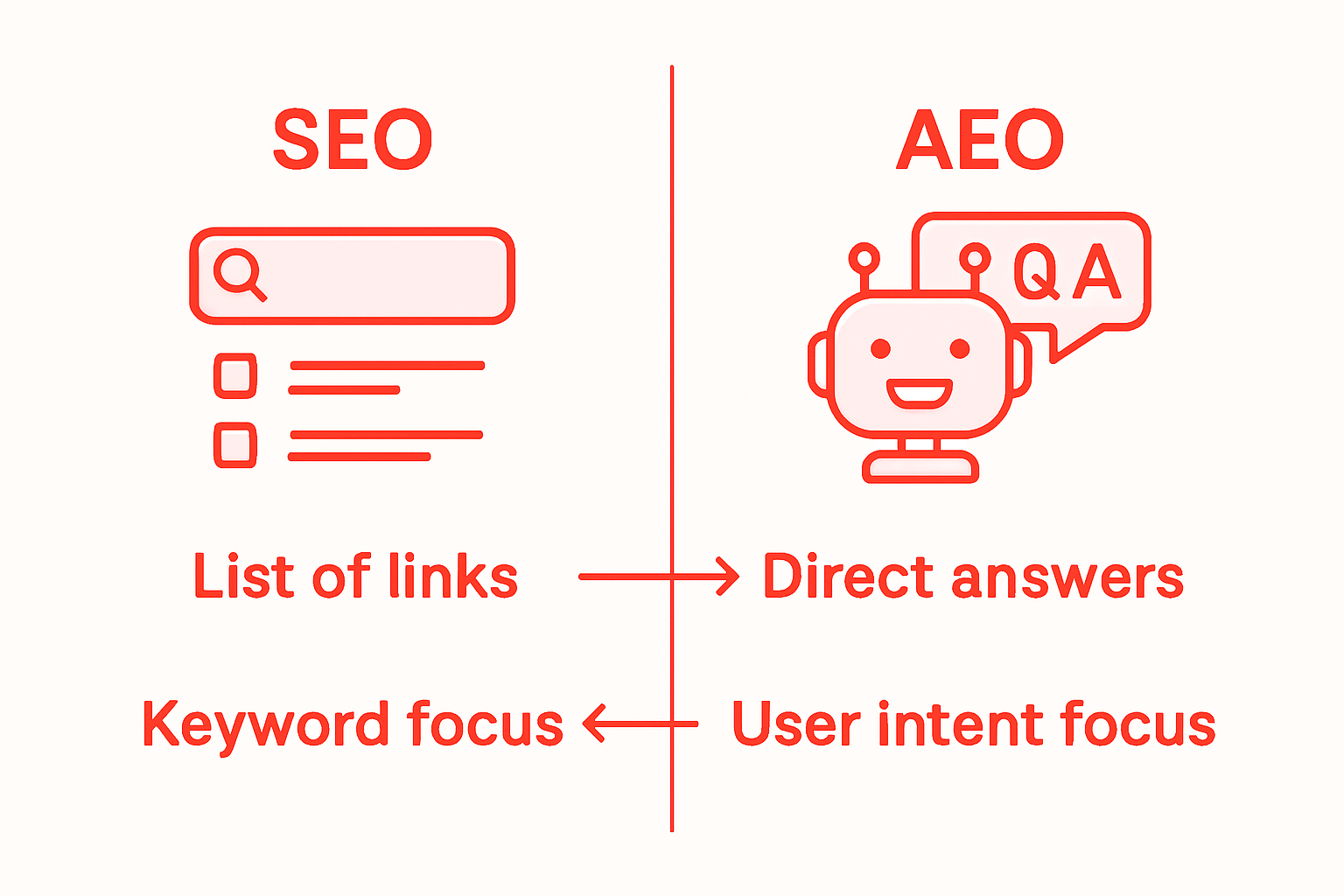
The evolution from SEO to AEO reflects broader changes in digital communication. AI-powered platforms are becoming increasingly sophisticated in understanding context and user intent. Successful digital strategies now require a holistic approach that combines technical optimisation with genuine, conversational content designed to provide immediate, valuable insights to users.
Common Mistakes Businesses Should Avoid
Navigating Answer Engine Optimisation requires a strategic approach that avoids common pitfalls which can undermine digital visibility. Understanding the nuanced landscape of modern search strategies is crucial for businesses seeking to establish a robust online presence.
Key mistakes businesses frequently make in AEO include:
- Keyword Stuffing: Cramming content with irrelevant keywords instead of creating natural, conversational text
- Ignoring User Intent: Failing to address the underlying questions users are asking genuinely
- Overlooking Structured Data: Neglecting schema markup and technical optimisation that helps AI understand content
- Generic Content: Producing bland, surface-level information that doesn’t provide unique insights
- Neglecting Conversational Language: Writing in overly formal or technical language that AI cannot easily parse
The most critical error businesses make is treating AEO as a technical checkbox rather than a genuine communication strategy. Successful Answer Engine Optimisation requires understanding that AI platforms prioritise content which demonstrates real expertise, answers specific questions comprehensively, and provides genuine value to users.
Businesses must shift from a traditional marketing mindset to a user-centric approach. This means creating content that anticipates user needs, speaks directly to their questions, and provides clear, authoritative information. By focusing on authenticity, depth, and user experience, organisations can transform their digital content from mere information repositories to valuable, AI-friendly resources that genuinely help their audience.
Unlock Your Online Potential with Expert Answer Engine Optimisation
If you are striving to make your business easily discoverable when customers ask precise questions online, Answer Engine Optimisation offers the strategic advantage you need. The challenge many face is creating clear, authoritative content that AI tools like ChatGPT and Gemini can recognise and share. At Bamsh Digital Marketing, we understand the pain points of navigating complex digital algorithms and user intent. Our approach focuses on crafting straightforward answers in a natural conversational tone, backed by robust schema markup to help AI platforms put your business front and centre.
Discover how our award-winning team can help you transform your online visibility through proven SEO and AEO techniques. Start by learning more about how we tailor content and technical structure to boost your rankings by visiting our SEO Agency Bristol – Bamsh Digital Marketing page. Want insights from industry experts and detailed digital marketing discussions? Explore our Podcasts – Bamsh Digital Marketing for valuable tips and strategies. Take the first confident step towards mastering Answer Engine Optimisation today and schedule your free consultation at https://bamsh.co.uk/15-min/ so you can begin turning precise answers into increased leads and revenue.
Frequently Asked Questions
What is Answer Engine Optimisation (AEO)?
Answer Engine Optimisation (AEO) is a digital strategy focused on creating content that directly answers user queries using AI-powered platforms. It aims to enhance visibility by understanding user intent and providing concise, structured responses.
How does AEO differ from traditional SEO?
AEO differs from traditional SEO in that it prioritises direct, conversational answers to specific questions rather than merely ranking content for keywords. While SEO often focuses on link building and keyword density, AEO enhances user engagement by delivering immediate and synthesised information.
What are the key components of effective AEO?
Effective AEO includes structured content with clear headings and bullet points, natural language that is easy to understand, direct answers to user queries, and technical optimisation techniques such as schema markup to help AI understand content context.
What common mistakes should businesses avoid in AEO?
Common mistakes in AEO include keyword stuffing, ignoring user intent, overlooking structured data, producing generic content, and neglecting conversational language. Successful AEO requires a focus on genuine communication and clarity to provide valuable information to users.