

Nearly 98 percent of first-time website visitors in the British market leave without making a purchase. For small business owners across the South West UK, this means missed opportunities to convert genuine interest into real sales. Understanding how retargeting works and what sets it apart from other digital strategies can help your business reconnect with those visitors and drive measurable growth online.
Table of Contents
- Retargeting Defined And Common Misunderstandings
- Main Types Of Retargeting And Key Differences
- How Retargeting Works In Digital Campaigns
- Benefits And Costs For Small Businesses
- Common Mistakes And Legal Considerations
Key Takeaways
| Point | Details |
|---|---|
| Understanding Retargeting | Retargeting enables businesses to reconnect with potential customers through personalised online advertisements based on prior interactions. |
| Types of Retargeting | Various retargeting strategies, such as website, search, social media, email, and app retargeting, allow for targeted marketing across multiple channels. |
| Performance Monitoring | Implement robust analytics to track campaign performance, optimise audience targeting, and improve conversion potential. |
| Legal Compliance | Ensure adherence to privacy regulations, such as GDPR, by obtaining user consent and maintaining transparent data policies. |
Retargeting Defined and Common Misunderstandings
Retargeting represents a powerful digital marketing technique designed to reconnect with potential customers who have previously interacted with your online presence but did not complete a purchase. At its core, retargeting is about giving businesses a second chance to engage interested prospects by strategically displaying targeted advertisements across digital platforms.
The fundamental mechanism of retargeting involves tracking website visitors using small pieces of code called cookies. When a potential customer visits your website, these cookies enable you to track user interactions and subsequently display personalised advertisements that remind them of products or services they previously viewed. Unlike broad marketing approaches, retargeting allows businesses to focus their advertising efforts on individuals who have already demonstrated genuine interest.
Many business owners misunderstand retargeting, often confusing it with traditional remarketing. While both strategies aim to re-engage potential customers, they differ significantly in execution. Remarketing typically involves sending follow-up emails to customers who abandoned shopping carts, whereas retargeting concentrates on displaying targeted display ads across websites and social media platforms. This precision makes retargeting a more dynamic and flexible approach for reconnecting with potential customers.
Pro tip: Install a robust analytics platform to track your retargeting campaign performance and continuously refine your targeting strategy based on real user data and engagement metrics.
Main Types of Retargeting and Key Differences
Retargeting strategies can be broadly classified into several distinct categories, each designed to re-engage potential customers through different digital channels and approaches. Understanding these variations helps businesses craft more targeted and effective marketing campaigns that reconnect with interested prospects across multiple touchpoints.
The primary types of retargeting include website retargeting, which focuses on displaying ads to users who have previously visited your website, and search retargeting, which targets individuals based on their previous search engine queries. Another significant category is social media retargeting, which allows businesses to show personalised advertisements to users who have interacted with their social media content or visited their business profiles. These methods enable precise audience targeting by leveraging user behaviour and interaction data.

Additionally, businesses can implement email retargeting, which involves sending targeted emails to users who have shown interest but not completed a purchase, and app retargeting, specifically designed for mobile application users who have downloaded but not actively engaged with an app. Each retargeting approach offers unique advantages, allowing marketers to create multi-channel strategies that persistently remind potential customers about products or services they might find interesting.
Here is a summary comparing the main retargeting types and their typical business impact:
| Retargeting Type | Main Channel | Typical Use Case | Business Impact |
|---|---|---|---|
| Website Retargeting | Display ads | Targets previous website visitors | Boosts conversions, increases ROI |
| Search Retargeting | Paid search ads | Reaches users after relevant searches | Expands audience reach |
| Social Media Retargeting | Social platforms | Engages users via social interactions | Improves brand visibility |
| Email Retargeting | Email campaigns | Nurtures leads who abandoned baskets | Enhances direct engagement |
| App Retargeting | Mobile applications | Re-engages inactive app users | Increases app interaction |
Pro tip: Combine multiple retargeting strategies and continuously analyse performance metrics to develop a sophisticated, data-driven approach that maximises your conversion potential.
How Retargeting Works in Digital Campaigns
Retargeting operates through a sophisticated tracking mechanism that allows businesses to reconnect with potential customers who have previously demonstrated interest in their products or services. The core functionality relies on sophisticated digital tracking technologies that monitor user interactions across various online platforms.
Digital campaign tracking involves embedding small pieces of code called tracking pixels on websites, which anonymously record user behaviour such as page visits, product views, and abandoned shopping cart interactions. These pixels enable businesses to build detailed user profiles and create highly personalised advertising experiences that target individuals based on their specific browsing history and demonstrated interests.
The effectiveness of retargeting depends on several critical factors, including precise audience segmentation, strategic ad placement, and carefully managed ad frequency. Businesses must balance the desire to remain memorable with the risk of overwhelming potential customers. By implementing sophisticated tracking mechanisms and multichannel marketing strategies, companies can create nuanced retargeting campaigns that gently guide potential customers through their purchasing journey without appearing intrusive or aggressive.
Pro tip: Implement frequency capping on your retargeting ads to prevent audience fatigue and maintain a positive brand perception by limiting the number of times a single user sees your advertisement.
Benefits and Costs for Small Businesses
Retargeting presents a unique opportunity for small businesses to maximise their digital marketing efforts with a relatively low-cost, high-impact approach. Unlike traditional advertising methods that cast a wide net, retargeting allows businesses to focus their limited marketing budgets on individuals who have already demonstrated genuine interest in their products or services.
The primary benefits for small businesses include significantly improved conversion rates, enhanced brand recognition, and cost-effective customer re-engagement. Targeted advertising strategies enable businesses to create personalised marketing experiences that can dramatically increase the likelihood of converting interested prospects into paying customers. Small businesses can expect to see more efficient use of their marketing spend, with the ability to track and measure campaign performance in real-time, allowing for rapid adjustments and optimisation.
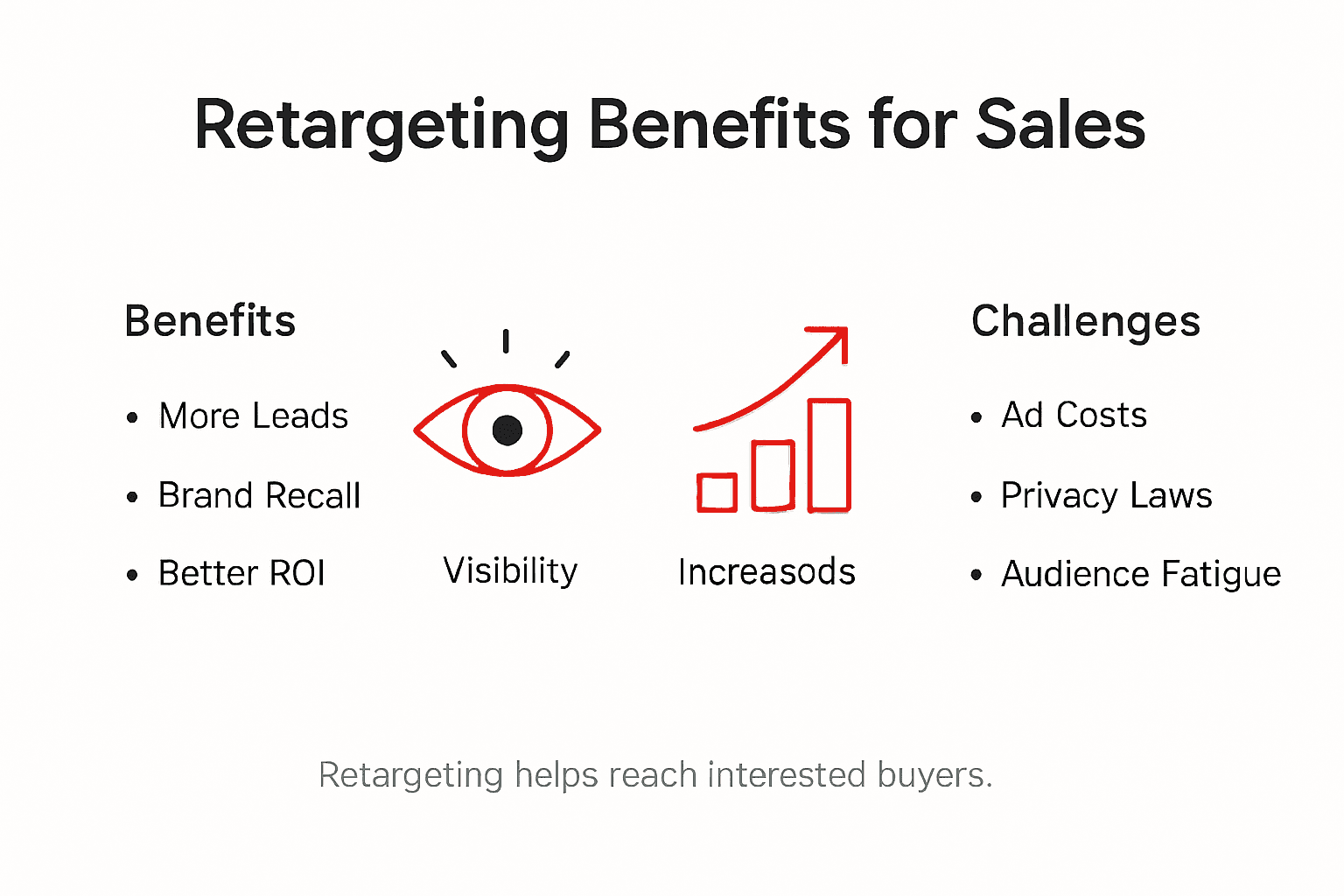
However, small businesses must carefully consider the potential costs and challenges associated with retargeting. These include initial setup expenses for tracking technologies, potential advertising platform fees, and the need for sophisticated data management capabilities. Additionally, businesses must navigate privacy concerns and ensure compliance with data protection regulations. The investment requires not just financial resources, but also time and expertise to develop sophisticated, non-intrusive marketing campaigns that genuinely engage potential customers.
Pro tip: Start with a modest budget and gradually scale your retargeting efforts, carefully monitoring conversion rates and return on investment to ensure cost-effectiveness and continuous improvement.
Common Mistakes and Legal Considerations
Retargeting campaigns present numerous potential pitfalls that can compromise both legal compliance and marketing effectiveness. Small businesses must navigate a complex landscape of digital marketing regulations, user privacy concerns, and strategic implementation challenges to ensure their retargeting efforts remain both ethical and productive.
The most common mistakes include excessive ad frequency, which can irritate potential customers, and poor audience segmentation that results in irrelevant advertising. Remarketing strategies require careful management to prevent user fatigue and potential brand damage. Businesses must also be acutely aware of data protection regulations such as the UK General Data Protection Regulation (GDPR), which mandates explicit user consent for tracking and personalised advertising. This means implementing robust consent mechanisms, providing clear opt-out options, and maintaining transparent data handling practices.
Legal considerations extend beyond mere technical compliance. Businesses must develop comprehensive privacy policies that clearly communicate how user data is collected, stored, and utilised. This includes obtaining explicit user consent, ensuring data anonymisation, and implementing secure data management protocols. Additionally, companies must be prepared to handle user requests for data deletion and provide clear mechanisms for users to control their tracking preferences. The potential financial and reputational risks of non-compliance can far outweigh the potential marketing benefits of aggressive retargeting campaigns.
The table below outlines common retargeting mistakes and legal requirements for UK businesses:
| Common Mistake | Business Risk | Legal Requirement | Solution |
|---|---|---|---|
| Excessive ad frequency | Audience annoyance | Compliance with GDPR consent rules | Use frequency caps |
| Poor segmentation | Irrelevant advertising | Transparent data handling | Refine audience segments |
| Weak privacy policies | Reputational damage | Maintain detailed privacy statement | Update policy regularly |
| Lack of user control | Loss of trust | Provide opt-out options | Offer clear tracking control |
Pro tip: Consult with a legal professional specialising in digital marketing regulations to ensure your retargeting strategy fully complies with current UK data protection laws and best practices.
Boost Your Sales with Smart Retargeting Strategies
Retargeting gives your business a second chance to connect with visitors who showed interest but did not complete a purchase. The article highlights how effective retargeting depends on precise audience segmentation, frequency capping, and multichannel approaches like social media and email campaigns. If your marketing efforts struggle with wasted spend or ignored prospects, you can solve those pain points using transparent, results-driven solutions.
At Bamsh Digital Marketing, we specialise in crafting personalised paid social media advertising campaigns and Google PPC management that target your ideal customers exactly when they are ready to buy. Our award-winning approach takes the guesswork out of retargeting by combining expert planning with ongoing optimisation and clear reporting. You can also enhance your lead nurturing with our CRM setup and automated pipelines, ensuring no enquiry gets lost.
Discover how to turn interested visitors into loyal customers with a strategy tailored to your business. Take the next step now by booking a free 15-minute consultation at Bamsh Digital Marketing. Let us show you how to combine industry-best techniques with ethical retargeting practices that comply with data protection laws and boost your bottom line. Visit Paid Social Media Advertising to learn more about our targeted ad solutions, or explore the benefits of Google PPC Management to maximise your Google presence.
Frequently Asked Questions
What is retargeting, and how does it work?
Retargeting is a digital marketing technique that reconnects with potential customers who have previously interacted with your online presence. It works by using cookies to track user behaviour on your website and then displaying personalised advertisements to remind them of products or services they viewed.
How does retargeting differ from traditional remarketing?
Retargeting typically focuses on showing targeted display ads across websites and social media platforms, whereas traditional remarketing usually involves sending follow-up emails to customers who abandoned shopping carts. This makes retargeting a more dynamic approach to re-engage interested prospects.
What are the main types of retargeting?
The main types of retargeting include website retargeting, search retargeting, social media retargeting, email retargeting, and app retargeting. Each type targets potential customers through different channels and methods to maximise engagement and conversion rates.
What are the benefits of retargeting for small businesses?
Retargeting offers small businesses improved conversion rates, enhanced brand recognition, and cost-effective customer re-engagement. It allows businesses to focus their marketing efforts on individuals who have already expressed interest, leading to more efficient use of marketing budgets.