

Most advice about data-driven marketing leaves british small business owners more confused than confident. With over 9,600 data-driven companies operating across the United Kingdom, the pressure to keep up can feel intense. Understanding how accurate, actionable data fuels smarter marketing will help your business compete more effectively, attract better leads, and reach the right customers throughout the South West.
Table of Contents
- What Is Data-Driven Marketing Today?
- Key Types of Data and How They Differ
- How Data Fuels Targeting and Measurement
- Real UK Small Business Use Cases
- Risks, Barriers, and How to Overcome Them
Key Takeaways
| Point | Details |
|---|---|
| Embrace Data-Driven Strategies | Businesses should leverage detailed consumer data to create personalised marketing campaigns, moving beyond intuition to informed decision-making. |
| Understand Data Types | Familiarity with various data types—demographic, psychographic, behavioural, and contextual—enables marketers to develop more effective targeting strategies. |
| Invest in Analytics Tools | Implementing robust analytics tools is crucial for tracking campaign performance and refining marketing efforts based on actionable insights. |
| Address Barriers to Adoption | Overcome challenges such as technological limitations and privacy concerns by investing in user-friendly tools and training initiatives that promote data literacy. |
What Is Data-Driven Marketing Today?
Data-driven marketing represents a strategic approach where businesses leverage detailed consumer information to create targeted, personalised marketing campaigns. Unlike traditional marketing strategies that rely on intuition, this method uses concrete data insights to make informed decisions about customer engagement and product positioning.
The core principles of data-driven marketing involve collecting, analysing, and interpreting customer data from multiple sources such as website interactions, social media behaviour, purchase history, and demographic information. By understanding precise consumer behaviour patterns, businesses can craft highly targeted marketing strategies that resonate more effectively with their intended audience.
According to recent UK government research, approximately 9,600 active data-driven companies now operate across various sectors, demonstrating the growing significance of this approach. These organisations use advanced technologies and analytical tools to transform raw data into actionable marketing insights, enabling more precise customer targeting and improved return on marketing investments.
Pro tip: Start small by implementing basic analytics tools and gradually build your data collection and analysis capabilities to enhance your marketing precision.
Key Types of Data and How They Differ
Data-driven marketing relies on multiple types of data, each offering unique insights into customer behaviour and preferences. Understanding these different data categories is crucial for developing sophisticated marketing strategies that deliver precise targeting and personalisation.
Marketers typically work with four primary data classifications: demographic, psychographic, behavioural, and contextual data. Demographic data provides basic customer characteristics like age, gender, income, and location, enabling broad segmentation. Psychographic data delves deeper, exploring customers’ values, interests, lifestyle choices, and personality traits, which helps create more nuanced marketing approaches.
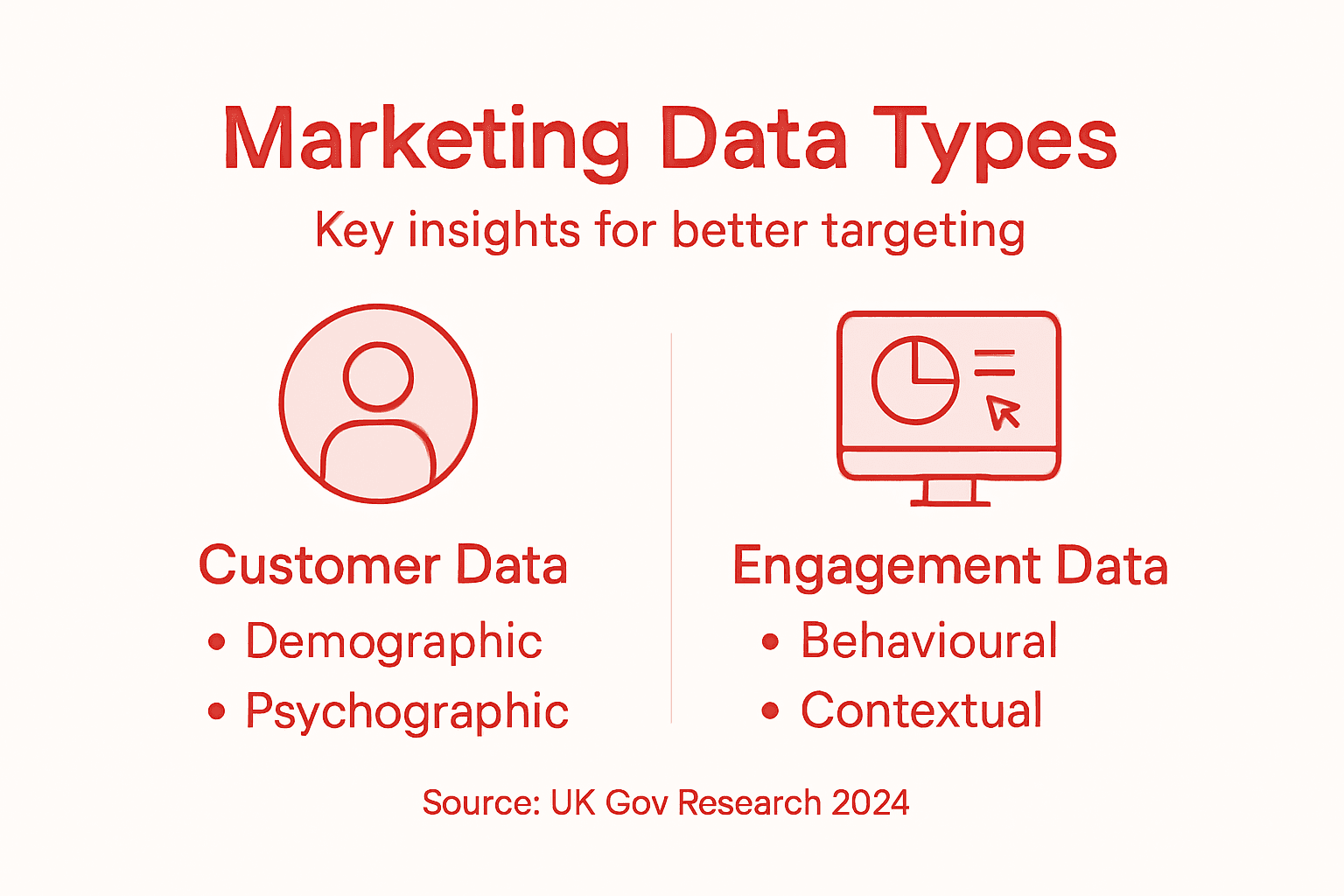
Behavioural data tracks actual consumer actions, including purchasing patterns, website interactions, engagement with marketing materials, and product usage. This information allows marketers to understand customer journeys and predict future behaviour. Contextual data adds another layer by considering external factors such as time, device type, geographic location, and current market conditions that might influence purchasing decisions.
Moreover, data can be categorised by its source and collection method. These categories include zero-party data (voluntarily shared by customers), first-party data (collected directly from customer interactions), second-party data (shared through partnerships), and third-party data (aggregated from external sources). Each type varies in terms of accuracy, privacy considerations, and potential marketing applications.
Pro tip: Prioritise collecting high-quality first-party and zero-party data, as these provide the most accurate and consensual insights into your customers’ preferences.
Here’s a summary of common data types used in marketing and their unique value for businesses:
| Data Type | Main Insight Provided | Typical Sources | Strategic Benefit |
|---|---|---|---|
| Demographic | Age, gender, location trends | Surveys, profiles | Broad customer segmentation |
| Psychographic | Attitudes, interests, beliefs | Social media, surveys | Personalised messaging |
| Behavioural | Purchase and engagement habits | Transaction logs, web | Accurate behaviour prediction |
| Contextual | Environment and timing factors | Devices, locations | Fine-tuned real-time targeting |
How Data Fuels Targeting and Measurement
Data-driven marketing transforms how businesses approach customer targeting and campaign performance evaluation by providing unprecedented insights into audience behaviour and marketing effectiveness. The ability to precisely segment and understand potential customers has become a critical competitive advantage in today’s digital marketplace.
By leveraging advanced machine learning and big data analytics, marketers can create highly personalised targeting strategies that go far beyond traditional demographic segmentation. These sophisticated approaches enable businesses to identify specific customer preferences, predict purchasing behaviours, and craft messages that resonate deeply with individual audience segments.

UK businesses increasingly utilise sophisticated measurement tools like Google Analytics and customer relationship management (CRM) platforms to track campaign performance with exceptional granularity. These technologies allow marketers to establish SMART (Specific, Measurable, Achievable, Relevant, Time-bound) key performance indicators (KPIs) that provide actionable insights into campaign effectiveness, conversion rates, and return on investment.
The real power of data-driven targeting lies in its ability to create dynamic, responsive marketing strategies. By continuously analysing customer interactions, businesses can adapt their approaches in real-time, optimising messaging, timing, and channel selection to maximise engagement and conversion potential.
Pro tip: Invest in robust analytics tools and develop a systematic approach to data collection and interpretation to transform raw information into meaningful marketing insights.
Real UK Small Business Use Cases
Data-driven marketing is transforming how small businesses across the United Kingdom approach growth, with concrete examples demonstrating its profound impact on operational efficiency and strategic decision-making. Small business case studies reveal remarkable digital transformation strategies that showcase the tangible benefits of embracing data-driven methodologies.
In the West Midlands, for instance, a local catering business transformed its marketing approach by implementing advanced customer data analytics. By tracking customer preferences, dining patterns, and seasonal trends, they developed targeted promotional campaigns that increased repeat business by 42%. Another example from the region involves a small manufacturing firm that used predictive analytics to optimize inventory management, reducing wastage and improving overall operational efficiency.
Regional concentrations, particularly in London and the South East, have emerged as hotspots for data-driven innovation among small businesses. These enterprises are leveraging digital tools to gain deeper customer insights, personalise marketing efforts, and make more informed strategic decisions. From local retail shops to professional service providers, businesses are discovering that data-driven approaches can level the playing field against larger competitors by enabling more precise and cost-effective marketing strategies.
The UK government’s research highlights that data-driven companies are not just technological outliers but are becoming the new standard for competitive small businesses. These companies demonstrate improved customer understanding, more efficient resource allocation, and the ability to adapt quickly to changing market conditions.
Pro tip: Start small by implementing one or two key data collection and analysis tools, focusing on metrics that directly impact your business growth and customer satisfaction.
Risks, Barriers, and How to Overcome Them
Data-driven marketing, while promising significant benefits, presents numerous challenges that businesses must strategically navigate. Key barriers impact organizational data integration efforts across technology, skills, and strategic implementation.
The most prevalent risks emerge from technological limitations and data management complexities. Many UK businesses struggle with connecting disparate data sources, insufficient analytical tools, and integration difficulties. Consumer privacy concerns further complicate data collection, requiring robust ethical frameworks and transparent data handling practices. Small businesses often face resource constraints that make comprehensive data strategies seem overwhelming, leading to hesitation and potential missed opportunities.
Overcoming these barriers demands a multifaceted approach. Businesses must prioritise investing in user-friendly data collection and analysis tools, develop internal data literacy programmes, and create clear data governance policies. Securing leadership support is crucial, as top-down commitment helps embed a data-driven culture throughout the organisation. Training programmes that demystify data analysis and make insights accessible to non-technical staff can dramatically reduce resistance and enhance adoption.
Moreover, businesses must address potential ethical and legal risks associated with data collection. This involves implementing stringent data protection measures, obtaining clear customer consent, and maintaining transparency about data usage. By treating customer data as a valuable and sensitive asset, businesses can build trust and mitigate potential reputational risks.
Pro tip: Start with a small, manageable data project that demonstrates clear value, and gradually expand your data-driven capabilities while maintaining robust privacy and ethical standards.
Below is a comparison of key barriers to adopting data-driven marketing and practical solutions to address them:
| Barrier | Impact on Business | Practical Solution | Long-Term Benefit |
|---|---|---|---|
| Technological limitations | Slows data integration | Invest in scalable tools | Seamless data visibility |
| Skills gap | Limits data utility | Implement staff training | Empowered, data-literate teams |
| Privacy concerns | Reduces customer trust | Strengthen data governance | Enhanced reputation |
| Resource constraints | Stalls adoption plans | Start with small pilot projects | Gradual, sustainable growth |
Unlock Business Growth with Data-Driven Marketing and Bamsh
The article highlights how data-driven marketing is essential for understanding customer behaviour and crafting personalised campaigns that deliver real results. If you struggle with collecting and analysing the right customer data or find targeting and measurement overwhelming, you are not alone. Many businesses face challenges in turning raw insights into actionable strategies that boost revenue and customer loyalty.
At Bamsh Digital Marketing, we specialise in taking the complexity out of data-driven marketing. Our award-winning services include SEO, PPC management, CRM setup, and AI-powered lead nurturing – all designed to help your ideal customers find you and choose you with confidence. We believe in transparency and clear reporting so you always know exactly how your investment is working.
Ready to transform your marketing with clarity and proven tactics? Visit our Bamsh page to learn about our approach and hear success stories. Explore special ways to get started with Special Offers that fit your budget. Or book a free 15-minute consultation now at https://bamsh.co.uk/15-min/ to see how data-driven marketing can fuel your business growth today.
Frequently Asked Questions
How does data-driven marketing improve customer targeting?
Data-driven marketing utilises detailed consumer information to precisely segment audiences, allowing businesses to craft personalised marketing strategies that resonate with each segment’s preferences and behaviours.
What types of data are essential for effective data-driven marketing?
Key types of data include demographic, psychographic, behavioural, and contextual data. Each type provides unique insights that help businesses understand customer preferences and improve campaign effectiveness.
What are some practical tools for implementing data-driven marketing?
Advanced analytics tools such as Google Analytics, customer relationship management (CRM) software, and social media analytics platforms are essential for collecting, analysing, and interpreting customer data effectively.
How can small businesses start using data-driven marketing?
Small businesses can begin by implementing basic analytics tools, focusing on collecting high-quality first-party data, and gradually building their data collection and analysis capabilities to enhance marketing precision.