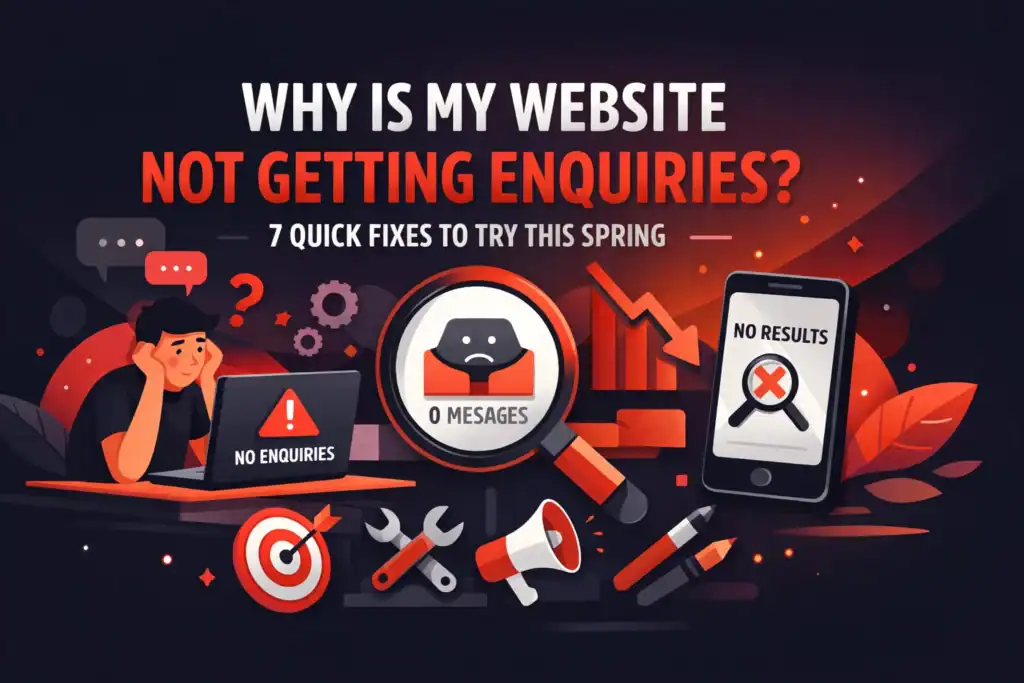
It’s a beautiful spring morning in Bristol. You’ve got your coffee, you’ve opened your laptop, and you’re checking your inbox. But instead of a flurry of new enquiries, it’s quiet. A bit too quiet.
If your website feels more like a ghost town than a digital storefront, you aren’t alone. Many Bristol business owners find themselves in this exact position. You’ve spent money on a site, it looks “okay,” but the phone isn’t ringing and the contact forms are gathering digital dust.
The truth is, having a website is only half the battle. If it isn’t designed to convert visitors into customers, it’s just an expensive business card. The good news? Spring is the perfect time for a digital clear-out.
Let’s look at seven quick fixes you can try right now to turn things around.
1. Stop Asking for a Marriage Proposal on the First Date
One of the biggest reasons websites fail to generate leads is “form friction.” You know the feeling, you land on a site, you’re interested, but then you see a contact form with 15 required fields, including your inside leg measurement and your first pet’s name.
People are busier than ever in 2026. If your form is too long, they’ll leave.
Why This Matters
High friction kills conversions. Every extra field you add to a form reduces the chance of someone completing it. In a world of instant gratification, a long form feels like a chore.
How It Helps You
By shortening your forms or switching to interactive tools, you make it easy for people to say “yes.” Instead of a static form, consider using something like our digital marketing costs estimator. It gives the user value (a price) while giving you the lead. It’s a win-win.
2. Put Your Proof Where Their Eyes Are
Do you have testimonials buried on a “Reviews” page that nobody clicks? That’s a missed opportunity. In 2026, trust must be established before you ever ask for an email address.
The “above the fold” area (the part of the screen people see before they start scrolling) is the most valuable real estate on your site. If there’s no evidence there that you’re good at what you do, you’re losing trust instantly.
Why This Matters
Visitors are naturally skeptical. They want to know if you’ve actually helped people like them. If they have to go hunting for proof, they’ll likely just hit the “back” button.
How It Helps You
Adding a row of logos of Bristol companies you’ve worked with, or a quick “4.9/5 stars on Google” badge near your main heading, builds immediate credibility. It bridges the “imagination gap”: helping the customer see that you are a real, trusted professional.
3. The “Mobile-First” Reality Check
We’ve been talking about mobile-friendly sites for years, but here is the reality: over 60% of your traffic is likely coming from a smartphone. If your site looks great on your desktop but the buttons are too small to click on an iPhone, you are effectively closed for business to more than half of Bristol.
Why This Matters
Google now prioritises mobile-first indexing. If your mobile experience is poor, not only will users leave, but your SEO services efforts will suffer because Google won’t want to show your site to searchers.
How It Helps You
A site that works perfectly on mobile feels professional. It removes the “website embarrassment” you might feel when a client mentions they couldn’t find your number while they were out and about. You can use our website preview tool to see exactly how your site looks across different devices right now.
4. Fix Your Vague Messaging
Are you trying to be everything to everyone? Many business owners use jargon-heavy phrases like “innovative solutions for modern challenges.” What does that actually mean?
If a visitor can’t tell what you do within five seconds of landing on your page, they will leave.
Why This Matters
Clarity beats cleverness every single time. People don’t buy what they don’t understand. If your messaging is vague, you’re asking the visitor to do the hard work of figuring out if you can help them. Most won’t bother.
How It Helps You
By using “selectable” offers: where you solve one specific problem for one specific audience: you reduce decision paralysis. For example, instead of “Digital Marketing,” specify “Local Bristol SEO for Tradespeople.” It’s direct and effective.

5. Give Away a “Small Win”
Most people visiting your site for the first time aren’t ready to buy yet. They are in the “research” phase. If your only call to action is “Buy Now” or “Book a Call,” you are ignoring 90% of your potential leads.
Why This Matters
You need to meet people where they are in their journey. A lead magnet: like a guide, a checklist, or a calculator: allows you to capture their info in exchange for immediate value.
How It Helps You
By offering something like lead generation tips for 2026, you position yourself as the expert. You’re helping them before you’ve even met them. This builds a relationship of “They Ask, You Answer,” which is the gold standard for modern marketing.
6. Speed Up Your Site (The “Three-Second” Rule)
In 2026, if your website takes more than three seconds to load, you’ve lost the visitor. We are more impatient than ever. A slow site isn’t just annoying; it looks unprofessional.
Why This Matters
Site speed is a direct ranking factor for Google. If your images are huge and your code is messy, you’ll be buried on page four of the search results.
How It Helps You
A fast site feels snappy and reliable. It shows that you care about the user experience. Often, this is a technical fix that falls under professional web design, but even simple things like compressing your images can make a massive difference.
7. Optimise for “Generative Search” (GEO)
You’ve heard of SEO, but have you heard of GEO? As AI tools like ChatGPT and Perplexity become more common, people are searching differently. They aren’t just typing “Plumber Bristol”; they are asking, “Who is the best-rated emergency plumber in Clifton with fair prices?”
Why This Matters
If your content doesn’t answer specific questions or provide verifiable data, AI search engines won’t recommend you.
How It Helps You
By creating FAQ sections and using clear, structured data on your site, you make it easy for AI to find and recommend your business. This is the future of local Bristol SEO.

DIY Quick Fixes vs. Professional Redesign
Sometimes a few tweaks are enough. Other times, the foundation is so shaky that you’re better off starting fresh. Here is how they compare:
| Feature | DIY Quick Fixes | Professional Redesign |
|---|---|---|
| Cost | Low (mostly your time) | Medium to High investment |
| Speed of Implementation | Instant | 4–8 weeks |
| Impact on Lead Gen | Incremental improvements | Major shift in conversion rates |
| Longevity | Short-term “patch” | Built for 2-3 years of growth |
| SEO Foundation | Limited to existing structure | Built-in SEO from day one |
| Technical Anxiety | High (you have to fix it) | Zero (we handle it) |
Frequently Asked Questions
Why is my website traffic high but my enquiries low?
This usually means you have a “conversion” problem rather than a “traffic” problem. People are finding you, but once they arrive, they don’t find what they need, they don’t trust you yet, or the process to contact you is too difficult.
How much does it cost to fix a website in the UK?
It varies wildly. A few hours of consulting might cost a few hundred pounds, while a full bespoke redesign can range from £2,000 to £10,000+ depending on the complexity. You can get an instant idea using our digital marketing costs estimator.
Do I really need a blog?
You don’t need one, but it is one of the best ways to answer the questions your customers are actually asking. This builds trust and helps with SEO costs in the long run because you’re creating assets that live on your site forever.
What is “Website Embarrassment”?
It’s that feeling you get when you’re talking to a great prospect, but you’re hesitant to give them your URL because you know the site looks dated, doesn’t work on mobile, or doesn’t represent how good your business actually is.
Ready to stop guessing?
If you’re tired of wondering why your website isn’t working, let’s get you some instant visual proof.
First, use our Website Preview Tool to see how your site actually looks to your customers. It’s a great way to spot those “mobile-first” issues we talked about without any technical jargon.
Then, if you’re curious about what it would actually cost to turn your site into a lead-generating machine, head over to our Digital Marketing Costs Estimator. There’s no sales pressure and no “call for a quote” mystery: just clear, transparent numbers so you can bridge the imagination gap and start planning your business growth this spring.