
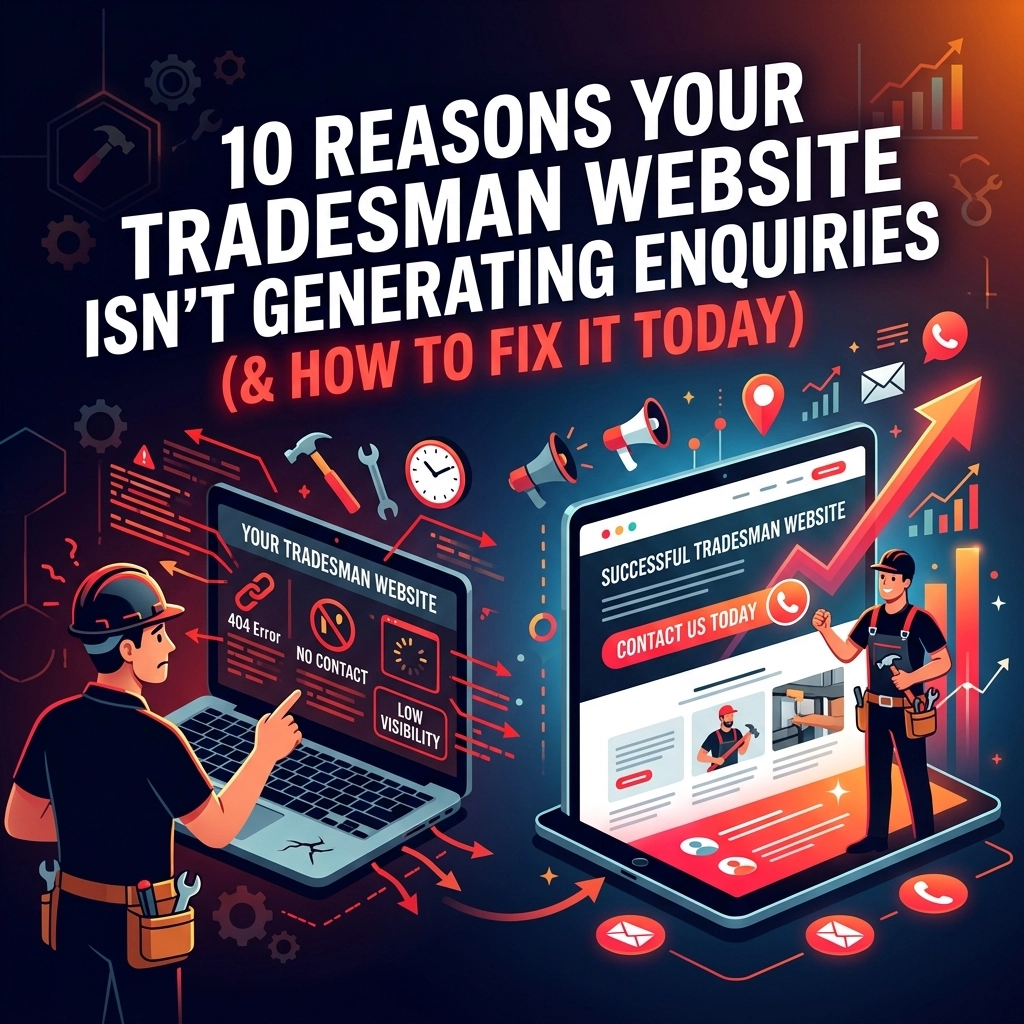
You’ve spent the money. You’ve got the logo. You’ve even got the website live. But there’s one big problem: the phone isn’t ringing.
If you’re a plumber, electrician, or landscaper, your website shouldn’t just be a digital business card that sits there looking pretty. It should be your hardest-working employee, bringing in leads while you’re on-site or grabbed a rare five minutes for a brew.
The reality is that most tradesman websites fail not because they look “ugly,” but because they aren’t built to sell. At Bamsh Digital Marketing, we see the same mistakes over and over again. Here is the truth about why your site is staying silent and, more importantly, how we can fix it together.
1. You Only Have One Service Page (or None at All)
Does your website just have a single page that says “Services” with a bulleted list of everything you do? If so, you’re invisible to Google.
When someone needs a “boiler repair in Birmingham,” Google wants to show them a page specifically about boiler repairs in Birmingham. If you’ve lumped boiler repairs, bathroom fitting, and emergency call-outs all on one page, Google gets confused. It doesn’t know which search to rank you for, so it chooses none of them.
How it helps you: By creating dedicated pages for your high-value jobs: like “Consumer Unit Upgrades” or “Kitchen Extensions”: you tell search engines exactly what you do. This makes it much more likely that you’ll show up when a customer is searching for that specific fix.
2. You’re Shouting Into a Void (Lack of Local SEO)
Have you ever said, “We cover the whole of the North West”? While that might be true, saying it on your website doesn’t help you rank. Search engines need specific geographic signals to connect you with local homeowners.
If you don’t have location-specific content, you are competing with every tradesperson in the country. That is a battle you won’t win.
The Fix: You need to create “Location Pages.” Instead of a generic contact page, imagine having pages dedicated to the specific towns you serve. A page titled “Plumber in Solihull” or “Electrician in Worcester” is a magnet for local enquiries.
3. The “Trust Gap” is Too Wide
Why should a stranger invite you into their home? They don’t know you, and they’ve probably heard horror stories about “cowboy builders.” If your website is full of stock photos of generic American men in hard hats, you aren’t building trust.
People buy from people. If they can’t see your face, your van, or your actual work, they’ll move on to the next person who shows them.
What this means for you: You need to bridge that trust gap immediately. This means:
- Real photos of your team and your branded vans.
- Before-and-after shots of your actual projects.
- Prominent display of your certifications (Gas Safe, NAPIT, etc.).
- Google Reviews embedded directly onto the page, not just a link to them.
4. Your Value Proposition is Vague
“Quality service at competitive prices.” We’ve all seen it. The problem is, it doesn’t mean anything. Every tradesperson says they are “quality” and “competitive.”
If a visitor can’t figure out within five seconds what you do and why you’re the best choice for them, they’re gone. You might wonder, “How do I stand out?” You do it by being specific.
Let’s look at an example:
- Vague: “We do all types of electrical work.”
- Specific: “We specialise in making old Victorian homes safe with full rewires and modern smart home integration.”
See the difference? One is a commodity; the other is a specialist service. You can learn more about how we position your business by checking out our Websites for Tradespeople page.
5. Too Much Friction in the Conversion Process
Here’s the thing: people are lazy. They are also usually stressed when they’re looking for a tradesman. If your enquiry form has 15 fields, including “How did you hear about us?” and “Your Budget,” they will close the tab.
Every extra click or form field is a “friction point.” The more friction you have, the fewer leads you get.
How to fix it today:
- Reduce your contact form to the basics: Name, Phone, Postcode, and Message.
- Make your phone number “Click-to-Call.”
- Add a “Get a Quote” button that stays visible as they scroll.
6. You’ve Failed the “Fat Thumb” Test
The vast majority of local trade searches happen on a mobile phone: often while someone is standing in a wet kitchen or a dark hallway. If your website doesn’t work perfectly on a mobile, you’re losing 70% of your potential business.
If the buttons are too small to press with a thumb, or if the text is so tiny you have to pinch and zoom, your site is broken in the eyes of the customer.
Why this matters: Google actually penalises websites that aren’t mobile-friendly. If you want to see how your site stacks up, you can use our website preview tool to see how it looks across different devices.

7. Being Too Polite (Missing Calls to Action)
Are you waiting for the customer to find your contact page? Don’t. You need to tell them exactly what to do next. A website without clear “Calls to Action” (CTAs) is like a shop without a till.
“Learn More” is a weak CTA. It doesn’t promise a result. You need action-oriented language that solves their problem.
Try these instead:
- “Book Your Free Survey”
- “Get My Emergency Quote”
- “Check Our Availability”
8. Slow Loading Speeds
We live in an era of instant gratification. If your website takes more than three seconds to load, visitors will bounce back to the search results and click on your competitor. Slow sites feel “unstable” and unprofessional.
Often, this is caused by massive, unoptimised photos or cheap, low-quality hosting. While it might seem like a small technical detail, it’s one of the biggest killers of conversion rates.
9. No Honest Discussion About Costs
This is a big one from the “They Ask, You Answer” philosophy. Most tradespeople are terrified of putting prices on their website. They say, “Every job is different.”
While that’s true, customers want a ballpark. If you hide your prices, they might assume you’re too expensive. If you address costs head-on: explaining what factors make a price go up or down: you build incredible trust. You aren’t just a contractor; you’re an advisor. You can see how we handle this by using our digital marketing costs estimator.
10. No Clear Customer Journey
What happens after someone lands on your homepage? If there isn’t a clear path, they’ll wander around and then leave. A good website acts as a guide.
The logical flow should be:
- The Hook: I understand your problem (e.g., “Leaky roof?”).
- The Solution: I can fix it (e.g., “Expert roof repairs in Leeds”).
- The Proof: I’ve done it for others (e.g., Reviews and photos).
- The Action: Here is how to get started (e.g., “Request a call back”).
Comparison: A “Standard” Site vs. A Lead-Generating Machine
| Feature | Standard Tradesman Site | Lead-Generating Machine |
|---|---|---|
| Service Pages | One generic “Services” list | Individual pages for every core service |
| Photos | Stock images of people in hard hats | Real photos of your team, vans, and jobs |
| Mobile | Scaled-down version of desktop | Mobile-first design with click-to-call |
| Reviews | A “Testimonials” link in the footer | Recent Google Reviews embedded on every page |
| Pricing | “Call for a quote” | Honest guides on what affects job costs |
| SEO | “We cover the UK” | Targeted local pages for specific towns |
Frequently Asked Questions
How much does it cost to fix these issues?
It depends on the state of your current site. Sometimes a few tweaks to your content and speed can make a massive difference. Other times, if the foundation is rotten, it’s cheaper and more effective to start fresh with a bespoke digital marketing plan.
How long does it take to see more enquiries?
Technical fixes like speed and mobile responsiveness can show results within weeks. Content-based fixes like SEO and new service pages usually take 3 to 6 months to fully mature as Google “crawls” and understands your new structure.
Do I really need to put my face on the website?
Yes. In the trades, trust is your most valuable currency. People aren’t just buying a service; they are buying peace of mind that the person entering their home is professional and reliable.
Can I just use Facebook instead of a website?
You can, but you don’t own Facebook. If their algorithm changes or your page gets flagged, your business vanishes. A website is an asset you own. Plus, people “scroll” on Facebook, but they “search” on Google when they have an urgent problem.
What’s Next?
If your website isn’t working for you, it’s working against you. Every day it sits there without these fixes is another day your competitors are picking up the leads that should have been yours.
Don’t stay invisible. Let’s get your phone ringing again.
Here is how you can take action right now:
- Explore our dedicated service: Visit https://bamsh.co.uk/websites-for-tradespeople/ to see how we build sites specifically for your industry.
- Give us a bell: Call the office on 0333 900 3322 for a straight-talking chat about your site.
- Book a strategy call: Pick a time that suits you at https://api.leadconnectorhq.com/widget/bookings/30-min-bamsh-trades.
We’ll take a look at what you’ve got and give you an honest appraisal: no jargon, no fluff, just the facts. Let’s get to work.