
TL;DR:
- UK SMEs should establish essential tools like Google Search Console, Analytics, and a reliable CMS before marketing.
- Consistent, data-driven SEO and content marketing focused on local queries significantly boost website traffic.
- Ongoing analysis, quick adaptation, and a system mindset are key to sustained online growth.
Getting consistent website traffic is one of the biggest frustrations for UK small and medium-sized businesses. You invest time, money, and energy into your website, yet the visitors just do not show up in the numbers you need. Sound familiar? The good news is that growing your web traffic is not about chasing the latest trend or spending a fortune on ads. It is about building the right foundations, applying proven tactics in the right order, and measuring what actually works. This guide walks you through exactly that, from essential setup to SEO, social media, paid advertising, and ongoing analysis, so you can attract more of the right visitors and turn them into real leads.
Table of Contents
- Essential tools and setup for traffic growth
- Create high-impact SEO and content marketing strategies
- Maximise social media for traffic and engagement
- Amplify results with paid and local advertising
- Track, analyse, and avoid common mistakes
- What we’ve learned helping UK businesses grow their web traffic
- Get expert support to supercharge your website traffic
- Frequently asked questions
Key Takeaways
| Point | Details |
|---|---|
| Prepare with essential tools | Set up Google Search Console, Analytics, and local listings before pursuing traffic growth strategies. |
| Prioritise local SEO | Leverage postcode and locally focused keywords to boost visibility among UK customers. |
| Mix organic and paid tactics | Combining content, social, and targeted ads yields faster and more sustainable website traffic. |
| Measure and adjust regularly | Track analytics to refine your efforts and avoid common mistakes that slow down growth. |
Essential Tools and Setup for Traffic Growth
Before you launch any campaign, you need the right tools in place. Think of this as laying the groundwork. Without it, you are essentially driving with no dashboard.
Here is what every UK SME should set up before doing anything else:
- Google Search Console: This free tool lets you submit pages for indexing, diagnose crawl errors, identify high-impression low-CTR queries, monitor Core Web Vitals, and track performance by UK-specific queries. It is non-negotiable.
- Google Analytics: Tracks who visits your site, where they come from, and what they do once they arrive.
- Google Business Profile: Essential for local visibility. If you serve customers in a specific area, this listing puts you on the map, literally.
- A reliable CMS: WordPress is the most popular choice for UK SMEs because it makes on-page optimisations straightforward, even without a developer.
| Tool | Cost | Primary use |
|---|---|---|
| Google Search Console | Free | Indexing, crawl errors, CTR |
| Google Analytics | Free | Traffic sources, behaviour |
| Google Business Profile | Free | Local search visibility |
| WordPress | Free/low cost | Content and SEO management |
Beyond tools, your technical SEO basics must be solid. Your site needs to load quickly, work perfectly on mobile, and carry an SSL certificate (the padlock in the browser bar). These are not optional extras. They directly affect your rankings and how much Google trusts your site. You can review SEO tool recommendations to find the right fit for your budget and goals.
Pro Tip: Use postcode-specific landing pages or location mentions throughout your site to give your visibility a meaningful boost in local search results.
Create High-impact SEO and Content Marketing Strategies
With your basic tools and website setup sorted, the next priority is mastering SEO and content marketing to drive quality visitors. 77% of UK businesses now invest in SEO, and 86% use content marketing. The competition is real, but so is the opportunity.
Follow this three-step approach:
- Audit your existing site. Identify which pages already rank, which keywords you appear for, and where the gaps are. Google Search Console makes this straightforward.
- Research local topics. What questions are your ideal customers in Bristol, Manchester, or Leeds actually typing into Google? Use tools like Google’s autocomplete or AnswerThePublic to find them.
- Create targeted content. Build landing pages and blog posts that speak directly to those local queries. A roofing company in Birmingham will outperform a generic national competitor simply by being more relevant.
Content marketing is not just about writing blogs. Guides, how-to articles, and infographics all attract and retain the right audience. Updating existing content regularly is just as important as creating new material. A page that ranked well two years ago can lose ground quickly if it is not refreshed.
“Local SEO boosts visibility by 44% with postcode targeting.”
That is a significant uplift for a tactic that costs very little to implement. Learn more about SEO for UK businesses and the SEO benefits for growth that businesses like yours are already seeing.
Pro Tip: Include your postcode or town name naturally within your page titles, meta descriptions, and headings to stand out in local searches without it feeling forced.
Maximise Social Media for Traffic and Engagement
After optimising your site with SEO, it is time to send more users your way via social media. The key word here is targeted. Not every platform suits every business.
Here is how to approach it:
- Choose the right platforms. LinkedIn works well for B2B services. Facebook and Instagram suit local consumer businesses. TikTok is growing fast for younger audiences. X (formerly Twitter) still drives traffic in certain sectors.
- Share content with clear calls-to-action. Every post that links back to your website should give people a reason to click. “Read the full guide,” “Book your free audit,” or “See our latest case study” all work better than a vague link.
- Use UK-specific hashtags. Tags like #UKSmallBusiness, #MadeInBritain, or location-specific tags help you reach local audiences organically.
- Engage with local communities. Facebook Groups, LinkedIn local business networks, and industry forums are underused traffic sources for UK SMEs.
86% of UK businesses use content marketing, and social media is one of the primary distribution channels. If you are creating content but not sharing it strategically, you are leaving traffic on the table.

For paid options, social ads can generate quick wins. A well-targeted Facebook or Instagram campaign can put your content in front of the exact audience you want, often at a lower cost than Google Ads. Our social media guide covers the essentials, and if you want to go further, explore paid social campaigns tailored for UK businesses.
Pro Tip: Batch-schedule your posts a week in advance using a tool like Buffer or Hootsuite. Repurpose your best-performing content into different formats, a blog post becomes a carousel, a video, and three separate social posts.
Amplify Results With Paid and Local Advertising
Once you are driving organic and social traffic, amplify your results with paid and local strategies. Paid advertising delivers speed. Organic SEO builds long-term momentum. Together, they are far more powerful than either alone.
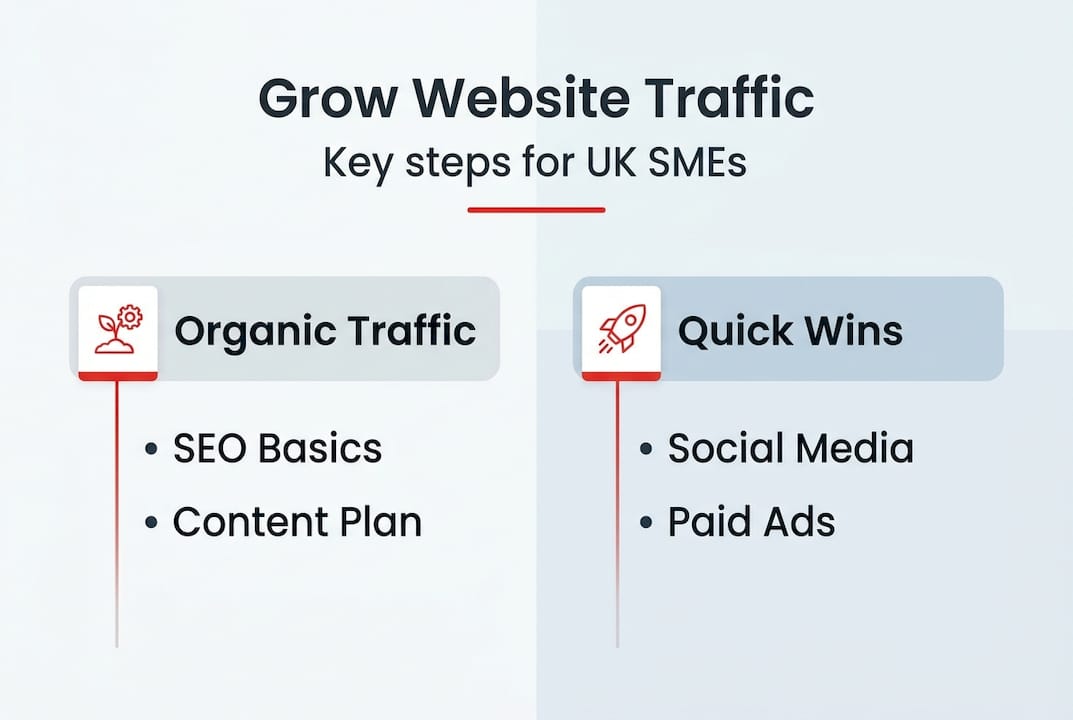
Here is a quick comparison to help you decide where to focus:
| Channel | Pros | Cons | Expected outcome |
|---|---|---|---|
| Google PPC | Immediate visibility, precise targeting | Costs money per click | Fast leads, measurable ROI |
| Local SEO | Long-term, cost-effective | Slower to build | Sustained organic traffic |
| Organic content | Builds authority and trust | Takes time | Compounding traffic growth |
Local SEO boosts visibility by 44% with postcode targeting, which means even a modest investment in local optimisation pays off significantly over time.
To launch a Google Ads or local campaign, follow these steps:
- Define your goal. Are you after phone calls, form fills, or website visits? Be specific.
- Set your targeting. Use postcode or radius targeting to focus your budget on the areas that matter most.
- Allocate your budget. Start small, perhaps £10 to £20 per day, and scale what works.
- Track conversions. Use Google Search Console alongside Google Ads to attribute traffic correctly and measure return on ad spend.
Do not overlook your Google Business Profile either. A fully optimised listing drives calls, map clicks, and footfall without any ad spend. Find out more about local SEO for UK businesses and how to get the most from your Google Business Profile.
Track, Analyse, and Avoid Common Mistakes
With campaigns running, ongoing analysis ensures you capitalise on gains and learn from missteps. Many UK SMEs set up their marketing, then forget to check whether it is actually working.
Focus on these core metrics:
- Sessions: Total visits to your site. Is the number growing week on week?
- Bounce rate: Are visitors leaving immediately? A high bounce rate often signals a mismatch between your ad or search result and the page content.
- Click-through rate (CTR): How many people see your page in search results and actually click? Improving your meta titles and descriptions can lift this significantly.
- Goal completions: Enquiry forms submitted, calls made, products purchased. This is the metric that actually matters to your bottom line.
Here are the most common mistakes UK SMEs make:
- Weak or missing calls-to-action on key pages
- Ignoring mobile users (over 60% of UK web traffic is now mobile)
- Slow page loading speeds that push visitors away before they even see your content
- Publishing content once and never updating it
- Not reviewing data regularly enough to spot what is working
Use Google Search Console to make evidence-based improvements rather than guessing. Set a monthly review in your calendar. Look at what changed, what improved, and what needs attention. Our online visibility guide and visibility action plan give you a practical framework for doing exactly that.
Stat to remember: 86% of UK businesses use content marketing. If you are not measuring its impact, you are flying blind.
What We’ve Learned Helping UK Businesses Grow Their Web Traffic
Here is the uncomfortable truth we have seen play out time and again: most UK SMEs do not fail at digital marketing because they lack effort. They fail because they chase tactics instead of building systems.
A business owner reads that short-form video is the next big thing, pivots their entire strategy, gets inconsistent results, then moves on to the next shiny idea. Meanwhile, the businesses quietly winning are the ones obsessing over their analytics, fixing technical issues, and publishing locally relevant content every single month.
Consistency beats cleverness. Every time.
The biggest overlooked advantage we see? Responding quickly to data. When a page suddenly gets more impressions in Search Console, that is a signal. Act on it within days, not months. Businesses that treat their website as a living asset, rather than a one-off project, are the ones that build reliable, compounding traffic over time.
Forget secret formulas. Real SEO is persistent, data-driven, and focused on audience needs. If you want a grounded view on what this looks like in practice, our SEO agency perspective is worth a read.
Get Expert Support to Supercharge Your Website Traffic
If this guide has given you clarity on where to focus, the next step is putting it into action. At Bamsh Digital Marketing, we work with UK SMEs every day to build traffic strategies that actually deliver results, not just reports.
Whether you need help with Answer Engine Optimisation to get found in AI tools like ChatGPT and Google, a fully managed Google Business Profile to dominate local search, or a targeted PPC management campaign to generate leads fast, we have the expertise to make it happen. Get in touch for a free, no-obligation conversation about your website traffic goals. We will tell you exactly what we would do and why.
Frequently Asked Questions
What is the fastest way for a UK SME to increase website traffic?
The quickest results typically come from targeted Google Ads (PPC), especially when combined with local SEO. Local SEO boosts visibility by 44% with postcode targeting, making it a powerful complement to paid campaigns.
How important is content marketing compared to SEO?
Content marketing and SEO work best together, with content covering topics your audience cares about and SEO ensuring your pages get found. 86% of UK businesses already use content marketing, which shows how central it has become to digital growth.
What free tools can I use to track my website traffic?
Google Search Console and Google Analytics are both free and highly capable. Google Search Console in particular lets you track indexing, crawl errors, Core Web Vitals, and UK-specific query performance at no cost.
How can I tell if my website changes are increasing traffic?
Monitor sessions, CTR, and keyword rankings regularly in Google Search Console to see improvements over time. Set a monthly review cadence so you can spot trends and act on them quickly.