
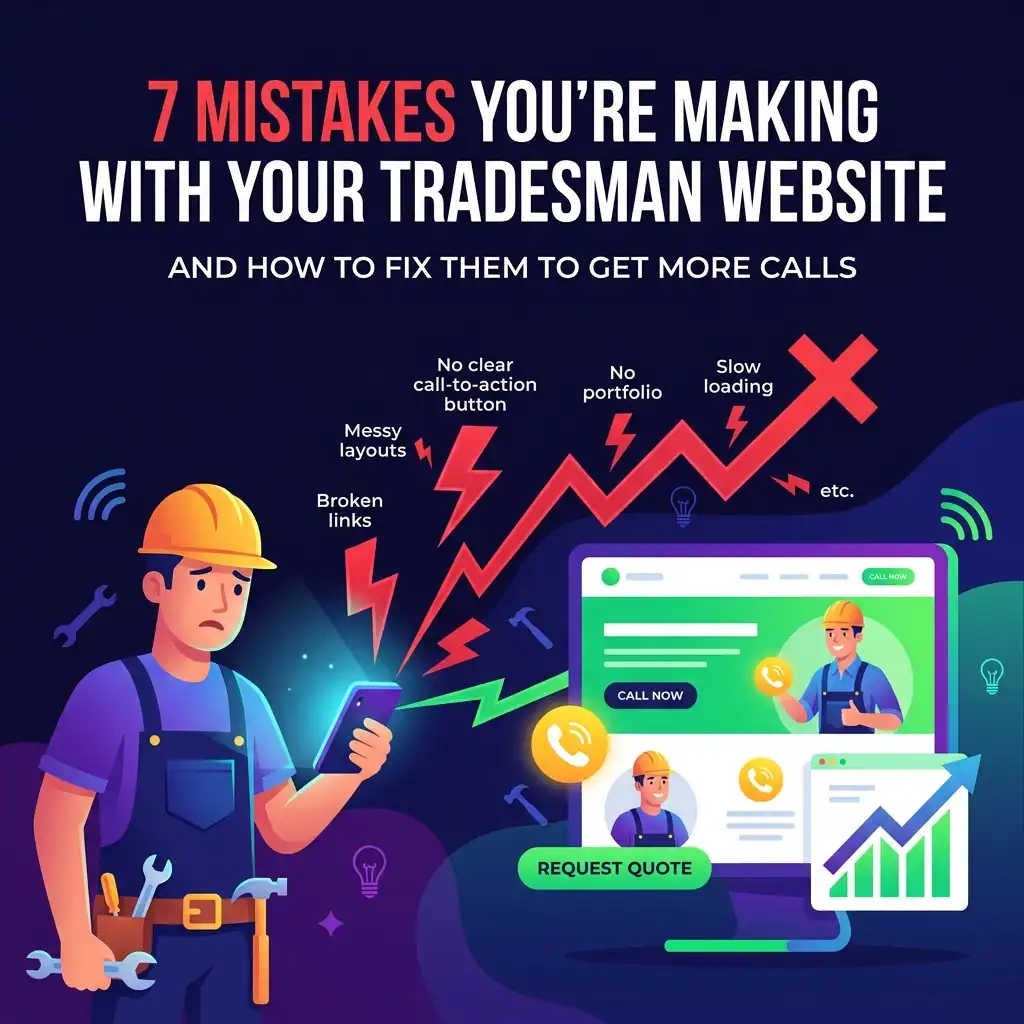
You’ve probably heard it before: “You need a website to grow your business.” So, you built one. Or maybe you paid an agency a few grand to build one for you. You waited for the phone to start ringing off the hook, but… nothing. Just the odd spam email or a cold caller trying to sell you more advertising.
If you’re an “Invisible Tradesperson” with no real leads coming in, or a “Frustrated Tradesperson” who feels like you’ve been burned by digital marketing before, you aren’t alone. The truth is, most tradesman websites are built as digital brochures rather than lead-generation machines.
At Bamsh Digital Marketing, we see the same errors day in and day out. Here’s the good news: most of these mistakes are easy to fix once you know what they are. Let’s dive into the seven most common mistakes you’re likely making with your tradesman website and exactly how to fix them to get your phone ringing.
1. You’re Using the “Wrong” Keywords
One of the biggest mistakes we see is tradespeople trying to rank for terms that nobody actually types into Google. You might be proud of your “Eco-Friendly Fenestration Solutions,” but your customers are just searching for “new windows in Bristol.”
Why This Matters
If you optimise your site for jargon or broad industry terms, you’ll end up competing with national giants or attracting people who aren’t looking to buy. You don’t want “information seekers”; you want “service seekers.”
How It Helps You
Focusing on local, specific terms: like “emergency plumber Reading” or “driveway company Oldham”: puts you right in front of people who have a problem right now and need a local pro to fix it.
2. You’re Ignoring Local Search Visibility
If your website targets “roofing” but doesn’t mention the specific towns or neighborhoods you cover, Google won’t know where to show you. Many agencies treat trade businesses like national eCommerce shops, which is a massive waste of your budget.
The Reality Is…
Google prioritises local results for trade services. If you haven’t claimed and optimised your Google Business Profile, you’re essentially invisible to anyone searching on a map.
What This Means for You
You need to create content that mentions your service areas naturally. You should also ensure your Name, Address, and Phone Number (NAP) are consistent across the web. If you want to see how you’re currently doing, check out our Google Business Profile checklist for local success.
3. Your Website Isn’t Built for Mobile Users
Think about your last customer. They probably weren’t sitting at a mahogany desk on a desktop computer when they realised their boiler was leaking. They were probably standing in their kitchen, stressed out, searching on their smartphone.
Why This Matters
If your website takes too long to load or looks “broken” on a phone, that customer is gone in two seconds. They will click the “back” button and call your competitor whose site works properly. Google also penalises sites that aren’t mobile-friendly, making it even harder for you to get found.
How It Helps You
A fast, responsive mobile site makes it easy for customers to find what they need. If you’re curious about how your site looks to others, you can use our website preview tool to see the difference.
4. Your Phone Number is Hiding
This sounds obvious, doesn’t it? But you’d be surprised how many tradesman websites hide their contact details on a separate “Contact” page. People are lazy (and busy). If they have to hunt for your phone number, they won’t bother.
Here’s the Key
Your phone number should be at the very top of every single page. On mobile, it should be a “click-to-call” button. This means the customer just taps the number, and their phone starts dialing you.
What This Means for You
By making it effortless to contact you, you’ll see an immediate jump in enquiries. Don’t make them fill out a 10-field form if they just want a quick quote. Keep it simple.

5. You Have a “Meta Title” Mess
The “Meta Title” is the blue link that appears in Google search results. Often, we see tradesman sites where the title is just “Home” or “Services.” This tells Google (and your customers) absolutely nothing.
The Fix
You need clear, descriptive titles. Instead of “Home,” try “Professional Electrician in Cardiff | 24/7 Emergency Repairs.”
Why This Matters
A good meta title is like a shop sign. It tells people exactly what you do and where you do it before they even click. If you’re struggling to show up on the first page, this is often one of the reasons your trade website isn’t showing on Google.
6. You’re Flying Blind Without Tracking
How many people visited your website last week? How many of them called you versus filled out a form? If you don’t know the answer, you’re “flying blind.” Many tradespeople spend money on SEO or ads but have no idea if they’re getting a return on their investment (ROI).
The Reality Is…
Without tracking (like Google Analytics), you can’t improve. You might be getting 1,000 visitors a month, but if none of them are calling, your website is failing.
How It Helps You
Setting up basic tracking allows you to see which pages are working and which ones are making people leave. This honesty about data is the only way to scale from a “Growing Tradesperson” to a market leader. If you’re worried about the tech side, don’t be: we handle all the heavy lifting for our clients.

7. You’re Missing Trust Signals
In the trades, reputation is everything. If your website looks like it was built in 1998, or if it doesn’t have any photos of your actual work, people will be skeptical. Stock photos of a generic guy in a hard hat don’t build trust; photos of your actual van, your team, and your completed projects do.
Here’s the thing:
People buy from people. They want to see that you’re a real, local business. Including customer reviews, badges from trade associations (like Gas Safe or Checkatrade), and “Before and After” photos will do more for your conversion rate than any fancy animation ever could.
Comparing the Good, the Bad, and the Invisible
To help you see where your site stands, we’ve put together this quick comparison table.
| Feature | The “Invisible” Site | The “Frustrated” Site | The Bamsh Growth Site |
|---|---|---|---|
| Mobile Speed | Doesn’t load or breaks | Slow and clunky | Instant and responsive |
| Contact Info | Hidden on one page | Not clickable | Click-to-call on every page |
| Keywords | None or generic jargon | “Plumbing Services” | “Emergency Plumber in [City]” |
| Photos | None or stock images | A few blurry phone pics | High-quality project gallery |
| Tracking | None | “My agency says it’s fine” | Full ROI and lead reporting |
| Local Focus | None | Mentions city once | Dedicated local area pages |
Frequently Asked Questions
How much should a tradesman website actually cost?
This is the question everyone asks but few agencies answer straight. A basic “brochure” site might cost £500, but it won’t get you leads. A professional, lead-generating platform for a growing trade business usually starts between £1,500 and £3,500, depending on the complexity. You can use our digital marketing costs estimator to get a better idea of the investment needed.
How long does it take to see results?
If you’re fixing technical errors (like a broken phone number or mobile speed), you can see more calls in days. For SEO (ranking higher on Google), it typically takes 3 to 6 months of consistent work to see a significant shift in organic traffic.
Do I really need a blog?
You don’t need a “lifestyle” blog, but you do need to answer your customers’ questions. Writing about “How much does a new boiler cost in 2026?” or “How to spot a roof leak” helps build trust and shows Google you’re an expert in your field.
Can I just use Facebook instead of a website?
Facebook is great for referrals, but you don’t own it. If Facebook changes its algorithm or closes your account, your business disappears. A website is an asset you own. Plus, when people have an emergency, they go to Google, not Facebook.
Let’s Get Your Phone Ringing Again
If you’ve recognised some of these mistakes on your own site, don’t worry. Most of them are just “growing pains” of a business that’s moving to the next level. The difference between a tradesperson who is constantly chasing work and one who has a waiting list is often just a website that works as hard as they do.
At Bamsh Digital Marketing, we specialise in building Websites for Tradespeople that actually deliver results. No jargon, no fluff: just more calls and more jobs.
Ready to stop being invisible?
- Explore our services: Websites for Tradespeople
- Give us a bell: Call us on 0333 900 3322 for a straight-talking chat.
- Book a free strategy call: Schedule a 30-minute call with our team.
Let’s stop the guesswork and start growing your trade business today.