
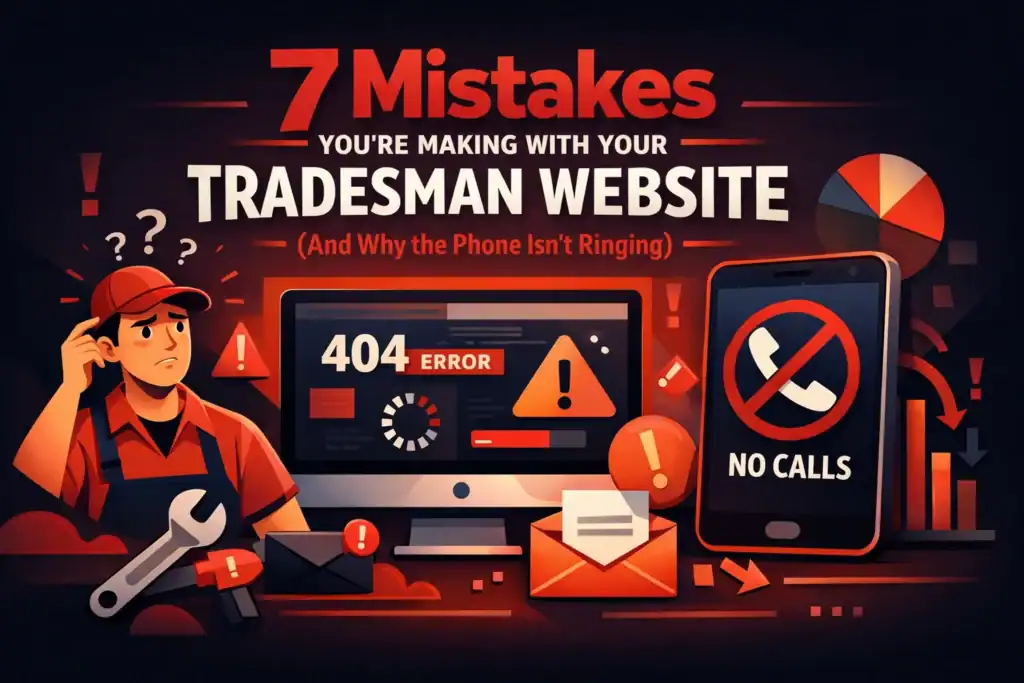
You built a website because everyone told you that you needed one. You might have spent a weekend on a DIY builder or paid a local “tech whiz” a few hundred quid to put something together. Yet, here you are, checking your inbox and seeing nothing but spam. The phone is silent.
If you are a plumber, electrician, or builder in the UK, your website should be your hardest-working employee. If it isn’t bringing in leads, it is likely because you are making one of these seven common mistakes. Bamsh has seen these errors time and again, and they are almost always the reason why a business remains invisible online.
1. Is your website a nightmare to use on a phone?
Most people looking for a tradesperson are doing so in a hurry. They might have a leaking tap or a flickering light. They are searching on their smartphones while standing in their kitchen. If your website is not “mobile responsive”: meaning it doesn’t automatically resize to fit a phone screen: people will leave within seconds.
A mobile-friendly site needs big buttons that are easy to tap with a thumb. It needs text that is large enough to read without zooming. If a potential customer has to pinch and zoom just to find your contact details, they will go to the next person on Google. Bamsh recommends checking your site on multiple devices or using a website preview tool to see how it actually looks to your customers.

2. Why are you hiding your phone number?
This is a classic mistake. You want people to call you, yet your phone number is buried on a “Contact Us” page or hidden in tiny text at the bottom. For a tradesperson, your phone number is the most important piece of information on the site.
It should be at the very top of every single page. Even better, it should be a “click-to-call” button. When a customer taps it on their phone, it should immediately dial your number. If you make people work to find a way to talk to you, they simply won’t. You can test your current site’s effectiveness by calling Bamsh at 0333 900 3322 to discuss how a lead-focused design can change your results.
3. Are you using “fake” stock photos?
We have all seen them: the photos of a generic, smiling “builder” wearing a pristine yellow hard hat that looks like it has never seen a day’s work, standing in front of a house that is clearly in California, not Cardiff.
Your customers aren’t stupid. They can spot a stock photo a mile away. When you use these images, you destroy trust. People want to see the person they are inviting into their home. They want to see your van, your uniform, and your actual work. Even a slightly blurry photo of a real bathroom you just tiled is better than a professional stock photo of a bathroom in a mansion. Real photos build trust; stock photos build suspicion.
4. Why is your website so slow?
Speed is a silent killer. If your website takes more than three seconds to load, you have already lost half of your visitors. Google also hates slow websites. If your site is sluggish, Google will push you down the search rankings, making you invisible.
Common causes of slow websites include massive image files that haven’t been compressed and cheap, low-quality hosting. Bamsh often finds that tradesmen try to save money on hosting, but a slow site costs you far more in lost jobs than you save in monthly fees. You can find out more about the technical side of this at Bamsh Digital Marketing.

5. Is your website invisible to your local area?
You might have a beautiful website, but if it isn’t optimised for Local SEO, no one will find it. Many tradespeople make the mistake of trying to rank for generic terms like “Plumber.” The problem is, you aren’t competing with every plumber in the UK; you are competing with the ones in your town.
If your website doesn’t mention the specific areas you cover: like “Emergency Electrician in Bristol” or “Boiler Repair in Gloucester”: Google won’t know to show your site to local homeowners. Neglecting local SEO is like having a shop in a back alley with no signs pointing to it. Bamsh provides SEO services specifically designed to fix this, with local SEO packages starting from £799/month. You can even check out a Bristol top SEO agency to see how the pros do it.
6. Where is the social proof?
In 2026, nobody hires a tradesperson without checking reviews. If your website doesn’t feature customer testimonials, logos of trade associations (like Gas Safe or NICEIC), or links to your Google Business Profile, you are missing a massive opportunity.
Potential customers are looking for reasons to trust you. They want to know that you show up on time and do a good job. Featuring real reviews prominently on your homepage can be the difference between a “maybe” and a phone call. If you don’t have reviews yet, you need a system to collect them.
7. Are you avoiding the “money” question?
This is the core of the “They Ask, You Answer” methodology. Most tradespeople are terrified of putting prices on their website because “every job is different.” While that is true, customers still want a ballpark figure.
If you avoid talking about costs, people assume you are the most expensive option, or that you are hiding something. You don’t have to give a fixed quote, but you can explain your hourly rates, call-out fees, or the typical price range for a standard job (e.g., “A basic boiler service usually costs between £80 and £120”). Providing a digital marketing costs estimator or a price guide shows honesty and transparency, which customers love.
Comparing a “Brochure” Site vs. a “Lead-Gen” Site
| Feature | The “Mistake” Site (Brochure) | The Bamsh Site (Lead-Gen) |
|---|---|---|
| Mobile Use | Hard to read, tiny buttons | Built for thumbs, fast loading |
| Contact Info | Hidden on a contact page | Click-to-call on every page |
| Images | Generic stock photos | Real photos of your team and work |
| Trust | No reviews or logos | Verified reviews and trade badges |
| SEO | No local keywords | Targetted at your specific town |
| Pricing | “Call for a quote” (No info) | Clear pricing ranges and explainers |
| Result | Silent phone | Consistent, high-quality leads |
Frequently Asked Questions
Do I really need a website if I get work from word of mouth?
Even if someone is recommended to you, the first thing they will do is search for your name on Google to see if you are “legit.” If you don’t have a professional presence, you might lose that referral to a competitor who looks more established. You can read more about whether you really need a website in 2026 on the Bamsh blog.
How much does a professional tradesman website cost?
A basic, high-quality site usually starts around £1,500, but for a site built to scale and generate leads, you may invest more. Ongoing SEO costs typically start from £799/month. Think of it as a marketing investment rather than an expense.
How long does it take to see results?
A new website can be built in a few weeks, but SEO is a long game. It usually takes 3 to 6 months to start seeing significant movement in Google rankings. However, things like Google Ads can start ringing your phone almost instantly.
Can I just use Facebook instead of a website?
Facebook is great for social proof, but you don’t own it. If Facebook changes its algorithm or closes your account, your business vanishes. A website is “owned media”: it is your digital asset that you control entirely.
What is Your Next Step?
A website shouldn’t be a digital business card that sits gathering dust. It should be a lead-generation machine that works while you are on-site or asleep. If your current site is making these mistakes, you are leaving money on the table.
Bamsh specialises in websites for tradespeople that actually work. We don’t do jargon; we do results.
Ready to get the phone ringing?
- Book a 15-minute call: Let’s talk about your business and your goals.
- Request an SEO audit: See exactly why your site isn’t ranking.
- Use the Cost Estimator: Get a bespoke digital marketing calculation to see what your investment looks like.
Call Bamsh today on 0333 900 3322 or visit the digital marketing agency Bristol pillar page to learn how we can help your trades business grow.