
TL;DR:
- Digital transparency involves openly sharing data, strategies, finances, and performance with customers.
- Lack of transparency poses legal, reputational, and financial risks for UK SMEs.
- SMEs should regularly audit, focus on relevant communication, and use plain language to build trust.
Most UK SME owners know trust matters. But 42% of UK SMEs fear losing customer trust more than they fear regulatory fines. That’s a striking statistic. Yet when you ask those same owners what “digital transparency” actually means, many hesitate. They assume it’s about cookie banners and privacy policies. It isn’t. Transparency is a genuine competitive advantage, one that shapes how customers find you, choose you, and stick with you. This guide cuts through the noise and gives you a clear, practical map for building digital transparency into your marketing, without overcomplicating it.
Table of Contents
- What is digital transparency and why does it matter?
- The main risks of digital opacity for UK SMEs
- Practical ways SMEs can implement digital transparency
- Balancing transparency with the realities of AI and automation
- Our experience: what most SMEs miss about digital transparency
- Let’s help you build marketing trust with transparency
- Frequently asked questions
Key Takeaways
| Point | Details |
|---|---|
| Transparency drives trust | Clearly communicating how you use data and measure marketing builds lasting loyalty and referrals with UK customers. |
| SMEs have an edge | Smaller businesses can be more agile, direct, and simple in being transparent compared to large competitors. |
| Balance disclosure carefully | Avoid both secrecy and information overload by sharing what matters—focus on key actions, outcomes, and customer impact. |
| Start small and improve | Begin with one plain-language report, then incrementally improve transparency processes each quarter. |
What is digital transparency and why does it matter?
Digital transparency is the practice of being open and honest with your customers about how you collect their data, how you spend your marketing budget, what results you’re getting, and how you make decisions. It’s not a single policy or a legal checkbox. It’s a way of doing business.
For UK SMEs, digital transparency spans four types: data, strategic, financial, and performance. Here’s what each looks like in practice:
- Data transparency: Telling customers exactly what information you collect, why you collect it, and how you store or use it
- Strategic transparency: Being open about your marketing plans and priorities, especially with clients or partners
- Financial transparency: Sharing where marketing spend goes and what it’s delivering
- Performance transparency: Showing real results, including metrics that aren’t always flattering
Why does this matter beyond compliance? Because customers are paying close attention. 44% of consumers say transparency over data use is the top factor in deciding whether to trust a brand. When trust exists, customers spend more, refer others, and stay longer. When it’s absent, even a single misstep can undo months of goodwill.
“Trust is not built through grand gestures. It’s built through consistent, honest communication about things that matter to your customers.”
For an SME, this is genuinely good news. You don’t need a legal department or a dedicated compliance team to get this right. You need clarity about what you do, and the willingness to say it plainly. The businesses winning on building marketing trust right now aren’t the ones with the most sophisticated tech. They’re the ones with the clearest voice.
Transparency also boosts your marketing directly. It improves conversion rates because customers feel safer buying. It reduces churn because people feel respected. It generates reviews and referrals because your openness feels refreshing in a world full of vague promises and buried small print.
The main risks of digital opacity for UK SMEs
What happens when transparency is missing? The risks run deeper than most business owners realise, and they don’t just come from regulators.
Legal risk is the obvious one. GDPR remains active and enforceable. The ASA (Advertising Standards Authority) has clear rules about misleading claims in digital adverts. If your privacy policy is out of date, your cookie consent is non-compliant, or your ad copy overpromises, you’re exposed. Review your GDPR basics for SMEs if you’re unsure where you stand.
Reputational risk is quieter but more damaging. 52% of UK adults are cautious about personal data privacy, and 56% have personally experienced data breaches. That means your customers are already primed to distrust. One clumsy email campaign or unclear data request can tip the balance.

Financial risk compounds the other two. Customers who don’t trust you don’t return. They don’t upgrade. They don’t refer. And 35% of European businesses fear trust loss more than fines or revenue decline. The long-term revenue impact of opacity is real.
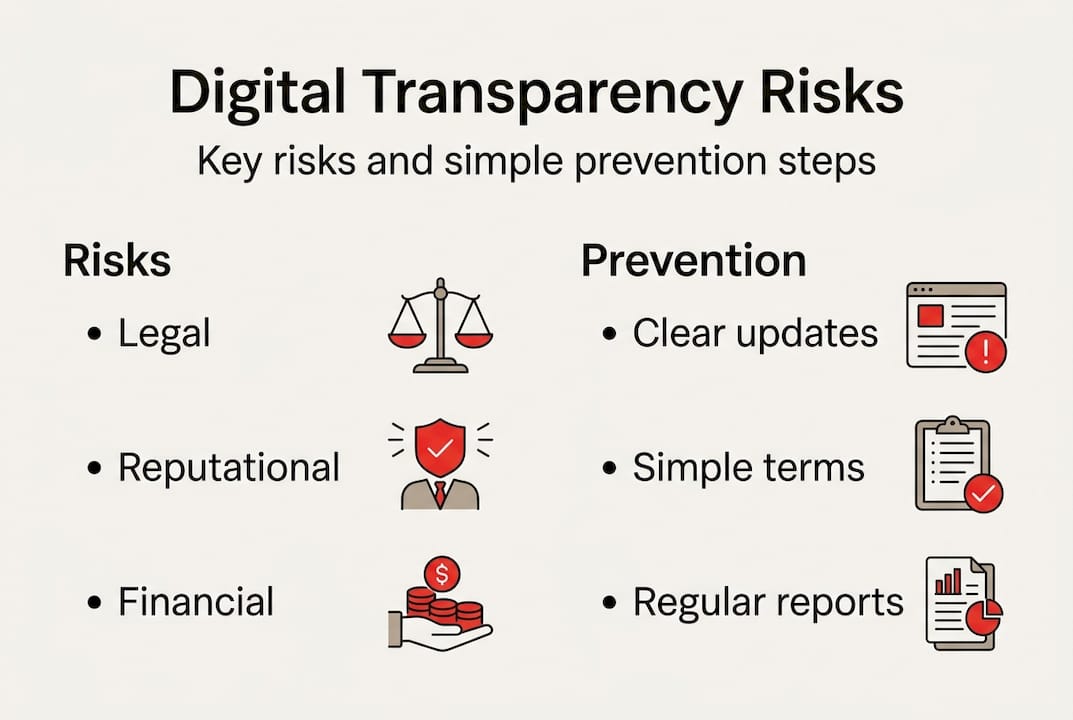
Here’s a quick view of the major risks:
| Risk type | Consequence | Prevention action |
|---|---|---|
| GDPR non-compliance | Fines, enforcement notices | Update privacy policy annually |
| Misleading ad claims | ASA rulings, reputational damage | Review ad copy against ASA guidelines |
| Data mishandling | Customer loss, negative press | Use transparent data collection forms |
| Automation without disclosure | Customer distrust | Disclose automated communications |
| Poor reporting | Client or customer confusion | Share plain-language monthly summaries |
Pro Tip: Send a short, plain-English marketing summary to your top customers or clients once a month. Three numbers, one paragraph. It pre-empts questions, builds confidence, and costs almost nothing.
Practical ways SMEs can implement digital transparency
Understanding the risks leads directly to the most important question: how do you actually make transparency work for your business?
Start by mapping where you currently stand across the four types. Which one is weakest? For most SMEs, financial and strategic transparency are the least developed. They’re often private by default, even when there’s no good reason for that.
Here’s a simple process to follow:
- Audit your current state. Review your website privacy policy, cookie notice, ad claims, and any automated emails. Note what’s missing or vague. A good starting point is reading through your site as if you were a first-time visitor who’s slightly sceptical.
- Prioritise your weakest area. Don’t try to fix everything at once. If your sharing results process is non-existent, start there. If your data notices are buried, surface them.
- Introduce plain-language reporting. Whether you’re reporting to yourself, a client, or a board, use simple language. Three key metrics, one honest paragraph on what’s working and what isn’t.
- Update customer-facing communications. Review your email sequences, chatbot responses, and social adverts for clarity and honesty. Remove superlatives that you can’t back up.
- Build a review cycle. Transparency isn’t a one-time project. Schedule a quarterly check to update your data practices, review ad claims, and refresh your reporting.
SMEs are more agile than large companies and typically have simpler data systems. That’s a real advantage. You can make changes this week that a corporation would take six months to implement.
Here’s a useful comparison when deciding how much to share:
| Approach | Pros | Cons |
|---|---|---|
| Over-disclosure | Shows confidence, nothing to hide | Can overwhelm or confuse customers |
| Minimal viable disclosure | Clear, focused, low fatigue | May feel evasive if done poorly |
| Balanced disclosure | Builds trust without noise | Requires judgment and regular review |
Pro Tip: If you’re unsure where to start, use the free estimating marketing costs tool to understand your spend, then use that as the basis of your first transparent financial update to clients or stakeholders.
Balancing transparency with the realities of AI and automation
The growing use of AI tools creates a new kind of transparency challenge for UK SMEs. Customers are increasingly aware that automated systems are being used in marketing, customer service, and data processing. But awareness doesn’t automatically mean comfort.
Only 23% of consumers trust brands to use AI responsibly with their data, and 59% are uncomfortable with their personal information being used to power AI systems. That’s a significant trust gap.
“Knowing AI is involved isn’t the same as feeling reassured about it. Disclosure is the start, not the finish.”
So what’s the right approach? Being vague about automation in marketing is increasingly risky as customers become more savvy. But overcorrecting with technical explanations creates fatigue and worry.
Here’s a practical guide for AI disclosure:
- Do disclose when an automated system is handling a customer enquiry or when AI is involved in personalising content
- Do say something simple: “Our booking system is automated, so you’ll get an instant response. A team member will follow up shortly.”
- Don’t over-explain the technical architecture of your AI tools. Customers want reassurance, not a technical brief.
- Do check ASA guidelines on AI-generated advertising content, as the rules are evolving quickly in 2026
- Don’t assume that silence is neutral. Customers who discover automation without prior notice feel deceived
It’s also worth noting that AI disclosure can reduce ad effectiveness by up to 31% in some contexts. That’s not an argument against disclosure. It’s an argument for crafting your disclosure thoughtfully, so it reassures rather than alarms. Review your approach to AI chatbots and transparency to make sure you’re striking the right tone.
The goal is what we call minimum viable transparency: enough honesty to build confidence, delivered clearly enough that customers feel respected rather than overwhelmed.
Our experience: what most SMEs miss about digital transparency
After working with SMEs across the UK for well over a decade, we’ve noticed a pattern. Most business owners overthink transparency. They imagine it requires dashboards, legal sign-off, or months of preparation. It rarely does.
The SMEs that get transparency right are usually the ones doing something remarkably simple: they communicate regularly, in plain language, about things that actually matter to their customers. Not every data point. Not every strategic decision. Just the things that affect trust.
The trap we see most often is what you might call “transparency theatre.” Business owners update their privacy policy, add a cookie banner, and consider the job done. Meanwhile, their customers have no idea what’s happening with their enquiries, their data, or their money.
True transparency isn’t about volume. It’s about relevance. Customers want reassurance, not perfection. One honest update a month about how you handle their information or what your marketing is doing is worth more than a 40-page policy document they’ll never read.
Our advice? Use your free marketing audits to identify your starting point. Then commit to correcting one transparency weakness every quarter. Small, visible steps build more trust than grand overhauls.
Let’s help you build marketing trust with transparency
Digital transparency doesn’t have to be complicated. At Bamsh Digital Marketing, we help UK SMEs make it simple, consistent, and effective. Whether you need a clear picture of your current SEO performance, honest reporting on your marketing spend, or guidance on communicating your data practices to customers, we’ve got practical tools and experience to help.
Start with a full SEO audit report to understand exactly where you stand online. Then explore our marketing transparency resources to find the right next step for your business. One action this week can start rebuilding or reinforcing the trust your customers expect. Let’s make it straightforward together.
Frequently asked questions
How does digital transparency build customer trust?
Transparency reassures customers that their data is handled honestly and their money is being spent wisely, making them far more likely to engage, return, and refer others. 35% of businesses say losing customer trust is their greatest fear, which reflects just how central it is to sustainable growth.
Do small businesses in the UK have a transparency advantage?
Absolutely. SMEs have real advantages including agility, direct customer relationships, and simpler data systems, all of which make it faster and easier to implement genuine transparency compared to large corporations.
How can I start improving digital transparency today?
Map where you’re currently strong or weak across data, financial, strategic, and performance transparency, then send a plain-language update about your marketing or data practices to your customers this month as your first visible step.
Are there risks in being too transparent with customers?
Yes. Sharing too much detail can cause information fatigue or unnecessary worry, so aim for clear, meaningful updates over raw data dumps. Over-disclosure causes fatigue, which is why minimum viable transparency is a smarter long-term approach.
Recommended
- Marketing Transparency: Building Trust and Boosting Results
- Digital Marketing in 2026: Boosting Growth and Leads
- Digital Marketing in 2026: Boosting Growth and Leads
- Importance of Clear Marketing Results for UK SMEs
- Insurance Digital Transformation Guide for Effective Change – Digital Insurance Platform | IBSuite Insurance Software | Modern Insurance System