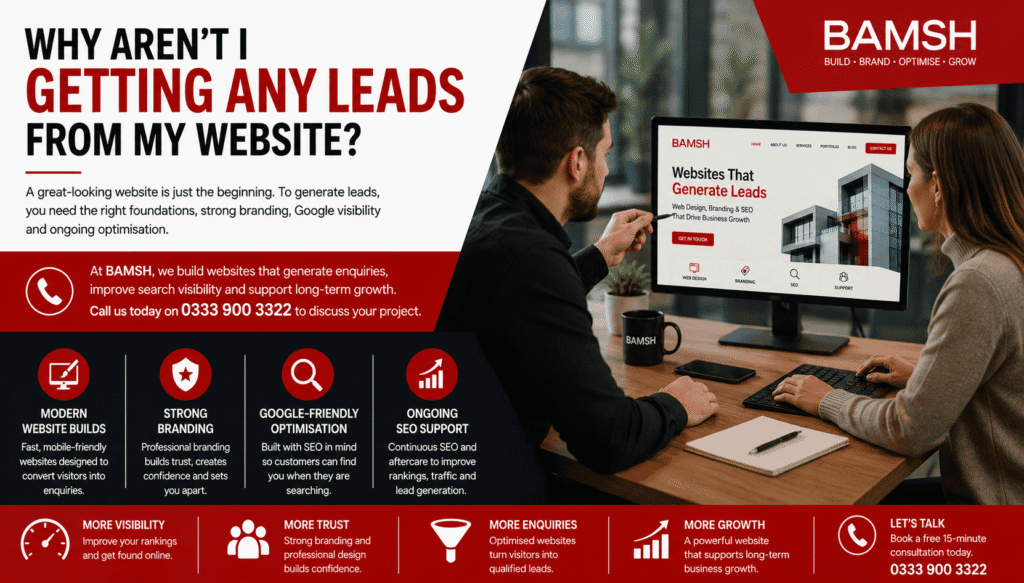
You have invested in a website. It looks professional, explains what you do and gives potential customers a way to contact you.
But the enquiries are not coming in.
If you are asking, “Why isn’t my website getting enquiries?”, the problem usually falls into one of two areas. Either the right people are not finding your website, or they are finding it but are not being given enough reason to contact you.
For tradespeople and other service businesses, both problems matter. A website can look great and still sit unnoticed in Google. It can also attract visitors and lose them because it is slow, difficult to use on a phone, short on trust signals or unclear about what the visitor should do next.
The first step is finding out where the problem actually starts.
The 60-Second Website Audit You Can Do Right Now
Before changing your website, spend one minute looking at it as a potential customer rather than as the business owner.
Run through these simple checks:
- Open a private or incognito browser window and search your main service + your town. Can you find your business on the first page or in the Google Map Pack?
- Open your website on your phone using mobile data rather than your office Wi-Fi. Does it load quickly and display correctly?
- Look at your homepage. How many seconds does it take you to find your phone number or main contact button?
- Without scrolling far, can you immediately understand what the business does and where it operates?
- Can you see evidence that real customers trust the business, such as recent reviews, genuine photographs, case studies or testimonials?
- Is there one obvious next step, such as calling, requesting a quote or booking a consultation?
- Open your contact form. Would you personally want to fill it in?
If you struggle with any of these tasks when you already know your own business, a new visitor is likely to struggle even more.
That gives you a useful starting point for understanding why your website is not generating leads.
5 Reasons Your Website Isn’t Generating Leads
A website not generating leads in the UK does not necessarily need to be completely rebuilt.
Sometimes the problem is visibility. Sometimes it is the content. In other cases, relatively small issues with speed, mobile usability, trust or calls to action are creating unnecessary friction.
Here are five areas worth checking first.
1. Potential Customers Cannot Find You on Google
Before worrying about conversion rates, establish whether enough potential customers are actually reaching the website.
A visually impressive website means very little if it cannot be found when somebody searches for the service you provide.
One of the biggest misconceptions about website development is that publishing a new website automatically means Google will rank it.
It doesn’t.
Google needs to understand what your business does, which searches your pages are relevant to and, for local businesses, where you provide your services.
A Google-friendly website therefore needs more than attractive design. Important foundations include:
- Logical website structure
- Useful service pages
- Clear page headings
- Optimised page titles and descriptions
- Relevant internal linking
- Fast page speeds
- Mobile-friendly design
- Useful, original content
- Local relevance where appropriate
- Sound technical SEO
Your Google Business Profile also matters for local searches, particularly when customers are looking for a nearby tradesperson or service provider.
Try searching for your most important service and location yourself.
If you are a roofer in Bristol, for example, search the way a customer would rather than searching for your company name. If your website and Google Business Profile are nowhere to be seen, your first problem is visibility rather than conversion.
Search visibility has also moved beyond traditional Google listings. Customers increasingly use AI-powered search tools and ask detailed, conversational questions before choosing a business. This makes Answer Engine Optimisation another consideration when structuring useful website content.
This is why SEO should not be treated as something added after a website has been built. Search visibility needs to be considered throughout the structure and content of the site.
2. Your Website Is Difficult to Use on a Mobile Phone
Your website may look excellent on the large monitor you use at work.
That does not mean it works well for your customers.
Someone looking for a tradesperson might be searching from their phone while dealing with a problem at home, sitting in a van between jobs or comparing several companies from their sofa.
They do not have much patience for a website that requires pinching the screen, navigating tiny menus or hunting for a telephone number.
Open your website on a phone and check:
- Can you read the text without zooming?
- Is the menu easy to use?
- Can you tap the phone number?
- Are buttons large enough to press comfortably?
- Do images fit the screen properly?
- Is the contact form straightforward?
- Can you understand what the business does immediately?
- Can you reach the main services without repeatedly opening menus?
Mobile design should not simply be a smaller version of the desktop website.
The most important information needs to remain easy to find, and the route from landing on the page to making an enquiry should be straightforward.
If your trade website is not generating leads, checking it properly on a phone is one of the first things worth doing.
3. Your Website Is Too Slow
Every extra obstacle gives a potential customer another opportunity to leave.
Page speed is one of them.
Large images, excessive scripts, outdated plugins, poor hosting and badly optimised website builds can all make pages unnecessarily slow.
The problem can be particularly noticeable on mobile connections.
You do not need to become a web developer to spot an obvious problem. Open the site on your phone and navigate through several pages.
Does each page appear promptly, or are you staring at a blank screen or watching elements gradually move into position?
Tools such as Google PageSpeed Insights can provide a more technical assessment, but the customer experience matters too.
A beautiful homepage is of little value if potential customers abandon it before they see your services or contact details.
4. Visitors Do Not Trust You Yet
Getting someone onto your website is not the same as convincing them to contact you.
Potential customers are assessing risk. They want to know whether your business is genuine, whether you have done this type of work before and whether other customers have had a good experience.
That is why simply saying that you are professional, reliable or experienced is rarely enough.
Support those claims with evidence.
Useful trust signals can include:
- Recent customer reviews
- Genuine testimonials
- Photographs of completed work
- Before-and-after examples
- A photograph of the business owner or team
- Relevant qualifications and accreditations
- Case studies
- Clear contact information
- Service areas
- Information about your process
- Transparent pricing or an explanation of what affects the price
Where these elements appear matters too.
Do not hide every review on a testimonials page that visitors may never open. Place relevant evidence close to the service, claim or decision it supports.
If you say you specialise in a particular type of project, show one.
If you say customers recommend you, show recent reviews.
If somebody is deciding whether to invite your team into their home or business, give them enough information to understand who they are dealing with.
Your wider online presence should reinforce the same impression. Your social media channels, Google Business Profile, website and online directories should all support a consistent business identity.
5. There Is No Obvious Next Step
One of the simplest reasons a website fails to generate enquiries is that it never clearly asks for one.
Look at your homepage again.
What is the main action you want somebody to take?
Call?
Request a quote?
Book an appointment?
Send an enquiry?
There should be an obvious route forward.
A visitor should not have to reach the footer, open a separate contact page and search for a telephone number before they can speak to you.
Calls to action also need to match the visitor’s stage in the buying process.
Someone who urgently needs a service may be ready to call immediately. Someone researching a larger purchase may want to see prices, case studies or further information before speaking to anyone.
Your website should make both journeys straightforward.
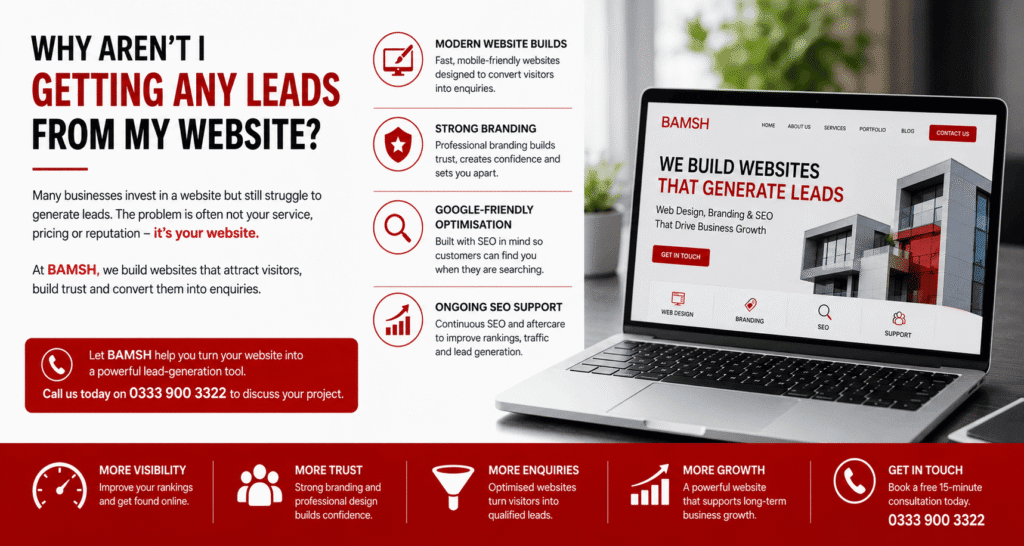
Getting Traffic Is Only Half the Job
Your website can attract traffic and still fail to generate leads.
Once you know people are reaching the site, the next question is what happens when they arrive.
Ask yourself:
- Are visitors landing on a page that matches what they searched for?
- Can they find the information they need?
- Does the page answer their main questions?
- Is the navigation straightforward?
- Are your contact details obvious?
- Is the enquiry form simple?
- Is there enough evidence to trust the business?
- Does the content focus on the customer’s problem as well as your service?
- Is there a useful next step for someone who is not ready to enquire?
A website that only describes your business can easily become little more than a digital brochure.
A lead-generating website needs to do more.
It should answer the questions potential customers normally ask before making an enquiry, address common concerns and explain what happens next.
Think of your website as part of your sales process. It should continue educating and reassuring potential customers even when nobody from your team is available to speak to them.
Is Your Website Talking About You or Your Customer?
Another common problem is website copy that focuses almost entirely on the company.
“We have years of experience.”
“We pride ourselves on quality.”
“We offer excellent customer service.”
There is nothing wrong with explaining your experience or credentials, but that is rarely the main reason somebody visits your website.
They have a problem they want solved.
Good website copy connects what the business does with what matters to the customer.
Instead of simply listing services, explain:
- What problem does the service solve?
- Who is it suitable for?
- What can the customer expect?
- How does the process work?
- How much might it cost?
- What affects the final price?
- How long might it take?
- What happens after they enquire?
- Why should they trust you to do the work?
This type of information helps potential customers decide whether your business is right for them.
It can also qualify leads before they contact you by making your services, likely costs and process clearer.
What About Visitors Who Aren’t Ready to Enquire Yet?
Not everybody who reaches your website is ready to pick up the phone.
Some visitors are comparing businesses. Others are researching costs, trying to understand a service or deciding whether they need professional help at all.
If every page offers only a hard enquiry as the next step, you may lose people who are interested but not ready.
Useful guides, FAQs, case studies, cost information and other genuinely helpful resources can support people during this research stage.
The aim is not to put additional barriers between a visitor and an enquiry. It is to give people useful information at different stages of the buying process.
For businesses that have a longer sales cycle, CRM and lead nurturing can also help manage enquiries and maintain contact with potential customers who are not ready to buy immediately.
What a Website That Generates Leads Actually Looks Like
There is no single website design that guarantees enquiries.
A successful plumber’s website will not necessarily look like a successful professional services website.
But effective lead-generating websites tend to make the customer’s job easy.
A visitor should be able to arrive and quickly establish:
What do you do?
Your core service should be immediately understandable.
Do you work in my area?
For local businesses, service locations should be clear.
Can I trust you?
Use real reviews, photographs, projects, people and credentials rather than relying entirely on marketing claims.
Can you solve my particular problem?
Your service pages should explain problems and outcomes, not simply provide a list of features.
What is this likely to cost?
Where possible, publish prices. Where an exact figure is impossible, explain typical costs or the factors affecting a quotation.
What happens next?
Explain the enquiry and service process so customers know what to expect.
How do I contact you?
Do not make this difficult. Phone numbers, forms and other primary actions should be easy to find.
You can see the approach we take through our web design service, where search visibility, mobile usability and conversion are considered as part of the same job rather than separate afterthoughts.
Is Your Website Simply Outdated?
Age alone does not make a website ineffective.
A five-year-old website that remains fast, useful, mobile-friendly and easy to navigate can still perform perfectly well.
The problem comes when the website has been left behind while customer behaviour, competitors and search technology have changed.
Warning signs include:
- Poor mobile usability
- Slow pages
- Outdated or inaccurate information
- Difficult navigation
- Weak service pages
- No clear calls to action
- Old photographs
- Limited trust signals
- Poor SEO foundations
- Complicated contact forms
That does not automatically mean you need a completely new website.
Sometimes individual pages, calls to action, content or technical issues can be improved without starting again. In other cases, the existing structure itself is holding the business back and a redesign makes more sense.
At BAMSH, our web design work focuses on usability, mobile performance, search visibility and conversion rather than design alone.
Does the Look and Feel of Your Brand Inspire Confidence?
Your website is often the first interaction a potential customer has with your business.
Before reading about your services or contacting your team, visitors are already forming an impression of the company.
Branding contributes to that impression through:
- Colour
- Typography
- Photography
- Page layouts
- Messaging
- Tone of voice
- Overall presentation
Strong branding is not about making a website flashy. It is about creating consistency and confidence.
Trust also comes from transparency. Where appropriate, explaining typical costs, starting prices or the factors influencing what customers will pay can remove uncertainty before someone makes an enquiry.
If exact prices cannot be provided, explaining how quotations work and what affects the final cost can still give potential customers useful information.
Professional presentation should then be backed up with genuine evidence such as reviews, photographs, testimonials and case studies.
Why SEO Aftercare Matters After Your Website Launch
One of the biggest mistakes businesses make is assuming SEO ends when the website goes live.
Launch day is only the beginning.
Competitors publish new content and improve their websites. Customer behaviour changes. Services and prices change. Search engines also need to continue discovering and assessing the information on your website.
Ongoing SEO can therefore include:
- Content updates
- Keyword monitoring
- Technical audits
- Performance reviews
- Local SEO improvements
- Competitor analysis
- Internal linking
- User experience improvements
A website should evolve alongside the business it represents.
Our ongoing SEO services are designed to help businesses improve and maintain their search visibility rather than leaving a website untouched after launch.
You can also review our SEO costs and packages to understand the options available.
How BAMSH Builds Websites Designed to Generate Leads
At BAMSH, we believe a website should be one of the hardest-working assets in a business.
That means considering more than how it looks.
Professional Website Builds
Modern websites should be designed around user behaviour, mobile performance and clear conversion goals.
Strong Brand Presentation
The website should present the business consistently and give potential customers confidence in the company behind it.
Google-Friendly Foundations
Technical SEO, useful content and a logical site structure should be considered from the start rather than added once the website has already been built.
Ongoing SEO Support
Continued optimisation can help a website respond to changes in search behaviour, competition and the business itself.
The objective is to connect visibility and conversion. There is little benefit in attracting hundreds of visitors who never enquire, just as there is little benefit in building a highly persuasive website nobody can find.
Your Website Should Generate More Than Just Traffic
If your website is not generating leads, do not immediately assume you need more visitors.
First work out where the problem occurs.
If potential customers cannot find you, concentrate on visibility.
If they are finding you but leaving, look at mobile performance, page speed, content, trust and usability.
If they are spending time on the site but not contacting you, look closely at your calls to action, enquiry process and whether the website answers the questions stopping them from taking the next step.
And if you are generating enquiries but they are consistently poor quality, review whether your website clearly explains your services, pricing, locations and who you are best suited to help.
A successful website needs to attract the right people and help those people make a decision.
That is what turns a website from an online brochure into a genuine part of your sales process.
If you want another opinion on what may be holding your website back, book a free 15-minute consultation with BAMSH.
You can also contact us on 0333 900 3322.
Frequently Asked Questions
Why am I getting website traffic but no actual leads?
Traffic alone does not guarantee enquiries. Visitors may be reaching the wrong page, struggling to find important information, encountering a slow or difficult mobile experience, or leaving because there is no obvious next step. Start by checking which pages receive traffic and whether those pages match the reason people searched in the first place.
Why isn’t my website getting enquiries?
First determine whether people are actually finding the website. Search for your main service and location, review your search visibility and check your website analytics. If relevant visitors are already arriving, examine page speed, mobile usability, trust signals, service information and calls to action to identify where potential customers may be dropping out.
How can I tell where potential customers leave my website?
Analytics can show which pages people enter, where they leave and how they move through the site. This helps identify pages receiving traffic but failing to move visitors towards an enquiry. Integrating a Customer Relationship Management system can also help track enquiries and identify which traffic sources generate useful leads.
Could my contact form be reducing enquiries?
Yes. Long or confusing forms create unnecessary friction. Ask only for the information you genuinely need at the first stage, make the form easy to complete on a phone and explain what happens after it is submitted.
Why does mobile performance affect lead generation?
Potential customers frequently visit business websites from smartphones. If text is difficult to read, buttons are awkward to press, pages load slowly or contact details are hard to find, visitors have an easy reason to leave and try another business. Test the complete enquiry journey on an actual phone rather than relying solely on how the website appears on a desktop.
Does website speed affect enquiries?
It can. A slow website delays visitors from reaching the information or contact options they came for. Large images, excessive scripts, poor hosting and technical problems can all contribute, so page speed should be reviewed alongside the rest of the user experience.
What trust signals should I put on my website?
Useful trust signals include genuine customer reviews, testimonials, photographs of completed work, case studies, team photographs, relevant qualifications, accreditations and clear contact details. They are most effective when placed close to the service or claim they support instead of being hidden on a separate page.
Does SEO influence how many leads my website generates?
Yes. A website cannot convert potential customers who never find it. Effective SEO helps relevant visitors discover your pages when searching for the services you provide. Answer Engine Optimisation can also help structure useful information for newer AI-driven search experiences.
Can paid advertising help generate more enquiries?
PPC advertising can bring relevant potential customers to your website more quickly, but advertising does not fix a poor website. Sending paid traffic to a slow, confusing or unconvincing page can simply mean paying for visitors who leave without contacting you.
Who can help improve my website’s lead generation performance?
BAMSH works with businesses on web design, SEO and lead generation. We can review whether the problem lies with search visibility, the website itself or what happens after an enquiry is received. You can review our pricing, request a free SEO audit or book a free 15-minute consultation to discuss the problem.
Recommended
- Why Is My Website Not Generating Leads? The Simple Trick to Turn Your Site Into a 24/7 Salesperson
- 10 Reasons Your Trade Website Isn’t Generating Leads (And How to Fix It)
- How UK Businesses Can Increase Website Traffic, Visibility and Leads
- Maximise Online Leads with AEO: The Guide for UK Businesses
- Proven Facebook Ads Strategies To Boost Leads and Revenue
- Types of Google Ads: Maximise Leads and ROI for UK SMEs
- Build Real Brand Authority: Drive Trust and Leads Online
- How Predictive Lead Scoring Transforms UK SMB Sales