
TL;DR:
- A lead engine is a systematic system that automates lead capture, nurturing, and conversion.
- Building a lead engine involves defining target customers, creating landing pages, automating follow-up, and refining processes.
- Using integrated digital tools and regularly measuring key metrics boosts lead reliability and business growth.
Most business owners think lead generation means putting up a few adverts and hoping the phone rings. It doesn’t work like that. Real, predictable growth comes from something far more structured: a lead engine. This is a system that brings together your digital presence, automation, and analytics into one repeatable process. It captures interest, nurtures prospects, and converts them into paying customers, consistently. In this article, you’ll learn exactly what a lead engine is, how it differs from basic lead generation, and how to build one that works for your UK business.
Table of Contents
- Understanding lead engines: definitions and framework
- Building your lead engine: steps and best practices
- Digital tools and automation: driving efficiency
- Measuring success: metrics and optimisation
- Why lead engines change the game for UK SMEs
- Take your lead engine further with expert guidance
- Frequently asked questions
Key Takeaways
| Point | Details |
|---|---|
| Lead engines explained | A lead engine is a strategic system turning marketing visibility into predictable sales opportunities for UK businesses. |
| Automation is essential | Digital tools and automation significantly enhance conversion rates and save SMEs time. |
| Practical implementation | Building a lead engine involves clear steps, smart technology choices, and measured optimisation. |
| Track and optimise | Consistently tracking performance metrics ensures your lead engine improves over time. |
Understanding lead engines: definitions and framework
Let’s clear something up. Lead generation is an activity. A lead engine is a system. The difference matters enormously.
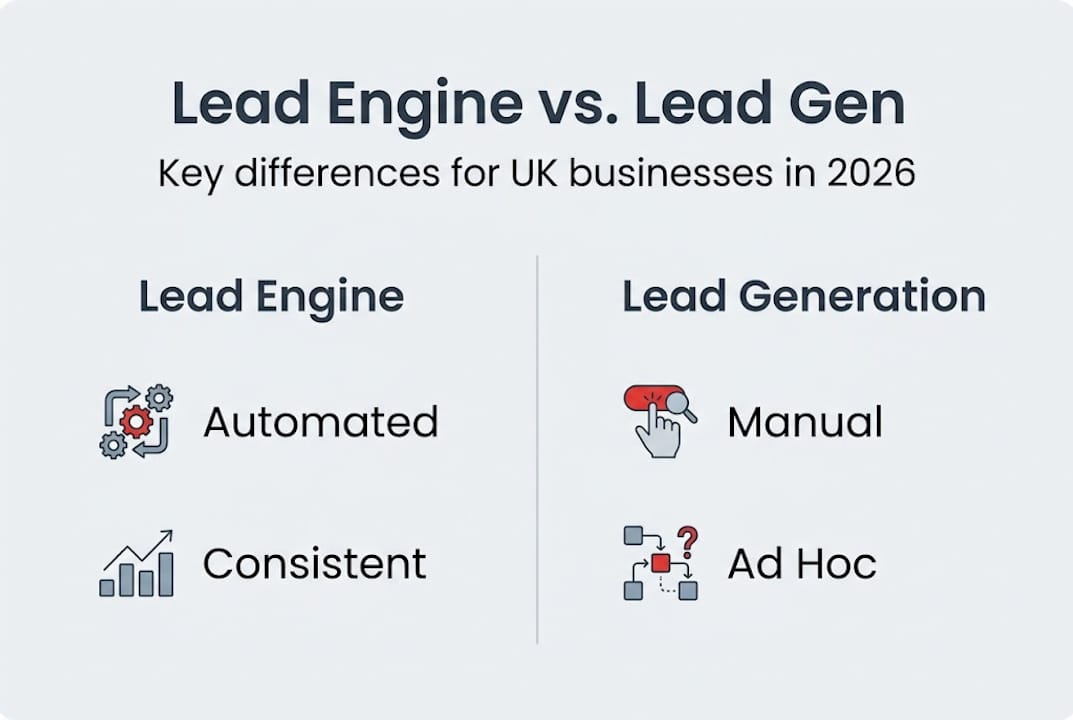
When you run a single Google Ads campaign or post on social media, that’s lead generation. It’s manual, reactive, and inconsistent. A lead engine, by contrast, is a systematic digital process that runs continuously, capturing, qualifying, and nurturing prospects without you having to manage every step manually.
Think of it like a well-oiled machine in a factory. Traditional lead generation is a person assembling products by hand. A lead engine is the conveyor belt, the automated equipment, and the quality checks all working together.
The three core components of a lead engine
Every effective lead engine has three layers:
- Funnel: The journey a prospect takes from first discovering your business to becoming a customer. This includes your website, landing pages, content, and offers.
- Automation: The systems that handle follow-up, nurturing, and communication without manual input. Automation in lead generation is what makes scale possible.
- Analytics: The data that tells you what’s working, what isn’t, and where to focus your energy next.
Without all three, you don’t have a lead engine. You just have bits and pieces.
Lead engine vs basic lead generation: a quick comparison
| Feature | Basic lead generation | Lead engine |
|---|---|---|
| Process | Manual and ad hoc | Automated and systematic |
| Follow-up | Inconsistent | Timely and structured |
| Scalability | Limited | High |
| Data use | Minimal | Central to decisions |
| Predictability | Low | High |
For UK SMEs, the practical implication is significant. You’re not just trying to get more leads. You’re building infrastructure that generates leads reliably, even when you’re busy running the rest of your business. Exploring a lead generation software comparison can help you identify the right tools to underpin this infrastructure from day one.
Building your lead engine: steps and best practices
Now that we’ve outlined what a lead engine is, let’s explore how you can build your own, step by step.
Step 1: Define your ideal customer
Before you touch any tool or platform, you need clarity on who you’re targeting. What problems do they have? Where do they search for answers? What makes them choose one business over another? This shapes everything that follows.
Step 2: Build a high-converting landing page
Your landing page is the engine’s entry point. It should have one clear offer, a compelling headline, and a simple form. Remove distractions. Focus on one action you want visitors to take.
Step 3: Drive targeted traffic
Use SEO, Google PPC, and paid social to bring your ideal customers to your landing page. These channels feed the top of your funnel. Using proven digital marketing strategies here makes a measurable difference to your cost per lead.
Step 4: Set up your automation sequence
Once someone submits their details, your follow-up should begin instantly. An automated email or SMS sequence keeps them engaged, answers their questions, and moves them closer to a decision. Automation tools for lead nurturing make this possible without adding to your workload.

Step 5: Score and qualify leads
Not every lead is ready to buy. Lead scoring assigns values to prospect behaviour, helping your team focus on the warmest opportunities first.
Step 6: Review and refine
Your lead engine isn’t a set-and-forget solution. Check your data weekly, identify drop-off points, and test improvements regularly.
Pro Tip: Automating your follow-up can boost conversions significantly, making timely response one of the highest-leverage actions in your entire system.
Common pitfalls to avoid:
- Skipping the qualification step and wasting time on cold leads
- Using too many tools that don’t integrate with each other
- Neglecting mobile optimisation on landing pages
- Failing to test different offers or messages
Digital tools and automation: driving efficiency
With a foundation laid, let’s examine the digital tools and automation that power modern lead engines.
The right tools don’t just save time. They make the impossible possible. A small team of two or three people can manage hundreds of leads per month, provided the right systems are in place.
Essential tools for your lead engine
- CRM (Customer Relationship Management): Tracks every lead, their status, and their history. Without a CRM, leads fall through the cracks.
- Email automation software: Sends the right message at the right time without manual effort.
- AI-powered lead scoring: Automatically ranks leads by behaviour, helping you prioritise follow-up.
- Landing page builders: Rapid deployment of high-converting pages without needing a developer.
- Analytics platforms: Connect your data so you can see the full customer journey.
Tool comparison for UK SMEs
| Tool category | Examples | Primary benefit |
|---|---|---|
| CRM | HubSpot, Zoho, Pipedrive | Contact management |
| Email automation | Mailchimp, ActiveCampaign | Nurture sequences |
| Lead scoring | Marketo, HubSpot | Prioritise hot leads |
| Analytics | Google Analytics, Hotjar | Performance insight |
See our guide on top marketing tools for a detailed breakdown tailored to UK business needs.
Automation is where most SMEs see the biggest gains. When you automate follow-up, your response time drops from hours to seconds. That matters. Studies show 50% higher conversions in lead nurturing when automation is properly implemented, a figure that should make any business owner sit up straight.
For automation in marketing for SMEs, the key is integration. Your CRM, email platform, and lead scoring system should all talk to each other. Siloed tools create gaps where leads get lost.
Pro Tip: Start with one automation sequence before building more. A simple welcome email series that answers common questions can dramatically improve early-stage engagement and set the tone for the entire relationship.
Measuring success: metrics and optimisation
After exploring powerful tools and automation, it’s crucial to measure your efforts and optimise for results.
Building a lead engine without measuring it is like driving with your eyes closed. You need data to know whether your system is performing or quietly underdelivering.
The metrics that matter most:
- Conversion rate: What percentage of visitors become leads? What percentage of leads become customers?
- Cost per lead (CPL): How much are you spending to acquire each lead? Lower isn’t always better if quality drops.
- Lead response time: How quickly does your system respond to a new enquiry?
- Lead-to-close rate: Of all the leads that enter your funnel, how many convert to paying customers?
- Customer lifetime value (CLV): What is each customer worth over the entire relationship?
- Return on investment (ROI): Are you making more than you’re spending?
- Retention rate: Are customers coming back, or was it a one-time transaction?
📊 Stat to know: Proper metric tracking improves lead conversion accuracy and helps businesses identify their highest-value channels faster.
The key to optimisation is running regular review cycles. Weekly, look at your conversion rates and response times. Monthly, review your CPL, ROI, and lead quality. Quarterly, reassess your overall strategy, your audience targeting, your offers, and your automation sequences.
Don’t try to fix everything at once. Pick the single biggest drop-off point in your funnel and focus there. Once that improves, move to the next. Consistent incremental improvements compound over time into significant gains. This is how lead generation automation success is built, through steady refinement rather than occasional overhauls.
Also track qualitative signals. Are sales conversations getting easier? Are customers better educated before they speak to you? Are you getting fewer time-wasting enquiries? These softer indicators often signal that your lead engine is working at a deeper level than raw numbers reveal.
Why lead engines change the game for UK SMEs
Here’s something most agencies won’t tell you: having a lead engine doesn’t automatically mean you’re using it well. The majority of UK SMEs we speak to have some version of the components in place. A CRM here, an email tool there. But they’re not connected. They’re not systematic. And they’re definitely not producing predictable results.
The impact of automation for UK SMEs goes beyond efficiency. When your lead engine works properly, it changes how you think about growth. You stop hoping for referrals and start expecting enquiries. That’s a fundamental shift.
The UK market has its own character. Buyers here tend to research more before committing. They expect credibility signals, reviews, and clear communication. A well-built lead engine accounts for this by nurturing longer consideration cycles rather than pushing for an immediate sale. Most SMEs underestimate how much value is sitting in their existing pipeline, in the leads they never followed up with properly. A real lead engine recovers that value and turns it into revenue.
Take your lead engine further with expert guidance
If you’ve read this far, you already understand that a lead engine is more than a marketing tactic. It’s a business asset. At Bamsh Digital Marketing, we help UK SMEs build exactly this kind of system, combining SEO, automation, CRM, and paid advertising into one joined-up solution.
Our AI lead engine for UK SMEs is our flagship service, designed to generate leads consistently and predictably. We also offer answer engine optimisation to ensure your business appears in AI-driven search results as well as Google. Explore our full range of AEO digital marketing services and find out how we can help you grow with confidence, without the guesswork.
Frequently asked questions
How does a lead engine differ from typical lead generation?
A lead engine uses automation and systemised follow-up to convert visibility into predictable leads, while traditional lead generation relies on manual outreach with far less optimisation and consistency.
What digital tools are best for building a lead engine for UK SMEs?
Popular choices include CRM platforms, email automation software, and AI-powered lead scoring systems. A detailed software comparison for SMEs can help you select the right combination for your business size and budget.
Can automation improve lead conversion rates?
Yes. Automation boosts conversions through timely follow-up and structured nurturing, with studies showing up to 50% higher conversions when automation is properly implemented.
How do I measure my lead engine’s performance?
Track conversion rate, return on investment, and customer retention as your core indicators, then review these regularly to identify optimisation opportunities and improve results over time.
Recommended
- AI Lead Engine Explained: Predictable Growth for UK SMEs
- Role of Digital Strategy – Driving Business Growth in the UK
- Lead Generation Explained: Strategies for UK Businesses – Bamsh Digital Marketing
- AI Boosts UK SMEs: 19% Higher Turnover & £78B Growth
- Integrations in insurtech: driving efficiency in 2026