

More than 80% of british businesses struggle to translate digital marketing efforts into measurable growth. With so many options and constant tech updates, finding clarity can be challenging. This guide shows how to cut through the noise by defining clear goals, understanding your audience, and building strategies that actually deliver results. Whether you run a small start-up or manage a large enterprise, these practical steps help you approach digital marketing with confidence and purpose.
Table of Contents
- Step 1: Define Your Digital Marketing Goals And Audience
- Step 2: Set Up Essential Platforms And Integrations
- Step 3: Launch Multi-Channel Campaigns With Automation
- Step 4: Monitor Results And Optimise For Better Performance
- Step 5: Validate Workflow Efficiency And Ensure Scalability
Quick Summary
| Important Insight | Clarification |
|---|---|
| 1. Define clear marketing goals | Establish specific, measurable objectives to guide your digital marketing strategy and ensure effective use of resources. |
| 2. Research your target audience | Develop detailed customer personas using market research to tailor your marketing messages for better engagement. |
| 3. Integrate essential platforms | Establish key digital platforms and ensure they work together for streamlined marketing efforts and data flow. |
| 4. Automate multi-channel campaigns | Use marketing automation tools to create personalised campaigns and enhance customer engagement across various channels. |
| 5. Monitor and optimise performance | Regularly analyse metrics to adjust strategies, ensuring continuous improvement and effective audience connection. |
Step 1: Define your digital marketing goals and audience
Successful digital marketing starts with crystal clear objectives and a precise understanding of who you want to reach. According to UK Digital Excellence Awards, defining well-structured goals ensures coherence across marketing channels and drives measurable results.
Begin by asking yourself strategic questions: What specific business outcomes do you want to achieve? Are you seeking to increase website traffic, generate more sales leads, boost online conversions, or enhance brand visibility? Each goal requires a tailored approach. For instance, if you want more sales leads, you might focus on search engine optimisation and targeted pay-per-click advertising. If brand awareness is your primary aim, social media marketing and content strategies become more critical.
To pinpoint your ideal audience, conduct comprehensive market research. Map out detailed customer personas, including demographics, interests, online behaviours, and pain points. Business.gov.uk recommends understanding cultural nuances and specific customer segments to craft more resonant marketing messages. Pro tip: Use existing customer data, website analytics, and social media insights to build accurate audience profiles that will sharpen your digital marketing precision.
Next, you will translate these goals and audience insights into a structured digital marketing strategy that connects your business objectives with targeted audience engagement.
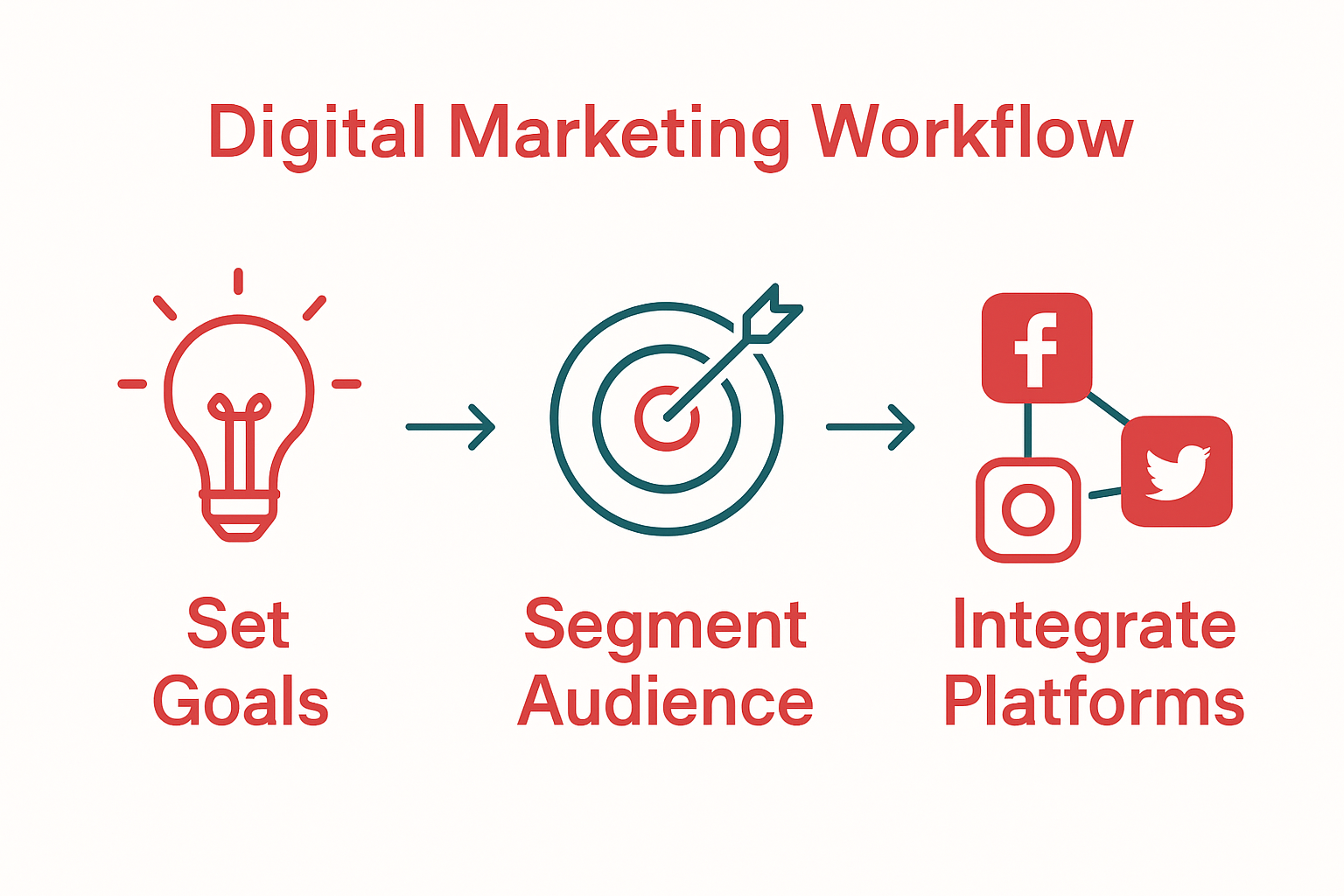
Step 2: Set up essential platforms and integrations
Digital marketing success hinges on strategically selecting and connecting your core online platforms. According to Salford University, choosing appropriate digital platforms and integrating them effectively is crucial for enhancing your online presence and achieving marketing objectives.
Start by establishing foundational platforms that align with your defined goals. This typically includes creating robust profiles on key channels such as Google Business Profile, relevant social media platforms, and setting up a comprehensive website or landing page. CH4B recommends ensuring these platforms can communicate seamlessly with each other to streamline marketing efforts and improve overall efficiency. Consider implementing a customer relationship management system that can centralise data from multiple sources, enabling more sophisticated tracking and personalisation of your marketing approach.
Prioritise platform integrations that allow smooth data flow and automated workflows. This might include connecting your website analytics with your email marketing platform, linking social media advertising accounts with your CRM, or setting up tracking pixels that enable retargeting across different channels. A pro tip is to select platforms with strong API capabilities and native integration options to minimise manual data transfer and reduce potential errors. By creating an interconnected digital marketing ecosystem, you will build a more responsive and intelligent marketing infrastructure that can adapt quickly to changing customer behaviours.

With your platforms established and integrated, you are now prepared to develop a comprehensive content and engagement strategy that leverages these connected digital assets.
Step 3: Launch multi-channel campaigns with automation
Automation transforms digital marketing from scattered efforts into a precision-driven strategy. According to ArXiv Research, marketing is rapidly shifting towards AI-driven strategies that create personalised campaigns, enhancing customer engagement and satisfaction.
Begin by mapping out your customer journey across different channels. This means identifying touchpoints where automated messaging can create seamless interactions, whether through email sequences, social media targeted adverts, or personalised website experiences. The Neural Optimisation with Adaptive Heuristics framework suggests using machine learning algorithms to optimise campaign performance across multiple platforms. Select marketing automation tools that offer robust integration capabilities, connecting your CRM, email platform, social media management systems and analytics dashboards.
Implement smart segmentation and trigger-based communications that respond dynamically to customer behaviours. This could involve setting up automated welcome sequences for new subscribers, retargeting adverts for website visitors who did not complete purchases, or personalised product recommendations based on previous interactions. A pro tip is to continuously test and refine your automation workflows, ensuring they remain responsive and relevant. By creating an intelligent marketing ecosystem that adapts in real time, you will develop more meaningful connections with your audience and drive more efficient business growth.
With your multi-channel campaigns now automated, you are prepared to monitor performance and continuously optimise your digital marketing strategy.
Step 4: Monitor results and optimise for better performance
Successful digital marketing requires continuous analysis and strategic refinement. ArXiv Research highlights sophisticated clustering algorithms that enable precise customer segmentation and performance tracking in the UK retail market, providing critical insights for ongoing marketing optimisation.
Establish a comprehensive monitoring dashboard that tracks key performance indicators aligned with your initial marketing objectives. This should include metrics such as conversion rates, engagement levels, customer acquisition costs, and return on investment across different channels. ArXiv Research on Influencer Marketing recommends systematic computational approaches to evaluate campaign performance, suggesting the use of advanced analytical tools that can provide granular insights into your marketing efforts.
Implement a data-driven optimisation cycle where you regularly review performance metrics and make incremental adjustments. This might involve A/B testing different messaging, refining audience targeting, adjusting ad spending, or reallocating resources between channels based on their demonstrated effectiveness. A pro tip is to create monthly performance review sessions where you critically examine your data, identifying both successful strategies and areas requiring improvement. By maintaining a dynamic and responsive approach to your digital marketing, you will continuously enhance your ability to connect with your target audience and drive meaningful business growth.
With your performance monitoring system in place, you are now prepared to develop a sustainable and adaptive digital marketing strategy that evolves with your business needs.
Step 5: Validate workflow efficiency and ensure scalability
Scalability is the cornerstone of sustainable digital marketing strategies. ArXiv Research highlights the NOAH framework as a breakthrough in integrating adaptive heuristics and machine learning to optimise marketing workflows, demonstrating how intelligent systems can dramatically improve operational efficiency.
Conduct comprehensive workflow audits by systematically mapping out each stage of your digital marketing process and identifying potential bottlenecks or inefficiencies. AI AI-driven marketing Research emphasises the significant advantage of automated strategies over traditional techniques, suggesting that businesses should leverage technology to create more responsive and adaptable marketing systems. This means critically examining your current tools, assessing their integration capabilities, and determining whether they can scale alongside your business growth.
Develop a scalability stress test that simulates different business growth scenarios. This involves running simulated campaigns at increased volumes, testing your automation systems’ performance under higher data loads, and ensuring your marketing infrastructure can handle exponential growth without compromising quality. A pro tip is to build in redundancy and flexibility within your systems, allowing for quick recalibration and seamless expansion. By creating a robust and adaptable digital marketing workflow, you will position your business to respond swiftly to market changes and emerging opportunities.
With your workflow validated and scalability confirmed, you are now equipped to transform your digital marketing from a tactical operation into a strategic growth engine.
Unlock Your Business Growth with a Mastered Digital Marketing Workflow
The article highlights common challenges businesses face in creating a seamless and scalable digital marketing strategy. If you struggle with connecting your platforms efficiently, automating multi-channel campaigns, or continuously optimising performance, you are not alone. Many businesses want clear, measurable results but find themselves overwhelmed by complicated tools and unclear marketing processes. Key goals like defining precise audience segments, integrating platforms, and leveraging AI-driven automation can seem out of reach without expert guidance.
At Bamsh Digital Marketing, we understand these pain points and focus on delivering transparent, results-driven solutions that help your business attract and retain ideal customers with ease. Our expert team specialises in everything from SEO and Google PPC management to CRM setup and AI-powered automation, ensuring your marketing workflow is efficient and scalable. We invite you to explore how our proven approach can simplify your marketing and drive growth through our Bamsh Digital Marketing services. Ready to take control of your digital marketing journey? Book your free 15-minute consultation now at https://bamsh.co.uk/15-min/ and start building a clear, tailored plan that delivers the business outcomes you need. Discover why businesses across the UK choose us by visiting our Digital Marketing Bristol page.
Frequently Asked Questions
What are the first steps to define my digital marketing goals?
Start by identifying specific business outcomes like increasing website traffic or generating more leads. Conduct a thorough analysis of your current situation and set measurable targets that align with these goals, ensuring clarity in your objectives for the next 30 days.
How can I set up essential platforms for my digital marketing workflow?
Begin by selecting core platforms that match your marketing goals, such as social media channels or a website. Ensure these platforms are properly integrated to streamline processes and communication, aiming to complete all setups within two weeks.
What is the role of automation in multi-channel campaigns?
Automation helps create a more cohesive marketing strategy by managing tasks across channels automatically. Implement automated workflows tailored to your customer journey, which can enhance engagement by up to 30%.
How do I monitor my digital marketing performance effectively?
Establish a dashboard to track key performance indicators like conversion rates and engagement levels. Review these metrics regularly, ideally on a monthly basis, to make informed adjustments that can improve overall effectiveness.
What strategies can I use to ensure my digital marketing is scalable?
Conduct thorough audits of your marketing workflows to identify inefficiencies and bottlenecks. Prepare for growth by stress-testing your systems under increased demand, and aim to ensure your marketing processes can handle a 50% increase in data flow without losing quality.