

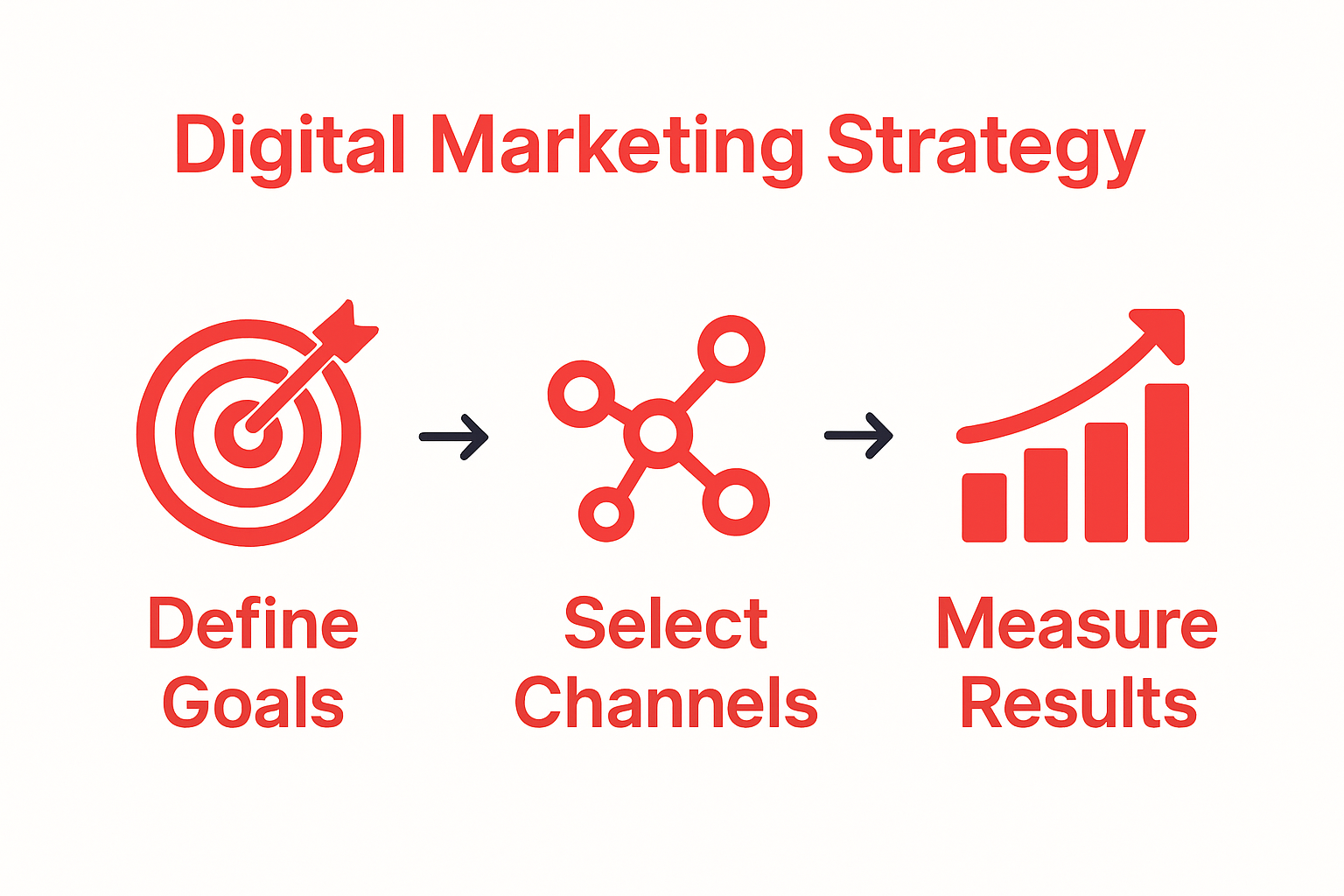
Over 80 percent of british businesses report that a focused digital marketing strategy leads to better results. With the digital marketplace growing more crowded each day, success depends on finding smart ways to stand out. By understanding what really drives your audience and setting clear goals from the start, you can create campaigns that actually connect, cut through the noise, and fuel real growth for your business.
Table of Contents
- Stage 1: Define Your Business Goals And Target Audience
- Stage 2: Audit Your Current Digital Presence And Assets
- Stage 3: Choose Marketing Channels And Set Your Budget
- Stage 4: Create Campaigns That Align With Your Objectives
- Stage 5: Track Key Metrics And Measure Your Results
Quick Summary
| Summary Point | Explanation |
|---|---|
| 1. Define clear business goals | Establish specific objectives like lead generation or revenue growth to focus your marketing efforts effectively. |
| 2. Conduct a thorough digital audit | Assess your current digital assets and performance metrics to identify strengths and weaknesses for improvement. |
| 3. Choose targeted marketing channels | Align selected channels with your goals, focusing on a few to maximise your budget effectiveness and impact. |
| 4. Craft focused marketing campaigns | Develop campaigns that address your audience’s needs while connecting directly to your established business objectives. |
| 5. Track metrics and evaluate performance | Regularly analyse key performance indicators to derive actionable insights and refine your marketing strategy accordingly. |
 |
|
Stage 1: Define your business goals and target audience
Successful digital marketing starts with crystal clear business goals and a deep understanding of who your ideal customers are. In this stage, you’ll map out a strategic foundation that transforms scattered efforts into a focused, powerful marketing approach.
According to UnLtd, defining your target audience requires thoughtful stakeholder analysis and clear value proposition articulation. Begin by asking yourself critical questions: What specific business outcomes do you want to achieve? Are you seeking more leads, increased website traffic, higher conversion rates, or revenue growth? Get granular about your objectives.
To pinpoint your target audience, Digital Boost recommends creating detailed customer profiles. Start by examining your existing customer base. Look for common characteristics like age, location, income level, professional background, and online behaviours. What problems do these customers have that your product or service solves? Develop a comprehensive picture that goes beyond basic demographics.
One practical tip: don’t try to appeal to everyone. Precise targeting beats broad messaging every time. By understanding exactly who your ideal customer is and what motivates them, you can craft marketing messages that speak directly to their needs and desires. This laser focused approach will significantly improve your marketing effectiveness and return on investment.
Ready to move forward? Your next step is transforming these insights into a concrete marketing strategy that connects with your perfectly defined audience.
Stage 2: Audit your current digital presence and assets
In this critical stage, you’ll perform a comprehensive assessment of your existing digital platforms, revealing hidden opportunities and potential roadblocks in your marketing strategy. Think of this audit as a health check for your online business ecosystem.
According to Salford University, evaluating your current digital platforms is fundamental to identifying strengths and weaknesses. Start by creating a detailed inventory of all your digital assets: websites, social media profiles, email lists, content repositories, and digital advertising accounts. Document each platform’s performance metrics, audience engagement rates, and alignment with your core business objectives.
Research from Birmingham City University emphasises the importance of assessing content effectiveness and audience interaction. Examine your existing digital channels meticulously. How are your current website pages performing? Which social media posts generate the most engagement? What email campaigns have delivered the best conversion rates? Look beyond surface level statistics and dig into meaningful insights that reveal genuine audience preferences.
A practical tip: be brutally honest during this audit. Don’t sugarcoat underperforming assets or make excuses. Every piece of data provides valuable information that can help refine your strategy. By understanding exactly where you stand today, you create a solid foundation for future marketing improvements.

With your comprehensive audit complete, you are now ready to develop a strategic roadmap that transforms your digital presence from fragmented to focused.
Stage 3: Choose marketing channels and set your budget
This crucial stage transforms your digital marketing strategy from theoretical planning to practical execution. You will strategically select the most effective channels for reaching your target audience while establishing a budget that maximises your investment potential.
According to Salford University, selecting appropriate digital marketing channels requires careful alignment with your business objectives. Begin by matching each potential channel to specific goals. Google Ads might drive immediate sales, while LinkedIn could be perfect for B2B lead generation. Social media platforms like Facebook and Instagram work brilliantly for businesses targeting younger demographics, whereas email marketing provides direct communication with existing customers.
Research from Birmingham City University emphasises strategic budget allocation across chosen channels. A practical approach is allocating your budget proportionally based on potential return on investment. Consider starting with a 60 40 split between proven channels and experimental platforms. Track performance meticulously and be prepared to reallocate funds quickly. Your budget should remain flexible digital marketing landscapes change rapidly.
One critical tip: never spread your budget too thin. It is far more effective to excel on two or three channels than to perform mediocrely across six or seven. Quality always trumps quantity in digital marketing. Concentrate your resources where you can create the most impactful, targeted campaigns.
With your channels selected and budget carefully planned, you are now ready to craft compelling content that will transform your digital marketing efforts.
Stage 4: Create campaigns that align with your objectives
In this pivotal stage, you will transform your strategic vision into targeted marketing campaigns that precisely connect your business goals with your audience’s needs. Your campaigns will become powerful vehicles for driving meaningful engagement and tangible results.
According to Salford University, crafting effective digital marketing campaigns requires developing messages that authentically resonate with your target audience. Begin by mapping each campaign objective to a specific business goal. If your aim is lead generation, design campaigns with clear value propositions that solve your audience’s most pressing challenges. Focus on creating content that answers their core questions and demonstrates your unique problem solving capabilities.
Research from Birmingham City University emphasises establishing clear measurable goals for each campaign. Implement specific key performance indicators that allow you to track success. For instance, if running a PPC campaign targeting local businesses, define precise metrics like click through rates, conversion percentages, and cost per acquisition before launching your initiative.
One critical tip: maintain laser focus. A well targeted campaign targeting a narrow audience will always outperform a generic approach attempting to please everyone. Your messaging should feel like a personal conversation with your ideal customer rather than a broadcast to the masses.
With your precisely designed campaigns ready, you are now prepared to implement and monitor your digital marketing strategy with confidence and strategic precision.
Stage 5: Track key metrics and measure your results
This critical stage transforms raw data into actionable business intelligence. You will learn how to systematically evaluate your marketing performance, turning numbers into strategic insights that drive future success.
According to Salford University, tracking key performance indicators requires a structured approach to analytics. Start by establishing a comprehensive dashboard that captures essential metrics across all your marketing channels. For digital campaigns, focus on indicators like website traffic, conversion rates, engagement percentages, cost per lead, and return on advertising spend. These metrics will provide a clear snapshot of your marketing effectiveness.
Research from Birmingham City University emphasises measuring marketing outcomes against predefined objectives. Create a comparison framework that tracks actual performance against your initial goals. If your original objective was generating 50 qualified leads per month, assess not just the quantity but the quality of those leads. Look deeper than surface level numbers examine conversion rates, customer lifetime value, and the actual revenue generated from these acquisitions.
One critical tip: embrace data transparency. Do not shy away from metrics that reveal underperformance. Weak results are not failures they are opportunities for strategic refinement. Treat each data point as valuable feedback that helps you continuously improve your marketing approach.
With your metrics carefully tracked and analysed, you are now equipped to make informed decisions that will propel your digital marketing strategy forward.
Build Your Winning Digital Marketing Strategy with Bamsh
Crafting a successful digital marketing plan takes more than just ideas. It requires clarity on your business goals, a deep understanding of your target audience, precise channel selection, and measurement of key results. Many businesses struggle with messy campaigns that do not deliver clear leads or predictable revenue. If you want to eliminate guesswork and focus on what truly works, Bamsh Digital Marketing is here to help. Our award-winning team specialises in creating transparent, results-driven plans that align with your unique objectives and deliver measurable growth.
Discover tailored solutions that cover SEO, PPC, social advertising, automation, and AI-driven tools all designed to help your ideal customers find you and choose you. Whether you need expert guidance on building engaging campaigns or tracking vital metrics for continuous optimisation, Bamsh provides straightforward support without confusion or jargon. Start your journey to a clear, confident marketing strategy today by booking a free consultation at https://bamsh.co.uk/15-min/. Explore how our Digital Marketing Bristol – Bamsh Digital Marketing services can transform your presence or learn more about us at Bamsh – Bamsh Digital Marketing. Don’t leave your growth to chance when expert help is just a click away.
Frequently Asked Questions
What are the first steps in creating a digital marketing plan?
To start creating a digital marketing plan, define your business goals and identify your target audience. Begin by asking targeted questions about the outcomes you wish to achieve, such as increasing leads or enhancing website traffic.
How can I effectively audit my current digital marketing assets?
To effectively audit your current digital marketing assets, compile a comprehensive inventory of all platforms and evaluate their performance. Focus on metrics like audience engagement rates and content effectiveness to identify strengths and weaknesses.
Which marketing channels should I choose for my strategy?
Choose marketing channels that align with your business objectives and target audience. Consider channels such as Google Ads for immediate sales or social media platforms for engaging younger demographics, ensuring your selection directly ties to your goals.
How do I create a campaign that aligns with my business objectives?
To create a campaign that aligns with your business objectives, develop targeted messages that resonate with your audience. Clearly define specific goals for your campaign and ensure that the content addresses your audience’s needs while solving their problems.
What key metrics should I track to measure my marketing success?
Track key metrics such as website traffic, conversion rates, and return on advertising spend to measure your marketing success. Establish a comparison framework to evaluate actual performance against your initial goals for continuous improvement.
How often should I review and adjust my digital marketing strategy?
Review and adjust your digital marketing strategy at least every quarter to ensure it remains effective. Regularly analysing data and performance can help you identify areas for improvement and optimise your efforts based on recent insights.