

Most british businesses now invest in social media advertising, yet only a small percentage achieve sustained results. Understanding what drives real success is what sets thriving campaigns apart from wasted budgets. Whether you want to boost visibility, generate leads, or drive direct sales, this guide shows how to approach every stage of the advertising process with proven, strategic steps that deliver measurable outcomes.
Table of Contents
- Stage 1: Define Your Advertising Objectives And Target Audience
- Stage 2: Set Up Your Social Media Advertising Accounts
- Stage 3: Create Compelling Ad Creatives And Messages
- Stage 4: Launch Targeted Campaigns Across Key Platforms
- Stage 5: Monitor Performance And Optimise Your Adverts
- Stage 6: Measure Results And Adjust Your Strategy
Quick Summary
| Key Insight | Explanation |
|---|---|
| 1. Define clear objectives | Establish specific, measurable advertising goals to align with business aims, such as brand awareness or sales. |
| 2. Understand your audience deeply | Create detailed customer personas considering demographics and psychographics to tailor your ads effectively. |
| 3. Set up professional accounts | Ensure consistency in branding and complete account details to enhance your business’s online credibility. |
| 4. Craft compelling ad creatives | Develop engaging ad content that resonates emotionally, focusing on strong visuals and clear messaging. |
| 5. Monitor and optimise campaigns continuously | Track key performance metrics systematically and adjust strategies based on data to improve advertising effectiveness. |
Stage 1: Define your advertising objectives and target audience
Defining clear advertising objectives and understanding your target audience transforms social media advertising from guesswork into a strategic growth engine. University of Westminster’s Social Media Marketing course emphasises that without precise goals, your advertising efforts will scatter resources and miss meaningful results.
Start by establishing specific, measurable objectives that align directly with your business goals. Are you seeking brand awareness, lead generation, website traffic, or direct sales? Each objective requires a different approach. For instance, brand awareness campaigns need broader reach and engaging visual content, while lead generation demands targeted messaging and compelling calls to action. Cambridge University’s social media guidelines recommend creating objectives that are SMART: Specific, Measurable, Achievable, Relevant, and Time-bound.
To pinpoint your target audience, dig deeper than basic demographics. Consider psychographics like interests, behaviours, pain points, and online consumption patterns. Create detailed customer personas that capture not just age and location, but motivations, challenges, and digital habits. This granular understanding allows you to craft advertisements that resonate personally, increasing engagement and conversion potential. Pro tip: Use existing customer data, website analytics, and social media insights to refine your audience targeting.
What comes next? Selecting the right social media platforms that match your audience’s preferences and your advertising objectives.
Stage 2: Set up your social media advertising accounts
Setting up your social media advertising accounts requires strategic planning and careful configuration to ensure your business presents a professional online presence. London Metropolitan University’s guidelines highlight the critical importance of consistent branding and professional account management from the very beginning.
Start by selecting the most relevant social media platforms for your business objectives. While Facebook and Instagram are popular choices, consider where your target audience spends their time. Create dedicated business accounts using a professional email address specifically for social media management. University of Strathclyde’s social media guidelines recommend using a communal email address that can be transferred between team members if staff changes occur.

When setting up your accounts, pay close attention to your profile details. Use a high-quality, recognisable business logo for your profile picture, craft a clear and concise bio that communicates your value proposition, and include essential contact information. Add a link to your website and ensure all profile sections are completely filled out. Most platforms offer business account features that provide additional analytics and advertising tools, so take time to explore these options and verify your business profile for increased credibility.
Ready to dive deeper? Next, we will explore how to craft compelling ad creative that captures your audience’s attention.
Stage 3: Create compelling ad creatives and messages
Crafting compelling social media ad creatives requires a strategic blend of visual storytelling and targeted messaging that captures your audience’s attention instantly. The University of Manchester’s social media guidance emphasises the power of using dynamic images and videos to enhance audience engagement, recommending behind-the-scenes content that humanises your brand.
Start by developing ad messages that speak directly to your target audience’s needs and aspirations. University of Westminster’s content development strategies suggest creating impactful content that aligns closely with your business objectives while resonating emotionally with potential customers. This means moving beyond generic sales pitches to tell authentic stories that demonstrate how your product or service solves real problems.
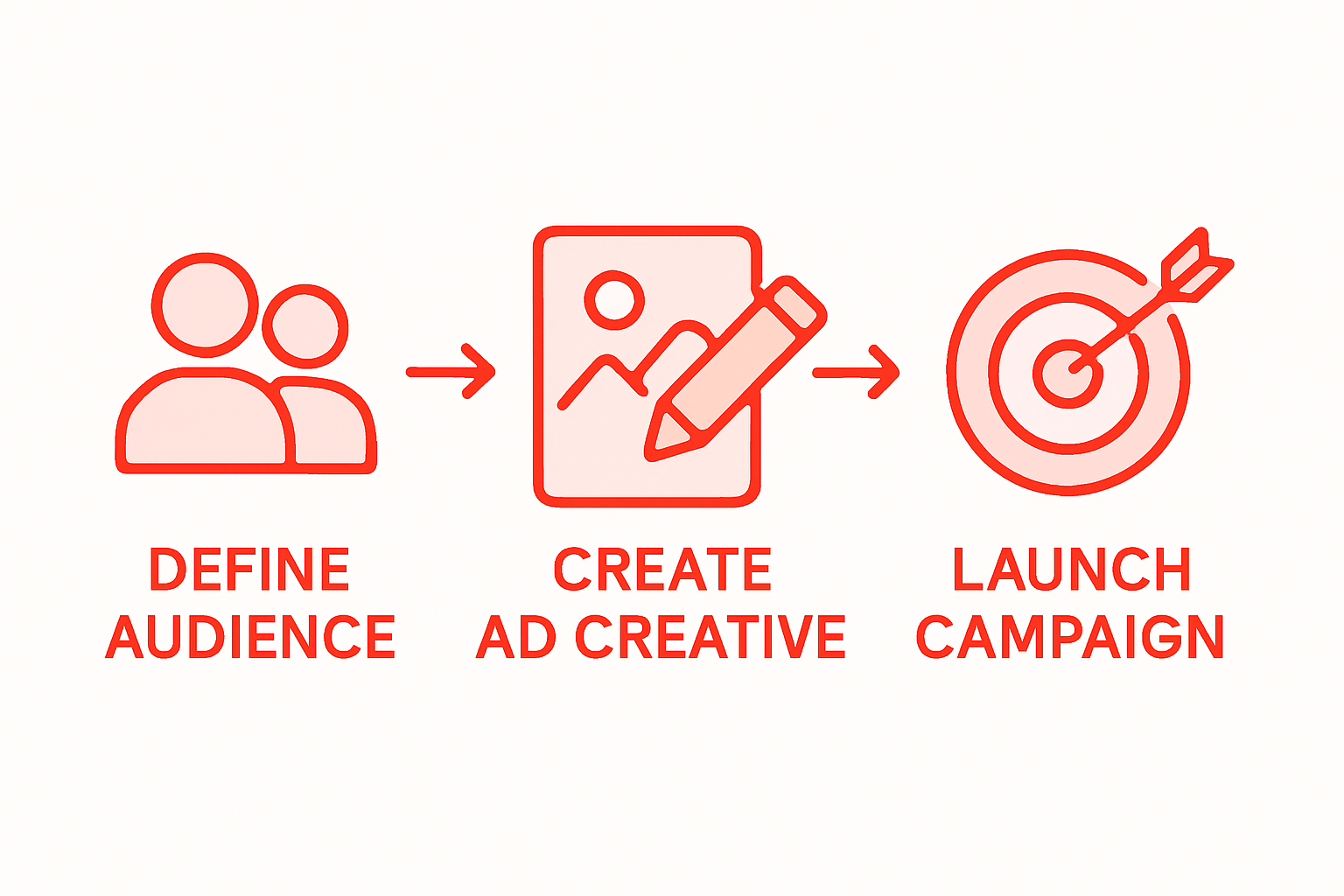
When designing your ad creative, focus on clear visual hierarchy and concise messaging. Your primary visual element should communicate your core value proposition within seconds. Use high-quality imagery that represents your brand professionally, incorporate clear call-to-action buttons, and ensure your text overlays are legible across different device sizes. Pro tip: A/B test multiple creative variations to understand what resonates most with your audience, allowing data to guide your refinement process.
Ready to take your advertising to the next level? Next, we will explore budget allocation and bidding strategies for maximising your return on investment.
Stage 4: Launch targeted campaigns across key platforms
The University of Westminster’s social media marketing course highlights the critical importance of platform specific campaign strategies for achieving distinct marketing objectives. Launching targeted social media advertising campaigns requires a nuanced approach that considers the unique characteristics of each platform and your specific business goals.
Begin by aligning your campaign objectives with platform strengths. Facebook and Instagram are ideal for visual brand storytelling and demographic targeting, while LinkedIn works best for B2B professional audiences. Twitter suits quick messaging and trending topics. The University of Manchester’s strategic recommendations suggest using strategic tagging and precise audience targeting to expand your campaign’s potential reach and engagement.
When setting up your campaigns, leverage each platform’s unique targeting capabilities. Use detailed audience segmentation including demographics, interests, behaviours, and lookalike audiences to ensure your ads reach the most relevant potential customers. Configure your campaign budget allocation carefully, starting with smaller test budgets to understand performance before scaling. Pro tip: Monitor your campaign metrics closely in the first week, being prepared to adjust targeting, creative elements, and budget distribution based on initial performance data.
Ready to maximise your advertising investment? Next, we will explore how to track and analyse your campaign performance for continuous improvement.
Stage 5: Monitor performance and optimise your adverts
The University of Westminster’s social media marketing course emphasises the critical importance of continuous campaign analysis and strategic optimization. Monitoring your social media advertising performance is not just about tracking numbers but understanding the story behind those metrics and making intelligent, data driven decisions.
The University of Manchester’s strategic recommendations suggest developing a comprehensive approach to tracking engagement metrics that go beyond surface level statistics. Focus on key performance indicators such as click through rates, conversion rates, cost per acquisition, and return on ad spend. Pay close attention to audience engagement metrics like likes, comments, shares, and time spent interacting with your content to gain deeper insights into your campaign effectiveness.
Implement a systematic approach to optimization by conducting regular A/B testing of your ad creatives, targeting parameters, and messaging. Start with small experimental variations and progressively refine your strategies based on empirical data. This might involve testing different image styles, headline variations, audience segments, or call to action phrases. Pro tip: Set up automatic performance reports and schedule weekly reviews to ensure you are consistently adapting your campaigns for maximum efficiency. By maintaining a disciplined, data informed approach, you will continuously improve your social media advertising performance.
Ready to take your advertising strategy to the next level? Let us explore advanced techniques for scaling your social media marketing efforts.
Stage 6: Measure results and adjust your strategy
The University of Westminster’s social media marketing course emphasises the critical importance of comprehensive campaign evaluation, understanding that measuring results goes far beyond simple numerical analysis. Effective strategy measurement requires a holistic approach that considers both organic and paid campaign performance to generate meaningful insights.
Develop a robust measurement framework that tracks key performance indicators across multiple dimensions. The University of Manchester’s strategic recommendations suggest creating a dynamic strategy that adapts to emerging trends and audience behaviours. Focus on metrics that directly impact your business objectives such as customer acquisition cost, lifetime value, engagement rates, and conversion percentages. Compare these metrics against your initial campaign goals to understand the genuine effectiveness of your social media advertising efforts.
Implement a continuous improvement cycle where data informs strategy refinement. This means regularly reviewing performance data, identifying trends, and making incremental adjustments to your targeting, creative approaches, and messaging. Pro tip: Create a monthly performance dashboard that provides a clear visual representation of your key metrics, allowing you to quickly spot opportunities for optimization. By maintaining a disciplined, data driven approach, you transform your social media advertising from a static campaign into a responsive, evolving marketing strategy.
Ready to unlock the full potential of your digital marketing efforts? Let us explore advanced techniques for scaling and automating your social media advertising performance.
Unlock the Full Potential of Your Social Media Advertising with Bamsh Digital Marketing
Navigating the complexities of social media advertising can feel overwhelming when aiming to define clear objectives, target the right audience, and craft compelling messages that drive real results. The challenge lies in turning detailed strategies into action that brings more leads, increases visibility, and generates predictable revenue without confusion or wasted budget. If you are ready to stop guessing and start growing with confidence Bamsh Digital Marketing is here to help.
Our team specialises in creating targeted, transparent social media advertising campaigns tailored for UK businesses. Whether you want to boost brand awareness or generate high-quality leads we work with you by combining expert knowledge and proven methods to deliver measurable impact. Discover how our services in Social Media Marketing Agency Bristol – Bamsh Digital Marketing can take your efforts further with clear reporting and honest strategy.
Take the first step to transform your social media advertising today by booking a free consultation at https://bamsh.co.uk/15-min/. Also explore our Special Offers – Bamsh Digital Marketing page for current promotions that can give your campaigns an extra boost. Don’t let uncertainty hold you back when your ideal customers are just a well-crafted advert away. Let Bamsh help you make every pound count and every campaign perform.
Frequently Asked Questions
What are the best advertising objectives for my social media campaigns?
To ensure success, clearly define your advertising objectives such as brand awareness, lead generation, or sales. Start by establishing specific, measurable goals that align directly with your overall business objectives.
How can I identify my target audience for social media advertising?
Identify your target audience by looking beyond basic demographics; consider interests, behaviours, and pain points. Create detailed customer personas that encapsulate motivations and digital habits to inform your ad content.
What should I include when setting up my social media advertising accounts?
When setting up your advertising accounts, use a professional email address, a recognisable business logo, and a clear bio that accurately communicates your value proposition. Ensure all profile details are complete to establish a credible online presence.
How can I optimise my social media ad creatives for better engagement?
To optimise your ad creatives, focus on high-quality visuals and messaging that directly addresses your audience’s needs. A/B test different designs and copy to determine which elements resonate the most, refining your approach based on the results.
What metrics should I monitor to evaluate the performance of my social media campaigns?
Monitor key performance indicators such as click-through rates, conversion rates, and cost per acquisition to evaluate campaign effectiveness. Regularly review engagement metrics to understand audience interaction and make informed adjustments to your strategy.
How can I adjust my advertising strategy based on performance results?
After measuring your campaign results, analyse the data to identify trends and areas for improvement. Implement a continuous improvement cycle by adjusting your targeting, creatives, and messaging based on performance insights to enhance future campaigns.