

Finding the right formula to make your Google Ads budget work harder can feel like a guessing game for many business owners in the South West. Clear, data-driven optimisation means every pound spent chases higher-quality leads and a stronger return on investment—not wasted clicks. By focusing on measurable results and structured testing, you turn your campaigns from a risk into a reliable generator of business growth. For those ready to move beyond trial and error, intelligent Google Ads optimisation offers practical answers.
Table of Contents
- What Google Ads Optimisation Means
- Types Of Optimisation For Google Ads
- Key Strategies For Improved Performance
- Common Mistakes And Wasted Spend Risks
- Comparing Optimisation To Other Approaches
Key Takeaways
| Point | Details |
|---|---|
| Importance of Optimisation | Systematic optimisation of Google Ads campaigns leads to improved performance and reduced costs for acquiring qualified leads. |
| Data-Driven Decisions | Utilising data from keyword performance and audience behaviour allows for targeted adjustments that maximise ROI. |
| Holistic Approach | Focus on the entire customer journey, from ad click to conversion, ensuring that landing pages align with ad promises. |
| Regular Audits | Conduct frequent audits of keywords and audience targeting to identify and eliminate wasted spend, enhancing campaign efficiency. |
What Google Ads Optimisation Means
Google Ads optimisation isn’t some mysterious black art. It’s the practical process of systematically improving how your campaigns perform by refining how you spend your budget, who you’re targeting, and what you’re bidding on. At its core, it means making deliberate changes to your ads, keywords, landing pages, and campaign settings so that every pound you invest works harder and generates better results. For small to medium-sized businesses in the South West, this translates directly into one thing: more qualified leads at a lower cost per acquisition.
The foundation of Google Ads optimisation rests on applying intelligent techniques to how your campaigns operate. Using mathematical and algorithmic foundations, Google Ads systems use methods like gradient descent and adaptive bidding strategies to automatically allocate your budget more efficiently across keywords and audiences. But here’s what matters to you: this means the platform learns from your campaign data and adjusts itself over time. If certain keywords consistently deliver better quality leads, the system can prioritise those. If specific audience segments convert at higher rates, your budget naturally gravitates towards them. This isn’t magic—it’s data-driven decision-making that removes guesswork from your spending.
Where optimisation really makes a difference is when you combine technical campaign adjustments with conversion performance. Conversion Rate Optimisation focuses on turning the traffic you’re already paying for into actual leads and sales. This means testing different landing pages, improving your ad copy, adjusting your call-to-action buttons, or refining your form fields. You might discover that removing an optional field from your contact form increases submissions by 23 percent. You might find that changing your headline from “Get a Quote” to “See Your Savings” boosts click-through rates considerably. These aren’t guesses—they’re tested improvements that directly impact your return on investment. The most overlooked element in Google Ads optimisation is that it’s not just about the ads themselves. It’s about the entire journey: from the moment someone searches for something related to your business, to clicking your ad, to landing on your page, to completing a form or making a call.
For your business, optimisation means answering hard questions. Are you attracting the right people or just anyone searching your industry keywords? Are your ads showing at times when your customers are actually searching? Are you bidding too aggressively on keywords that don’t convert well, or too conservatively on your best performers? Are people landing on a page that matches what your ad promised, or are they bouncing because the experience is disjointed? Addressing these questions systematically turns your Google Ads account from a budget drain into a consistent lead generation engine. It transforms paid search from an expense into an investment with measurable, predictable returns.
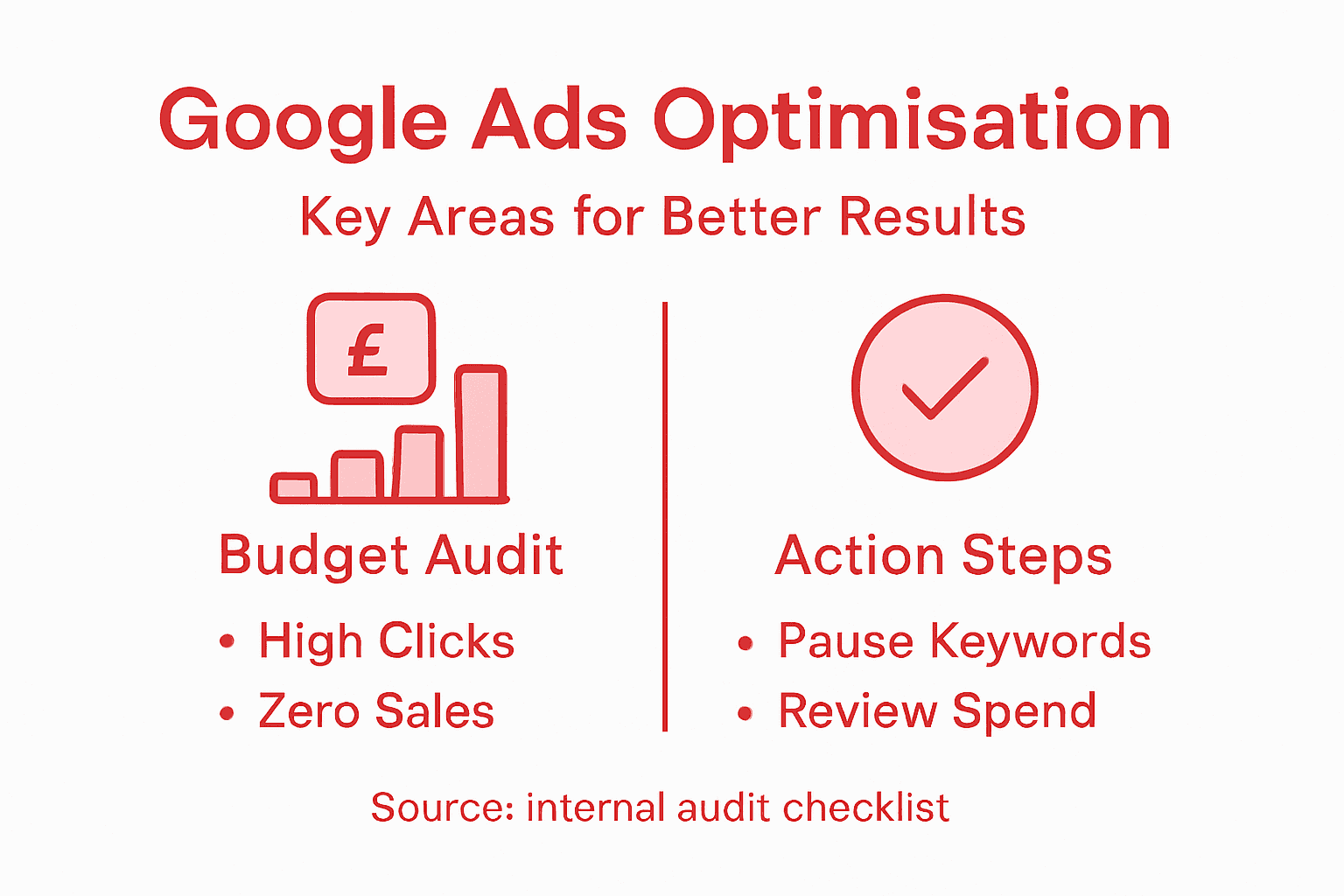
Pro tip: Start your optimisation work by auditing your account for wasted spend: find keywords with high clicks but zero conversions, and pause or lower bids on those immediately—this frees up budget to test new high-performing keywords without increasing your overall spend.
Types Of Optimisation For Google Ads
Google Ads optimisation isn’t a one-size-fits-all activity. Different aspects of your campaigns need different types of refinement, and understanding these distinct approaches helps you prioritise where to focus your effort first. Think of it like tuning an engine: you wouldn’t just adjust the fuel mixture and ignore the timing. Similarly, your ads need systematic improvements across multiple areas to deliver real results. The main types of optimisation break down into bid strategy, budget allocation, audience targeting, and creative testing, each playing a crucial role in how effectively your campaigns perform.
Bid optimisation focuses on how much you’re willing to pay for each click on your ads. Many businesses bid the same amount across all keywords, which is like paying the same price for premium petrol and regular unleaded. The smarter approach involves adjusting your bids based on performance data. If a particular keyword consistently generates high-quality leads, you might increase your bid to win more impressions for that term. Conversely, if another keyword attracts clicks but never converts, you lower or pause the bid entirely. You can also implement bid optimization strategies that use historical data to predict which clicks are likely to convert, allowing Google’s algorithms to adjust bids automatically in real-time. This removes the tedium of manual adjustment while ensuring your budget goes toward the most promising opportunities.

Budget allocation optimisation examines how you distribute your overall advertising spend across campaigns, ad groups, and keywords. Many small business owners split their budget equally, but that’s rarely the right answer. If one campaign is generating leads at £15 each whilst another costs £45 per lead, you should shift more budget to the better performer. This type of optimisation also considers seasonal patterns. If you’re a heating engineer, winter months warrant larger budgets, whilst summer might require minimal spend. You might also test increasing the budget to a high-performing campaign to see if you can capture additional market share before competitors do. The key principle is simple: money follows results.
Audience targeting optimisation involves refining who sees your ads based on their behaviour, interests, location, and demographics. You might discover that people aged 45 to 65 in the South West convert at double the rate of younger audiences, so you adjust your targeting accordingly. You could exclude certain locations where your service doesn’t operate, or add custom audiences of people who’ve visited your website but haven’t yet converted. Location targeting becomes particularly powerful for local service businesses: why show your ads to someone 50 miles away when they’ll never visit your physical location? This type of optimisation also encompasses device targeting. Perhaps your mobile visitors spend more time on your site but rarely convert, whilst desktop visitors complete forms at much higher rates. You’d adjust your mobile bid downwards and protect desktop traffic.
Creative testing rounds out the main optimisation types. This means testing different ad headlines, descriptions, images, and landing pages to find combinations that resonate with your audience. One ad might say “Get a Free Quote” whilst another says “See How Much You Could Save.” One might lead to a contact form, whilst another goes directly to a pricing page. The winning combination might surprise you. For example, you might assume that emphasising “Fast Installation” attracts your best customers, but testing reveals that “Family-Owned Since 2005” actually generates higher-quality leads because it builds trust.
A structured approach to testing these optimisations involves using multiphase optimisation across preparation, testing, and evaluation stages to systematically evaluate which components work best together rather than testing in isolation. This means you don’t just test one headline change and declare victory. Instead, you test multiple variations, measure results rigorously, and implement only the changes backed by data.
Here’s a summary of the main Google Ads optimisation types and their business benefits:
| Optimisation Type | What It Focuses On | Business Impact |
|---|---|---|
| Bid Strategy | Adjusting keyword bids | Higher quality leads, reduced cost |
| Budget Allocation | Distributing ad spend | More efficient investment |
| Audience Targeting | Refining ad viewer groups | Increased conversion rates |
| Creative Testing | Experimenting with ads | Improved click-through & trust |
Pro tip: Start by optimising the areas causing the biggest losses first: audit your keywords for any generating clicks without conversions, then tackle bid adjustments on your top performers before experimenting with audience refinements.
Key Strategies For Improved Performance
Improving your Google Ads performance isn’t about implementing one clever tactic and expecting dramatic results. Instead, it’s about combining several proven strategies that work together to steadily increase your return on investment. The businesses in the South West that see the best results from their Google Ads aren’t necessarily spending the most money. They’re the ones using a deliberate, methodical approach to refine every element of their campaigns. Let’s look at the key strategies that actually move the needle.
The first strategy involves establishing clear measurement systems before you start optimising anything. You can’t improve what you don’t measure. Setting up key performance indicators and continuous monitoring of user behaviour helps you understand exactly what’s working and what isn’t. This means going beyond vanity metrics like impressions or clicks. Instead, track metrics that matter to your business: cost per lead, lead quality, conversion rate by keyword, and ultimately return on ad spend. Many business owners focus on click volume when they should be focusing on cost per qualified lead. If you’re paying £2 per click but only converting 5 per cent of those clicks into actual customers, you’re wasting money on poor-quality traffic. Once you know your numbers, you can spot patterns. You might discover that keyword variations drive different quality leads, or that certain times of day generate better conversions. This data becomes your foundation for optimisation decisions.
The second key strategy is ruthless keyword management. Your keyword list determines who sees your ads. Too many businesses include keywords that are vaguely related to their business rather than directly aligned with what they actually sell. If you’re a plumbing company in Bristol, “emergency plumber Bristol” is a high-intent keyword worth bidding aggressively on. “Plumbing tips” or “how to fix a leaky tap” attract search volume but generates unqualified traffic from DIY enthusiasts. You need both positive keywords (what you want to show for) and negative keywords (what you explicitly don’t want to show for). Negative keywords are often overlooked, but they’re where significant cost savings hide. Exclude “free,” “cheap,” “DIY,” and other terms attracting the wrong audience. Review your search terms report monthly. Google shows you exactly what real people typed when your ads appeared. You’ll find surprising keyword combinations attracting clicks. Some become new positive keywords to bid on. Others should be added to your negative list immediately.
The third strategy addresses landing page quality and relevance. Your ad is just the beginning of the customer journey. When someone clicks your ad promising “£50 Boiler Servicing Special,” they need to land on a page about boiler servicing specials, not your homepage. Mismatched landing pages destroy conversion rates. Google also penalises ads sending traffic to irrelevant landing pages by charging you more per click. Creating dedicated landing pages for different ad campaigns takes effort, but it pays dividends. These pages should match the promise in your ad headline, clearly explain what the customer gets, remove unnecessary navigation that causes distraction, and include a straightforward call-to-action. A/B test different versions to find what resonates with your audience.
The fourth strategy involves competitive positioning and transparency. Ensuring transparency in how your ads appear and compete against others helps you stay competitive while building trust. This means understanding where your ads show, understanding how the auction system works, and regularly reviewing your competition. Use Google Ads’ auction insights to see which competitors are bidding on your keywords, how often their ads show, and how your click share compares. This context helps you decide whether to increase bids, improve ad quality, or focus elsewhere.
Finally, implement a regular review schedule. Weekly reviews catch obvious problems like underperforming keywords or depleted budgets. Monthly reviews look at broader patterns and identify optimisation opportunities. Quarterly reviews assess whether your overall strategy is working and whether you need to pivot. The businesses that succeed with Google Ads treat it as an ongoing process, not a set-it-and-forget-it investment.
Pro tip: Establish a monthly keyword audit routine: pull your search terms report, identify the top 10 performing keywords by conversion, then use that insight to expand your positive keyword list and aggressively add irrelevant searches to your negative keyword list.
Common Mistakes And Wasted Spend Risks
Every pound you waste on Google Ads is a pound you can’t invest in something that actually works. Yet most small business owners are throwing money away without realising it. They’re making predictable mistakes that drain budgets faster than a leaky tap drains water. Understanding these pitfalls is genuinely your best defence against wasted spend. The good news? Once you recognise these patterns, they’re relatively easy to fix.
The first major mistake is running ads without clear messaging or honest communication. Many businesses create ads that sound impressive but fail to deliver on the promise. Your ad headline might say “Free Consultation,” but your landing page asks for a credit card. Your ad claims “Same-Day Installation” but your fine print reveals you only offer this in certain postcodes. This disconnect destroys trust and burns cash on clicks that never convert. Beyond the conversion problem, unclear fee disclosures and misleading claims can create serious compliance issues that expose your business to regulatory scrutiny and reputational damage. Your ads must say exactly what you deliver. If you offer free quotes, say that. If you charge for consultations, be upfront. If you serve only certain areas, state that clearly. The businesses with the best conversion rates aren’t the flashiest advertisers. They’re the honest ones.
The second mistake involves poor audience targeting. Many business owners set up campaigns and let Google show their ads to everyone remotely interested in their industry. If you’re a luxury kitchen installer in Exeter, why would you pay to show ads to someone searching from Cornwall or London? Location targeting exists for a reason. Similarly, excluding the wrong people wastes money. If you sell luxury products, why show ads to people explicitly searching for “cheapest” or “discount”? Demographic targeting matters too. A financial adviser targeting millennials with penny-pinching parents might find better results focusing on established professionals aged 40 to 60. Many businesses also fail to implement negative keywords effectively. You’ll spend money on clicks for searches containing words like “free,” “DIY,” “job posting,” “course,” or competitor names, depending on your business. These searches don’t convert for you, yet they consume your budget every single day.
The third mistake is ignoring conversion tracking entirely. You can’t know if your ads work if you don’t measure what actually matters. Some business owners track clicks and stop there. Others track leads but don’t follow up to see which leads turned into paying customers. This blindness leads to optimisation decisions based on incomplete information. You might kill a keyword that looks bad based on click volume but actually generates your highest-quality customers. Conversely, you might protect a keyword that attracts cheap clicks but never converts. Without proper conversion tracking, you’re flying blind.
The fourth critical mistake relates to transparency and pricing clarity in your messaging. Misleading pricing practices and a lack of transparency about what customers actually pay destroy both conversion rates and brand trust. If your ad promises a price but hidden fees appear later, you’ll lose customers and generate angry reviews. Even worse, you’ll attract the wrong leads: people who feel deceived and have no intention of becoming good customers. Clear, honest pricing in your ads and landing pages filters out time-wasters and attracts genuinely interested prospects willing to pay your actual rates.
The fifth mistake is neglecting bid management and budget allocation. Some businesses bid the same amount on every keyword, spreading budgets thinly across underperformers. Others set a daily budget and let it run out by mid-afternoon, missing evening searches. Still others fail to adjust bids seasonally. A heating engineer spending equally in summer and winter wastes significant money when winter demand is five times higher.
Finally, many businesses launch campaigns and never revisit them. They expect ads to work on day one and become frustrated when results don’t appear instantly. Google Ads requires ongoing refinement. Accounts that improve month after month do so because someone is actively optimising them.
Pro tip: Audit your current campaigns for the “big three” money drains: non-converting keywords consuming significant budget, location settings showing your ads outside your service area, and missing conversion tracking that prevents you from knowing which clicks actually matter.
Comparing Optimisation To Other Approaches
When it comes to growing your business through digital advertising, you have choices. You could optimise your existing Google Ads campaigns. You could try organic search engine optimisation. You could experiment with social media advertising. You could even hire a traditional marketing agency and hope they understand your business. Each approach has merit, but they’re fundamentally different in cost, timeline, and predictability. Understanding how Google Ads optimisation compares to other marketing approaches helps you make smarter investment decisions.
Optimisation of your Google Ads campaigns differs significantly from launching ads without any systematic approach. The difference is stark. An un-optimised account is like driving a car with the handbrake on: you’re spending fuel but making slow progress. You’re paying for clicks from people who don’t want what you offer. Your landing pages don’t match your ads. Your bids are randomly set. Your budget depletes on low-quality traffic. An optimised account, by contrast, uses structured evidence-based approaches that test components systematically and discard ineffective ones, ensuring every pound works harder. This isn’t guesswork. It’s methodical refinement based on data.
Comparing Google Ads optimisation to organic search engine optimisation reveals important distinctions. Organic SEO involves building website authority, creating content that ranks in search results, and earning traffic without paying for each click. It’s powerful but slow. Most businesses take 6 to 12 months to see meaningful organic traffic growth. You need quality content, technical excellence, and patience. Google Ads optimisation, by contrast, delivers results within weeks. You can have qualified traffic arriving at your website within 48 hours of launching a campaign. The trade-off? Organic traffic is free once it arrives, whilst paid traffic costs money indefinitely. For immediate lead generation, Google Ads wins. For long-term sustainable traffic, organic SEO complements paid search. Smart businesses combine both approaches: use Google Ads to generate leads whilst building organic authority over time.
Social media advertising represents another alternative. Platforms like Facebook and Instagram excel at reaching people based on interests and demographics, making them powerful for awareness and brand-building. They work best for consumer-focused businesses with visually appealing products. However, social advertising typically performs worse than Google Ads for commercial intent. Someone searching “plumber near me” on Google is actively looking to buy your service. Someone scrolling Instagram isn’t necessarily looking for anything specific. Social ads interrupt the user experience and require more creative persuasion. Google Ads tap into existing demand. If your business relies on people actively searching for what you offer right now, Google Ads outperform social media on conversion metrics.
Traditional marketing agencies often take a different approach to Google Ads. Some treat it as a set-and-forget service, launching campaigns and reviewing them quarterly. Others make optimisation recommendations without explaining the reasoning. This approach lacks transparency and often wastes client money through inefficient bid strategies and poorly targeted campaigns. Optimisation-focused management, by contrast, treats Google Ads as a dynamic system requiring continuous improvement and transparent reporting. You know which keywords work, which waste money, and why changes are being made. Bamsh’s approach differs fundamentally from old-school PPC management: we explain what we’re doing, why we’re doing it, and how it benefits your bottom line.
Different approaches also vary in cost structure. Organic SEO requires upfront investment in content creation and technical improvements with no guaranteed ranking timeline. Social media advertising requires creative production and often has a higher cost per acquisition for commercial intent. Google Ads optimisation requires monthly management fees plus ad spend, but delivers immediate, measurable results. For small to medium-sized businesses needing predictable lead flow, Google Ads optimisation offers the best balance of speed, cost-effectiveness, and control.
This table contrasts paid Google Ads optimisation with other digital marketing approaches:
| Approach | Speed of Results | Cost Structure | Predictability |
|---|---|---|---|
| Google Ads Optimisation | Immediate | Ongoing ad spend + fee | Highly measurable |
| Organic SEO | Slow (months) | Upfront time/cost | Unpredictable rankings |
| Social Media Ads | Moderate | Creative + ad spend | Varies by audience/desire |
| Traditional Agencies | Variable | Retainer + % of spend | Often less transparent |
The regulatory environment around digital advertising also differs from optimisation approaches. Governments worldwide are implementing rules about fair competition and transparency in how digital platforms operate, aiming to prevent monopolistic behaviour and protect consumers. These regulatory measures address structural market issues. Optimisation, meanwhile, addresses tactical performance within the current system. Both matter. Good optimisation practices align with evolving regulatory standards by maintaining transparency, avoiding misleading claims, and treating customers fairly.
Ultimately, the businesses winning market share in the South West aren’t choosing between optimisation and other approaches. They’re combining them strategically. They run optimised Google Ads campaigns for immediate lead generation. They invest in organic SEO for long-term visibility. They use social advertising for brand awareness. They implement automation to nurture leads. This integrated approach ensures consistent, predictable growth.
Pro tip: Start with Google Ads optimisation if you need qualified leads within 30 days, but simultaneously begin organic SEO work that pays dividends over the next 12 months—this dual strategy provides immediate cash flow whilst building long-term assets.
Unlock Better Returns with Expert Google Ads Optimisation
The article highlights a crucial challenge many businesses face: stretching every penny of their Google Ads budget effectively to attract the right customers and generate high-quality leads. If you’ve ever felt frustrated by wasted spend, unclear audience targeting, or disjointed customer journeys, you are not alone. Bamsh Digital Marketing specialises in transforming this complexity into clarity with transparent, data-driven Google PPC management that aligns perfectly with your business goals.
With a focus on bid strategy, audience refinement, and continuous creative testing, your campaigns will deliver better-quality leads at a lower cost. Our team, led by industry experts, will explain every step so you always know where your investment is going and how it benefits your bottom line. Ready to stop guesswork and start seeing consistent, measurable results? Discover how our award-winning approach makes optimisation straightforward and effective by visiting our Bamsh category page and taking advantage of fresh insights on our Special Offers as you begin your journey.
Don’t let your competitors win more clicks and customers because of inefficiencies in your ads. Take a confident step today. Book a no-obligation 15-minute strategy call with us at https://bamsh.co.uk/15-min/ and turn your Google Ads from a cost centre into a powerful growth engine.
Frequently Asked Questions
What does Google Ads optimisation involve?
Google Ads optimisation involves making systematic improvements to your campaigns by refining budget spending, targeting the right audience, and adjusting bids to enhance ad performance and generate better leads.
How can I improve my ad click-through rate?
Improving your ad click-through rate can be achieved by testing different ad headlines, descriptions, and calls to action. A/B testing various creative elements helps identify which combinations resonate best with your audience.
Why is keyword management important in Google Ads?
Keyword management is crucial because it determines who sees your ads. Using relevant keywords, along with effective negative keywords to filter out unwanted traffic, ensures you attract qualified leads who are genuinely interested in your services.
What are the benefits of using a structured optimisation approach?
A structured optimisation approach helps systematically test, measure, and refine each component of your campaigns. This method maximises your advertising budget, leads to higher conversion rates, and ensures you make data-driven decisions for better overall performance.