
TL;DR:
- Effective audience targeting ensures marketing efforts reach the most relevant prospects, boosting ROI.
- Using layered segmentation methods like demographic, behavioural, and intent-based data improves precision.
- Ad platforms require sufficiently large audiences; small segments can hinder optimization and results.
Most UK business owners assume that reaching more people means getting more customers. It sounds logical. But it is one of the most expensive misconceptions in marketing. The truth is, broad advertising without precise audience targeting wastes budget on people who will never buy from you. Smart targeting means your message reaches the right person, at the right moment, with the right intent. In this article, we will define what audience targeting actually means, break down the methods that work, flag the pitfalls to avoid, and show you exactly how to apply it for measurable ROI improvement in your UK business.
Table of Contents
- Defining audience targeting in marketing
- How audience targeting methods work
- Common pitfalls and privacy challenges
- Leveraging audience targeting for better ROI in the UK
- Why most businesses get audience targeting wrong, and how to fix it
- Enhance your audience targeting with expert support
- Frequently asked questions
Key Takeaways
| Point | Details |
|---|---|
| Segmentation is essential | Dividing your audience into clear groups boosts marketing performance and ROI. |
| Privacy shifts matter | UK privacy laws prioritise contextual and first-party targeting over cookies. |
| Avoid broad targeting | Focusing on intent and value delivers more sales than chasing large audiences. |
| AI & automation require testing | Smart targeting with real-time tools works best when regularly reviewed and improved. |
Defining audience targeting in marketing
Audience targeting is the practice of selecting and focusing your marketing efforts on specific groups of people who are most likely to become your customers. It is not guesswork. It is a data-backed discipline that sits at the heart of every high-performing digital marketing strategy.
Rather than broadcasting your message to everyone, audience targeting narrows your focus so that every pound you spend works harder. Think of it like fishing. You could drag a net across the entire ocean and hope for the best. Or you could drop a line in exactly the right spot, at the right time, with the right bait.
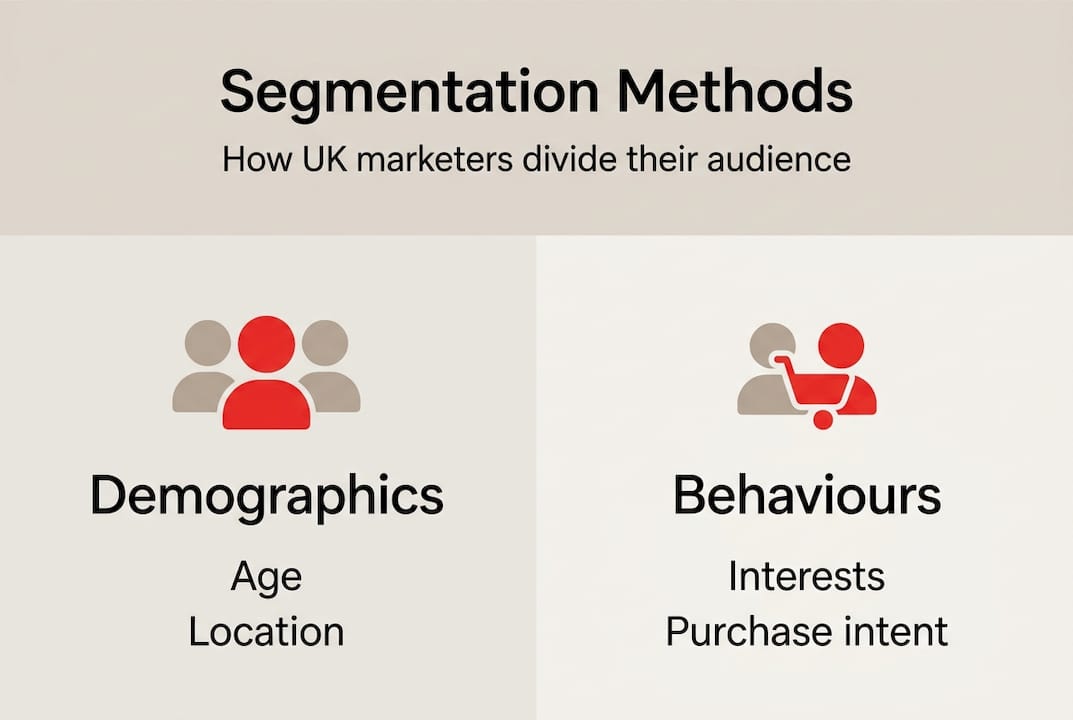
There are several core segmentation methods available to you, and each one reveals a different facet of who your ideal customer actually is. Core methodologies include demographic, behavioural, psychographic, geographic, intent-based, contextual, and relationship-based segmentation, giving you multiple lenses through which to understand your audience.
Here is a quick breakdown of what each method covers:
- Demographic segmentation: Age, gender, income, occupation, education level
- Behavioural segmentation: Purchase history, browsing patterns, product usage frequency
- Psychographic segmentation: Interests, values, lifestyle choices, attitudes
- Geographic segmentation: Country, region, city, postcode, local area
- Intent-based segmentation: Search behaviour showing readiness to buy
- Contextual segmentation: Matching ads to relevant content rather than tracking users
- Relationship-based segmentation: Existing customers, lapsed buyers, loyal advocates
Used together, these methods give you a complete picture of your market. A demographic segment tells you who someone is. A behavioural segment tells you what they do. A psychographic segment tells you why they do it. Combining all three is where the real power lies.
Pro Tip: Do not rely on just one segmentation method. Layering two or three together, such as geographic plus intent-based, dramatically improves the relevance of your targeting and reduces wasted spend.
How audience targeting methods work
Understanding the theory is one thing. Putting it into practice is where many businesses stumble. Let us look at how modern targeting actually functions and how it differs from the old-school approach.
The shift from classic to modern segmentation is significant. Traditional demographic targeting is static. You pick an age range and a gender and you run an ad. Modern targeting is dynamic, pulling in real-time signals such as browsing behaviour, recent searches, and engagement patterns. Move from static demographics to dynamic audiences; use exclusions, sequence campaigns, and test value-based segments to stay ahead of the competition.

| Approach | Data type | Flexibility | Best use case |
|---|---|---|---|
| Classic demographic | Age, gender, income | Low | Awareness campaigns |
| Behavioural | Purchase history, clicks | Medium | Conversion campaigns |
| Intent-based | Search queries, signals | High | Bottom-of-funnel ads |
| AI-powered dynamic | Real-time, predictive | Very high | Scaling campaigns |
Two tactics that are often overlooked but enormously effective are exclusions and sequencing. Exclusions let you remove audiences who have already converted, who are not in your service area, or who have shown no relevant intent. This stops your budget leaking on people who will never buy. Sequencing controls the order in which people see your messages, moving them from awareness through to decision in a logical flow.
Here is a practical process you can apply right now:
- Identify your existing best customers and find common traits across demographics, behaviour, and location.
- Build lookalike audiences based on those traits using your CRM data or platform tools.
- Apply exclusions immediately, removing past converters and irrelevant geographic areas.
- Layer in intent signals from search data to prioritise people actively looking for your solution.
- Use retargeting strategies to re-engage people who visited your site but did not convert.
AI-powered targeting tools on platforms like Google and Meta now adapt in real time, shifting budget toward the audiences most likely to convert based on live performance data. This is powerful, but it still needs human oversight. Use our social ads targeting guide to understand how to set up these campaigns correctly from the start.
Pro Tip: Always create a separate audience for your highest-value customers and use it as a benchmark. Compare new segments against this group to measure quality, not just quantity.
Common pitfalls and privacy challenges
Even experienced marketers make costly targeting mistakes. Knowing what to avoid is just as valuable as knowing what to do.
The most common error is over-relying on demographics alone. Age and gender tell you very little about intent. A 45-year-old man in Birmingham could be your ideal customer or completely irrelevant, depending on his behaviour and interests. Demographics set the scene, but they rarely close the sale on their own.
Here are the most frequent pitfalls UK businesses fall into:
- Targeting too broadly in pursuit of reach, leading to low conversion rates and wasted budget
- Ignoring exclusions, which means your ads reach people who have already bought or are clearly not interested
- Skipping performance reviews, allowing underperforming segments to drain budget for weeks
- Assuming one segment fits all products, when different offerings often suit different audiences entirely
Then there is the privacy challenge, which is reshaping targeting for every business in the UK. Privacy changes reduce cookie tracking, shifting to contextual targeting and first-party data, and this trend is accelerating.
“The death of the third-party cookie is not the end of targeting. It is the beginning of smarter targeting. Businesses that build first-party data assets now will hold a serious competitive advantage.”
GDPR and UK data regulations limit how platforms can track users across the web. This means your customer email list, your website visitor data, and your CRM are now more valuable than ever. They are your first-party data assets, and no regulation can take them away.
The small audience trap is another real risk. If your target segment contains fewer than roughly 1,000 users, most ad platforms simply cannot optimise properly. The algorithm does not have enough data to learn. You end up burning budget without results. This is especially relevant for highly niche B2B businesses. Explore effective retargeting approaches to build audience scale before tightening your segments too far.
Leveraging audience targeting for better ROI in the UK
Now for the part that matters most: putting this into action and seeing real results.
Here is a step-by-step framework designed for UK SMEs:
- Define your audience clearly. Write a one-paragraph profile of your ideal customer, including their job, location, pain points, and what triggers their purchase decision.
- Organise your segments. Split your audience into at least three groups: cold prospects, warm leads, and existing customers. Each needs a different message.
- Apply exclusions from day one. Remove competitors, existing customers from acquisition campaigns, and geographic areas outside your service zone.
- Monitor performance weekly. Check which segments are converting and which are draining budget. Make adjustments quickly.
- Feed your automation. Connect your targeting data to your CRM so leads are followed up automatically and nothing falls through the cracks.
When it comes to platforms, Google Ads remains one of the most powerful tools for intent-based targeting. Optimised targeting in Google Ads can widen reach, but needs conversion data or risks budget waste, so always feed your campaigns with enough conversion history before switching on automated targeting. Check out our Google Ads tips for practical guidance on getting this right.
| Targeting method | Platform | Typical ROI uplift | Best for |
|---|---|---|---|
| Intent-based search | Google Ads | High | Ready-to-buy prospects |
| Lookalike audiences | Meta Ads | Medium to high | Scaling new customer acquisition |
| Retargeting | Google, Meta | Very high | Converting warm leads |
| Contextual | Display networks | Medium | Brand awareness |
A practical example: one UK SME in the home services sector switched from broad demographic targeting to intent-based search combined with postcode-level geographic targeting. Within three months, their cost per lead dropped by 40% and their conversion rate doubled. They did not spend more. They spent smarter. If you are exploring which ad formats suit your goals, understanding the types of Google Ads available will help you choose the right approach from the outset.
Why most businesses get audience targeting wrong, and how to fix it
Here is something we see repeatedly working with UK SMEs: business owners chase big audiences because big numbers feel reassuring. Ten thousand impressions sounds impressive. But impressions do not pay your invoices. Conversions do.
The businesses that outperform their competitors are not always spending more. They are narrowcasting, reaching fewer people with far more relevance. A tightly defined audience of 2,000 motivated buyers will almost always outperform a broad audience of 50,000 uninterested scrollers.
AI tools and automated targeting are genuinely useful, but they need proper setup and regular review. Handing over targeting decisions to an algorithm without checking the results weekly is like leaving a tap running and wondering why the water bill is high.
Our honest advice: review your segmentation every single month. Look at which customer groups deliver the highest lifetime value, not just the cheapest clicks. Understanding the role of ad targeting in your overall strategy will help you prioritise where to focus. Iterate, test, and trust the data over your gut instinct.
Enhance your audience targeting with expert support
If you are ready to stop guessing and start targeting with precision, Bamsh Digital Marketing can help. We work with UK SMEs every day, building campaigns that put your message in front of the right people at exactly the right moment. Our PPC management for UK businesses is built around your specific goals, not generic templates. Whether you need a sharper Google Ads agency approach or want to explore fully targeted PPC ads that convert, we are here to make it happen. Book a free consultation today and let us show you what smarter targeting looks like in practice.
Frequently asked questions
What are the main types of audience targeting?
Audience targeting uses demographic, behavioural, psychographic, geographic, intent-based, contextual, and relationship-based segmentation methods to define and reach the most relevant customer groups for your business.
How does privacy regulation impact audience targeting?
Privacy rules limit cookie-based tracking, requiring businesses to shift toward contextual signals and first-party data such as customer email lists and CRM records.
Why is audience targeting important for UK SMEs?
Targeting the right audience increases conversions, reduces wasted ad spend, and delivers stronger ROI. Moving to dynamic, value-based segments helps SMEs compete effectively without needing larger budgets than their rivals.
Can small audiences limit targeting effectiveness?
Yes. Small audiences below roughly 1,000 users prevent ad platforms from optimising properly, which can lead to poor performance and wasted budget without sufficient conversion data to guide the algorithm.