
TL;DR:
- Business automation uses technology to perform repetitive tasks, boosting efficiency and shortening workflows. Most SMEs see significant time savings, with an average return on investment of 5.8 times within 14 months. Automation supports staff by reducing errors and handling high-volume processes, rather than replacing employees.
Business automation is the use of technology to perform repetitive, rule-based tasks, replacing manual effort to improve efficiency and reduce costs across your operations. UK SMEs that automate administrative processes can reclaim 122 to 360 hours of staff time annually per employee. That is the equivalent of up to nine working weeks returned to your business every year. The advantages of automating business processes extend well beyond time savings: they include measurable cost reductions, fewer errors, and stronger customer experiences. This guide covers the practical, financial, and operational benefits of business automation, grounded in 2026 research, so you can make an informed decision for your business.
What are the benefits of business automation for SME efficiency?
Automation frees your team from low-value, repetitive work so they can focus on tasks that actually grow your business. Processes like invoice processing, appointment scheduling, and lead qualification are prime candidates. They are high volume, rule-based, and time-consuming. When you automate them, the time savings compound quickly across your workforce.

The productivity gains are real and measurable. Businesses that automate report 20–30% productivity improvements in the processes they target. That means your team produces more output in the same hours, without burning out or adding headcount. SMEs that are further along in their use of digital tools see +71 percentage points net improvement in productivity once automation reaches maturity. The gap between early adopters and those still doing everything manually is widening fast.
Speed and accuracy also improve together. A manual invoicing process that takes 20 minutes per invoice, with a 5% error rate, becomes a two-minute automated task with near-zero errors. That is not a marginal gain. It is a structural change in how your business operates.
✅ What’s in it for you?
- Hours returned to your team for client-facing and revenue-generating work
- Faster turnaround on invoicing, scheduling, and customer communications
- Fewer errors caused by manual data entry or missed steps
- Consistent process execution every time, regardless of who is on shift
- Reduced onboarding time when new staff join, because the process is already defined
Pro Tip: Start with the processes your team complains about most. High volume, high frustration, and high repeatability are the three signals that a task is ready to automate. Invoicing and lead qualification are almost always the best first targets.
What is the ROI of business automation for small businesses?
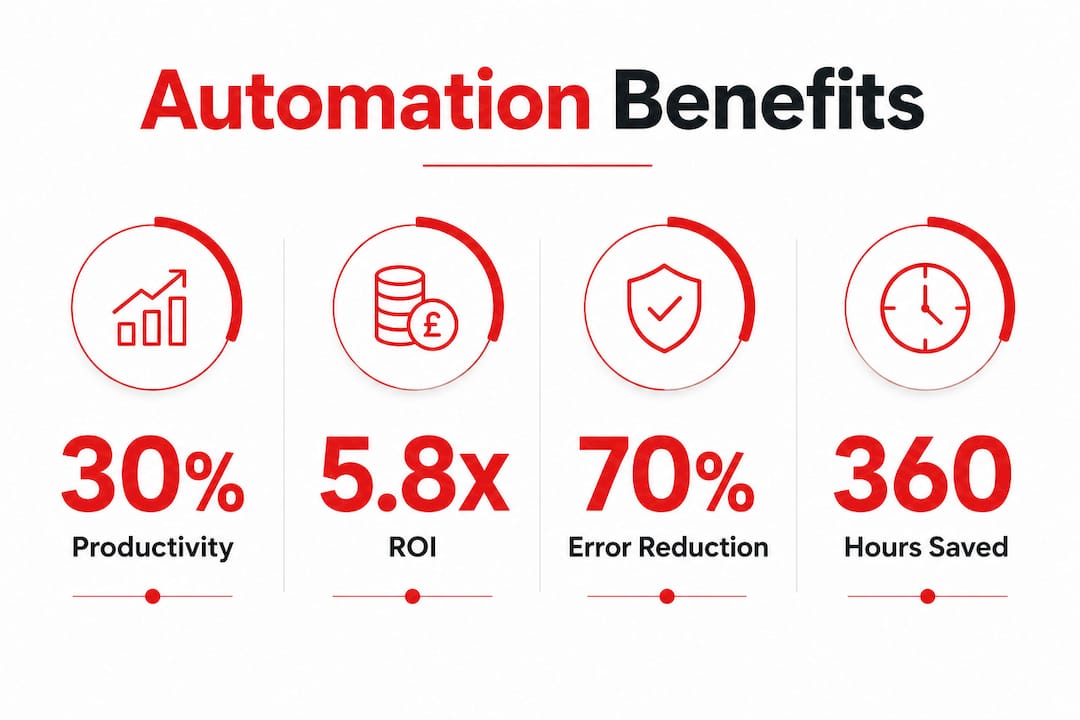
The financial case for automation is strong. Well-scoped automation projects typically achieve a 5.8x return on investment within 14 months. Payback periods often fall between three and six months. For businesses with high-volume, repetitive processes, returns can reach 10x. Those are not outlier numbers. They reflect what happens when you remove labour costs from tasks that do not require human judgement.
The cost savings come from two sources. First, you reduce the hours your team spends on manual tasks. Second, you reduce the cost of errors. A single missed invoice, a duplicated payment, or a compliance failure can cost far more than the automation system itself. Typical annual savings per automated process range from £15,000 to £50,000, depending on volume and complexity.
| Automation area | Typical time saved | Estimated annual saving |
|---|---|---|
| Invoice processing | 15–20 mins per invoice | £15,000–£30,000 |
| Appointment scheduling | 5–10 mins per booking | £10,000–£20,000 |
| Lead qualification | 8–12 hours per week | £20,000–£50,000 |
| Customer follow-up | 3–5 hours per week | £10,000–£25,000 |
Scale effects make automation increasingly valuable over time. As your business grows, the savings grow with it. You do not need to hire additional admin staff to handle increased volume. The system absorbs the extra load.
Pro Tip: Do not over-engineer your first automation project. A simple, well-defined process that runs reliably delivers more value than a complex system that breaks under edge cases. Set a clear baseline metric before you start, such as time per task or error rate, so you can measure the actual return.
What operational and quality improvements does automation deliver?
Automation reduces manual errors by 70–90%, which has a direct impact on compliance, customer satisfaction, and your team’s confidence in the data they work with. When errors drop, trust in your systems rises. That matters enormously in regulated industries where audit trails and accurate records are non-negotiable.
Compliance improves because automated systems apply rules consistently. They do not have off days. They do not skip a step because they are busy. Standards like ISO 9001 require documented, repeatable processes. Automation makes that straightforward to demonstrate because every action is logged automatically.
Customer experience also improves in ways that directly affect your revenue. Automated appointment reminders reduce no-shows by up to 80%. Automated payment reminders cut late payments by up to 60%, which accelerates your cash conversion cycle. Automated lead routing lifts conversion rates by 25–40% by getting the right enquiry to the right person within seconds rather than hours.
✅ Quality improvements you can expect:
- Fewer data entry errors across invoicing, CRM records, and customer communications
- Built-in audit trails that support compliance with HMRC, ISO 9001, and GDPR requirements
- Faster response times for customer enquiries through automated customer service workflows
- Consistent follow-up sequences that do not depend on individual staff memory
- Reliable reporting because the data feeding your dashboards is accurate
One important caveat: automation amplifies the process you give it. A poorly designed workflow produces errors faster and at greater scale when automated. Map and standardise your manual process first. Fix the friction points before you automate them.
How do you successfully implement business automation in an SME?
The most common reason automation projects fail is not the technology. Most failures stem from poorly defined manual processes that were automated before they were understood. The technology then amplifies the confusion rather than removing it. Getting the process right before you automate it is the single most important step.
A practical implementation approach follows this sequence:
- Map the current process. Write down every step, every decision point, and every exception. If you cannot describe the process clearly on paper, you are not ready to automate it.
- Identify the highest-impact starting point. Prioritise high-volume, repeatable tasks with measurable costs. Invoicing, scheduling, and lead handling are the most common quick wins for UK SMEs.
- Standardise before you automate. Remove unnecessary steps, clarify decision rules, and agree on the correct output. Automation should codify your best practice, not your current habit.
- Involve your team early. Staff who understand why the change is happening adopt it faster. Resistance usually comes from fear of the unknown, not the technology itself.
- Roll out incrementally. Start with one process, measure the results, and then expand. Trying to automate everything at once creates risk and makes it harder to identify what is working.
- Build in maintenance from day one. APIs change, business rules evolve, and data formats shift. Ongoing maintenance prevents your automation from accumulating technical debt that quietly undermines the gains you made.
Track three metrics from the start: time saved per task, error rate before and after, and cost per process. These give you the evidence to justify further investment and to spot problems early.
What are the broader competitive advantages of automating workflows?
The impact of business automation extends beyond individual tasks. It changes the shape of your business. You can grow revenue without growing headcount at the same rate. You can handle more customers, more orders, and more enquiries without the operational strain that normally accompanies growth.
The British Chambers of Commerce reported in march 2026 that 95% of AI-adopting SMEs saw no workforce reduction, with 86% noting unchanged job roles. Automation supports your people rather than replacing them. That finding matters because fear of job losses is the most common reason SME owners hesitate to automate. The evidence says those fears are largely unfounded.
✅ Broader competitive advantages:
- Scale operations without a proportional increase in staff costs
- Respond to market changes faster because your processes are already documented and consistent
- Attract better talent by removing the dull, repetitive work that drives good people out
- Build organisational resilience because your processes do not depend on one person’s knowledge
- Unlock hidden productivity by standardising internal workflows across the business
Sector-specific gains are also significant. Manufacturing businesses use automation to manage stock levels and production scheduling. Professional services firms automate client onboarding and document generation. Retail businesses automate order processing and customer communications. The principle is the same across all sectors: remove the repetition, and your people do better work.
Key takeaways
Business automation delivers its greatest value when you automate well-defined, high-volume processes and maintain those systems as your business evolves.
| Point | Details |
|---|---|
| Time savings are substantial | UK SMEs can reclaim up to 360 hours of admin time per employee annually through automation. |
| ROI is fast and measurable | Well-scoped projects typically return 5.8x within 14 months, with payback in 3–6 months. |
| Quality improves significantly | Automation reduces manual errors by 70–90%, improving compliance and customer satisfaction. |
| Process clarity comes first | Map and standardise manual workflows before automating to avoid amplifying existing problems. |
| Jobs are supported, not cut | 95% of AI-adopting SMEs reported no workforce reduction, according to the British Chambers of Commerce. |
Why I think most SMEs are approaching automation back to front
I have worked with dozens of small business owners who came to me excited about a specific automation tool they had seen advertised. They wanted to implement it immediately. The problem was that they had not yet decided what problem they were solving.
Automation is not a product you buy. It is an outcome you design. The businesses I have seen get the best results from it spent time getting their processes clear first. They knew exactly what happened at each step, who was responsible, and what a good outcome looked like. The technology was almost secondary.
The other misconception I encounter regularly is that automation is about cutting staff. The British Chambers of Commerce data backs up what I see in practice: most businesses use automation to take the grind away from their people, not to remove them. Your best employees do not want to spend their days copying data between spreadsheets. Give them better work to do, and they perform better and stay longer.
My honest advice: pick one process that costs you real time and real money. Map it. Fix it. Then automate it. Measure the result. Then do it again. That incremental approach builds confidence, delivers quick wins, and avoids the expensive mistakes that come from trying to automate everything at once. Automation is a tool that amplifies what you already do well. Make sure what you are amplifying is worth amplifying.
— Martyn
How Bamsh helps UK SMEs put automation to work
If you are ready to move beyond theory and put automation to work in your business, Bamsh can help. We work with UK SMEs to build automated lead nurturing pipelines, CRM systems, and AI-powered customer service tools that generate results from day one. Our AI Lead Engine brings together automation, SEO, paid advertising, and CRM into a single system that captures and converts leads consistently. Most clients are live within a week. There are no long-term contracts, and you always know exactly what your investment is delivering. If you want a clear picture of what automation could do for your specific business, get in touch with the Bamsh team for a straightforward conversation.
FAQ
What is business automation?
Business automation is the use of technology to perform repetitive, rule-based tasks without manual effort. Common examples include invoice processing, appointment scheduling, and automated customer follow-up.
How much time can automation save a small business?
UK SMEs can reclaim 122 to 360 hours of administrative time per employee annually by automating repetitive tasks. That is equivalent to 3–9 working weeks returned to your business each year.
What ROI can I expect from business automation?
Well-scoped automation projects typically deliver a 5.8x return on investment within 14 months, with payback periods of 3–6 months for most SMEs.
Will automation replace my staff?
The evidence says no. The British Chambers of Commerce found that 95% of AI-adopting SMEs reported no workforce reduction, with 86% noting their job roles remained unchanged.
Where should I start with business automation?
Start with high-volume, repeatable tasks that have a measurable cost, such as invoicing, lead qualification, or appointment scheduling. Map the process clearly before you automate it.