

Most british businesses underestimate just how much a thoughtful strategy drives real marketing results. Setting clear business goals and truly knowing your audience form the backbone of content marketing success. In fact, companies that document their content strategies are over 300 percent more likely to achieve strong results than those without a plan. This guide shows how British brands can build a focused, step-by-step marketing workflow that attracts customers and fuels lasting growth.
Table of Contents
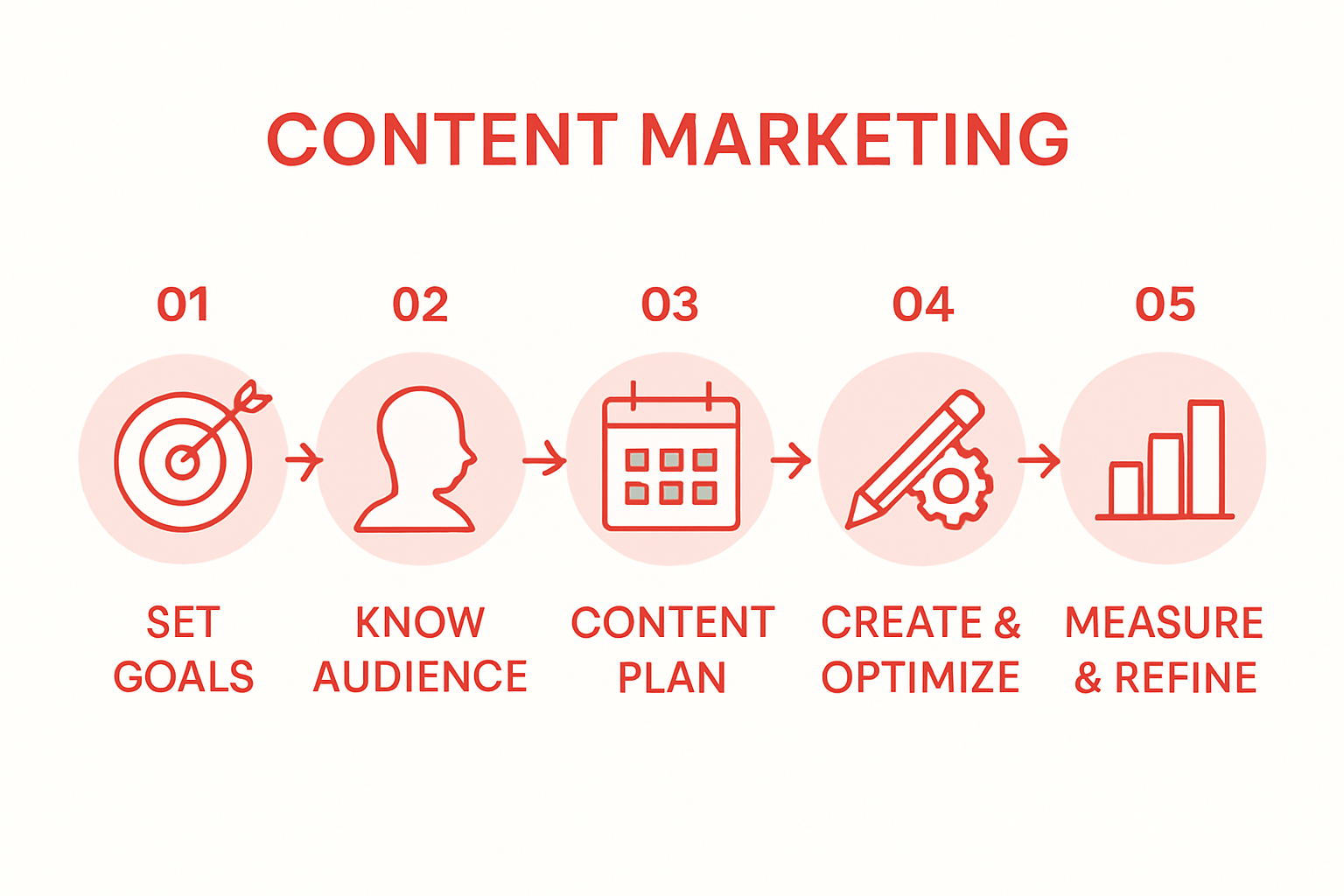
- Step 1: Define Business Goals And Target Audience
- Step 2: Map Out A Strategic Content Plan
- Step 3: Create And Optimise Marketing Assets
- Step 4: Distribute Content Across Chosen Channels
- Step 5: Measure Performance And Refine Workflow
Quick Summary
| Key Message | Explanation |
|---|---|
| 1. Set Clear Business Goals | Establish specific objectives like increasing traffic or boosting sales to guide your marketing efforts effectively. |
| 2. Understand Your Target Audience | Develop detailed customer personas based on demographic and psychographic insights to tailor your content. |
| 3. Create a Comprehensive Content Plan | Develop a strategic content calendar that addresses customer questions and aligns with business goals for effective outreach. |
| 4. Distribute Content Strategically | Leverage multiple channels, adapting content to suit each platform, to maximise visibility and engagement. |
| 5. Measure Performance Regularly | Analyse key metrics like engagement rates to refine strategies and improve content effectiveness over time. |
Step 1: Define business goals and target audience
Defining crystal clear business goals and understanding your target audience are foundational steps in creating a powerful content marketing workflow. By strategically mapping out these key elements, you transform random marketing efforts into a precision instrument designed to attract and convert your ideal customers.
Let’s break this down practically. First, examine your core business objectives through a strategic lens. Are you aiming to increase website traffic? Generate more qualified leads? Boost sales conversions? These goals will serve as your marketing north star. The Chartered Institute of Marketing recommends developing a content strategy framework that directly aligns with your organisational objectives.
To pinpoint your target audience, you’ll want to dive deep into audience segmentation using demographic and psychographic insights. Consider factors like age, income, professional role, challenges, and aspirations. Create detailed customer personas that represent your ideal clients. What keeps them up at night? What solutions are they desperately seeking? By understanding these nuanced details, you can craft content that speaks directly to their needs and desires.
Pro tip: Do not try to appeal to everyone. The most effective marketing strategies are laser-focused on a specific audience segment. Better to create content that resonates deeply with 100 potential customers than to produce generic material that connects with no one.
With your goals and audience defined, you’re now ready to develop a targeted content strategy that will systematically attract and convert your ideal clients.
Step 2: Map out a strategic content plan
Now that you understand your business goals and target audience, it is time to create a robust content marketing strategy that transforms those insights into actionable planning. A well-crafted content plan acts as your marketing roadmap, guiding every piece of content you will produce.
Start by developing a comprehensive content strategy framework that outlines your key objectives, content types, and distribution channels. Think of this as your strategic blueprint. Consider which content formats will resonate most with your audience: blog posts, videos, podcasts, infographics, or a mix. Each piece should serve a specific purpose in your customer journey, whether that is generating awareness, nurturing leads, or driving conversions.
Your editorial calendar becomes mission-critical at this stage. Map out content themes that align with your audience’s interests and your business goals. Prioritise creating content that addresses your customers’ key questions and challenges. This means conducting thorough keyword research, understanding search intent, and developing topics that provide genuine value. Aim to create a balanced content mix that covers different stages of the customer journey from initial awareness through to purchase decision.
Pro tip: Consistency trumps perfection. It is better to publish high-quality content regularly than to produce sporadic brilliant pieces. Establish a realistic publishing cadence that you can maintain without burning out.
With your strategic content plan in place, you are now prepared to move into the detailed content creation phase where you will start producing compelling materials that attract and engage your ideal customers.
Step 3: Create and optimise marketing assets
With your strategic plan in place, it is time to transform your insights into compelling marketing assets that will capture your audience’s attention and drive meaningful engagement. This stage is about crafting content that not only looks professional but also speaks directly to your target customers’ needs and challenges.

When developing marketing assets, consider working with creators and influencers who can help differentiate your content and bring fresh perspectives. Focus on creating high-quality materials that address specific customer pain points. This might include blog posts, videos, infographics, podcasts or whitepapers that provide genuine value and demonstrate your expertise. Each asset should align with the stages of your customer journey from awareness to consideration and purchase.
Optimisation is key to ensuring your marketing assets perform effectively. This means adapting your content for different platforms, ensuring mobile responsiveness, using relevant keywords, and creating engaging titles and meta descriptions. Pay attention to visual design elements that make your content digestible and shareable. Use compelling graphics, break up text with subheadings, and include clear calls to action that guide your audience towards the next step.
Pro tip: Always prioritise quality over quantity. One exceptional piece of content that truly helps your audience will always outperform multiple mediocre assets.
With your marketing assets created and optimised, you are now ready to develop a strategic distribution and promotion plan that will maximise their reach and impact.
Step 4: Distribute content across chosen channels
With your marketing assets ready, the next crucial step is strategically distributing your content to ensure it reaches the right audience at the right time. Effective distribution is about maximising your content’s visibility and impact across multiple platforms.
Planning and distributing content across paid, owned, and earned channels becomes your primary focus. This means leveraging your own digital platforms like your website and social media channels, investing in strategic paid advertising, and creating opportunities for organic sharing and engagement. Consider the unique characteristics of each channel. LinkedIn might be perfect for professional whitepapers, while Instagram could showcase visual storytelling, and YouTube could host your longer-form video content.
Tailor your content format and messaging to suit each platform’s audience and algorithmic requirements. This might mean creating platform-specific versions of your core content. A blog post could become an infographic for Instagram, a series of tweets for Twitter, or a short video snippet for TikTok. Ensure your core message remains consistent while adapting the presentation to maximise engagement.
Pro tip: Use analytics tools to track performance across different channels. This will help you understand where your audience engages most and refine your distribution strategy continuously.
With your content strategically distributed, you are now ready to measure and analyse its performance to inform future marketing efforts.
Step 5: Measure performance and refine workflow
Measuring and analysing your content marketing performance is the critical final stage that transforms your strategy from guesswork to data-driven decision-making. This is where you understand what truly resonates with your audience and how to continuously improve your marketing approach.
Focus on testing and measuring for ongoing improvements and budget optimisation. Track key performance indicators such as engagement rates, website traffic, conversion rates, and return on investment. Look beyond surface-level metrics to understand deeper insights like time spent on page, social shares, and customer feedback. Use tools like Google Analytics, social media insights, and customer surveys to gather comprehensive data about your content’s performance.
Analyse your findings systematically. Which content types generate the most engagement? What topics trigger the highest conversion rates? Which channels deliver the best results? Use these insights to refine your content strategy continually. This might mean adjusting your content mix, experimenting with new formats, or shifting your distribution channels based on real-world performance data.
Pro tip: Implement a quarterly review process. Set aside dedicated time to comprehensively review your content marketing performance, allowing you to make strategic adjustments and stay ahead of changing audience preferences.
With a robust measurement and refinement process in place, you have now established a dynamic content marketing workflow that can adapt and grow with your business.
Boost Your Content Marketing Workflow with Bamsh Digital Marketing
Mastering a content marketing workflow requires clarity in business goals, targeted audience insight, and seamless strategy execution—challenges that many businesses find overwhelming. If you struggle with transforming strategic content plans into measurable growth or optimising your marketing assets across multiple channels, Bamsh Digital Marketing can help you overcome these hurdles. Our award-winning agency specialises in delivering clear, honest, results-driven marketing tailored to attract and nurture your ideal customers throughout the entire journey.
Discover how our expert services, including SEO & Answer Engine Optimisation, automated lead nurturing, and AI-powered solutions, align perfectly with the concepts of strategic content creation and performance measurement outlined in the article. Stop guessing and start growing today by booking a free 15-minute consultation at https://bamsh.co.uk/15-min/ to unlock your business’s full potential.
Explore our proven approach and join clients who already enjoy more leads, better visibility, and predictable revenue without the jargon or smoke and mirrors. Ready to transform your content marketing workflow into a powerful growth engine? Visit Bamsh – Bamsh Digital Marketing and take your first step now.
Frequently Asked Questions
What are the first steps to creating a content marketing workflow?
To create a content marketing workflow, first define your business goals and understand your target audience. Start by identifying key objectives like increasing website traffic or generating leads, and develop detailed customer personas based on demographic and psychographic data.
How can I develop an effective content strategy framework?
To develop an effective content strategy framework, outline your key objectives, content types, and distribution channels. Map out content themes that align with your audience’s interests and prioritise creating content that answers their specific questions and challenges.
What types of content should I create for my audience?
You should create a mix of content types that resonate with your audience, such as blog posts, videos, infographics, and podcasts. Focus on producing high-quality materials that address customer pain points and align with various stages of the customer journey, from awareness to purchase.
How can I optimise my marketing assets for better performance?
To optimise your marketing assets, ensure they are mobile responsive, use relevant keywords, and incorporate engaging design elements. Create compelling titles and meta descriptions, and always include clear calls to action that guide your audience towards the next step in their journey.
What is the best way to measure the performance of my content marketing?
The best way to measure content marketing performance is to track key performance indicators like engagement rates, website traffic, and conversion rates. Use this data to identify which content types and distribution channels produce the best results, and adjust your strategy accordingly.
How often should I review and refine my content marketing strategy?
You should implement a quarterly review process for your content marketing strategy. Set aside dedicated time every three months to analyse your performance data, identify trends, and make necessary adjustments to stay aligned with your audience’s preferences.